
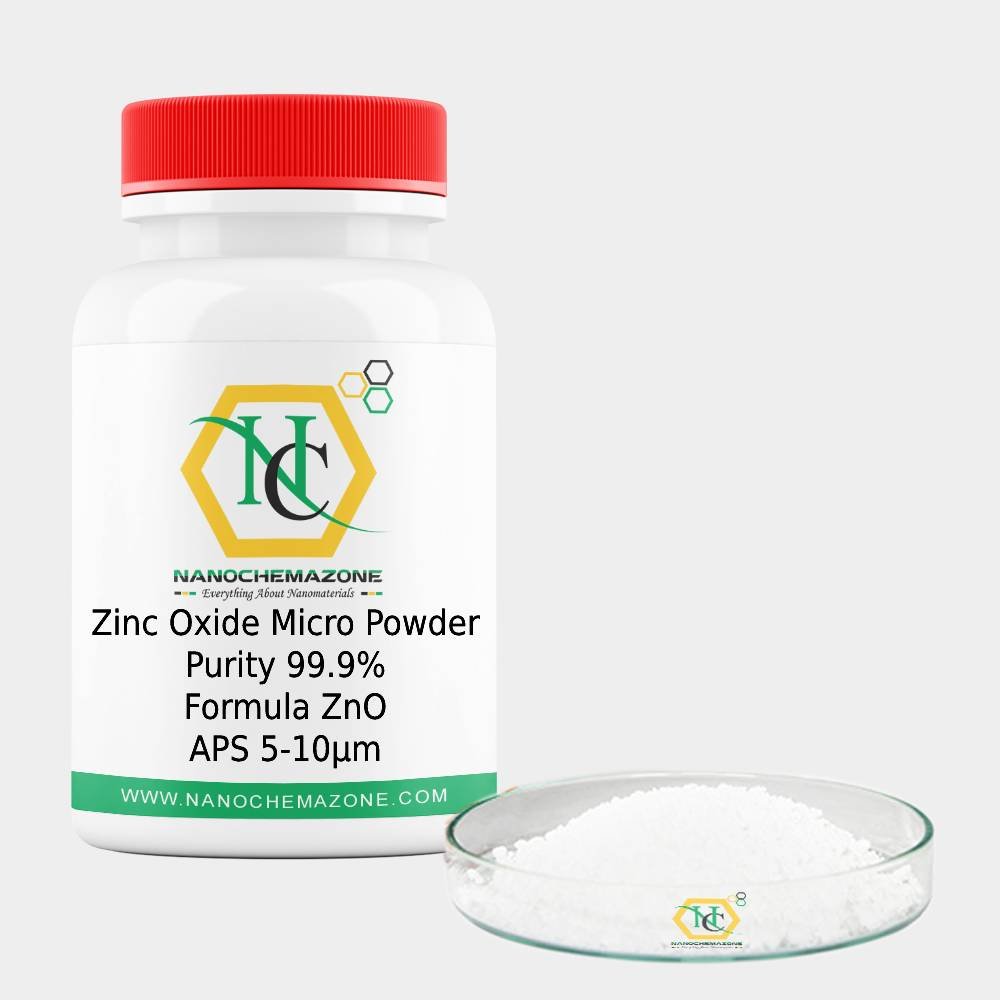


Zinc Oxide Micro Powder
$0.00
Zinc Oxide Micro Powder
Product Name: Zinc Oxide Micro Powder
| Product Name | Zinc Oxide Micro Powder |
| Stock No | NCZ-NSC298-/20 |
| CAS No | 7782-42-5 |
| Purity | 99.9% |
| APS | 5,-10µm (Can be customized) |
| Molecular Formula | ZnO |
| Form | Powder |
| Color | White Powder |
| Density | 5600 kg/m3 |
Zinc Oxide Micro Powder
Zinc oxide Micro Powder is an inorganic compound with the formula is a white powder that is insoluble in water. It is used as an additive in numerous materials and products including cosmetics, food supplements, rubbers, plastics, ceramics, glass, cement, lubricants, paints, ointments, adhesives, sealants, pigments, foods, batteries, ferrites, fire retardants, and first-aid tapes. Although it occurs naturally as the mineral zincite, most zinc oxide is produced synthetically. ZnO is a wide-bandgap semiconductor of the semiconductor group.
The native doping of the semiconductor due to oxygen vacancies or zinc interstitials is n-type. Other favorable properties include good transparency, high electron mobility, wide bandgap, and strong room-temperature luminescence. Those properties are valuable in emerging applications for transparent electrodes in liquid crystal displays, energy-saving or heat-protecting windows, and electronics as thin-film transistors and light-emitting diodes
Physical Properties of Zinc Oxide Micro Powder
Zinc oxide crystallizes in two main forms, hexagonal wurtzite and cubic zincblende. The wurtzite structure is most stable at ambient conditions and thus most common. The zincblende form can be stabilized by growing on substrates with a cubic lattice structure. In both cases, the zinc and oxide centers are tetrahedral, the most characteristic geometry for Zn. It converts to the rocksalt motif at relatively high pressures about 10 GPa. T
he many remarkable medical properties of creams containing ZnO can be explained by its elastic softness, which is characteristic of tetrahedral coordinated binary compounds close to the transition to octahedral structures. Hexagonal and zincblende polymorphs have no inversion symmetry a reflection of a crystal relative to any given point does not transform it into itself. This and other lattice symmetry properties result in piezoelectricity of the hexagonal and zincblende ZnO, and pyroelectricity of hexagonal ZnO.
Mechanical properties of Zinc Oxide Micro Powder
ZnO is a relatively soft material with an approximate hardness of 4.5 on the Mohs scale. Its elastic constants are smaller than those of relevant semiconductors, such as GaN. The high heat capacity and heat conductivity, low thermal expansion, and high melting temperatures are beneficial for ceramics.
The E2 optical phonon exhibits an unusually long lifetime of Among the tetrahedrally bonded semiconductors, it has been stated that has the highest piezoelectric tensor, or at least one comparable to that of GaN and AlN. This property makes it a technologically important material for many piezoelectrical applications, which require a large electromechanical coupling. Therefore ZnO has been in forms of thin-film one of the most studied resonator material for thin-film bulk acoustic resonators.
Zinc Oxide Micro Powder Related Information
Storage Conditions:
Airtight sealed, avoid light, and keep dry at room temperature.
Please contact us for customization and price inquiry
Email: contact@nanochemazone.com
Note: We supply different size ranges of Nano and micron as per the client’s requirements and also accept customization in various parameters.
Note: For pricing & ordering information, please contact us at sales@nanochemazone.com
Please contact us for quotes on Larger Quantities & Customization. E-mail: contact@nanochemazone.com
Customization:
If you are planning to order large quantities for your industrial and academic needs, please note that customization of parameters (such as size, length, purity, functionalities, etc.) are available upon request.
Other composition and customer’s specified configurations can be delivered upon request. Stabilizer, pH Value, Pack Size, and Contents of Artificial Lysosomal Fluid are customizable.
Contact us for Customization: sales@nanochemazone.com
Transportation and storage: Transportation at room temperature, storage at 4 ℃. For Longterm Storage Freeze it at -20 ℃


Only logged in customers who have purchased this product may leave a review.
Related products

Aluminum Diboride Powder
Aluminum Diboride Powder
| MF: | AlB2-P |
| Chemical Name | Aluminum Diboride |
| Color | Gray Black |
| EINECS | 234-923-7 |
| Purity: | 99.9% |
| Particle size | 30µm |
| Product Number: | NCZ-SC-113/20 |
| Cas Number: | 12041-50-8 |
Aluminum Diboride Powder Description
Aluminum boride Powder is an ionic compound, with a hexagonal crystal structure. Aluminum boride at an absolute temperature slightly 40K (equivalent to -233 ℃) will be transformed into a superconductor. And its actual operating temperature is 20 ~ 30K. To reach this temperature, we can use liquid neon, liquid hydrogen, or closed-cycle refrigerator to finish cooling. Compared to the current industry using liquid helium to cool the niobium alloy (4K), these methods are simpler and more economical. Once it is doped with carbon or other impurities, magnesium diboride powder in a magnetic field, or there is a current passing, the ability to maintain the superconducting is as much as niobium alloys, or even better.
Aluminum Diboride Powder Related Information
Please email us for the customization.
Email: contact@nanochemazone.com
Please contact us for customization and price inquiry
Note: We supply different size ranges of nano and micron size powder as per the client’s requirements and also accept customization in various parameters.

Ferro Manganese Nitride Powder
Product Name: Ferro Manganese Nitride Powder
| Product | Ferro Manganese Nitride Powder |
| Colour | Gray |
| Purity | ≥ 99.9% |
| Particle size | 1-10 µM (customizable) |
| Ingredient/MF | FeMnN |
| Product Code | NCZ-CN-150/20 |
| CAS Number | 7439-89-6 / 7439-96-5 |
Ferro Manganese Nitride Powder Description:
Ferro Manganese Nitride ferro alloy powder FeMnN is an essential alloy agent for special alloy steel, stainless steel, and heat resistant steel.
It is usually obtained by filling nitrogen with medium and low carbon ferromanganese.
There is the high content of the main elements of nitride ferromanganese, low content of phosphorus, and other harmful impurities.
Ferro Manganese Nitride Powder Application:
Mainly used for steel production ferromanganese nitride nitrogen additive, which can improve the mechanical properties, such as the strength of steel, refined grains, and stabilize austenite. Mainly used for special alloy steel high strength stainless steel heat-resistant steel production.
Please email us for the customization.
Email: contact@nanochemazone.com
Please contact us for customization and price inquiry
Note: We supply different size ranges of Nano and micron as per the client’s requirements and also accept customization in various parameters.

Ferro Titanium Carbide Powder
Product Name: Ferro Titanium Carbide Powder
| Product | Ferro Titanium Carbide Powder |
| Colour | Gray Powder |
| Purity | ≥ 99.9% |
| Particle size | 1-10 µM (customizable) |
| Ingredient/MF | FeTiC |
| Product Code | NCZ-C-102/20 |
| CAS Number | 12604-56-7 |
Ferro Titanium Carbide Powder Applications Fields:
Ferro Titanium Carbide Powder is a ferroalloy, an alloy of iron and titanium with between 10–20% iron and 45–75% titanium and sometimes a small amount of carbon. Ferrotitanium can be manufactured by mixing titanium sponge and scrap with iron and melting them together in an induction furnace.
During steelmaking, titanium is usually introduced as ferrotitanium because of its relatively low melting temperature and high density.
Ferrotitanium is usually produced by induction melting of titanium scrap with iron or steel; however, it also is produced directly from titanium mineral concentrates.
Application of Ferro Titanium carbide powder:
In the present study, Fe-based hardfacing coating reinforced by TiC particles was obtained by manual shielded metal arc welding (SMAW) in which H08A bare electrode was coated with fluxes, to which different measures of ferrotitanium, rutile, graphite, calcium carbonate, and calcium fluoride had been added.
The microstructure and wear properties of the hardfacing coating were studied through scanning electron microscopy (SEM), transmission electron microscopy (TEM), an X-ray diffractometer (XRD), and a wear test.
The results indicate that TiC particles are produced by a direct metallurgical reaction between ferrotitanium and graphite during welding.
TiC particles are uniformly dispersed in the matrix of lath martensite and retained austenite with particle sizes in the range of 3–5 μm. Fe-based hardfacing coating reinforced by TiC particles is found to possess better wear resistance and a lower coefficient of friction than that of the AISI 1045 steel substrate.
Please email us for the customization.
Email: contact@nanochemazone.com
Please contact us for customization and price inquiry
Note: We supply different size ranges of Nano and micron as per the client’s requirements and also accept customization in various parameters.

Hafnium Carbide Powder
Product Name: Hafnium Carbide Powder
| Product | Hafnium Carbide Powder |
| Colour | Gray Powder |
| Purity | ≥ 99.9% |
| Particle size | 1-10 µM (customizable) |
| Ingredient/MF | HfC |
| Product Code | NCZ-C-103/20 |
| CAS Number | 12069-85-1 |
Brief Description of Hafnium carbide powder HfC:
Hafnium carbide ( HfC) is a chemical compound of hafnium and carbon
With a melting point of about 3900 °C it is one of the most refractory binary compounds known.
However, it has low oxidation resistance, with the oxidation starting at temperatures as low as 430 °C
Hafnium carbide is usually carbon deficient and therefore its composition is often expressed as HfCx (x = 0.5 to 1.0). It has a cubic (rock-salt) crystal structure at any value of x
Application of Hafnium carbide powder HfC:
- Used for preparation of ultra-high temperature ceramics
- The reactant in the synthesis of hafnium-containing organometallic polymers
- Used as an additive in alloys
- Used in coatings
- Widely used in microelectronics, semiconductor, aerospace high-temperature resistant material, coating materials, ceramic materials, ceramic target material, etc.
Hafnium carbide Powder related Information
Please email us for the customization.
Email: contact@nanochemazone.com
Please contact us for customization and price inquiry
Note: We supply different size ranges of Nano and micron as per the client’s requirements and also accept customization in various parameters.

Manganese Nitride Powder
Manganese Nitride Powder
Product Name: Manganese Nitride Powder
| Product | Manganese Nitride Powder |
| Colour | Dark Gray |
| Purity | ≥ 99.9% |
| Particle size | 1-10 µM (customizable) |
| Ingredient/MF | MnN |
| Product Code | NCZ-CN-148/20 |
| CAS Number | 7439-96-5 |
Manganese Nitride Powder Description:
Manganese Nitride Powder is generally immediately available in most volumes. High purity, submicron and nanopowder forms may be considered. Our factory produces too many standard grades when applicable, including Mil Spec (military grade); ACS, Reagent and Technical Grade; Food, Agricultural and Pharmaceutical Grade; Optical Grade
Manganese Nitride in Briquettes, as a kind of Nitrogen and manganese alloy additive, its characteristics are: high content of main elements, low content of harmful impurities, Nitrogen utilization is to be improved after add melt. We adopt the continuous nitride process with unique intellectual property rights in mass production, which has stable quality and uniform nitrogen
Manganese Nitride Powder Application:
- Used for production of special alloy steel, high strength steel, stainless steel, heat-resistant steel products
2. Application in the field of high nitrogen steel smelting
- Used as the steel-making additive and endow many excellent performances to steel grade such as strength, toughness, creep resistance, etc.
- Specialty demonstrated its good market prospects in large diameter steel pipe of transmitting oil and gas strength steel in shipbuilding and automotive.
Basic information of Manganese Nitride Powder
Manganese (atomic symbol: Mn, atomic number: 25) is a Block D, Group 7, Period 4 element with an atomic weight of 54.938045.
In its elemental form, manganese has a silvery metallic appearance.
It is a paramagnetic metal that oxidizes easily in addition to being very hard and brittle.
Manganese is found as a free element in nature and also in the minerals pyrolusite, braunite, psilomelane, and rhodochrosite.
Nitrogen is a Block P, Group 15, Period 2 element.
Nitrogen is an odorless, tasteless, colorless, and mostly inert gas.
It is the seventh most abundant element in the universe, and it constitutes 78.09% (by volume) of Earth’s atmosphere.
Please email us for the customization.
Email: contact@nanochemazone.com
Please contact us for customization and price inquiry
Note: We supply different size ranges of Nano and micron as per the client’s requirements and also accept customization in various parameters.

Titanium Carbide Powder
Titanium Carbide Powder
Product Name: Titanium Carbide Powder
| Product | Titanium Carbide Powder |
| Colour | Grey |
| Purity | ≥ 99.9% |
| Particle size | 1-10 µM (customizable) |
| Ingredient/MF | TiC |
| Product Code | NCZ-C-106/20 |
| CAS Number | 12070-08-5 |
Titanium Carbide Powder Description :
Titanium Carbide (TIC) is a Gray metallic powder with a cubic system structure.
With high-wear resistance, perfect corrosion resistance and high-temperature resistance,
As hardness material, it’s widely used as the thermal spray coating powder material, the welding material, the flinty membranous material, the military aviation material, the hard alloy, and the cermet.
Titanium carbide, TiC, is an extremely hard (Mohs 9-9.5) refractory ceramic material, similar to tungsten carbide.
It has the appearance of black powder with the sodium chloride (face-centered cubic) crystal structure.
Also, the product has good conductivity and chemical inert ability to steel and iron
Application of Titanium Carbide TiC:
1. The carbide is mainly used in the manufacturing of cermet, heat-resistant alloy, and cemented carbide due to its high melting point, high hardness, and good chemical stability.
- Applies in the spray coating material, the welding material, the flinty membranous material, the military aviation material, the hard alloy, and the cermet.
3.Used as welding and flux-cored wire
- Used in the preparation of cermets, which are frequently used to machine steel materials at high cutting speed.
- Used as an abrasion-resistant surface coating on metal parts, such as tool bits and watch mechanisms.
- Used as a heat shield coating for atmospheric reentry of spacecraft.
7. TiC is used in manufacturing wear-resistant materials, cutting tools, etc
Please email us for the customization.
Email: contact@nanochemazone.com
Please contact us for customization and price inquiry
Note: We supply different size ranges of Nano and micron as per the client’s requirements and also accept customization in various parameters.

Tungsten Carbide Powder
Tungsten Carbide Powder
Product Name: Tungsten Carbide Powder
| Product | Tungsten Carbide Powder |
| Colour | Grey |
| Purity | ≥ 99.9% |
| Particle size | 1-10 µM (customizable) |
| Ingredient/MF | WC |
| Product Code | NCZ-C-109/20 |
| CAS Number | 12070-12-1 |
Brief Description of WC Tungsten Carbide Powder
Tungsten carbide powder (chemical formula: WC ) is a chemical compound (specifically, a carbide ) containing equal parts of tungsten and carbon atoms.
In its most basic form, tungsten carbide is a fine Gray powder, but it can be pressed and formed into shapes for use in industrial machinery, cutting tools, abrasives, armor-piercing rounds, other tools and instruments, and jewelry.
Physical Properties of WC Tungsten Carbide Powder
Tungsten carbide has a high melting point at 2,870 °C (5,200 °F), a boiling point of 6,000 °C (10,830 °F) when under a pressure equivalent to 1 standard atmosphere (100 kPa), the thermal conductivity of 110 W·m−1·K−1, and a coefficient of thermal expansion of 5.5 µm·m−1·K−1.
Tungsten carbide is extremely hard, ranking about 9 on Mohs scale, and with a Vickers number of around 2600.
It has Young’s modulus of approximately 530–700 GPa, a bulk modulus of 630–655 GPa, and a shear modulus of 274 GPa.
It has an ultimate tensile strength of 344 MPa, the ultimate compression strength of about 2.7 GPa and a Poisson’s ratio of 0.31.
Chemical Properties of WC Tungsten Carbide Powder
There are two well-characterized compounds of tungsten and carbon, WC and tungsten semi abide, W2C.
Both compounds may be present in coatings and the proportions can depend on the coating method.
At high temperatures, WC decomposes to tungsten and carbon and this can occur during high-temperature thermal spray, e.g., in high-velocity oxygen fuel (HVOF) and high energy plasma (HEP) methods.
Application of WC Tungsten Carbide Powder
1 Used for Producing high capability nano-crystalline or superfine horniness alloy, hard-face abrasion-resistant spraying and petrochemical cracking catalyst;
- Used for chipless forming tools; Cutting tools; Mining tolls; Nano-composites (for enhanced hardness, strength, and wear resistance);
- Used for erosion-resistant coatings; wear-resistance coatings; Corrosion-resistant coatings; Wear-resistant parts
- To produce hard carbide.
Please email us for the customization.
Email: contact@nanochemazone.com
Please contact us for customization and price inquiry
Note: We supply different size ranges of Nano and micron as per the client’s requirements and also accept customization in various parameters.

Zirconium Carbide Powder
Zirconium Carbide Powder
Product Name: Zirconium Carbide Powder
| Product | Zirconium Carbide Powder |
| Colour | Black |
| Purity | ≥ 99.9% |
| Particle size | 1-10 µM (customizable) |
| Ingredient/MF | ZrC |
| Product Code | NCZ-C-110/20 |
| CAS Number | 12070-14-3 |
Zirconium Carbide Powder Description:
Like most carbides of refractory metals, zirconium carbide is sub-stoichiometric, i.e., it contains carbon vacancies.
At carbon contents higher than approximately ZrC0.98 the material contains free carbon.
ZrC reacts with water and acids and is pyrophoric.
It becomes readily oxidized in the air when exposed to elevated temperatures.
It shows a high amount of corrosion resistance property and contains carbon vacancies.
It reacts with water as well as acids.
Application:
1.Used as an abrasive, in metal cladding, in cermet, incandescent filaments, and cutting tools.
2. The mixture of zirconium carbide and tantalum carbide is an important cermet material.
3. Hafnium-free zirconium carbide and niobium carbide can be used as refractory coatings in nuclear reactors.
4. Zirconium carbide is used extensively as a coating of uranium dioxide and thorium dioxide particles of nuclear fuel.
5. The coating is usually deposited by thermal chemical vapor deposition in a fluidized bed reactor.
6. High-temperature wear-resistant surface materials
Please email us for the customization.
Email: contact@nanochemazone.com
Please contact us for customization and price inquiry
Note: We supply different size ranges of Nano and micron as per the client’s requirements and also accept customization in various parameters.

Reviews
There are no reviews yet.