



Chloro(1,5-cyclooctadiene)rhodium(I) Dimer Powder
$0.00
Chloro(1,5-cyclooctadiene)rhodium(I) Dimer Powder
| Product | Chloro(1,5-cyclooctadiene)rhodium(I) Dimer Powder |
| CAS No. | 12092-47-6 |
| Appearance | Yellow Crystalline Powder |
| Purity | ≥99%, ≥99.9%, ≥95%(Other purities are also available) |
| APS | 1-5 µM, 10-53 µM (Can be customized), Ask for other available size range. |
| Ingredient | C16H24Cl2Rh2 |
| Density | N/A |
| Molecular Weight | 493.08g/mol |
| Product Code | NCZ-MNO-377/25 |
Chloro(1,5-cyclooctadiene)rhodium(I) Dimer Description:
Chloro(1,5-cyclooctadiene)rhodium(I) Dimer Powder is one of the numerous advanced ceramic materials manufactured by Nanochemazone. Nanochemazone produces too many standard grades when applicable, including Mil Spec (military grade); ACS, Reagent and Technical Grade; Food, Agricultural and Pharmaceutical Grade; Optical Grade, USP and EP/BP (European Pharmacopoeia/British Pharmacopoeia) and follows applicable ASTM testing standards. Typical and custom packaging is available. Additional technical, research and safety (MSDS) information are available. Please request a quote above for more information on lead time and pricing.
Chloro(1,5-cyclooctadiene)rhodium(I) Dimer Powder Related Information:
Storage Conditions:
Airtight sealed, avoid light and keep dry at room temperature.
Please contact us for customization and price inquiry
Email: contact@nanochemazone.com
Note: We supply different size ranges of Nano and micron as per the client’s requirements and also accept customization in various parameters.
Chloro(1,5-cyclooctadiene)rhodium(I) Dimer Powder (CAS No. 12092-47-6)
| Catalog No. | NCZ-MNO-377/25 |
| Purity | 98% trace metals basis |
| CAS Number | 12092-47-6 |
| Appearance | Yellow crystalline |
| Molecular Formula | C16H24Cl2Rh2 |
Chloro(1,5-cyclooctadiene)rhodium(I) Dimer Powder Description
Chloro(1,5-cyclooctadiene)rhodium(I) Dimer is always used as Catalysts. You can be assured that Chloro(1,5-cyclooctadiene)rhodium(I) Dimer Powder offered, meets or exceeds the grade requirements or specifications for each individual product.
Chloro(1,5-cyclooctadiene)rhodium(I) Dimer Powder Specifications
| CAS Number | 12092-47-6 |
| Molecular Formula | C16H24Cl2Rh2 |
| Molecular Weight | 493.08 |
| Appearance | Yellow crystalline |
| Melting Point | 243 °C (469 °F) – dec. |
Chloro(1,5-cyclooctadiene)rhodium(I) Dimer Powder Applications
Chloro(1,5-cyclooctadiene)rhodium(I) Dimer Powder can be used in:
* Umicore Precatalysts for Asymmetric and Cross-Coupling Catalysis;
* Efficient and Selective Catalysts for Asymmetric Synthesis.
Our Chloro(1,5-cyclooctadiene)rhodium(I) Dimer Powder finds applications in various fields:
Pharmaceuticals: Facilitates the synthesis of pharmaceutical intermediates, enabling efficient drug development processes.
Chemical Manufacturing: Supports the production of specialty chemicals, agrochemicals, and fine chemicals through palladium-catalyzed transformations.
Academic and Industrial Research: Ideal for catalysis studies, allowing researchers to explore innovative reactions and optimize existing processes.
Chloro(1,5-cyclooctadiene)rhodium(I) Dimer Powder Features:
High Purity: Our Chloro(1,5-cyclooctadiene)rhodium(I) Dimer Powder boasts an extremely high level of purity, minimizing impurities that can interfere with reactions and allowing for precise control over your chemical processes.
Versatile Catalyst: This compound serves as a versatile precursor for palladium-catalyzed reactions, including cross-coupling, Heck, Suzuki, and Stille reactions, among others.
Exceptional Quality Control: Each batch of our powder undergoes rigorous quality control procedures to ensure consistency and purity, meeting the highest industry standards.
Ease of Handling: The powder form is easy to store and handle, providing convenience and efficiency in your laboratory or production facility.
Customizable Packaging: We offer customizable packaging options to suit your specific needs, from small research quantities to bulk orders for industrial-scale applications.
Chloro(1,5-cyclooctadiene)rhodium(I) Dimer Powder Safety Information
| Symbol | GHS07 |
| Signal Word | Warning |
| Hazard Statements | Causes skin irritation. |
| IF IN EYES: Rinse cautiously with water for several minutes. Remove contact lenses, if present and easy to do. Continuerinsing. | |
| Personal Protective Equipment | dust mask type N95 (US), Eye shields, Gloves |
| RIDADR | NONH for all modes of transport |
| WGK Germany | 3 |
Description
Note: For pricing & ordering information, please get in touch with us at sales@nanochemazone.com
Please contact us for quotes on Larger Quantities and customization. E-mail: contact@nanochemazone.com
Customization:
If you are planning to order large quantities for your industrial and academic needs, please note that customization of parameters (such as size, length, purity, functionalities, etc.) is available upon request.
NOTE:
Images, pictures, colors, particle sizes, purity, packing, descriptions, and specifications for the real and actual goods may differ. These are only used on the website for the purposes of reference, advertising, and portrayal. Please contact us via email at sales@nanochemazone.com or by phone at (+1 780 612 4177) if you have any questions.
Only logged in customers who have purchased this product may leave a review.
Related products

(1,3-Bis(diphenylphosphino)propane)palladium(II) Chloride Powder
(1,3-Bis(diphenylphosphino)propane)palladium(II) Chloride Powder
| Product | (1,3-Bis(diphenylphosphino)propane)palladium(II) Chloride Powder |
| CAS No. | 59831-02-6 |
| Appearance | Off-White Powder |
| Purity | ≥99%, ≥99.9%, ≥95%
(Other purities are also available) |
| APS | 1-5 µM, 10-53 µM (Can be customized), Ask for other available size range. |
| Ingredient | C27H26P2.PdCl2 |
| Density | N/A |
| Molecular Weight | 589.77g/mol |
| Product Codes | NCZ-MNO-203/25 |
(1,3-Bis(diphenylphosphino)propane)palladium(II) Chloride Description:
(1,3-Bis(diphenylphosphino)propane)palladium(II) Chloride Powder is one of the numerous advanced ceramic materials manufactured by Nanochemazone. Nanochemazone produces too many standard grades when applicable, including Mil Spec (military grade); ACS, Reagent and Technical Grade; Food, Agricultural and Pharmaceutical Grade; Optical Grade, USP and EP/BP (European Pharmacopoeia/British Pharmacopoeia) and follows applicable ASTM testing standards. Typical and custom packaging is available. Additional technical, research and safety (MSDS) information are available. Please request a quote above for more information on lead time and pricing.
(1,3-Bis(diphenylphosphino)propane)palladium(II) Chloride Powder Related Information:
Storage Conditions:
Airtight sealed, avoid light and keep dry at room temperature.
Please contact us for customization and price inquiry
Email: contact@nanochemazone.com
Note: We supply different size ranges of Nano and micron as per the client’s requirements and also accept customization in various parameters.
(1,3-Bis(diphenylphosphino)propane)palladium(II) Chloride Powder Description
(1,3-Bis(diphenylphosphino)propane)palladium(II) Chloride Powder (CAS59831-02-6) is a kind of off-white powder, which is used as a precious metal catalyst.
(1,3-Bis(diphenylphosphino)propane)palladium(II) Chloride Powder Specification
| CAS Number | 59831-02-6 |
| Chemical Formula | C27H26P2 · PdCl2 |
| Synonym | Dichloro[1,3-bis(diphenylphosphino)propane]palladium(II), PdCl2(dippp), (DPPP)PdCl2 |
| Molecular Weight | 589.77 |
| Form | Off-white powder |
| Boiling Point | 529.7ºC at 760 mmHg |
| Exact Mass | 587.992 |
| Solubility | Soluble in dichloromethane. |
| Sensitivity | Air Sensitive |
(1,3-Bis(diphenylphosphino)propane)palladium(II) Chloride Powder Applications
Used as a precious metal catalyst.
(1,3-Bis(diphenylphosphino)propane)palladium(II) Chloride Powder Safety Information
| Signal Word | Warning |
| Hazard Statements | H302-H312-H315-H319-H332-H335 |
| Hazard Codes | Xn |
| Precautionary Statements | P261-P280-P305 + P351 + P338 |
| Flash Point | Not applicable |
| Risk Codes | 20/21/22-36/37/38 |
| Safety Statements | 26-36/37 |
| RTECS Number | N/A |
| Transport Information | NONH |
| WGK Germany | 3 |
| GHS Pictograms |
(1,3-Bis(diphenylphosphino)propane)palladium(II) Chloride Powder Packaging
Our (1,3-Bis(diphenylphosphino)propane)palladium(II) Chloride Powder is carefully handled during storage and transportation to preserve the quality of our product in its original condition.

Bis(acetonitrile) Dichloropalladium(II) Powder
Bis(acetonitrile) Dichloropalladium(II) Powder
| Product | Bis(acetonitrile) Dichloropalladium(II) Powder |
| CAS No. | 14592-52-4 |
| Appearance | Orange Powder |
| Purity | ≥99%, ≥99.9%, ≥95%(Other purities are also available) |
| APS | 1-5 µM, 10-53 µM (Can be customized), Ask for other available size range. |
| Ingredient | PdCl2 • (CH3CN)2 |
| Density | N/A |
| Molecular Weight | 259.43g/mol |
| Product Codes | NCZ-MNO-320/25 |
Bis(acetonitrile) Dichloropalladium(II) Description:
Bis(acetonitrile) Dichloropalladium(II) Powder is one of the numerous advanced ceramic materials manufactured by Nanochemazone. Nanochemazone produces too many standard grades when applicable, including Mil Spec (military grade); ACS, Reagent and Technical Grade; Food, Agricultural and Pharmaceutical Grade; Optical Grade, USP and EP/BP (European Pharmacopoeia/British Pharmacopoeia) and follows applicable ASTM testing standards. Typical and custom packaging is available. Additional technical, research and safety (MSDS) information are available. Please request a quote above for more information on lead time and pricing.
Bis(acetonitrile) Dichloropalladium(II) Powder Related Information:
Storage Conditions:
Airtight sealed, avoid light and keep dry at room temperature.
Please contact us for customization and price inquiry
Email: contact@nanochemazone.com
Note: We supply different size ranges of Nano and micron as per the client’s requirements and also accept customization in various parameters.
Bis(acetonitrile) Dichloropalladium(II) Powder (CAS No.14592-56-4)
| Catalog No. | CZ-MNO-320/25 |
| Purity | 98.0 % |
| CAS Number | 14592-52-4 |
| Appearance | Orange powder |
| Molecular Formula | PdCl2 • (CH3CN)2 |
| Theoretical Metal Content | 41.2 % |
Bis(acetonitrile) Dichloropalladium(II) Powder Description
Bis(acetonitrile) Dichloropalladium(II) powder is the coordination complex with the formula PdCl2(NCCH3)2. It is the adduct of two acetonitrile ligands with palladium (II) chloride. It is a yellow-brown solid that is soluble in organic solvents. The compound is a reagent and a catalyst for reactions that require soluble Pd(II). The compound is similar to bis(benzonitrile)palladium dichloride. It reacts with 1,5-cod to give dichloro(1,5-cyclooctadiene)palladium.
Bis(acetonitrile) Dichloropalladium(II) Powder Specification
| CAS Number | 14592-56-4 |
| Molecular formula | PdCl2 · (CH3CN)2 |
| Molecular weight | 259.43 g/mol |
| Appearance | Orange powder |
| Melting point | 129–131 °C |
| Flash point | 5.6 °C |
| Boiling point | 63.5 °C at 760 mmHg |
| Synonyms | Palladium dichloride bis(acetonitrile), Bis(acetonitrile)palladium dichloride |
Bis(acetonitrile) Dichloropalladium(II) Powder Applications
It is used as a catalyst in an ether-directed aza-Claisen rearrangement. Also used in cyclization and cross-coupling reactions. It is applied for olefin isomerization, preparation of acetals, and hemiacetal esters.
Safety information
| Symbol | GHS06 |
| Signal word | Danger |
| Hazard statements | H301-H311-H331 |
| Precautionary statements | P261-P280-P301 + P310-P311 |
| Personal protective equipment | Eyeshields, Faceshields, Gloves, type P2 (EN 143) respirator cartridges |
| RIDADR | UN 3077 9/PGIII |
| WGK Germany | 3 |

Chloroplatinic Acid Hexahydrate Powder
Chloroplatinic Acid Hexahydrate Powder
| Product | Chloroplatinic Acid Hexahydrate Powder |
| CAS No. | 18497-13-7 |
| Appearance | Orange Powder |
| Purity | ≥99%, ≥99.9%, ≥95%
(Other purities are also available) |
| APS | 1-5 µM, 10-53 µM (Can be customized), Ask for other available size range. |
| Ingredient | Cl6H14O6Pt |
| Density | N/A |
| Molecular Weight | 427.83g/mol |
| Product Codes | NCZ-MNO-267/25 |
Chloroplatinic Acid Hexahydrate Description:
Chloroplatinic Acid Hexahydrate Powder is one of the numerous advanced ceramic materials manufactured by Nanochemazone. Nanochemazone produces too many standard grades when applicable, including Mil Spec (military grade); ACS, Reagent and Technical Grade; Food, Agricultural and Pharmaceutical Grade; Optical Grade, USP and EP/BP (European Pharmacopoeia/British Pharmacopoeia) and follows applicable ASTM testing standards. Typical and custom packaging is available. Additional technical, research and safety (MSDS) information are available. Please request a quote above for more information on lead time and pricing.
Chloroplatinic Acid Hexahydrate Powder Related Information:
Storage Conditions:
Airtight sealed, avoid light and keep dry at room temperature.
Please contact us for customization and price inquiry
Email: contact@nanochemazone.com
Note: We supply different size ranges of Nano and micron as per the client’s requirements and also accept customization in various parameters.
Chloroplatinic Acid Hexahydrate Powder (CAS No.18497-13-7)
| Catalog No. | NCZ-MNO-267/25 |
| CAS Number | 18497-13-7 |
| Appearance | Orange powders and chunks |
| Molecular Formula | Cl6H14O6Pt |
| Molecular Weight | 427.83 |
Description of Chloroplatinic Acid Hexahydrate Powder
Chloroplatinic Acid Hexahydrate is generally immediately available in most volumes. High purity, submicron and nano powder forms may be considered.
Specification of Chloroplatinic Acid Hexahydrate Powder
| Compound Formula | Cl6H14O6Pt |
| Molecular Weight | 427.83316 |
| Appearance | Orange powders and chunks |
| Exact Mass | 426.801172 |
| Monoisotopic Mass | 424.804122 |
Safety Information of Chloroplatinic Acid Hexahydrate Powder
| Signal Word | Danger |
| Hazard Statements | H301-H314-H317-H334 |
| Hazard Codes | T |
| Precautionary Statements | P261-P280-P301 + P310-P305 + P351 + P338-P310 |
| Flash Point | Not applicable |
| Risk Codes | 25-34-42/43 |
| Safety Statements | 22-26-36/37/39-45 |
| RTECS Number | TP1510000 |
| Transport Information | UN 2507 8 / PGIII |
| WGK Germany | 1 |
| GHS Pictograms |
Application of Chloroplatinic Acid Hexahydrate Powder
Chloroplatinic acid hexahydrate has been used in the following studies:
• Preparation of Pd nano cubes (150nm width) and Pt nanospheres (150nm diameter).
• To compose the plating solution for the electrodeposition of Pt nanoparticles on the multilayered graphene petal nanosheets (MGPNs).
• Synthesis of nano-composites of Pt and nano-carbon (NC).
Chloroplatinic acid hexahydrate may be used as a platinum precursor in the preparation of ceria supported Pt catalyst, TiO2/Pt nano-composites, Pt nanoparticles impregnated porous carbon films and cadmium sulfide-Pt colloidal system.
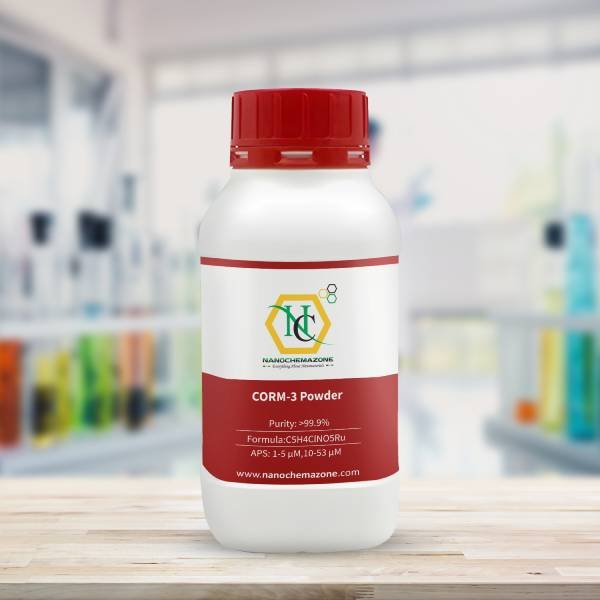
CORM-3 Powder
CORM-3 Powder
| Product | CORM-3 Powder |
| CAS No. | 475473-26-8 |
| Appearance | White Powder |
| Purity | ≥99%, ≥99.9%, ≥95%
(Other purities are also available) |
| APS | 1-5 µM, 10-53 µM (Can be customized), Ask for other available size range. |
| Ingredient | C5H4ClNO5Ru |
| Density | N/A |
| Molecular Weight | 294.61g/mol |
| Product Codes | NCZ-MNO-304/25 |
CORM-3 Description:
CORM-3 Powder is one of the numerous advanced ceramic materials manufactured by Nanochemazone. Nanochemazone produces too many standard grades when applicable, including Mil Spec (military grade); ACS, Reagent and Technical Grade; Food, Agricultural and Pharmaceutical Grade; Optical Grade, USP and EP/BP (European Pharmacopoeia/British Pharmacopoeia) and follows applicable ASTM testing standards. Typical and custom packaging is available. Additional technical, research and safety (MSDS) information are available. Please request a quote above for more information on lead time and pricing.
CORM-3 Powder Related Information:
Storage Conditions:
Airtight sealed, avoid light and keep dry at room temperature.
Please contact us for customization and price inquiry
Email: contact@nanochemazone.com
Note: We supply different size ranges of Nano and micron as per the client’s requirements and also accept customization in various parameters.
CORM-3 Powder (CAS No.475473-26-8)
| Catalog No. | NCZ-MNO-304/25 |
| Purity | 99.0 % |
| CAS Number | 475473-26-8 |
| Appearance | White powder |
| Molecular Formula | C5H4ClNO5Ru |
| Theoretical Metal Content | 34.31 % |
The enzymatic reaction of heme oxygenase inspired the development of synthetic CORMs. The first synthetic CORMs were typically metal carbonyl complexes. A representative CORM that has been extensively characterized both from a biochemical and pharmacological viewpoint is the ruthenium(II) complex Ru(glycinate)Cl(CO)3, commonly known as CORM-3.
CORM-3 Powder is a water-soluble carbon monoxide (CO) releasing molecule that can be used to study the effects of CO on cellular systems. Carbon monoxide (CO), produced during the degradation of heme by the enzyme heme oxygenase, has recently been found to be an important gaseous signaling mediator in mammalian cells CORM-3 has been shown to have anti-inflammatory and cardioprotective activity.
CORM-3 Powder Specifications
| CAS Number | 475473-26-8 |
| Molecular Formula | C5H4ClNO5Ru |
| Molecular Weight | 294.61 |
| Synonyms | Carbon monoxide releasing molecule 3, Tricarbonylchloro(glycinato)ruthenium (II) |
| Appearance | White powder |
| Solubility | H2O: 20 mg/mL, clear |
CORM-3 (carbon monoxide (CO) releasing molecule-3) has been used to study its effect on NLRP3 (leucine-rich-repeat-containing receptor, pyrin-domain-containing 3) inflammasome activation via glycolysis in macrophages and also on hyperglycemia-induced IL-1β (interleukin-1 β) production. CORM-3 Powder has also been used to study its protective function against H2O2-induced apoptosis using primary rabbit lens epithelial cells.
CORM-3 Powder Safety information
| RIDADR | NONH for all modes of transport |
| WGK Germany | 3 |

Dichloro(p-cyMene)triphenylphosphinerutheniuM(II) DichloroMethane Adduct Powder
Dichloro(p-cyMene)triphenylphosphinerutheniuM(II) DichloroMethane Adduct Powder
| Product | Dichloro(p-cyMene)triphenylphosphinerutheniuM(II) DichloroMethane AdductPowder |
| CAS No. | 52490-94-5 |
| Appearance | Orange to Red Powder |
| Purity | ≥99%, ≥99.9%, ≥95%
(Other purities are also available) |
| APS | 1-5 µM, 10-53 µM (Can be customized), Ask for other available size range. |
| Ingredient | C29H31Cl4PRu |
| Density | N/A |
| Molecular Weight | 653.41g/mol |
| Product Codes | NCZ-MNO-235/25 |
Dichloro(p-cyMene)triphenylphosphinerutheniuM(II) DichloroMethane Adduct Description:
Dichloro(p-cyMene)triphenylphosphinerutheniuM(II) DichloroMethane Adduct Powder is one of the numerous advanced ceramic materials manufactured by Nanochemazone. Nanochemazone produces too many standard grades when applicable, including Mil Spec (military grade); ACS, Reagent and Technical Grade; Food, Agricultural and Pharmaceutical Grade; Optical Grade, USP and EP/BP (European Pharmacopoeia/British Pharmacopoeia) and follows applicable ASTM testing standards. Typical and custom packaging is available. Additional technical, research and safety (MSDS) information are available. Please request a quote above for more information on lead time and pricing.
Dichloro(p-cyMene)triphenylphosphinerutheniuM(II) DichloroMethane Adduct Powder Related Information:
Storage Conditions:
Airtight sealed, avoid light and keep dry at room temperature.
Please contact us for customization and price inquiry
Email: contact@nanochemazone.com
Note: We supply different size ranges of Nano and micron as per the client’s requirements and also accept customization in various parameters.
Dichloro(p-cyMene)triphenylphosphinerutheniuM(II) DichloroMethane Adduct Powder (CAS No. 52490-94-5)
| Catalog No. | NCZ-MNO-235/25 |
| CAS Number | 52490-94-5 |
| Chemical Formula | C29H31Cl4PRu |
| Molecular Weight | 653.41 |
| Form | Orange to red powder |
| Purity | 99% |
| Theoretical Metal Content | 15.47% |
Dichloro(p-cyMene)triphenylphosphinerutheniuM(II) DichloroMethane Adduct Powder Description
Dichloro(p-cyMene)triphenylphosphinerutheniuM(II) DichloroMethane Adduct Powder (CAS: 52490-94-5) is a kind of orange to red powder, which is one of the useful organometallics with applications in thin film deposition, industrial chemistry, pharmaceuticals, LED manufacturing, and others.
Dichloro(p-cyMene)triphenylphosphinerutheniuM(II) DichloroMethane Adduct Powder Specifications
| CAS Number | 52490-94-5 |
| Chemical Formula | C29H31Cl4PRu |
| Synonym | [Dichloro(p-cymene)(triphenylphosphane)ruthenium(II) |
| Molecular Weight | 653.41 |
| Form | Orange to red powder |
| Exact Mass | 651.996 |
| Storage conditions | 2-8℃ |
Dichloro(p-cyMene)triphenylphosphinerutheniuM(II) DichloroMethane Adduct Powder Applications
Used as a catalyst and reagent with applications in thin film deposition, industrial chemistry, pharmaceuticals etc.
Dichloro(p-cyMene)triphenylphosphinerutheniuM(II) DichloroMethane Adduct Powder Packaging
Our Dichloro(p-cyMene)triphenylphosphinerutheniuM(II) DichloroMethane Adduct Powder is carefully handled during storage and transportation to preserve the quality of our product in its original condition.
![Dichlorobis[di-tert-butyl(4-dimethylaminophenyl)phosphine]palladium(II) Powder](https://nanochemazone.ca/wp-content/uploads/2025/03/Dichlorobisdi-tert-butyl4-dimethylaminophenylphosphinepalladiumII-Powder-1.jpg)
Dichlorobis[di-tert-butyl(4-dimethylaminophenyl)phosphine]palladium(II) Powder
Dichlorobis[di-tert-butyl(4-dimethylaminophenyl)phosphine]palladium(II) Powder
| Product | Dichlorobis[di-tert-butyl(4-dimethylaminophenyl)phosphine]palladium(II) Powder |
| CAS No. | 884879-23-6 |
| Appearance | Yellow Powder |
| Purity | ≥99%, ≥99.9%, ≥95%
(Other purities are also available) |
| APS | 1-5 µM, 10-53 µM (Can be customized), Ask for other available size range. |
| Ingredient | C35H45N2ClPd |
| Density | N/A |
| Molecular Weight | N/A |
| Product Code | NCZ-MNO-271/25 |
Dichlorobis[di-tert-butyl(4-dimethylaminophenyl)phosphine]palladium(II) Description:
Dichlorobis[di-tert-butyl(4-dimethylaminophenyl)phosphine]palladium(II) Powder is one of the numerous advanced ceramic materials manufactured by Nanochemazone. Nanochemazone produces too many standard grades when applicable, including Mil Spec (military grade); ACS, Reagent and Technical Grade; Food, Agricultural and Pharmaceutical Grade; Optical Grade, USP and EP/BP (European Pharmacopoeia/British Pharmacopoeia) and follows applicable ASTM testing standards. Typical and custom packaging is available. Additional technical, research and safety (MSDS) information are available. Please request a quote above for more information on lead time and pricing.
Dichlorobis[di-tert-butyl(4-dimethylaminophenyl)phosphine]palladium(II) Powder Related Information:
Storage Conditions:
Airtight sealed, avoid light and keep dry at room temperature.
Please contact us for customization and price inquiry
Email: contact@nanochemazone.com
Note: We supply different size ranges of Nano and micron as per the client’s requirements and also accept customization in various parameters.
Dichlorobis[di-tert-butyl(4-dimethylaminophenyl)phosphine]palladium(II)
| Catalog No. | NCZ-MNO-271/25 |
| CAS Number | 884879-23-6 |
| Chemical Formula | C35H45N2ClPd |
| Molecular Weight | 647.63 |
| Form | Yellow powder |
| Purity | 99% |
| Theoretical Metal Content | Pd 16% |
Dichlorobis[di-tert-butyl(4-dimethylaminophenyl)phosphine]palladium(II) Description
Dichlorobis[di-tert-butyl(4-dimethylaminophenyl)phosphine]palladium(II) is a palladium(II) complex with two phosphine ligands containing bulky di-tert-butyl groups and dimethylaminophenyl groups. This combination of ligands provides stability and steric hindrance, making it an excellent precatalyst for cross-coupling reactions. The phosphine ligands enhance the reactivity and solubility of the complex in organic solvents, making it useful in C-C and C-N bond formation processes.
Dichlorobis[di-tert-butyl(4-dimethylaminophenyl)phosphine]palladium(II) Specifications
| CAS Number | 884879-23-6 |
| Chemical Formula | C35H45N2ClPd |
| Synonym | CX 31 |
| Molecular Weight | 647.63 |
| Melting Point | 205-208℃ |
| Form | yellow powder |
| Storage conditions | Sealed and store at a cool place. |
Dichlorobis[di-tert-butyl(4-dimethylaminophenyl)phosphine]palladium(II) Applications
Catalyst for:
Suzuki-Miyaura couplings
Buchwald-Hartwig couplings
Dichlorobis[di-tert-butyl(4-dimethylaminophenyl)phosphine]palladium(II) Safety Information
| Signal Word | Warning |
| Hazard Statements | H315-H319-H335 |
| Hazard Codes | Xi |
| Precautionary Statements | P261-P305+P351+P338 |
| RTECS Number | N/A |
| Transport Information | NONH for all modes of transport |
| WGK Germany | 3 |
| GHS Pictograms |
Dichlorobis[di-tert-butyl(4-dimethylaminophenyl)phosphine]palladium(II) Packaging
Our Dichlorobis[di-tert-butyl(4-dimethylaminophenyl)phosphine]palladium(II) is carefully handled during storage and transportation to preserve the quality of our product in its original condition.

Iridium Ruthenium Oxide Powder
Iridium Ruthenium Oxide Powder
| Product | Iridium Ruthenium Oxide Powder |
| CAS No. | 182482-86-6 |
| Appearance | Black Powder |
| Purity | ≥99%, ≥99.9%, ≥95%
(Other purities are also available) |
| APS | 1-5 µM, 10-53 µM (Can be customized), Ask for other available size range. |
| Ingredient | lrxRuyOz |
| Density | N/A |
| Molecular Weight | N/A |
| Product Codes | NCZ-MNO-252/25 |
Iridium Ruthenium Oxide Description:
Iridium Ruthenium Oxide Powder is one of the numerous advanced ceramic materials manufactured by Nanochemazone. Nanochemazone produces too many standard grades when applicable, including Mil Spec (military grade); ACS, Reagent and Technical Grade; Food, Agricultural and Pharmaceutical Grade; Optical Grade, USP and EP/BP (European Pharmacopoeia/British Pharmacopoeia) and follows applicable ASTM testing standards. Typical and custom packaging is available. Additional technical, research and safety (MSDS) information are available. Please request a quote above for more information on lead time and pricing.
Iridium Ruthenium Oxide Powder Related Information:
Storage Conditions:
Airtight sealed, avoid light and keep dry at room temperature.
Please contact us for customization and price inquiry
Email: contact@nanochemazone.com
Note: We supply different size ranges of Nano and micron as per the client’s requirements and also accept customization in various parameters.
Iridium Ruthenium Oxide
| Catalog No. | NCZ-MNO-252/25 |
| Chemical Formula | IrxRuyOz |
| Form | Black powder |
| Purity | 98% |
Iridium Ruthenium Oxide Description
Iridium Ruthenium Oxide is a mixed-metal compound consisting of iridium (Ir), ruthenium (Ru), and oxygen (O) atoms. This compound typically exists in the form of a solid with a complex crystal structure.
Iridium Ruthenium Oxide is a mixed iridium/ruthenium oxide electrocatalyst for solid polymer electrolyte membrane (SPE) fuel cells and hydrogen gas sensors.
Iridium Ruthenium Oxide Specification
| Chemical Formula | IrxRuyOz |
| Particle Size | 1~5μm |
| Form | Black powder |
| Purity | 98% |
Iridium Ruthenium Oxide Applications
Catalysis: Fuel cells, water splitting, and other energy conversion processes.
Electrochemical Applications: Electrochemical applications, such as electrodes for electrochemical capacitors (supercapacitors) and electrolyzers.
Electronic and Magnetic Properties: Depending on its structure and composition, iridium ruthenium oxide may exhibit interesting electronic and magnetic properties.
Corrosion Resistance: Iridium ruthenium oxide, like many noble metal oxides, can have excellent corrosion resistance. This property can be advantageous in certain environments, such as for coating materials used in harsh chemical or high-temperature settings.
Catalytic Sensors: Some mixed-metal oxides are used as sensing materials in gas sensors and environmental monitoring devices.
Iridium Ruthenium Oxide Packaging
Our Iridium Ruthenium Oxide is carefully handled during storage and transportation to preserve the quality of our product in its original condition.

Palladium (II) Trifluoroacetate Powder
Palladium (II) Trifluoroacetate Powder
| Product | Palladium (II) Trifluoroacetate Powder |
| CAS No. | 42196-31-6 |
| Appearance | Brown Powder |
| Purity | ≥99%, ≥99.9%, ≥95%
(Other purities are also available) |
| APS | 1-5 µM, 10-53 µM (Can be customized), Ask for other available size range. |
| Ingredient | (CF3COO)2Pd |
| Density | N/A |
| Molecular Weight | 332.45g/mol |
| Product Codes | NCZ-MNO-280/25 |
Palladium (II) Trifluoroacetate Powder Description:
Palladium (II) Trifluoroacetate Powder is one of the numerous advanced ceramic materials manufactured by Nanochemazone. Nanochemazone produces too many standard grades when applicable, including Mil Spec (military grade); ACS, Reagent and Technical Grade; Food, Agricultural and Pharmaceutical Grade; Optical Grade, USP and EP/BP (European Pharmacopoeia/British Pharmacopoeia) and follows applicable ASTM testing standards. Typical and custom packaging is available. Additional technical, research and safety (MSDS) information are available. Please request a quote above for more information on lead time and pricing.
Palladium (II) Trifluoroacetate Powder Related Information:
Storage Conditions:
Airtight sealed,avoid light and keep dry at room temperature.
Please contact us for customization and price inquiry
Email: contact@nanochemazone.com
Note: We supply different size ranges of Nano and micron as per the client’s requirements and also accept customization in various parameters.
Palladium (II) Trifluoroacetate Powder (CAS No.42196-31-6)
| Catalog No. | NCZ-MNO-280/25 |
| Purity | 98.0 % |
| CAS Number | 42196-31-6 |
| Appearance | Brown powder |
| Molecular Formula | (CF3COO)2Pd |
| Theoretical Metal Content | 32.0 % |
Palladium (II) Trifluoroacetate Powder Description
Palladium (II) Trifluoroacetate is a brown powder with the formula (CF3COO)2Pd. Palladium (II) Trifluoroacetate Powder is soluble in diethyl ether and acetone. It acts as a catalyst used in the mild decarboxylation of electron-rich aromatic acids and the direct cross-coupling of unactivated arenes.
Palladium(II)Trifluoroacetate Powder Specifications
| CAS Number | 42196-31-6 |
| Molecular Formula | (CF3COO)2Pd |
| Molecular Weight | 332.45 g/mol |
| Appearance | Brown powder |
| Synonyms | Pd(TFA)2, Trifluoroacetic acid palladium(II) salt |
| Melting Point | 220 °C |
| Solubility | Soluble in diethyl ether and acetone. Insoluble in benzene, chloroform and trifluoroacetic acid. |
Palladium (II) Trifluoroacetate Powder Applications
Palladium (II) trifluoroacetate is used in the preparation of allyl-palladium complexes. Palladium (II) Trifluoroacetate Powder acts as a catalyst used in the mild decarboxylation of electron-rich aromatic acids and the direct cross-coupling of un activated arenes. Further, Palladium (II) Trifluoroacetate Powder is involved in the selective allylic oxidation of geranylacetone and other olefins to their allyl acetates in order to prepare keto alcohols.
Palladium (II) Trifluoroacetate Powder Safety Information
| Symbol |
GHS07 |
| Signal Word | Warning |
| Hazard Statements | H315-H319-H335 |
| Precautionary Statements | P261-P305 + P351 + P338 |
| Personal Protective Equipment | Dust mask type N95 (US), Eye shields, Gloves |
| RIDADR | NONH for all modes of transport |
| WGK Germany | 3 |

Reviews
There are no reviews yet.