

Cobalt MicroPowder
$0.00
Cobalt Micro Powder
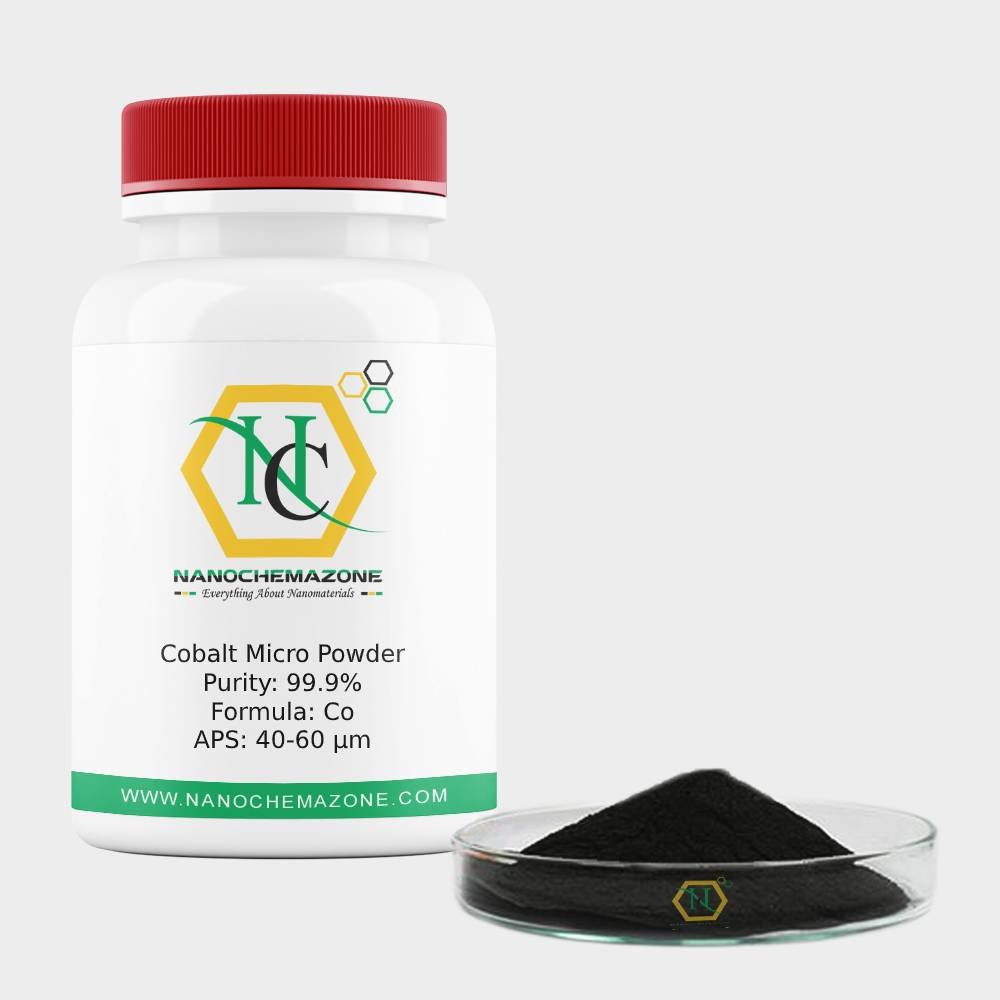
Product Name: Cobalt Micro Powder
| Product | Cobalt Micro Powder |
| CAS No. | 7440-48-4 |
| Appearance | Black Powder |
| Purity | 99.9% |
| APS | 40-60µm, (Can be customized) |
| Ingredient | Co |
| Product Code | NCZ-NSC339/20 |
| Molecular weight | 92.95g/mol |
| Density | 3.5g/cm3 |
Cobalt Micro Powder Description:
Cobalt is a chemical element with the symbol Co and atomic number. Like nickel, cobalt is found in the Earth’s crust only in chemically combined form, save for small deposits found in alloys of natural meteoric iron.
The free element, produced by reductive smelting, is a hard, lustrous, silver-gray metal. Cobalt-based blue pigments (cobalt blue) have been used since ancient times for jewelry and paints, and to impart a distinctive blue tint to glass, but the color was later thought to be due to the known metal bismuth.
Miners had long used the name for some of the blue-pigment-producing minerals; they were so named because they were poor in known metals, and gave poisonous arsenic-containing fumes when smelted. In 1735, such ores were found to be reducible to a new metal (the first discovered since ancient times), and this was ultimately named for the kobold.
Today, some cobalt is produced specifically from one of a number of metallic-lustered ores, such as cobaltite (CoAsS). The element is, however, more usually produced as a by-product of copper and nickel mining.
The copper belt in the Democratic Republic of the Congo (DRC) and Zambia yields most of the global cobalt production.
World production in 2016 was 116,000 tonnes (according to Natural Resources Canada), and the DRC alone accounted for more than 50%. Cobalt is primarily used in lithium-ion batteries, and in the manufacture of magnetic, wear-resistant and high-strength alloys.
The compounds cobalt silicate and cobalt(II) aluminate (CoAl2O4, cobalt blue) give a distinctive deep blue color to glass, ceramics, inks, paints, and varnishes. Cobalt occurs naturally as only one stable isotope, cobalt-59. Cobalt-60 is a commercially important radioisotope, used as a radioactive tracer and for the production of high-energy gamma rays.
Cobalt Micro Powder Related Information:
Storage Conditions:
Airtight sealed, avoid light and keep dry at room temperature.
Please contact us for customization and price inquiry
Email: contact@nanochemazone.com
Note: We supply different size ranges of Nano and micron as per the client’s requirements and also accept customization in various parameters.
Note: For pricing & ordering information, please contact us at sales@nanochemazone.com
Please contact us for quotes on Larger Quantities & Customization. E-mail: contact@nanochemazone.com
Customization:
If you are planning to order large quantities for your industrial and academic needs, please note that customization of parameters (such as size, length, purity, functionalities, etc.) are available upon request.
Other composition and customer’s specified configurations can be delivered upon request. Stabilizer, pH Value, Pack Size, and Contents of Artificial Lysosomal Fluid are customizable.
Contact us for Customization: sales@nanochemazone.com
Transportation and storage: Transportation at room temperature, storage at 4 ℃. For Longterm Storage Freeze it at -20 ℃


Only logged in customers who have purchased this product may leave a review.
Related products

Aluminum Diboride Powder
Aluminum Diboride Powder
| MF: | AlB2-P |
| Chemical Name | Aluminum Diboride |
| Color | Gray Black |
| EINECS | 234-923-7 |
| Purity: | 99.9% |
| Particle size | 30µm |
| Product Number: | NCZ-SC-113/20 |
| Cas Number: | 12041-50-8 |
Aluminum Diboride Powder Description
Aluminum boride Powder is an ionic compound, with a hexagonal crystal structure. Aluminum boride at an absolute temperature slightly 40K (equivalent to -233 ℃) will be transformed into a superconductor. And its actual operating temperature is 20 ~ 30K. To reach this temperature, we can use liquid neon, liquid hydrogen, or closed-cycle refrigerator to finish cooling. Compared to the current industry using liquid helium to cool the niobium alloy (4K), these methods are simpler and more economical. Once it is doped with carbon or other impurities, magnesium diboride powder in a magnetic field, or there is a current passing, the ability to maintain the superconducting is as much as niobium alloys, or even better.
Aluminum Diboride Powder Related Information
Please email us for the customization. Email: contact@nanochemazone.com Please contact us for customization and price inquiry Note: We supply different size ranges of nano and micron size powder as per the client’s requirements and also accept customization in various parameters.
Aluminum Powder
Aluminum Powder
Product Name: Al Powder
| Product | Al Powder |
| CAS No. | 7429-90-5 |
| Appearance | Grey |
| Purity | 99.9% |
| APS | 1 – 5 Micron (Can be customized) |
| Ingredient | Al+3 |
| Product Code | NCZ-NSC-163/20 |
Description of Al (Aluminum Powder)
| 3D printing metal Powder Powder metallurgy, injection molding, spray painting, etc. |
Al Powder Related Information
Storage Conditions:
Airtight sealed, avoid light, and keep dry at room temperature. Please email us for the customization. Email: contact@nanochemazone.com
Chromium Carbide Cr3C2 Powder
Product Name: Chromium Carbide Cr3C2 Powder
| Product | Chromium Carbide |
| Colour | Gray Powder |
| Purity | ≥ 99.9% |
| Particle size | 1-10 µM (customizable) |
| Ingredient/MF | Cr3C2 |
| Product Code | NCZ-C-101/20 |
| CAS Number | 12012-35-0 |
Chromium Carbide Cr3C2 Powder APPLICATION FIELDS
Chromium Carbide Cr3C2 Powder is a ceramic compound that exists in several different chemical compositions: Cr3C2, Cr7C3, and Cr23C6. At standard conditions, it exists as a gray solid. It is extremely hard and corrosion-resistant. It is also a refractory compound, which means that it retains its strength at high temperatures as well. These properties make use as an additive to metal alloys. When chromium carbide crystals are integrated into the surface of a metal it improves the wear resistance and corrosion resistance of the metal and maintains these properties at elevated temperatures. Cr3C2 powder is mixed with solid nickel-chromium. This mixture is then heated to very high temperatures and sprayed onto the object being coated where it forms a protective layer. This layer is essentially its own metal matrix composite, consisting of hard ceramic Cr3C2 particles embedded in a nickel-chromium matrix. Cr3C2 prevents large grains from forming in the composite, which results in a fine-grained structure of superior toughness.Chromium Carbide Cr3C2 Application:
- Used as high temperature resistant and wear-resistant surface materials
- Used for welding and flux-cored wire
- Chromium carbide is useful in the surface treatment of metal components.
- Chromium carbide is used to coat the surface of another metal in a technique known as thermal spraying.
- Chromium carbide is used as an additive in cutting tools in order to improve toughness by preventing the growth of large grains.
Chromium Carbide Cr3C2 Properties:
There are three different crystal structures for chromium carbide corresponding to the three different chemical compositions. Cr23C6 has a cubic crystal structure and a Vickers hardness of 976 kg/mm2. Cr7C3 has a hexagonal crystal structure and a microhardness of 1336 kg/mm2. Cr3C2 is the most durable of the three compositions and has an orthorhombic crystal structure with a microhardness of 2280 kg/mm2. For this reason, Cr3C2 is the primary form of chromium carbide used in surface treatment. Please email us for the customization. Email: contact@nanochemazone.com Please contact us for customization and price inquiry Note: We supply different size ranges of Nano and micron as per the client’s requirements and also accept customization in various parameters.
Ferrochrome Nitride Powder
| Product | Ferrochrome Nitride Powder |
| Colour | Black |
| Purity | ≥ 99.9% |
| Particle size | 1-10 µM (customizable) |
| Ingredient/MF | FeCrN |
| Product Code | NCZ-CN-151/20 |
| CAS Number | 7439-89-6, / 24094-93-7 |
- Widely used in stainless steel, heat resistant steel, corrosion-resistant steel, alloy steel, and other special steel smelting production
- Used in steelmaking industrial, casting foundry

Ferrovanadium Nitride Powder
Product Name: Ferrovanadium Nitride Powder
| Product | Ferrovanadium Nitride Powder |
| Colour | Greyish silver |
| Purity | ≥ 99.9% |
| Particle size | 1-10 µM (customizable) |
| Ingredient/MF | FeVN |
| Product Code | NCZ-CN-149/20 |
| CAS Number | 7439-89-6 / 24646-85-3 |
Ferrovanadium Nitride Powder Description:
Ferrovanadium Nitride (Vanadium-Nitrogen alloy) is a composition ferrovanadium nitride. Ferrovanadium nitride is proposed for joint nitrogen and vanadium steel doping. Ferrovanadium Nitride (Vanadium-Nitrogen Alloy) is a new type of alloy additive, It can substitute Ferro Vanadium used in the production of Micro alloying-steel.Ferrovanadium Nitride Powder Application:
- FeVN alloy powder can be used for structural steel, tool steel, pipeline steel, steel, and cast iron.
- It is used for nitrogen-containing steel melting: high- strength low-alloy steel (HSLA), rail steel, quick cutting steel, etc.
- Ferrovanadium Nitride adding to the steel can increase the strength, tough, tactility, anti-thermal fatigue, etc.
- It also can make the steel be able to fulfill solderability to attain the same strength, adding Ferrovanadium Nitride could save 30-40% of Vanadium, thereby saving the cost.
Ferrovanadium Nitride Powder Advantages:
- Low melting point, high-density products, under the condition of the same production, vanadium and nitrogen yield is higher than similar products.
- Low nitrogen vanadium than more reasonable, high strengthening ability.
- Stable high product purity, ingredients, production has smaller fluctuation, the mechanical performance of steel performance has higher reliability.

Molybdenum Boride Powder
Molybdenum Boride Powder
Product Name: Molybdenum Boride Powder
| MF: | Tr-MoB2 |
| Chemical Name | Boride Powder |
| Color | Yellow Gray |
| EINECS No.: | 234-502-8 |
| Purity: | 99.9% |
| Density: | 9.26 g/ cm3 |
| Product Number: | NCZ-NMB-112/20 |
| Cas Number: | 12006-99-4 |
RELATED INFORMATION
It's mainly used as an additive of electronic tungsten, molybdenum alloy, etc., and can also be used in the manufacture of wear semiconductor thin film and coating materials. Please email us for the customization. Email: contact@nanochemazone.com Please contact us for customization and price inquiry Note: We supply different size ranges of Nano and micron as per the client’s requirements and also accept customization in various parameters.
Niobium Boride Powder
Niobium Boride Powder
Product Name: Niobium Boride Powder
| MF | NbB |
| Chemical Name | Niobium Boride Powder |
| EINECS | 235-723-2 |
| Purity | 99.9% |
| Molecular weight | 103.72 |
| Product Number | NCZ-SC-112/20 |
| Cas Number | 12619-90-8 |
| Density | 7.39g/ml |
Niobium Boride Powder
Niobium boride Powders having NbB, NbB2, and Nb3B4 phases in various amounts and single-phase NbB powders were successfully synthesized by using powder metallurgy methods from related metal oxide raw materials in the presence of a strong reducing agent. Nb2O5, B2O3, and Mg powder blends were milled at room temperature by a high-energy ball mill for a different time. Subsequently, an undesired MgO phase was removed from the milled powders by HCl leaching to constitute NbB–NbB2–Nb3B4 as final products, and they were subjected to an annealing process at 1500 °C for 4 h to observe probable boride transformation. Characterization was carried out by XRD, DSC, PSA, SEM/EDX, TEM, and VSM.
The effects of milling time (up to 9 h) on the formation, microstructure, and thermal behavior of the final products were investigated. The reduction reaction took place after milling stoichiometric powder blends for 2 h. Nano-sized NbB–NbB2–Nb3B4 powders in high purity were obtained in the absence of any secondary phase and any impurity via mechanochemistry by milling for 5 h and leaching with 4 mol/L HCl. After annealing, pure and nano-sized NbB–NbB2–Nb3B4 powders transformed to a single NbB phase without leaving behind NbB2 and Nb3B4 phases.
RELATED INFORMATION Please email us for the customization. Email: contact@nanochemazone.com Please contact us for customization and price inquiry Note: We supply different size ranges of Nano and micron as per the client’s requirements and also accept customization in various parameters.
Tungsten Carbide Powder
Tungsten Carbide Powder
Product Name: Tungsten Carbide Powder
| Product | Tungsten Carbide Powder |
| Colour | Grey |
| Purity | ≥ 99.9% |
| Particle size | 1-10 µM (customizable) |
| Ingredient/MF | WC |
| Product Code | NCZ-C-109/20 |
| CAS Number | 12070-12-1 |
Brief Description of WC Tungsten Carbide Powder
Tungsten carbide powder (chemical formula: WC ) is a chemical compound (specifically, a carbide ) containing equal parts of tungsten and carbon atoms. In its most basic form, tungsten carbide is a fine Gray powder, but it can be pressed and formed into shapes for use in industrial machinery, cutting tools, abrasives, armor-piercing rounds, other tools and instruments, and jewelry. Physical Properties of WC Tungsten Carbide Powder Tungsten carbide has a high melting point at 2,870 °C (5,200 °F), a boiling point of 6,000 °C (10,830 °F) when under a pressure equivalent to 1 standard atmosphere (100 kPa), the thermal conductivity of 110 W·m−1·K−1, and a coefficient of thermal expansion of 5.5 µm·m−1·K−1. Tungsten carbide is extremely hard, ranking about 9 on Mohs scale, and with a Vickers number of around 2600. It has Young’s modulus of approximately 530–700 GPa, a bulk modulus of 630–655 GPa, and a shear modulus of 274 GPa. It has an ultimate tensile strength of 344 MPa, the ultimate compression strength of about 2.7 GPa and a Poisson’s ratio of 0.31. Chemical Properties of WC Tungsten Carbide Powder There are two well-characterized compounds of tungsten and carbon, WC and tungsten semi abide, W2C. Both compounds may be present in coatings and the proportions can depend on the coating method. At high temperatures, WC decomposes to tungsten and carbon and this can occur during high-temperature thermal spray, e.g., in high-velocity oxygen fuel (HVOF) and high energy plasma (HEP) methods.Application of WC Tungsten Carbide Powder
1 Used for Producing high capability nano-crystalline or superfine horniness alloy, hard-face abrasion-resistant spraying and petrochemical cracking catalyst;- Used for chipless forming tools; Cutting tools; Mining tolls; Nano-composites (for enhanced hardness, strength, and wear resistance);
- Used for erosion-resistant coatings; wear-resistance coatings; Corrosion-resistant coatings; Wear-resistant parts
- To produce hard carbide.
Reviews
There are no reviews yet.