
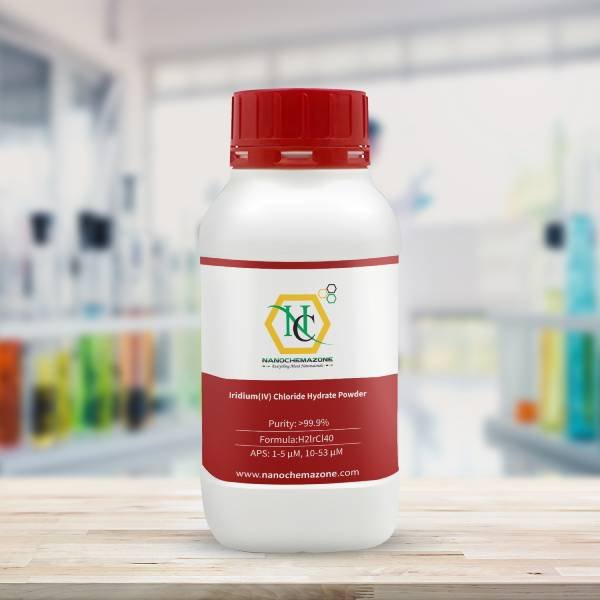


Iridium(IV) Chloride Hydrate Powder
$0.00
Iridium(IV) Chloride Hydrate Powder
| Product | Iridium(IV) Chloride Hydrate Powder |
| CAS No. | 207399-11-9 |
| Appearance | Black Crystal Powder |
| Purity | ≥99%, ≥99.9%, ≥95%
(Other purities are also available) |
| APS | 1-5 µM, 10-53 µM (Can be customized), Ask for other available size range. |
| Ingredient | H2lrCl40 |
| Density | 5.3g/cm3 |
| Molecular Weight | 334.03g/mol |
| Product Codes | NCZ-MNO-329/25 |
Iridium(IV) Chloride Hydrate Description:
Iridium(IV) Chloride Hydrate Powder is one of the numerous advanced ceramic materials manufactured by Nanochemazone. Nanochemazone produces too many standard grades when applicable, including Mil Spec (military grade); ACS, Reagent and Technical Grade; Food, Agricultural and Pharmaceutical Grade; Optical Grade, USP and EP/BP (European Pharmacopoeia/British Pharmacopoeia) and follows applicable ASTM testing standards. Typical and custom packaging is available. Additional technical, research and safety (MSDS) information are available. Please request a quote above for more information on lead time and pricing.
Iridium(IV) Chloride Hydrate Powder Related Information:
Storage Conditions:
Airtight sealed, avoid light and keep dry at room temperature.
Please contact us for customization and price inquiry
Email: contact@nanochemazone.com
Note: We supply different size ranges of Nano and micron as per the client’s requirements and also accept customization in various parameters.
Iridium(IV) Chloride Hydrate Powder (CAS No.207399-11-9)
| Catalog No. | NCZ-MNO-329/25 |
| CAS Number | 207399-11-9 |
| Density | 5.3 g/cm3 |
| Appearance | Black crystals |
| Molecular Formula | H2lrCl4O |
| Molecular Weight | 334.03 |
Description of Iridium(IV) Chloride Hydrate Powder
Iridium(IV) Chloride Hydrate is generally immediately available in most volumes, including bulk quantities. It can produce materials to custom specifications by request, in addition to custom compositions for commercial and research applications and new proprietary technologies.
Specification of Iridium(IV) Chloride Hydrate Powder
| Compound Formula | H2lrCl4O |
| Molecular Weight | 334.03 |
| Appearance | Black crystals |
| Melting Point | >350°C |
| Density | 5.3 g/cm3 |
| Exact Mass | 352.845952 |
| Monoisotopic Mass | 352.845952 |
Application of Iridium(IV) Chloride Hydrate Powder
Iridium(IV) Chloride Hydrate Powder is widely used in various industrial and research applications. It serves as a key precursor in the production of iridium-based catalysts, which are essential in organic synthesis and hydrogenation reactions. Additionally, it is used in the electroplating industry, contributing to durable and corrosion-resistant coatings. In the field of material science, Iridium(IV) Chloride Hydrate is applied in the development of advanced materials for electronics, optics, and chemical sensors. Its versatility and chemical stability make it a crucial component for high-performance applications in both industry and research.
Safety Information of Iridium(IV) Chloride Hydrate Powder
| Signal Word | Warning |
| Hazard Statements | H302-H315-H319-H335 |
| Hazard Codes | Xn |
| Precautionary Statements | P261-P305 + P351 + P338 |
| Flash Point | Not applicable |
| Risk Codes | 22-36/37/38 |
| Safety Statements | 26-36/37 |
| RTECS Number | NO3610000 |
| Transport Information | NONH |
| WGK Germany | 3 |
| GHS Pictograms |
Description
Note: For pricing & ordering information, please get in touch with us at sales@nanochemazone.com
Please contact us for quotes on Larger Quantities and customization. E-mail: contact@nanochemazone.com
Customization:
If you are planning to order large quantities for your industrial and academic needs, please note that customization of parameters (such as size, length, purity, functionalities, etc.) is available upon request.
NOTE:
Images, pictures, colors, particle sizes, purity, packing, descriptions, and specifications for the real and actual goods may differ. These are only used on the website for the purposes of reference, advertising, and portrayal. Please contact us via email at sales@nanochemazone.com or by phone at (+1 780 612 4177) if you have any questions.
Only logged in customers who have purchased this product may leave a review.
Related products

(Acetylacetonato)dicarbonylrhodium(I) Powder
(Acetylacetonato)dicarbonylrhodium(I) Powder
| Product | (Acetylacetonato)dicarbonylrhodium(I) Powder |
| CAS No. | 14874-82-9 |
| Appearance | Red Powder |
| Purity | ≥99%, ≥99.9%, ≥95%
(Other purities are also available) |
| APS | 1-5 µM, 10-53 µM (Can be customized), Ask for other available size range. |
| Ingredient | Rh(CO)2(C5H7O2) |
| Density | 1.95g/cm3 |
| Molecular Weight | 258.03g/mol |
| Product Codes | NCZ-MNO-290/25 |
(Acetylacetonato)dicarbonylrhodium(I) Description:
(Acetylacetonato)dicarbonylrhodium(I) Powder is one of the numerous advanced ceramic materials manufactured by Nanochemazone. Nanochemazone produces too many standard grades when applicable, including Mil Spec (military grade); ACS, Reagent and Technical Grade; Food, Agricultural and Pharmaceutical Grade; Optical Grade, USP and EP/BP (European Pharmacopoeia/British Pharmacopoeia) and follows applicable ASTM testing standards. Typical and custom packaging is available. Additional technical, research and safety (MSDS) information are available. Please request a quote above for more information on lead time and pricing.
(Acetylacetonato)dicarbonylrhodium(I) Powder Related Information:
Storage Conditions:
Airtight sealed, avoid light and keep dry at room temperature.
Please contact us for customization and price inquiry
Email: contact@nanochemazone.com
Note: We supply different size ranges of Nano and micron as per the client’s requirements and also accept customization in various parameters.
(Acetylacetonato)dicarbonylrhodium(I) Powder (CAS No.14874-82-9)
| Catalog No. | NCZ-MNO-290/25 |
| Purity | 99.0 % |
| CAS Number | 14874-82-9 |
| Appearance | Red Powder |
| Molecular Formula | Rh(CO)2(C5H7O2) |
| Theoretical Metal Content | 40.0 % |
(Acetylacetonato)dicarbonylrhodium(I) Powder Description
(Acetylacetonato)dicarbonylrhodium(I) powder is an organorhodium compound with the formula Rh(O2C5H7)(CO)2. The compound consists of two CO ligands and an acetylacetonate. It is a dark green solid that dissolves in acetone and benzene. The compound is used as a precursor to homogeneous catalysts.
(Acetylacetonato)dicarbonylrhodium(I) Powder Specifications
| CAS Number | 14874-82-9 |
| Molecular formula | Rh(CO)2(C5H7O2) |
| Molecular weight | 258.03 g/mol |
| Synonyms | Acetylacetonatodicarbonylrhodium;Acetylacetonatorhodium dicarbonyl;Dicarbonyl-(2,4-pentandione)-rhodium;Dicarbonyl(2,4-pentanedionato)rhodium;Dicarbonylacetylacetonatorhodium;Dicarbonylrhodium acetylacetonate;Rhodium dicarbonylacetylacetonate;Rhodium, dic |
| Appearance | Red powder |
| Melting point | 154-156 °C |
| Density | 1.95 g/mol |
(Acetylacetonato)dicarbonylrhodium(I) Powder Applications
(Acetylacetonato)dicarbonylrhodium(I) is used in situ formations of a fluorous-soluble hydroformylation catalyst of interest in molecular engineering. It is also used as a catalyst for various carbonylation reactions, silylcarbocyclizations, conjugate additions to enones, carbamoylstannation, and reduction of aromatic nitro compounds.
Safety information
| Symbol | GHS06 |
| Signal word | Danger |
| Hazard statements | H301-H315-H317-H319-H335 |
| Precautionary statements | P261-P280-P301 + P310-P305 + P351 + P338 |
| Personal protective equipment | dust mask type N95 (US), Eye shields, Gloves |
| RIDADR | UN 3467 6.1 / PGIII |
| WGK Germany | 3 |
![[1,1′-Bis(diphenylphosphino)ferrocene] Dichloropalladium(II) Powder](https://nanochemazone.ca/wp-content/uploads/2025/03/11′-Bisdiphenylphosphinoferrocene-DichloropalladiumII-Powder.jpg)
[1,1′-Bis(diphenylphosphino)ferrocene] Dichloropalladium(II) Powder
[1,1′-Bis(diphenylphosphino)ferrocene] Dichloropalladium(II) Powder
| Product | [1,1′-Bis(diphenylphosphino)ferrocene] Dichloropalladium(II) Powder |
| CAS No. | 72297-26-4 |
| Appearance | Orange-Red Powder |
| Purity | ≥99%, ≥99.9%, ≥95%
(Other purities are also available) |
| APS | 1-5 µM, 10-53 µM (Can be customized), Ask for other available size range. |
| Ingredient | (C17H14P)2Fe.PdCl2 |
| Density | N/A |
| Molecular Weight | N/A |
| Product Codes | NCZ-MNO-269/25 |
[1,1′-Bis(diphenylphosphino)ferrocene] Dichloropalladium(II) Description:
[1,1′-Bis(diphenylphosphino)ferrocene] Dichloropalladium(II) Powder is one of the numerous advanced ceramic materials manufactured by Nanochemazone. Nanochemazone produces too many standard grades when applicable, including Mil Spec (military grade); ACS, Reagent and Technical Grade; Food, Agricultural and Pharmaceutical Grade; Optical Grade, USP and EP/BP (European Pharmacopoeia/British Pharmacopoeia) and follows applicable ASTM testing standards. Typical and custom packaging is available. Additional technical, research and safety (MSDS) information are available. Please request a quote above for more information on lead time and pricing.
[1,1′-Bis(diphenylphosphino)ferrocene] Dichloropalladium(II) Powder Related Information:
Storage Conditions:
Airtight sealed, avoid light and keep dry at room temperature.
Please contact us for customization and price inquiry
Email: contact@nanochemazone.com
Note: We supply different size ranges of Nano and micron as per the client’s requirements and also accept customization in various parameters.
[1,1′-Bis(diphenylphosphino)ferrocene] Dichloropalladium(II) Powder (CAS No.72287-26-4)
| Catalog No. | NCZ-MNO-269/25 |
| Purity | 98.0% |
| CAS Number | 72287-26-4 |
| Appearance | Orange-red powder |
| Molecular Formula | (C17H14P)2Fe • PdCl2 |
| Theoretical Metal Content | 14.5 % |
[1,1′-Bis(diphenylphosphino)ferrocene] Dichloropalladium(II) Powder Description
[1,1′-Bis(diphenylphosphino)ferrocene] Dichloropalladium(II) is an orange powder with the formula of (C17H14P)2Fe • PdCl2. It can be used as a catalyst in actions such as cross-coupling of sec-alkyl and n-alkyl Grignard reagents.
[1,1′-Bis(diphenylphosphino)ferrocene] Dichloropalladium(II) Powder Specifications
| CAS Number | 72287-26-4 |
| Molecular Formula | (C17H14P)2Fe · PdCl2 |
| Molecular Weight | 731.7 |
| Appearance | Orange-red powder |
| Melting Point | 266-283 °C |
[1,1′-Bis(diphenylphosphino)ferrocene] Dichloropalladium(II) Powder Applications
[1,1′-Bis(diphenylphosphino)ferrocene] Dichloropalladium(II) Powder can be used as an effective palladium catalyst in the actions such as cross-coupling of sec-alkyl and n-alkyl Grignard reagents with high yield and selectivity; Kumada cross-coupling of 1,3,5-tribromobenzene with Grignard reagents to form star-shaped oligothiophenes.
[1,1′-Bis(diphenylphosphino)ferrocene] Dichloropalladium(II) Powder Safety Information
| RIDADR | NONH for all modes of transport |
| WGK Germany | 3 |

Bis(triphenylphosphine)rhodium(I) Carbonyl Chloride Powder
Bis(triphenylphosphine)rhodium(I) Carbonyl Chloride Powder
| Product | Bis(triphenylphosphine)rhodium(I) Carbonyl Chloride Powder |
| CAS No. | 13938-94-8 |
| Appearance | Light Yellow Powder |
| Purity | ≥99%, ≥99.9%, ≥95%
(Other purities are also available) |
| APS | 1-5 µM, 10-53 µM (Can be customized), Ask for other available size range. |
| Ingredient | C37H30ClOP2Rh |
| Density | N/A |
| Molecular Weight | 690.94g/mol |
| Product Codes | NCZ-MNO-208/25 |
Bis(triphenylphosphine)rhodium(I) Carbonyl Chloride Description:
Bis(triphenylphosphine)rhodium(I) Carbonyl Chloride Powder is one of the numerous advanced ceramic materials manufactured by Nanochemazone. Nanochemazone produces too many standard grades when applicable, including Mil Spec (military grade); ACS, Reagent and Technical Grade; Food, Agricultural and Pharmaceutical Grade; Optical Grade, USP and EP/BP (European Pharmacopoeia/British Pharmacopoeia) and follows applicable ASTM testing standards. Typical and custom packaging is available. Additional technical, research and safety (MSDS) information are available. Please request a quote above for more information on lead time and pricing.
Bis(triphenylphosphine)rhodium(I) Carbonyl Chloride Powder Related Information:
Storage Conditions:
Airtight sealed, avoid light and keep dry at room temperature.
Please contact us for customization and price inquiry
Email: contact@nanochemazone.com
Note: We supply different size ranges of Nano and micron as per the client’s requirements and also accept customization in various parameters.
Bis(triphenylphosphine)rhodium(I) Carbonyl Chloride Powder CAS 13938-94-8
| Catalog No. | NCZ-MNO-208/25 |
| Purity | 99.9% |
| CAS Number | 13938-94-8 |
| Appearance | Light Yellow Powder |
| Molecular Formula | C37H30ClOP2Rh |
Bis(triphenylphosphine)rhodium(I) Carbonyl Chloride Powder Description:
Bis(triphenylphosphine)rhodium(I) Carbonyl Chloride Powder is a kind of light-yellow powder. Stanford Advanced Materials (SAM) has over 20 years of experience in manufacturing the Bis(triphenylphosphine)rhodium(I) Carbonyl Chloride Powder. We provide our customers with high-quality Bis(triphenylphosphine)rhodium(I) Carbonyl Chloride Powder at a very competitive price.
Bis(triphenylphosphine)rhodium(I) Carbonyl Chloride Powder Specifications:
| CAS Number | 13938-94-8 |
| Molecular formula | C37H30ClOP2Rh |
| Molecular weight | 690.94 g/mol |
| Appearance | Light yellow powder |
| Melting point | 224 - 227 °C (435 - 441 °F) - dec. |
Bis(triphenylphosphine)rhodium(I) Carbonyl Chloride Powder Applications:
Bis(triphenylphosphine)rhodium(I) Carbonyl Chloride Powder can be used for cyclometallation.
Safety Information
| Personal protective equipment | Eye shields, Gloves, type N95 (US), type P1 (EN143) respirator filter |
| RIDADR | NONH for all modes of transport |
| WGK Germany | 3 |

Chloroplatinic Acid Hexahydrate Powder
Chloroplatinic Acid Hexahydrate Powder
| Product | Chloroplatinic Acid Hexahydrate Powder |
| CAS No. | 18497-13-7 |
| Appearance | Orange Powder |
| Purity | ≥99%, ≥99.9%, ≥95%
(Other purities are also available) |
| APS | 1-5 µM, 10-53 µM (Can be customized), Ask for other available size range. |
| Ingredient | Cl6H14O6Pt |
| Density | N/A |
| Molecular Weight | 427.83g/mol |
| Product Codes | NCZ-MNO-267/25 |
Chloroplatinic Acid Hexahydrate Description:
Chloroplatinic Acid Hexahydrate Powder is one of the numerous advanced ceramic materials manufactured by Nanochemazone. Nanochemazone produces too many standard grades when applicable, including Mil Spec (military grade); ACS, Reagent and Technical Grade; Food, Agricultural and Pharmaceutical Grade; Optical Grade, USP and EP/BP (European Pharmacopoeia/British Pharmacopoeia) and follows applicable ASTM testing standards. Typical and custom packaging is available. Additional technical, research and safety (MSDS) information are available. Please request a quote above for more information on lead time and pricing.
Chloroplatinic Acid Hexahydrate Powder Related Information:
Storage Conditions:
Airtight sealed, avoid light and keep dry at room temperature.
Please contact us for customization and price inquiry
Email: contact@nanochemazone.com
Note: We supply different size ranges of Nano and micron as per the client’s requirements and also accept customization in various parameters.
Chloroplatinic Acid Hexahydrate Powder (CAS No.18497-13-7)
| Catalog No. | NCZ-MNO-267/25 |
| CAS Number | 18497-13-7 |
| Appearance | Orange powders and chunks |
| Molecular Formula | Cl6H14O6Pt |
| Molecular Weight | 427.83 |
Description of Chloroplatinic Acid Hexahydrate Powder
Chloroplatinic Acid Hexahydrate is generally immediately available in most volumes. High purity, submicron and nano powder forms may be considered.
Specification of Chloroplatinic Acid Hexahydrate Powder
| Compound Formula | Cl6H14O6Pt |
| Molecular Weight | 427.83316 |
| Appearance | Orange powders and chunks |
| Exact Mass | 426.801172 |
| Monoisotopic Mass | 424.804122 |
Safety Information of Chloroplatinic Acid Hexahydrate Powder
| Signal Word | Danger |
| Hazard Statements | H301-H314-H317-H334 |
| Hazard Codes | T |
| Precautionary Statements | P261-P280-P301 + P310-P305 + P351 + P338-P310 |
| Flash Point | Not applicable |
| Risk Codes | 25-34-42/43 |
| Safety Statements | 22-26-36/37/39-45 |
| RTECS Number | TP1510000 |
| Transport Information | UN 2507 8 / PGIII |
| WGK Germany | 1 |
| GHS Pictograms |
Application of Chloroplatinic Acid Hexahydrate Powder
Chloroplatinic acid hexahydrate has been used in the following studies:
• Preparation of Pd nano cubes (150nm width) and Pt nanospheres (150nm diameter).
• To compose the plating solution for the electrodeposition of Pt nanoparticles on the multilayered graphene petal nanosheets (MGPNs).
• Synthesis of nano-composites of Pt and nano-carbon (NC).
Chloroplatinic acid hexahydrate may be used as a platinum precursor in the preparation of ceria supported Pt catalyst, TiO2/Pt nano-composites, Pt nanoparticles impregnated porous carbon films and cadmium sulfide-Pt colloidal system.

CORM-2 Powder
CORM-2 Powder
| Product | CORM-2 Powder |
| CAS No. | 22594-69-0 |
| Appearance | White to Light Yellow-Green Powder |
| Purity | ≥99%, ≥99.9%, ≥95%
(Other purities are also available) |
| APS& | 1-5 µM, 10-53 µM (Can be customized), Ask for other available size range. |
| Ingredient | [Ru(CO)3Cl2]2 |
| Density | N/A |
| Molecular Weight | 512.02g/mol |
| Product Codes | NCZ-MNO-300/25 |
CORM-2 Description:
Ruthenium(III) Chloride Powder is one of the numerous advanced ceramic materials manufactured by Nanochemazone. Nanochemazone produces too many standard grades when applicable, including Mil Spec (military grade); ACS, Reagent and Technical Grade; Food, Agricultural and Pharmaceutical Grade; Optical Grade, USP and EP/BP (European Pharmacopoeia/British Pharmacopoeia) and follows applicable ASTM testing standards. Typical and custom packaging is available. Additional technical, research and safety (MSDS) information are available. Please request a quote above for more information on lead time and pricing.
CORM-2 Powder Related Information:
Storage Conditions:
Airtight sealed, avoid light and keep dry at room temperature.
Please contact us for customization and price inquiry
Email: contact@nanochemazone.com
Note: We supply different size ranges of Nano and micron as per the client’s requirements and also accept customization in various parameters.
CORM-2 Powder (CAS No.22594-69-0)
| Catalog No. | NCZ-MNO-300/25 |
| Purity | 99.0 % |
| CAS Number | 22594-69-0 |
| Appearance | White to light yellow-green crystalline powder |
| Molecular Formula | [Ru(CO)3Cl2]2 |
| Theoretical Metal Content | 39.49 % |
Carbon monoxide-releasing molecules (CORMs) are chemical compounds designed to release controlled amounts of carbon monoxide (CO). CORMs are being developed as potential therapeutic agents to locally deliver CO to cells and tissues, thus overcoming limitations of CO gas inhalation protocols.
CORM-2 Powder Specifications
| CAS Number | 22594-69-0 |
| Molecular Formula | [Ru(CO)3Cl2]2 |
| Molecular Weight | 512.02 g/mol |
| Synonyms | Tricarbonyldichlororuthenium(II) dimer; Carbon monoxide-releasing molecule |
| Appearance | White powder |
| Density | White to light yellow-green crystalline powder |
| Solubility | Soluble in DMSO |
CORM-2 Powder can be used for pharmacological studies including:
- Enhancement of coagulation and attenuation of vulnerability to fibrinolysis
- Investigations of P2X4 as a possible target
- Possible modification of thrombus growth or disintegration
- Enhances fibrinogen as a substrate for thrombin
- Regulation of ion transport by gasotransmitters
Besides, CORM-2 Powder can also be used as a CO donor for reactive oxygen species-mediated bacterial killing. Tricarbonyldichlororuthenium(II) dimer can be used in the deuteration reaction for labeling secondary amines. It can also be used for the synthesis of racemization catalysts by reacting with cyclopenta[l]phenanthrenyl and cyclopenta[a]acenaphthylenyl ligands.
CORM-2 Powder Safety Information
| Symbol | GHS07 |
| Signal Word | Warning |
| Hazard Statements | H302 + H312 + H332-H315-H319-H335 |
| Precautionary Statements | P261-P280-P305 + P351 + P338 |
| Personal Protective Equipment | dust mask type N95 (US), Eye shields, Gloves |
| RIDADR | NONH for all modes of transport |
| WGK Germany | 3 |
![Dichloro[1,3-bis(2,6-diisopropylphenyl)-1,3-dihydro-2H-imidazol-2-ylidene]palladium(II) Dimer Powder](https://nanochemazone.ca/wp-content/uploads/2025/03/DICHLO1.jpg)
Dichloro[1,3-bis(2,6-diisopropylphenyl)-1,3-dihydro-2H-imidazol-2-ylidene]palladium(II) Dimer Powder
Dichloro[1,3-bis(2,6-diisopropylphenyl)-1,3-dihydro-2H-imidazol-2-ylidene]palladium(II) Dimer Powder
| Product | Dichloro[1,3-bis(2,6-diisopropylphenyl)-1,3-dihydro-2H-imidazol-2-ylidene]palladium(II) Dimer Powder |
| CAS No. | 44910-17-2 |
| Appearance | Orange Powder |
| Purity | ≥99%, ≥99.9%, ≥95%
(Other purities are also available) |
| APS | 1-5 µM, 10-53 µM (Can be customized), Ask for other available size range. |
| Ingredient | C54H72Cl4N4Pd2 |
| Density | N/A |
| Molecular Weight | 1131.83g/mol |
| Product Codes | NCZ-MNO-305/25 |
Dichloro[1,3-bis(2,6-diisopropylphenyl)-1,3-dihydro-2H-imidazol-2-ylidene]palladium(II) Dimer Powder Description:
Dichloro[1,3-bis(2,6-diisopropylphenyl)-1,3-dihydro-2H-imidazol-2-ylidene]palladium(II) Dimer Powder is one of the numerous advanced ceramic materials manufactured by Nanochemazone. Nanochemazone produces too many standard grades when applicable, including Mil Spec (military grade); ACS, Reagent and Technical Grade; Food, Agricultural and Pharmaceutical Grade; Optical Grade, USP and EP/BP (European Pharmacopoeia/British Pharmacopoeia) and follows applicable ASTM testing standards. Typical and custom packaging is available. Additional technical, research and safety (MSDS) information are available. Please request a quote above for more information on lead time and pricing.
Dichloro[1,3-bis(2,6-diisopropylphenyl)-1,3-dihydro-2H-imidazol-2-ylidene]palladium(II) Dimer Powder Related Information:
Storage Conditions:
Airtight sealed,avoid light and keep dry at room temperature.
Please contact us for customization and price inquiry
Email: contact@nanochemazone.com
Note: We supply different size ranges of Nano and micron as per the client’s requirements and also accept customization in various parameters.
Dichloro[1,3-bis(2,6-diisopropylphenyl)-1,3-dihydro-2H-imidazol-2-ylidene]palladium(II) Dimer Powder (CAS No. 444910-17-2
| Catalog No. | NCZ-MNO-305/25 |
| CAS Number | 444910-17-2 |
| Chemical Formula | C54H72Cl4N4Pd2 |
| Molecular Weight | 1131.83 |
| Form | Orange powder |
| Purity | 99% |
| Theoretical Metal Content | Pd 19% |
Dichloro[1,3-bis(2,6-diisopropylphenyl)-1,3-dihydro-2H-imidazol-2-ylidene]palladium(II) Dimer Powder Description
Dichloro[1,3-bis(2,6-diisopropylphenyl)-1,3-dihydro-2H-imidazol-2-ylidene]palladium(II) Dimer Powder (CAS: 444910-17-2) is a kind of orange powder, which is a useful catalyst for Cross Coupling Reactions with Arenes, Amination, Buchwald-Hartwig Aminaton, CH-Activation, Dehalogenation, Oxidation, and Suzuki-Miyaura Coupling Reaction.
Dichloro[1,3-bis(2,6-diisopropylphenyl)-1,3-dihydro-2H-imidazol-2-ylidene]palladium(II) Dimer Powder Specifications
| CAS Number | 444910-17-2 |
| Chemical Formula | C54H72Cl4N4Pd2 |
| Synonym | CX 41, Dichloro[1,3-bis(diisopropylphenyl)-2-imidazolidinylidene]palladium(II) dimer, [(SIPr)PdCl2]2 |
| Molecular Weight | 1131.83 |
| Melting Point | 331℃ |
| Form | orange powder |
| Storage conditions | Store at 2-8℃ |
| Signal word | Warning |
| Hazard statements | H315 - H319 - H335 |
| Precautionary statements | P302 + P352 - P305 + P351 + P338 |
| Target organs | Respiratory system |
| Personal Protective Equipment | dust mask type N95 (US), Eyeshields, Gloves |
| RIDADR | NONH for all modes of transport |
| WGK Germany | WGK 3 |
| GHS Pictograms |
Dichloro[1,3-bis(2,6-diisopropylphenyl)-1,3-dihydro-2H-imidazol-2-ylidene]palladium(II) Dimer Powder Packaging
Our Dichloro[1,3-bis(2,6-diisopropylphenyl)-1,3-dihydro-2H-imidazol-2-ylidene]palladium(II) Dimer Powder is carefully handled during storage and transportation to preserve the quality of our product in its original condition.

Iridium(III) Chloride Powder
Iridium(III) Chloride Powder
| Product | Iridium(III) Chloride Powder |
| CAS No. | 10025-83-9 |
| Appearance | Brown Powder |
| Purity | ≥99%, ≥99.9%, ≥95%
(Other purities are also available) |
| APS | 1-5 µM, 10-53 µM (Can be customized), Ask for other available size range. |
| Ingredient | IrCl3 |
| Density | N/A |
| Molecular Weight | N/A |
| Product Codes | NCZ-DCY-233/25 |
Iridium(III) Chloride Powder Description:
Iridium(III) Chloride Powder is one of the numerous advanced ceramic materials manufactured by Nanochemazone. Nanochemazone produces too many standard grades when applicable, including Mil Spec (military grade); ACS, Reagent and Technical Grade; Food, Agricultural and Pharmaceutical Grade; Optical Grade, USP and EP/BP (European Pharmacopoeia/British Pharmacopoeia) and follows applicable ASTM testing standards. Typical and custom packaging is available. Additional technical, research and safety (MSDS) information are available. Please request a quote above for more information on lead time and pricing
Iridium(III) Chloride Powder Related Information :
Storage Conditions:
Airtight sealed, avoid light and keep dry at room temperature.
Please contact us for customization and price inquiry
Email: contact@nanochemazone.com
Note: We supply different size ranges of Nano and micron as per the client’s requirements and also accept customization in various parameters.
Iridium(III) Chloride Powder (CAS No. 10025-83-9)
| Catalog No. | NCZ-DCY-233/25 |
| CAS Number | 10025-83-9 |
| Chemical Formula | IrCl3 |
| Molecular Weight | 298.58 |
| Form | brown powder |
| Metal Content | Ir 64.0% |
Iridium(III) Chloride Powder Description
Iridium(III) Chloride Powder (CAS: 10025-83-9) is a kind of brown powder, which is a important catalyst and raw material to prepare other iridium reagents.
Iridium(III) Chloride Powder Specification
| CAS Number | 10025-83-9 |
| Chemical Formula | IrCl3 |
| Molecular Weight | 298.58 |
| Form | brown powder |
| Melting Point | 763℃ |
| Exact Mass | 297.869 |
| Solubility | Insoluble in water. |
| Sensitivity | Hygroscopic |
| Storage conditions | Sealed and store in a dry place at room temperature. |
Iridium(III) Chloride Powder Applications
Catalysis in Chemical Reactions
Electronics and Semiconductor Industry
Fuel Cells and Energy Storage
Pharmaceuticals and Medicinal Chemistry
Nanomaterials and Coatings
Electroplating
Iridium(III) Chloride Powder Safety Information
| Signal Word | Warning |
| Hazard Statements | H319 |
| Hazard Codes | Xi |
| Precautionary Statements | P305 + P351 + P338 |
| Flash Point | Not applicable |
| Risk Codes | 36/37/38 |
| Safety Statements | 26-36 |
| RTECS Number | N/A |
| Transport Information | NONH |
| WGK Germany | 3 |
| GHS Pictograms |
Iridium(III) Chloride Powder Packaging
Our Iridium(III) Chloride Powder is carefully handled during storage and transportation to preserve the quality of our product in its original condition.
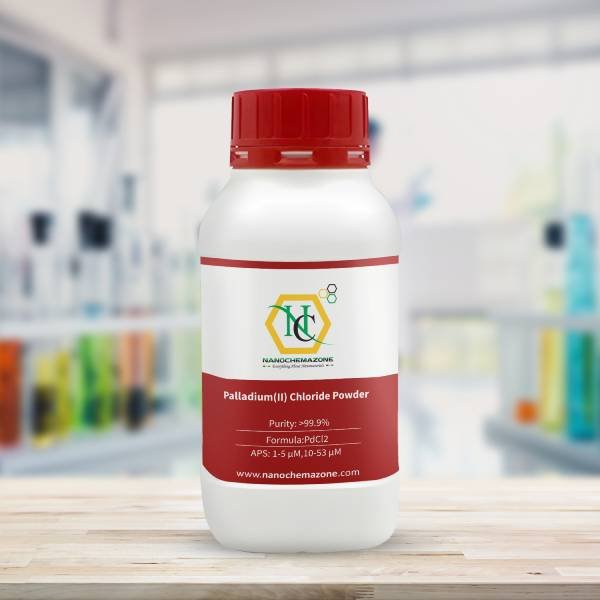
Palladium(II) Chloride Powder
Palladium(II) Chloride Powder
| Product | Palladium(II) Chloride Powder |
| CAS No. | 7647-10-1 |
| Appearance | Rust-Colored Powder |
| Purity | ≥99%, ≥99.9%, ≥95%
(Other purities are also available) |
| APS | 1-5 µM, 10-53 µM (Can be customized), Ask for other available size range. |
| Ingredient | PdCl2 |
| Density | 4g/cm3 |
| Molecular Weight | 177.33g/mol |
| Product Codes | NCZ-MNO-257/25 |
Palladium(II) Chloride Description:
Palladium(II) Chloride Powder is one of the numerous advanced ceramic materials manufactured by Nanochemazone. Nanochemazone produces too many standard grades when applicable, including Mil Spec (military grade); ACS, Reagent and Technical Grade; Food, Agricultural and Pharmaceutical Grade; Optical Grade, USP and EP/BP (European Pharmacopoeia/British Pharmacopoeia) and follows applicable ASTM testing standards. Typical and custom packaging is available. Additional technical, research and safety (MSDS) information are available. Please request a quote above for more information on lead time and pricing.
Palladium(II) Chloride Powder Related Information:
Storage Conditions:
Airtight sealed, avoid light and keep dry at room temperature.
Please contact us for customization and price inquiry
Email: contact@nanochemazone.com
Note: We supply different size ranges of Nano and micron as per the client’s requirements and also accept customization in various parameters.
Palladium(II) Chloride Powder (CAS No.7647-10-1)
| Catalog No. | NCZ-MNO-257/25 |
| Chemical Formula | PdCl2 |
| CAS Number | 7647-10-1 |
| Density | 4 g/cm3 |
| Appearance | Rust-colored powder |
| Molecular Weight | 177.33 |
Description of Palladium(II) Chloride Powder
Palladium Chloride is an excellent water soluble crystalline Palladium source for uses compatible with chlorides. Chloride compounds can conduct electricity when fused or dissolved in water.
Specification of Palladium(II) Chloride Powder
| Compound Formula | PdCl2 |
| Molecular Weight | 177.33 |
| Appearance | Rust-colored powder |
| Melting Point | 675 or 501b (dec.) |
| Boiling Point | N/A |
| Density | 4 g/cm3 |
| Solubility in H2O | soluble |
| Exact Mass | 177.33 |
| Monoisotopic Mass | 175.841 |
Safety Information of Palladium(II) Chloride Powder
| Signal Word | Danger |
| Hazard Statements | H301-H317 |
| Hazard Codes | Xi |
| Precautionary Statements | P280-P301 + P310 |
| Flash Point | Not applicable |
| Risk Codes | 37/38-41-43 |
| Safety Statements | 26-36/37/39 |
| RTECS Number | RT3500000 |
| Transport Information | UN 3288 6.1 / PGIII |
| WGK Germany | 3 |
| GHS Pictograms |
Application of Palladium(II) Chloride Powder
Used in the synthesis of semiconducting metal-containing polymers in which the polypyrrole backbone has a conformational energy minimum and is nearly planar.
Palladium(II) chloride can be used to catalyze:
• Cross-coupling reactions between terminal alkynes and aryl iodides or bromides under modified Sonogashira-Cassar-Heck conditions.
• Carbonylation of organic tellurides with carbon monoxide to form corresponding methyl carboxylates.
• Isomerization of allylic ester in acetic acid.
• Carbonylation of amines to form isocyanates.

Reviews
There are no reviews yet.