
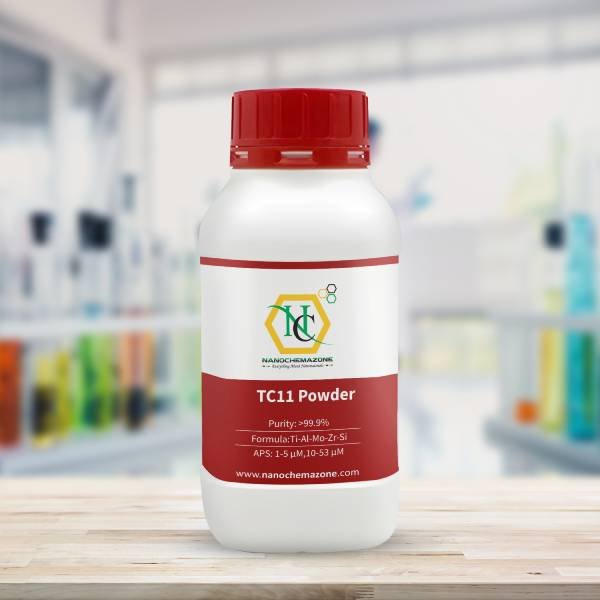


TC11 Powder
$0.00
TC11 Powder
| Product | TC11 Powder |
| CAS No. | N/A |
| Appearance | Gray Powder |
| Purity | ≥99%, ≥99.9%, ≥95%(Other purities are also available) |
| APS | 1-5 µM, 10-53 µM (Can be customized), Ask for other available size range. |
| Ingredient | Ti-Al-Mo-Zr-Si |
| Density | 2.1g/cm3 |
| Molecular Weight | N/A |
| Product Codes | NCZ-DCY-316/25 |
TC11 Description:
TC11 Powder is one of the numerous advanced ceramic materials manufactured by Nanochemazone. Nanochemazone produces too many standard grades when applicable, including Mil Spec (military grade); ACS, Reagent and Technical Grade; Food, Agricultural and Pharmaceutical Grade; Optical Grade, USP and EP/BP (European Pharmacopoeia/British Pharmacopoeia) and follows applicable ASTM testing standards. Typical and custom packaging is available. Additional technical, research and safety (MSDS) information are available. Please request a quote above for more information on lead time and pricing.
TC11 Powder Related Information :
Storage Conditions:
Airtight sealed, avoid light and keep dry at room temperature.
Please contact us for customization and price inquiry
Email: contact@nanochemazone.com
Note: We supply different size ranges of Nano and micron as per the client’s requirements and also accept customization in various parameters.
TC11 Powder : A Comprehensive Guide
TC11 powder, also known as Titanium Carbide 11, is a cutting-edge material with remarkable properties. It is composed of titanium and carbon atoms, resulting in a high-strength, lightweight powder that exhibits excellent wear resistance and thermal stability.
What Is TC11 Powder?
TC11 powder, also known as Titanium Carbide 11, is a cutting-edge material with remarkable properties. It is composed of titanium and carbon atoms, resulting in a high-strength, lightweight powder that exhibits excellent wear resistance and thermal stability.
TC11 powder possesses several noteworthy properties that make it an ideal choice for various applications. Some key properties of TC11 powder include:
High hardness and wear resistance
Excellent thermal stability
Low density
Good electrical conductivity
Chemical inertness
Advantages And Benefits Of TC11 Powder
The utilization of TC11 powder brings forth numerous advantages and benefits. These include:
Enhanced mechanical properties
Extended lifespan of components
Reduced weight and improved fuel efficiency
Increased resistance to high temperatures
Enhanced electrical conductivity
Superior corrosion resistance
Applications Of TC11 Powder
The versatility of TC11 powder allows for its utilization in a wide range of industries. Some notable applications of TC11 powder are:
The Role Of TC11 Powder In Aerospace Industry
In the aerospace industry, TC11 powder finds extensive use in manufacturing lightweight components for aircraft and spacecraft. Its high strength, low density, and exceptional thermal stability make it an excellent choice for producing turbine blades, engine components, and structural parts.
TC11 Powder In Automotive Manufacturing
The automotive industry can benefit greatly from TC11 powder. By incorporating TC11 powder in the manufacturing process, automakers can create lighter and more fuel-efficient vehicles. TC11 powder is used in producing engine parts, exhaust systems, and suspension components.
TC11 Powder In Medical Applications
TC11 powder has found its way into the medical field due to its biocompatibility and excellent wear resistance. It is used in orthopedic implants, dental prosthetics, and surgical instruments. The use of TC11 powder ensures long-lasting and reliable medical devices.
TC11 Powder In Electronics And Gadgets
The electrical conductivity and thermal stability of TC11 powder make it highly suitable for electronics and gadget manufacturing. It is used in the production of circuit boards, heat sinks, and various electronic components.
TC11 Powder In Sports And Recreation
In sports and recreation, TC11 powder plays a significant role. It is used in the manufacturing of sports equipment such as golf clubs, tennis rackets, and bicycle frames. The lightweight and durable nature of TC11 powder make it an excellent choice for performance-driven applications.
TC11 Powder In Defense And Military
TC11 powder has garnered interest in the defense and military sectors. It is used in the production of armor plates, ballistic vests, and protective gear. TC11 powder provides enhanced protection while ensuring lightweight and agile equipment.
How To Choose The Right TC11 Powder Supplier
When selecting a TC11 powder supplier, it is crucial to consider certain factors. Look for a supplier that offers high-quality TC11 powder, adheres to industry standards, provides technical support, and has a reliable track record.
Safety Considerations And Handling Of TC11 Powder
While TC11 powder offers numerous benefits, proper safety precautions must be followed during handling and processing. It is important to wear appropriate protective gear, ensure adequate ventilation, and follow the recommended guidelines provided by the manufacturer.
Future Prospects And Development Of TC11 Powder
As technology advances, the development of TC11 powder continues to progress. Researchers are exploring new manufacturing techniques and optimizing its properties for even broader applications. The future of TC11 powder holds immense potential in revolutionizing various industries.
Frequently Asked Questions (FAQs)
What are the main characteristics of TC11 powder?TC11 powder possesses high hardness, wear resistance, low density, good electrical conductivity, and chemical inertness.
Is TC11 powder suitable for high-temperature applications?Yes, TC11 powder exhibits excellent thermal stability, making it suitable for high-temperature environments.
Can TC11 powder be used in additive manufacturing?Absolutely, TC11 powder can be used in additive manufacturing processes like 3D printing to create intricate and customized components.
Are there any health risks associated with TC11 powder?When handled and processed following proper safety guidelines, TC11 powder poses minimal health risks. It is important to take necessary precautions during handling and use.
Where can I purchase TC11 powder?You can find TC11 powder from reputable suppliers and distributors. Visit our website here to access reliable sources for TC11 powder.
Description
Note: For pricing & ordering information, please get in touch with us at sales@nanochemazone.com
Please contact us for quotes on Larger Quantities and customization. E-mail: contact@nanochemazone.com
Customization:
If you are planning to order large quantities for your industrial and academic needs, please note that customization of parameters (such as size, length, purity, functionalities, etc.) is available upon request.
NOTE:
Images, pictures, colors, particle sizes, purity, packing, descriptions, and specifications for the real and actual goods may differ. These are only used on the website for the purposes of reference, advertising, and portrayal. Please contact us via email at sales@nanochemazone.com or by phone at (+1 780 612 4177) if you have any
Only logged in customers who have purchased this product may leave a review.
Related products

CPTi Powder
CPTi Powder
| Product | CPTi Powder |
| CAS No. | 12083-20-1 |
| Appearance | White -Silvery Powder |
| Purity | ≥99%, ≥99.9%, ≥95%(Other purities are also available) |
| APS | 1-5 µM, 10-53 µM (Can be customized), Ask for other available size range. |
| Ingredient | Cp-Ti |
| Density | 4.51g/cm3 |
| Molecular Weight | 41.86g/mol |
| Product Codes | NCZ-DCY-312/25 |
CPTi Description:
CPTi Powder is one of the numerous advanced ceramic materials manufactured by Nanochemazone. Nanochemazone produces too many standard grades when applicable, including Mil Spec (military grade); ACS, Reagent and Technical Grade; Food, Agricultural and Pharmaceutical Grade; Optical Grade, USP and EP/BP (European Pharmacopoeia/British Pharmacopoeia) and follows applicable ASTM testing standards. Typical and custom packaging is available. Additional technical, research and safety (MSDS) information are available. Please request a quote above for more information on lead time and pricing.CPTi Powder Related Information :
Storage Conditions: Airtight sealed, avoid light and keep dry at room temperature. Please contact us for customization and price inquiry Email: contact@nanochemazone.com Note: We supply different size ranges of Nano and micron as per the client’s requirements and also accept customization in various parameters. CPTi Powder CPTi (chemically pure titanium) powder is a high purity titanium metal powder used in various applications requiring excellent corrosion resistance, high strength, low weight, and biocompatibility. It offers superior properties compared to other titanium grades and alloy powders. Overview of CPTi Powder CPTi (chemically pure titanium) powder is a high purity titanium metal powder used in various applications requiring excellent corrosion resistance, high strength, low weight, and biocompatibility. It offers superior properties compared to other titanium grades and alloy powders. CPTi powder is produced by gas atomization process to achieve spherical powder morphology with minimal contamination. It has a particle size range of 15-150 microns generally. The high purity and cleanliness result in excellent flowability, packing density and sinterability. Some key properties and advantages of CPTi powder include: CPTi Powder Properties and Characteristics| Properties | Details |
| Composition | 99.5% minimum Titanium. Low O, C, N, H, Fe impurities |
| Density | 4.5 g/cc |
| Flowability | Excellent due to spherical morphology |
| Sinterability | Excellent, achieves near full density |
| Particle shape | Predominantly spherical |
| Particle size range | 15-150 microns |
| Apparent density | 2.7-3.2 g/cc |
| Purity | Up to 99.995% Ti content |
| Impurities | Low oxygen, nitrogen, carbon, iron |
| Color | Dark gray with metallic luster |
| Element | Weight % |
| Titanium | 99.5% min |
| Oxygen | 0.08% – 0.40% |
| Carbon | 0.03% – 0.08% |
| Nitrogen | 0.01% – 0.05% |
| Hydrogen | 0.005% – 0.015% |
| Iron | 0.05% – 0.25% |
| Grade | Purity | Particle Size | Applications |
| CPTi Grade 1 | 99.5% min | Medium, large | General use |
| CPTi Grade 2 | 99.9% | Fine, medium | Aerospace, medical |
| CPTi Grade 3 | 99.95% | Fine | Medical, dental |
| CPTi Grade 4 | 99.99% | Ultrafine | Implants, high purity uses |
| Properties | Values |
| Density | 4.5 g/cc |
| Melting point | 1668°C |
| Thermal conductivity | 21.9 W/mK |
| Electrical resistivity | 53.8 ohm-cm |
| Young’s modulus | 107 GPa |
| Poisson’s ratio | 0.33 |
| Mohs hardness | 6 |
| Oxidation resistance | Up to 590°C in air |
| Properties | Values |
| Tensile strength | 420 – 550 MPa |
| Yield strength | 380 – 470 MPa |
| Elongation | 15 – 30% |
| Hardness | 200-240 HV |
| Fatigue strength | 200-300 MPa |
| Industry | Application Examples |
| Aerospace | Engine components, airframe parts, fasteners |
| Medical | Implants, prosthetics, instruments |
| Automotive | Valves, connecting rods, springs |
| Chemical | Pumps, valves, tanks, pipes |
| 3D printing | Aerospace and medical components |
| Metal injection molding | Dental instruments, hardware |
| Investment casting | Turbine blades, golf club heads |
| Standard | Description |
| ASTM B348 | Standard specification for titanium and titanium alloy powders |
| ASTM F67 | Standard specification for unalloyed titanium bars for surgical implants |
| ISO 5832-2 | Implant grade wrought titanium materials |
| Particle size | Typical size range | Applications |
| Fine | 1-25 microns | Investment casting, MIM |
| Medium | 25-45 microns | Press and sinter, HIP |
| Coarse | 45-150 microns | Thermal and cold spraying |
| Apparent Density | Characteristics |
| 2.7 – 3.0 g/cc | Unalloyed CPTi powder |
| 3.0 – 3.2 g/cc | Alloyed CPTi powder |
| Up to 50% of true density | Due to voids between particles |
| Method | Details |
| Gas atomization | High pressure argon gas disintegrates molten Ti stream into fine droplets, which solidify into spherical powder |
| Vacuum arc melting | High purity Ti input stock is refined to reduce gaseous impurities like O, N, H |
| Multiple melting | Ensures chemical homogeneity of raw material |
| Sieving | Classifies powder into different particle size distributions |
| Blending | Powders with different particle sizes are mixed in optimized ratios |
| Recommendation | Reason |
| Avoid inhalation | Due to small particle size |
| Use protective masks | Prevent ingestion through nose/mouth |
| Conduct handling in ventilated areas | Reduce airborne powder circulation |
| Use hazmat suits in large operations | Minimize skin contact |
| Ensure no ignition sources nearby | Powder can combust in oxygen atmosphere |
| Follow anti-static protocols | Prevent accidental fire due to buildup of static charge |
| Use non-sparking tools | Avoids possibility of ignition during handling |
| Store sealed containers in cool, dry area | Prevents moisture pickup and reactivity |
| Test | Details |
| Chemistry analysis | ICP spectroscopy verifies elemental composition |
| Particle size distribution | Sieve analysis determines size distribution |
| Apparent density | Measured as per ASTM B212 standard |
| Powder morphology | Scanning electron microscopy verifies spherical shape |
| Flow rate | Time taken for fixed powder quantity to flow through defined nozzle |
| Tap density | Density measured after mechanically tapping powder sample |
| Compressibility | Monitoring of powder bed density change during compression |
| Factor | Effect |
| Air, oxygen | Moderate oxidation risk above 500°C |
| Moisture | Low corrosion rate at room temperature |
| Hydrocarbons | Risk of fire if allowed to contaminate powder |
| Acids, bases | Low corrosion rates in neutral solutions |
| Organic solvents | Some absorption and discoloration if immersed |
| Elevated temperatures | Increased reactivity with oxygen and nitrogen |
| Parameter | CPTi Powder | Ti-6Al-4V Powder |
| Density | 4.5 g/cc | 4.42 g/cc |
| Tensile strength | 420 – 550 MPa | 950 – 1050 MPa |
| Ductility | 15 – 30% | 10 – 18% |
| Fatigue strength | 200 – 300 MPa | 500 – 600 MPa |
| Corrosion resistance | Excellent | Moderate |
| Oxidation resistance | Excellent | Good |
| Cost | Low | Moderate |
| Toxicity | None | Low |
| Uses | Low temperature applications, prosthetics | Aerospace components, automotive parts |
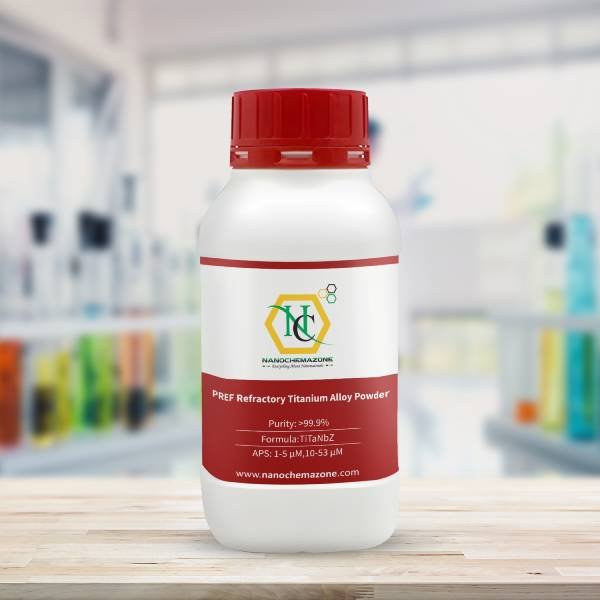
PREF Refractory Titanium Alloy Powder
PREF Refractory Titanium Alloy Powder
| Product | PREF Refractory Titanium Alloy Powder |
| CAS No. | 7440-32-6 |
| Appearance | Grey Powder |
| Purity | ≥99%, ≥99.9%, ≥95%(Other purities are also available) |
| APS | 1-5 µM, 10-53 µM (Can be customized), Ask for other available size range. |
| Ingredient | TiTaNbZr |
| Density | 2.53g/cm3 |
| Molecular Weight | N/A |
| Product Codes | NCZ-DCY-313/25 |
PREF Refractory Titanium Alloy Description:
PREF Refractory Powder is one of the numerous advanced ceramic materials manufactured by Nanochemazone. Nanochemazone produces too many standard grades when applicable, including Mil Spec (military grade); ACS, Reagent and Technical Grade; Food, Agricultural and Pharmaceutical Grade; Optical Grade, USP and EP/BP (European Pharmacopoeia/British Pharmacopoeia) and follows applicable ASTM testing standards. Typical and custom packaging is available. Additional technical, research and safety (MSDS) information are available. Please request a quote above for more information on lead time and pricing.PREF Refractory Powder Related Information :
Storage Conditions: Airtight sealed, avoid light and keep dry at room temperature. Please contact us for customization and price inquiry Email: contact@nanochemazone.com Note: We supply different size ranges of Nano and micron as per the client’s requirements and also accept customization in various parameters. PREP Refractory Titanium Alloy Powder TiAl is a new class of aerospace alloys that offers an excellent strength-to-weight ratio as well as high chemical and thermal stability. Gamma titanium aluminide alloy has excellent mechanical properties as well as oxidation and corrosion resistance at elevated temperatures (over 600 degrees Celsius). TiAl is the latest class of materials competing with Nickel superalloys for the fabrication of aircraft engine parts such as low-pressure turbine. Overview of PREP Refractory Titanium Alloy Powder PREP (Plasma Rotating Electrode Process) alloy is a high-performance refractory titanium alloy powder designed for additive manufacturing of components needing excellent mechanical properties at extreme temperatures. This article provides a comprehensive guide to PREP titanium alloy powder covering composition, properties, print parameters, applications, specifications, suppliers, handling, inspection, comparisons, pros and cons, and FAQs. Quantitative information is presented in easy-to-reference tables. Composition of PREP Titanium Alloy Powder PREP alloy has a complex composition containing various solute elements:| Element | Weight % | Purpose |
| Titanium | Balance | Principal matrix element |
| Aluminum | 5 – 7 | Solid solution strengthener |
| Tin | 1 – 3 | Solid solution strengthener |
| Zirconium | 0.5 – 2 | Grain structure control |
| Molybdenum | 1 – 3 | Solid solution strengthener |
| Silicon | 0.5 – 1.5 | Oxidation resistance |
| Niobium | 1 – 3 | Carbide former |
| Tantalum | 1 – 3 | Carbide former |
| Property | Description |
| High strength | Excellent tensile and creep strength up to 700°C |
| Fatigue resistance | High fatigue life at elevated temperatures |
| Fracture toughness | Up to 100 MPa-√m |
| Oxidation resistance | Forms protective oxide scale |
| Thermal stability | Microstructural stability after prolonged exposures |
| Damage tolerance | Resistant to crack growth |
| Biocompatibility | Non-toxic and non-allergenic |
| Parameter | Typical Value | Purpose |
| Layer height | 30-50 μm | Resolution versus build speed |
| Laser power | 150-500 W | Sufficient melting without evaporation |
| Scan speed | 750-1500 mm/s | Density versus production rate |
| Hatch spacing | 80-120 μm | Mechanical properties |
| Hot isostatic pressing | 900°C, 100 MPa, 3 hrs | Eliminate internal voids |
| Industry | Components |
| Aerospace | Turbine blades, compressor parts, mounts |
| Automotive | Connecting rods, valves, turbocharger wheels |
| Medical | Orthopedic implants, surgical tools |
| Chemical | Pumps, valves, reaction vessels |
| Power generation | Hot gas path components |
| Parameter | Specification |
| Particle size range | 15-45 μm typical |
| Particle shape | Spherical morphology |
| Apparent density | >2.5 g/cc |
| Tap density | >4.5 g/cc |
| Hall flow rate | >35 sec for 50 g |
| Purity | >99.95% |
| Oxygen content | <1000 ppm |
| Method | Parameters Tested |
| Sieve analysis | Particle size distribution |
| SEM imaging | Particle morphology |
| EDX | Chemistry/composition |
| XRD | Phases present |
| Pycnometry | Density |
| Hall flow rate | Powder flowability |
| Alloy | Strength | Oxidation Resistance | Cost | Printability |
| PREP | Excellent | Excellent | High | Good |
| Ti64 | Good | Good | Medium | Fair |
| Ti6242 | Excellent | Good | High | Fair |
| CP-Ti | Low | Excellent | Low | Excellent |
| Pros | Cons |
| Outstanding high temperature strength | Expensive compared to Ti64 and CP-Ti |
| Excellent thermomechanical fatigue resistance | Higher density than other titanium alloys |
| Complex geometries feasible | Controlled atmosphere handling mandatory |
| Lower anisotropy than Ti64 and CP-Ti | Processing very technique sensitive |
| Matching properties to PREP wrought forms | Limited suppliers and alloy variants |
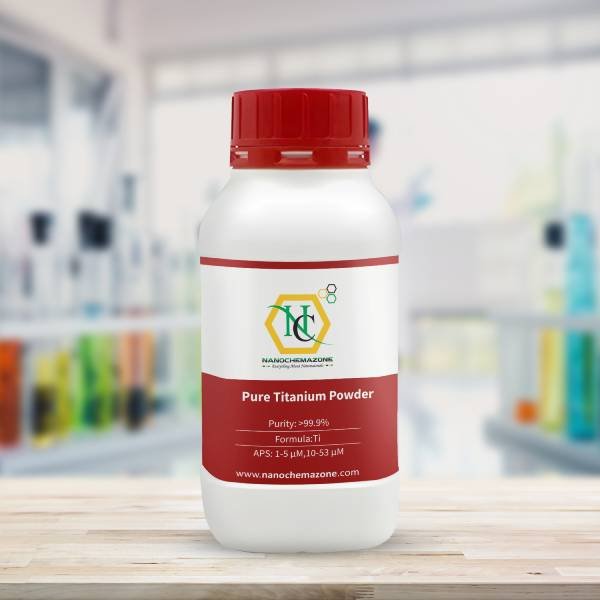
Pure Titanium Powder
Pure Titanium Powder
| Product | Pure Titanium Powder |
| CAS No. | 7440-32-6 |
| Appearance | Silvery Powder |
| Purity | ≥99%, ≥99.9%, ≥95%(Other purities are also available) |
| APS | 1-5 µM, 10-53 µM (Can be customized), Ask for other available size range. |
| Ingredient | Ti |
| Density | 4.54g/cm3 |
| Molecular Weight | 47.86g/mol |
| Product Codes | NCZ-DCY-314/25 |
Pure Titanium Description:
Pure Titanium Powder is one of the numerous advanced ceramic materials manufactured by Nanochemazone. Nanochemazone produces too many standard grades when applicable, including Mil Spec (military grade); ACS, Reagent and Technical Grade; Food, Agricultural and Pharmaceutical Grade; Optical Grade, USP and EP/BP (European Pharmacopoeia/British Pharmacopoeia) and follows applicable ASTM testing standards. Typical and custom packaging is available. Additional technical, research and safety (MSDS) information are available. Please request a quote above for more information on lead time and pricing.Pure Titanium Powder Related Information :
Storage Conditions: Airtight sealed, avoid light and keep dry at room temperature. Please contact us for customization and price inquiry Email: contact@nanochemazone.com Note: We supply different size ranges of Nano and micron as per the client’s requirements and also accept customization in various parameters. Pure Titanium Powder Titanium powder is a metal powder made from titanium metal. It is characterized by its high strength-to-weight ratio, corrosion resistance, and biocompatibility. Titanium powder has diverse applications across industries such as aerospace, medical, automotive, and consumer products. Overview of Pure Titanium Powder Titanium powder is a metal powder made from titanium metal. It is characterized by its high strength-to-weight ratio, corrosion resistance, and biocompatibility. Titanium powder has diverse applications across industries such as aerospace, medical, automotive, and consumer products. This article provides a comprehensive guide to titanium powder. It covers the composition, properties, applications, specifications, suppliers, handling, inspection, comparisons, pros and cons, and frequently asked questions about titanium powder. Quantitative data is presented in easy-to-read tables for quick reference. Composition of Titanium Powder Titanium powder can be pure titanium or an alloy containing titanium as the main element. The composition determines the properties and applications.| Composition | Details |
| Pure Titanium | Contains >99% titanium. Lowest strength but excellent corrosion resistance. |
| Ti-6Al-4V | 6% aluminum, 4% vanadium. Most common titanium alloy with high strength. |
| Ti-3Al-2.5V | 3% aluminum, 2.5% vanadium. Higher ductility than Ti-6Al-4V. |
| Ti-6Al-7Nb | 6% aluminum, 7% niobium. Higher strength for aerospace applications. |
| Ti-15Mo-3Nb-3Al-0.2Si | 15% molybdenum, 3% niobium, 3% aluminum, 0.2% silicon. Beta titanium alloy. |
| Property | Description |
| High strength | Has excellent strength-to-density ratio, close to high strength steels. |
| Low density | Weighs 60% less than steel or nickel alloys. |
| Corrosion resistance | Forms stable TiO2 oxide film for corrosion protection. |
| Biocompatibility | Non-toxic and compatible with human body tissues. |
| Heat resistance | Maintains mechanical properties up to 600°C. |
| Non-magnetic | Useful for non-magnetic applications. |
| Non-sparking | Safer for flammable environments compared to steel. |
| Industry | Applications |
| Aerospace | Engine components, aircraft structures, space vehicles |
| Medical | Implants, surgical instruments, medical devices |
| Automotive | Connecting rods, valves, springs, fasteners |
| Chemical | Corrosion resistant vessels, heat exchangers, pipes |
| Sporting goods | Golf clubs, tennis rackets, bicycles, helmets |
| Additive manufacturing | Aerospace, automotive, and medical 3D printed parts |
| Parameter | Specifications |
| Particle sizes | 15-45 microns, 45-105 microns, 105-250 microns |
| Particle shape | Spherical, angular, mixed morphology |
| Purity | Grade 1 (99.2% Ti), Grade 2 (99.5% Ti), Grade 4 (99.9% Ti) |
| Alloy grades | Ti-6Al-4V, Ti-6Al-7Nb, Ti-64, Ti-1023 |
| Production method | Gas atomization, plasma atomization, hydride-dehydride |
| Test Method | Parameter Measured |
| Sieve analysis | Particle size distribution |
| Laser diffraction | Particle size distribution, mean size |
| Scanning electron microscopy | Particle morphology, microstructure |
| Energy dispersive X-ray spectroscopy | Chemical composition |
| X-ray diffraction | Phase composition |
| Spectrophotometry | Oxygen, nitrogen, hydrogen content |
| Tap density | Apparent density, flowability |
| Pycnometer | Skeletal density |
| Titanium | Aluminum | Stainless Steel | |
| Density | Low | Lower | Higher |
| Strength | High | Medium | High |
| Corrosion resistance | Excellent | Good | Good |
| Temperature resistance | Good | Medium | Better |
| Cost | High | Low | Medium |
| Magnetic permeability | Low | Low | High |
| Biocompatibility | Excellent | Poor | Good |
| Pros | Cons |
| High strength-to-weight ratio | Expensive compared to steels |
| Corrosion resistant | Reactivity with oxygen at high temperatures |
| Non-toxic and non-allergenic | Low elastic modulus can mean springback in machining |
| Excellent biocompatibility | Low thermal conductivity |
| Retains properties at high temperatures | Requires inert atmosphere processing |
| Wide range of alloying possibilities | Limited high temperature strength |
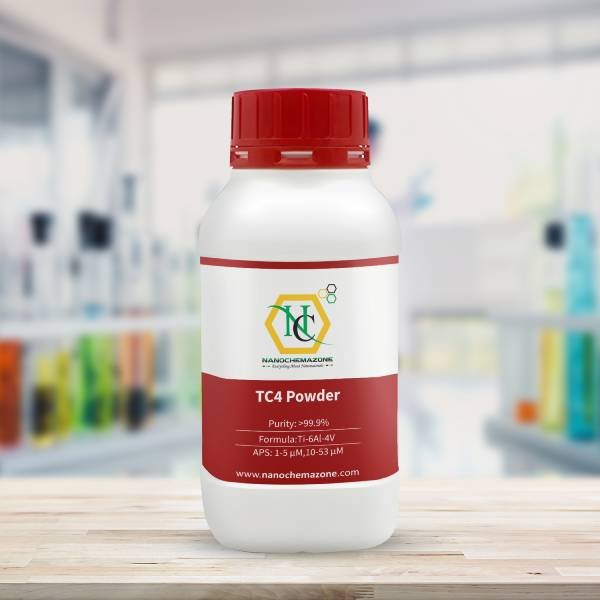
TC4 Powder
TC4 Powder
| Product | TC4 Powder |
| CAS No. | 72046-02-7 |
| Appearance | Silvery White Powder |
| Purity | ≥99%, ≥99.9%, ≥95%(Other purities are also available) |
| APS | 1-5 µM, 10-53 µM (Can be customized), Ask for other available size range. |
| Ingredient | Ti-6Al-4V |
| Density | 2.7g/cm3 |
| Molecular Weight | 98.90g/mol |
| Product Codes | NCZ-DCY-311/25 |
TC4 Description:
TC4 Powder is one of the numerous advanced ceramic materials manufactured by Nanochemazone. Nanochemazone produces too many standard grades when applicable, including Mil Spec (military grade); ACS, Reagent and Technical Grade; Food, Agricultural and Pharmaceutical Grade; Optical Grade, USP and EP/BP (European Pharmacopoeia/British Pharmacopoeia) and follows applicable ASTM testing standards. Typical and custom packaging is available. Additional technical, research and safety (MSDS) information are available. Please request a quote above for more information on lead time and pricing.TC4 Powder Related Information :
Storage Conditions: Airtight sealed, avoid light and keep dry at room temperature. Please contact us for customization and price inquiry Email: contact@nanochemazone.com Note: We supply different size ranges of Nano and micron as per the client’s requirements and also accept customization in various parameters. Best Ti-6Al-4V powder TC4 Powder for additive manufacturing TC4 powder, also known as Ti-6Al-4V, is a titanium alloy powder composed of 90% titanium (Ti), 6% aluminum (Al), and 4% vanadium (V). It is widely recognized for its exceptional strength, low density, and excellent corrosion resistance. TC4 powder is extensively utilized across industries due to its unique combination of properties, making it a highly sought-after material for various applications. Overview of TC4 Powder TC4 belongs to the two-phase α+β titanium alloy system. The aluminum stabilizes the alpha phase while vanadium is a beta stabilizer. This results in a good balance of strength, ductility and high temperature properties. Key characteristics of TC4 powder include: High strength-to-weight ratio Excellent fatigue strength and fracture toughness Good creep resistance at elevated temperatures Outstanding corrosion resistance Available in range of particle size distributions TC4 powder has emerged as an excellent choice for reducing weight and improving performance in aerospace, automotive, medical and other demanding applications. Composition of TC4 Powder| Element | Weight % |
| Titanium (Ti) | Balance |
| Aluminum (Al) | 5.5-6.75% |
| Vanadium (V) | 3.5-4.5% |
| Iron (Fe) | 0-0.40% |
| Oxygen (O) | 0-0.20% |
| Carbon (C) | 0-0.08% |
| Nitrogen (N) | 0-0.05% |
| Property | Value |
| Density | 4.41-4.43 g/cm3 |
| Melting Point | 1600-1660°C |
| Thermal Conductivity | 6.7 W/mK |
| Electrical Resistivity | 1.7 μΩ.cm |
| Young’s Modulus | 110 GPa |
| Poisson’s Ratio | 0.32-0.34 |
| Tensile Strength | 900-1200 MPa |
| Yield Strength | 860-900 MPa |
| Elongation | 8-15% |
| Fatigue Strength | 400-500 MPa |
| Parameter | TC4 | Ti6Al4V |
| Aluminum content | 5.5-6.75% | 5.5-6.75% |
| Vanadium content | 3.5-4.5% | 3.5-4.5% |
| Density | Higher | Lower |
| Tensile strength | Higher | Lower |
| Ductility | Lower | Higher |
| Oxidation resistance | Similar | Similar |
| Cost | Higher | Lower |
Ti45NB Powder
Ti45NB Powder
| Product | Ti45NB Powder |
| CAS No. | 7440-32-6 |
| Appearance | Metallic Gray Powder |
| Purity | ≥99%, ≥99.9%, ≥95%(Other purities are also available) |
| APS | 1-5 µM, 10-53 µM (Can be customized), Ask for other available size range. |
| Ingredient | Ti55Nb45 |
| Density | 5.7g/cm3 |
| Molecular Weight | 140.733g/mol |
| Product Codes | NCZ-DCY-320/25 |
Ti45NB Description:
Ti45NB Powder is one of the numerous advanced ceramic materials manufactured by Nanochemazone. Nanochemazone produces too many standard grades when applicable, including Mil Spec (military grade); ACS, Reagent and Technical Grade; Food, Agricultural and Pharmaceutical Grade; Optical Grade, USP and EP/BP (European Pharmacopoeia/British Pharmacopoeia) and follows applicable ASTM testing standards. Typical and custom packaging is available. Additional technical, research and safety (MSDS) information are available. Please request a quote above for more information on lead time and pricing.Ti45NB Powder Related Information :
Storage Conditions: Airtight sealed, avoid light and keep dry at room temperature. Please contact us for customization and price inquiry Email: contact@nanochemazone.com Note: We supply different size ranges of Nano and micron as per the client’s requirements and also accept customization in various parameters. Ti45Nb Powder for Additive Manufacturing Ti45Nb powder, a marvel of material science, is making waves in the realm of additive manufacturing.| Metal Powder | Size | Quantity | Price/kg |
| Ti45Nb | 15-45um | 30KG | 499 |
| Property | Description |
| Composition | 55% Ti, 45% Nb (nominal) |
| Density | ~6.0 g/cm³ |
| Melting Point | ~3000°C |
| Strength | Medium range |
| Elastic Modulus | 40% lower than commercially pure titanium |
| Biocompatibility | Excellent |
| Corrosion Resistance | Outstanding |
| Application | Description |
| Aerospace: Lightweight, high-strength components for aircraft, spacecraft, and satellite structures. | |
| Biomedical: Biocompatible implants for knees, hips, and other joints, as well as dental implants and surgical instruments. | |
| Chemical Processing: Corrosion-resistant components for pumps, valves, and other equipment exposed to aggressive chemicals. | |
| Oil and Gas: High-pressure and high-temperature components for drilling equipment and downhole tools. | |
| Consumer Products: High-performance sporting goods like bicycle frames and golf clubs. |
| Specification | Description |
| Particle Size: Typically ranges from 15 to 45 microns, with customized options available for specific applications. | |
| Grade: Available in various grades depending on the desired level of purity and oxygen content. | |
| Standards: Conforms to industry standards like ASTM F3056 for additive manufacturing powders. |
Ti6Al4V Powder
Ti6Al4V Powder
| Product | Ti6Al4V Powder |
| CAS No. | 12743-70-3 |
| Appearance | Gray Powder |
| Purity | ≥99%, ≥99.9%, ≥95%(Other purities are also available) |
| APS | 1-5 µM, 10-53 µM (Can be customized), Ask for other available size range. |
| Ingredient | TiAlV |
| Density | 2.2g/cm3 |
| Molecular Weight | N/A |
| Product Codes | NCZ-DCY-321/25 |
Ti6Al4V Description:
Ti6Al4V Powder is one of the numerous advanced ceramic materials manufactured by Nanochemazone. Nanochemazone produces too many standard grades when applicable, including Mil Spec (military grade); ACS, Reagent and Technical Grade; Food, Agricultural and Pharmaceutical Grade; Optical Grade, USP and EP/BP (European Pharmacopoeia/British Pharmacopoeia) and follows applicable ASTM testing standards. Typical and custom packaging is available. Additional technical, research and safety (MSDS) information are available. Please request a quote above for more information on lead time and pricing.Ti6Al4V Powder Related Information :
Storage Conditions: Airtight sealed, avoid light and keep dry at room temperature. Please contact us for customization and price inquiry Email: contact@nanochemazone.com Note: We supply different size ranges of Nano and micron as per the client’s requirements and also accept customization in various parameters. Overview of Ti6Al4V Powder Ti6Al4V powder, also referred to as Grade 5 titanium alloy, is one of the most popular titanium alloy powders. It contains 6% aluminum and 4% vanadium as the key alloying elements along with the remainder titanium. Spherical powder ti6al4v offers an exceptional combination of high strength, low weight, corrosion resistance, biocompatibility, and workability. Key properties and advantages of Ti6Al4V powder: Ti6Al4V Powder Properties and Characteristics| Properties | Details |
| Composition | Ti-6Al-4V alloy |
| Density | 4.43 g/cc |
| Particle shape | Predominantly spherical |
| Size range | 15-45 microns |
| Apparent density | Up to 60% of true density |
| Flowability | Good |
| Strength | High for a titanium alloy |
| Corrosion resistance | Excellent |
| Element | Weight % |
| Titanium | Balance |
| Aluminum | 5.5-6.75% |
| Vanadium | 3.5-4.5% |
| Oxygen | <0.2% |
| Carbon | <0.1% |
| Nitrogen | <0.05% |
| Hydrogen | <0.015% |
| Iron | <0.3% |
| Property | Values |
| Density | 4.43 g/cc |
| Melting point | 1604-1660°C |
| Thermal conductivity | 6.7 W/mK |
| Electrical resistivity | 170 μΩ-cm |
| Coefficient of thermal expansion | 8.4 x 10^-6 /K |
| Maximum service temperature | 400°C |
| Property | Values |
| Tensile strength | 950 – 1050 MPa |
| Yield strength | 860 – 950 MPa |
| Elongation | 10 – 18% |
| Hardness | 330 – 380 HB |
| Modulus of elasticity | 110 – 120 GPa |
| Fatigue strength | 400 – 500 MPa |
| Industry | Uses |
| Aerospace | Structural airframe parts, engine components |
| Biomedical | Orthopedic and dental implants |
| Automotive | Connecting rods, valves, springs |
| Chemical | Tanks, vessels, heat exchangers |
| Consumer | Sporting goods, watch cases, cellphone bodies |
| 3D Printing | Aerospace and medical components |
- Selective Laser Melting (SLM): SLM is a powder bed fusion (PBF) technique that employs a high-power laser to selectively melt and fuse fine layers of Ti6Al4V powder. This method produces high-density, high-strength parts with complex geometries.
- Electron Beam Melting (EBM): EBM is another PBF technique that utilizes a focused electron beam to melt Ti6Al4V powder. It is known for its ability to produce parts with excellent surface quality and fine features.
- Directed Energy Deposition (DED): DED is an additive manufacturing process that deposits material through a nozzle while simultaneously melting it with a laser or electron beam. Ti6Al4V powder can be used in DED to create large-scale, near-net-shape components.
- Binder Jetting (BJ): BJ is a PBF technique that uses a liquid binder to selectively adhere Ti6Al4V powder particles together. The unbound powder is then removed, leaving a pre-formed part that is sintered to achieve full density.
| Standard | Description |
| ASTM F2924 | Additive manufacturing Ti6Al4V alloy |
| ASTM F3001 | Specs for gas atomized Ti alloy powder for AM |
| AMS 4954 | Composition limits of Ti-6Al-4V powder for additive manufacturing |
| ASTM B348 | Specs for Ti and Ti alloy powders |
| ASTM F1472 | Wrought Ti6Al4V alloy for surgical implants |
| Particle Size | Characteristics |
| 15-45 microns | General purpose size range |
| 45-100 microns | Optimized for cold spraying |
| 5-25 microns | Finer sizes used in laser AM processes |
| Apparent Density | Details |
| Up to 60% of true density | For spherical powder morphology |
| 2.6 – 3.0 g/cc | Improves with greater packing density |
| Method | Details |
| Gas atomization | High pressure inert gas breaks up molten alloy stream into fine droplets |
| Vacuum arc melting | High purity input materials refined and melted in vacuum |
| Multiple remelts | Improves chemical homogeneity |
| Sieving | Classifies powder into different particle size fractions |
| Recommendation | Reason |
| Avoid inhalation | Due to risk of lung tissue damage from fine particles |
| Use protective mask | Prevent accidental ingestion |
| Handle in ventilated areas | Reduce airborne particle suspension |
| Ensure no ignition sources | Powder can combust in oxygen atmosphere |
| Follow anti-static protocols | Prevent fire from static discharge while handling |
| Store sealed containers in cool, dry area | Prevent moisture pickup and reactivity |
| Test | Details |
| Chemical analysis | ICP spectroscopy used to verify composition |
| Particle size distribution | Laser diffraction used to determine size distribution |
| Apparent density | Measured using Hall flowmeter as per ASTM B212 |
| Powder morphology | SEM imaging to check particle sphericity |
| Flow rate analysis | Using Hall flowmeter funnel |
| Tap density test | Density measured after mechanically tapping powder sample |
| Parameter | Ti6Al4V | Ti64 | Ti Grade 2 |
| Aluminum | 6% | 6% | – |
| Vanadium | 4% | 4% | – |
| Strength | 950-1050 MPa | 950-1050 MPa | 420-550 MPa |
| Ductility | 10-18% | 10-18% | 15-30% |
| Cost | Moderate | Moderate | Low |
| Uses | Aerospace, medical | Aerospace, automotive | Industrial, consumer |
TiNb Alloy Powder
TiNb Alloy Powder
| Product | TiNb Alloy Powder |
| CAS No. | 12010-55-8 |
| Appearance | Gray-Silver Powder |
| Purity | ≥99%, ≥99.9%, ≥95%(Other purities are also available) |
| APS | 1-5 µM, 10-53 µM (Can be customized), Ask for other available size range. |
| Ingredient | Ti-Nb |
| Density | 4.5-5.5g/cm3 |
| Molecular Weight | N/A |
| Product Codes | NCZ-DCY-322/25 |
TiNb Alloy Description:
TiNb Alloy Powder is one of the numerous advanced ceramic materials manufactured by Nanochemazone. Nanochemazone produces too many standard grades when applicable, including Mil Spec (military grade); ACS, Reagent and Technical Grade; Food, Agricultural and Pharmaceutical Grade; Optical Grade, USP and EP/BP (European Pharmacopoeia/British Pharmacopoeia) and follows applicable ASTM testing standards. Typical and custom packaging is available. Additional technical, research and safety (MSDS) information are available. Please request a quote above for more information on lead time and pricing.TiNb Alloy Powder Related Information :
Storage Conditions: Airtight sealed, avoid light and keep dry at room temperature. Please contact us for customization and price inquiry Email: contact@nanochemazone.com Note: We supply different size ranges of Nano and micron as per the client’s requirements and also accept customization in various parameters. TiNb Alloy Powder Titanium niobium (TiNb) alloy powder is an advanced material with excellent properties for use in biomedical, aerospace, automotive and other demanding applications. This article provides a comprehensive guide to TiNb alloy powder covering composition, properties, processing, applications, specifications, suppliers, costs, handling and more. Introduction to TiNb Alloy Powder TiNb alloy powder is composed of titanium and niobium metals. It offers a unique combination of high strength, low density, biocompatibility, corrosion resistance, fatigue and creep resistance at high temperatures. TiNb alloys are part of a broader class of titanium intermetallic materials that have superior physical, chemical and mechanical properties compared to pure titanium. The addition of niobium as an alloying element enhances certain properties and allows tailoring TiNb alloys for specific applications. Some key advantages of TiNb alloy powder include: High strength-to-weight ratio Ability to withstand extreme temperatures and stresses Resists wear, abrasion and corrosion in harsh environments Biocompatible and non-toxic for medical uses Can be processed into complex shapes using additive manufacturing Provides design flexibility for engineers TiNb alloys compete with nickel and cobalt-based superalloys in the aerospace industry. They also offer an alternative to stainless steels for biomedical implants and devices. TiNb alloys are enabling new applications and designs not possible with other materials. This article provides a technical reference covering the composition, properties, processing, applications, specifications, costs and other practical aspects of TiNb alloy powder. TiNb Alloy Powder Composition TiNb alloys contain primarily titanium and niobium as the key constituent elements. The niobium content typically ranges from 10% to 50% by weight, with the balance being titanium. The ratio of Ti to Nb can be adjusted to create different grades of TiNb alloys optimized for certain properties. Some common TiNb grades include: Ti-10Nb – 10% niobium, 90% titanium Ti-35Nb – 35% niobium, 65% titanium Ti-45Nb – 45% niobium, 55% titanium Ti-50Nb – 50% niobium, 50% titanium Additionally, small amounts of other elements like zirconium, tantalum, molybdenum, chromium may be added to further enhance properties. Oxygen and nitrogen may also be present as impurities. Table 1: Chemical composition of common TiNb alloy grades| Alloy Grade | Niobium Content | Titanium Content |
| Ti-10Nb | 10% | 90% |
| Ti-35Nb | 35% | 65% |
| Ti-45Nb | 45% | 55% |
| Ti-50Nb | 50% | 50% |
| Property | Value |
| Density | 5.2 g/cm3 |
| Melting point | 1600°C |
| Tensile strength | 650 MPa |
| Yield strength | 550 MPa |
| Elongation | 15% |
| Elastic modulus | 60 GPa |
| Hardness | 250 HV |
| Industry | Applications |
| Aerospace | Engine components, airframe parts, hydraulic systems |
| Automotive | Valve springs, engine valves, connecting rods |
| Biomedical | Implants, dental, surgical instruments, devices |
| Chemical | Heat exchangers, reactors, pumps, valves |
| Other | Sporting goods, watches, electrical contacts, furnace parts |
| Method | Description | Particle Size | Morphology |
| Mechanical alloying | Blending and milling Ti and Nb powders | 10 – 50 microns | Irregular, angular |
| Gas atomization | Inert gas atomization of molten alloy | 15 – 150 microns | Spherical |
| Plasma rotating electrode | Centrifugal disintegration of melted electrode | 50 – 150 microns | Spherical |
| HDH process | Hydriding, dehydriding, crushing blended powders | 10 – 63 microns | Irregular, angular |
| Method | Description | Density | Microstructure | Geometry |
| HIP | High pressure, high temperature | Near full density | Fine | Simple shapes |
| Vacuum sintering | Sintering in vacuum furnace | Near full density | Fine | Simple shapes |
| Spark plasma sintering | Pulsed current and pressure | Full density | Ultrafine | Simple shapes |
| Metal injection molding | Powder + binder molding | Near full density | Ultrafine | Complex shapes |
| Additive manufacturing | Powder bed fusion or directed energy deposition | Near full density | Coarse | Complex shapes |
| Parameter | Specification |
| Alloy composition | Ti-35Nb |
| Particle size | 15 to 45 microns |
| Morphology | Spherical |
| Production method | Gas atomization |
| Purity | Ti >99.5%, Nb >99.8% |
| Oxygen content | <1500 ppm |
| Flow rate | >38 sec/50g |
| Apparent density | ≥ 2.7 g/cc |
| Tap density | ≥ 4.2 g/cc |
| Parameter | Guidelines |
| Storage | Sealed containers, dry inert atmosphere |
| Atmosphere | Avoid oxygen, moisture, oils, combustibles |
| Equipment | Ground all conductive equipment |
| Tools | Use non-sparking tools |
| Ventilation | Grounded ventilation system |
| PPE | Gloves, respiratory protection |
| Precautions | Avoid heat, flames, sparks |
| Shelf life | 12 months in inert atmosphere |
| Safety Item | Precautions |
| PPE | Gloves, goggles, N95 mask |
| Inhalation | Use respiratory protection |
| Skin contact | Wash affected area with soap and water |
| Eye contact | Flush eyes with water for 15 minutes |
| Ingestion | Drink water. Get medical help if needed. |
| Ventilation | Use grounded ventilation hoods |
| Grounding | Ground all equipment during handling |
| Ignition | Avoid sparks, flames, heat sources |
| Storage | Inert atmosphere away from flammable materials |
| Test | Method | Standard |
| Composition | ICP, GDMS, LECO | ASTM E1479, ASTM E2330 |
| Particle size distribution | Laser diffraction, sieving | ASTM B822 |
| Morphology | SEM imaging | ASTM B822 |
| Flow rate | Hall flow meter | ASTM B213 |
| Density | Scott volumeter | ASTM B212 |
| Oxygen/Nitrogen | Inert gas fusion | ASTM E1019 |
| Phase analysis | X-ray diffraction | ASTM E1876 |
Titanium And Aluminum TA7 Powder
Titanium And Aluminum TA7 Powder
| Product | Titanium And Aluminum TA7 Powder |
| CAS No. | 7440-32-6 |
| Appearance | Gray or Metallic Silver |
| Purity | ≥99%, ≥99.9%, ≥95%(Other purities are also available) |
| APS | 1-5 µM, 10-53 µM (Can be customized), Ask for other available size range. |
| Ingredient | Ti-Al |
| Density | 3.7-4.0g/cm3 |
| Molecular Weight | N/A |
| Product Codes | NCZ-DCY-324/25 |
Titanium And Aluminum TA7 Description:
TTitanium And Aluminum TA7 Powder is one of the numerous advanced ceramic materials manufactured by Nanochemazone. Nanochemazone produces too many standard grades when applicable, including Mil Spec (military grade); ACS, Reagent and Technical Grade; Food, Agricultural and Pharmaceutical Grade; Optical Grade, USP and EP/BP (European Pharmacopoeia/British Pharmacopoeia) and follows applicable ASTM testing standards. Typical and custom packaging is available. Additional technical, research and safety (MSDS) information are available. Please request a quote above for more information on lead time and pricing.Titanium And Aluminum TA7 Powder Related Information :
Storage Conditions: Airtight sealed, avoid light and keep dry at room temperature. Please contact us for customization and price inquiry Email: contact@nanochemazone.com Note: We supply different size ranges of Nano and micron as per the client’s requirements and also accept customization in various parameters. Titanium and aluminum TA7 powder TA7 powder belongs to the family of titanium aluminides, which are intermetallic compounds composed of titanium and aluminum. This unique powder exhibits exceptional strength, lightweight characteristics, and high-temperature stability, making it an attractive choice for numerous engineering applications. Overview of Titanium and Aluminum TA7 Powder TA7 belongs to the titanium-aluminide intermetallic alloy system combining the lightweight properties of aluminum with the strength and corrosion resistance of titanium. The near-equiatomic ratio of Ti and Al provides an excellent balance of properties for elevated temperature applications. Key characteristics of TA7 powder include: Very high specific strength (strength-to-weight ratio) Excellent high temperature tensile and creep strength Low density compared to nickel or steel alloys Good corrosion resistance in various environments Available in range of particle sizes and morphologies TA7 powder has emerged as an excellent choice for reducing weight and improving efficiency in aerospace engines and airframes operating at high temperatures. Chemical Composition of TA7 Powder TA7 powder has the following nominal composition:| Element | Weight % |
| Titanium (Ti) | Balance |
| Aluminum (Al) | 7% |
| Tin (Sn) | 2-5% |
| Zirconium (Zr) | 1-4% |
| Silicon (Si) | 0.5% max |
| Carbon (C) | 0.1% max |
| Oxygen (O) | 0.13% max |
| Property | Value |
| Density | 3.7-4.0 g/cm3 |
| Melting Point | 1460°C |
| Thermal Conductivity | 6.7 W/mK |
| Electrical Resistivity | 1.78 μΩ.cm |
| Young’s Modulus | 110 GPa |
| Poisson’s Ratio | 0.32 |
| Tensile Strength | 800 MPa |
| Yield Strength | 760 MPa |
| Elongation | 1-2% |
| Creep Resistance | 190 MPa at 700°C |
| Parameter | TA7 | Inconel 718 |
| Density | 3.7-4.0 g/cm3 | 8.2 g/cm3 |
| High temperature strength | Comparable | Comparable |
| Oxidation resistance | Better | Good |
| Cost | Higher | Lower |
| Workability | Poor | Excellent |
| Applications | Aerospace components | Aerospace, automotive |
| Availability | Low | Readily available |
Reviews
There are no reviews yet.