



CuSn10 Powder
$0.00
CuSn10 Powder
| Product | CuSn10 Powder |
| CAS No. | 7440-50-8 |
| Appearance | Metallic Gray or Dark Gray Powder |
| Purity | ≥99%, ≥99.9%, ≥95%(Other purities are also available) |
| APS | 1-5 µM, 10-53 µM (Can be customized), Ask for other available size range. |
| Ingredient | CuSn |
| Density | 8.8g/cm3 |
| Molecular Weight | 63.5-118.7g/mol |
| Product Codes | NCZ-DCY-220/25 |
CuSn10 Description:
CuSn10 Powder is one of the numerous advanced ceramic materials manufactured by Nanochemazone. Nanochemazone produces too many standard grades when applicable, including Mil Spec (military grade); ACS, Reagent and Technical Grade; Food, Agricultural and Pharmaceutical Grade; Optical Grade, USP and EP/BP (European Pharmacopoeia/British Pharmacopoeia) and follows applicable ASTM testing standards. Typical and custom packaging is available. Additional technical, research and safety (MSDS) information are available. Please request a quote above for more information on lead time and pricing
CuSn10 Powder Related Information :
Storage Conditions:
Airtight sealed, avoid light and keep dry at room temperature.
Please contact us for customization and price inquiry
Email: contact@nanochemazone.com
Note: We supply different size ranges of Nano and micron as per the client’s requirements and also accept customization in various parameters.
and micron as per the client’s requirements and also accept customization in various parameters.
CuSn10 Powder
CuSn10 powder is a copper-tin alloy containing approximately 10% tin and the remainder copper. It offers an excellent combination of strength, ductility, corrosion resistance, wear resistance, and antifriction properties.
Overview of CuSn10 Powder
CuSn10 powder is a copper-tin alloy containing approximately 10% tin and the remainder copper. It offers an excellent combination of strength, ductility, corrosion resistance, wear resistance, and antifriction properties.
Key properties and applications of CuSn10 powder include:
CuSn10 Powder Properties and Characteristics
| Properties | Details |
| Composition | 90% copper, 10% tin |
| Density | 8.8 g/cc |
| Particle shape | Irregular, angular |
| Size range | 5-150 microns |
| Apparent density | Up to 50% of true density |
| Flowability | Moderate |
| Strength | Excellent for Cu alloy powder |
| Ductility | Good |
| Corrosion resistance | Very good |
CuSn10 is widely used in bearing cages, bushings, welding rods, and wear parts across the automotive, electrical, and industrial sectors.
CuSn10 Powder Composition
Typical composition of CuSn10 powder:
CuSn10 Powder Composition
| Element | Weight % |
| Copper (Cu) | Remainder |
| Tin (Sn) | 9-11% |
| Lead (Pb) | 0.2% max |
| Zinc (Zn) | 0.5% max |
| Other impurities | 0.1% max |
Copper provides excellent conductivity, corrosion resistance, ductility
Tin improves strength, hardness, and wear resistance
Lead, zinc, and other impurities carefully controlled
CuSn10 Powder Physical Properties
| Property | Value |
| Density | 8.8 g/cc |
| Melting point | 1020-1040°C |
| Thermal conductivity | 55 W/mK |
| Electrical resistivity | 7-9 μΩ-cm |
| Recrystallization temperature | 150-250°C |
| Maximum service temperature | 250°C |
Density is higher than copper
Melting point reduced compared to pure copper
Maintains good conductivity
Recrystallization enables powder compaction
Can withstand moderately high operating temperatures
The physical properties allow use of CuSn10 in electrical components needing good conductivity and strength.
CuSn10 Powder Mechanical Properties
| Property | Values |
| Hardness | 80-110 HB |
| Tensile strength | 350-550 MPa |
| Yield strength | 220-320 MPa |
| Elongation | 10-20% |
| Modulus of elasticity | 110-140 GPa |
Excellent strength for a copper alloy powder
Significantly higher than pure copper powder
Good ductility for 10% tin composition
Hardness values suitable for wear applications
Properties depend on production method and porosity
The mechanical properties allow use of CuSn10 powder in high strength electrical and friction components.
CuSn10 Powder Applications
| Industry | Application Examples |
| Automotive | Bearings, bushings, brake linings |
| Electrical | Welding electrodes, connectors, contacts |
| Industrial | Bearing cages, seals, impellers |
| Manufacturing | Sintered tooling components |
| Oil and gas | Bushings, ball valves |
Some specific product uses:
Bearing cages requiring antifriction properties
Bushing and thrust washers in high load applications
Automotive brake pads and clutch linings
Electrical connectors and pins
Welding rods and solder paste filler metal
Piping components like valves and flanges
Its excellent combination of strength, ductility, and cost make CuSn10 a popular choice for these applications.
CuSn10 Powder Specifications
| Standard | Description |
| ISO 44001 | Copper and copper alloy powders – Specifications |
| ASTM B602 | Standard specification for copper alloy powders |
| EN 1982 | Specification for copper and copper alloys ingots and castings |
| JIS H2111 | Bronze powders |
These define:
Chemical composition limits
Production method – atomization
Required physical and mechanical properties
Acceptable impurity levels
Particle size distribution
Testing protocols
Compliance ensures suitability for intended applications across global markets.
CuSn10 Powder Particle Size Distribution
| Particle Size | Characteristics |
| 5-25 microns | Ultrafine grade for high density and surface finish |
| 15-45 microns | Common size for pressing and sintering |
| 45-150 microns | Larger sizes for better powder flowability |
Finer particles allow greater densification
Larger particles improve powder flow properties
Size is selected based on final part properties needed
Both spherical and irregular shapes are available
Controlling particle size distribution optimizes pressing characteristics and final sintered density.
CuSn10 Powder Apparent Density
| Apparent density | Details |
| Up to 50% of true density | For irregular morphology powder |
| 4.5-6.5 g/cc | Improves with greater packing density |
Higher apparent density improves powder flow and compactibility
Density up to 60% is possible with optimized spherical powder
High apparent density enables easier compaction into green parts
Higher apparent density leads to better manufacturing productivity and part quality.
CuSn10 Powder Production Method
| Method | Details |
| Atomization | Melted alloy stream broken into fine droplets which solidify into powder |
| Induction melting | Pure copper and tin melted together under controlled atmosphere |
| Inert gas atomization | Prevent oxidation of particles during production |
| Sieving | Classifies powder into different particle size ranges |
Automated atomization enables large scale production
Controlled melting and atomization minimizes impurities
Inert gas prevents powder oxidation
Post-processing allows customization of particle sizes
Strict process controls result in reliable powder quality and repeatable characteristics.
CuSn10 Powder Handling and Storage
| Recommendation | Reason |
| Avoid inhalation | Potential respiratory irritation |
| Use protective mask and goggles | Prevent accidental ingestion |
| Ensure adequate ventilation | Reduce airborne particles |
| Avoid ignition sources | Flammable dust hazard |
| Follow anti-static procedures | Prevent fire from static discharge |
| Use non-sparking tools | Avoids sparks during handling |
| Store sealed containers in cool, dry area | Prevent oxidation and moisture absorption |
Storage Recommendations
Store in stable, inert containers
Keep away from acids, ammonia, acetylene
Maintain temperatures below 27°C
Proper handling and storage preserves powder purity and prevents reaction hazards.
CuSn10 Powder Testing
| Test | Details |
| Chemical analysis | ICP and XRF to verify composition |
| Particle size distribution | Sieve analysis or laser diffraction |
| Apparent density | Hall flowmeter test per ASTM B212 |
| Powder morphology | SEM imaging of particle shape |
| Tap density | Density measured after mechanical tapping |
| Flow rate analysis | Gravity flow rate through specified nozzle |
Stringent testing ensures the powder meets the chemical composition, physical properties, and microstructure required for the application.
CuSn10 Powder Pros and Cons
Advantages of CuSn10 Powder
Excellent strength for a copper alloy powder
Good ductility and formability
Very good corrosion resistance
Cost-effective compared to bronze grades
Good electrical and thermal conductivity
Recyclable and environmentally friendly
Disadvantages of CuSn10 Powder
Lower conductivity than pure copper powder
Moderate high temperature strength
Heavy compared to aluminum or magnesium alloys
Not suitable for highly stressed structural components
Surface discoloration over time if uncoated
Limitations for food contact applications
Comparison With CuNi10 Powder
CuSn10 vs CuNi10 Powder
| Parameter | CuSn10 | CuNi10 |
| Density | 8.8 g/cc | 8.9 g/cc |
| Strength | 350-550 MPa | 500-650 MPa |
| Conductivity | 55 W/mK | 20 W/mK |
| Corrosion resistance | Excellent | Very Good |
| Cost | Low | High |
| Uses | Electrical, moderate load | High strength structures |
CuSn10 provides better conductivity and cost
CuNi10 has higher tensile strength
CuSn10 preferred for electrical components
CuNi10 suited for high strength structural parts
CuSn10 Powder FAQs
Q: What are the main applications of CuSn10 powder?
A: Main applications include bearing cages, bushings, welding rods, brake linings, antifriction components, and electrical contacts, connectors and brushes. It is commonly used in automotive and electrical products.
Q: Does CuSn10 powder require special handling precautions?
A: General precautions are recommended including avoiding inhalation, ensuring proper ventilation, controlling dust, preventing ignition sources, avoiding static charge buildup, using non-sparking tools, and storing in a dry, inert atmosphere.
Q: What affects the properties of CuSn10 powder parts?
A: Key factors are apparent density, particle size distribution, compaction pressure, sintering temperature and time, alloy composition, impurities, and porosity.
Q: What is the key difference between bronze and CuSn10 powders?
A: Bronze powders contain 90-95% copper while CuSn10 has 90% copper, 10% tin. CuSn10 provides an optimal combination of strength, ductility and cost.
Description
Note: For pricing & ordering information, please get in touch with us at sales@nanochemazone.com
Please contact us for quotes on Larger Quantities and customization. E-mail: contact@nanochemazone.com
Customization:
If you are planning to order large quantities for your industrial and academic needs, please note that customization of parameters (such as size, length, purity, functionalities, etc.) is available upon request.
NOTE:
Images, pictures, colors, particle sizes, purity, packing, descriptions, and specifications for the real and actual goods may differ. These are only used on the website for the purposes of reference, advertising, and portrayal. Please contact us via email at sales@nanochemazone.com or by phone at (+1 780 612 4177) if you have any questions.
Only logged in customers who have purchased this product may leave a review.
Related products

17-4PH Stainless Steel Powder
17-4PH Stainless Steel Powder
| Product | 17-4PH Stainless Steel Powder |
| CAS No. | 12597-68-1 |
| Appearance | Fine Metallic Powder |
| Purity | ≥99%, ≥99.9%, ≥95%(Other purities are also available) |
| APS | 1-5 µM, 10-53 µM (Can be customized), Ask for other available size range. |
| Ingredient | Fe-Cr-Ni-Cu-Nb |
| Density | 7.75g/cm3 |
| Molecular Weight | N/A |
| Product Codes | NCZ-DCY-167/25 |
17-4PH Stainless Steel Description:
17-4PH Stainless Steel Powder is one of the numerous advanced ceramic materials manufactured by Nanochemazone. Nanochemazone produces too many standard grades when applicable, including Mil Spec (military grade); ACS, Reagent and Technical Grade; Food, Agricultural and Pharmaceutical Grade; Optical Grade, USP and EP/BP (European Pharmacopoeia/British Pharmacopoeia) and follows applicable ASTM testing standards. Typical and custom packaging is available. Additional technical, research and safety (MSDS) information are available. Please request a quote above for more information on lead time and pricing
17-4PH Stainless Powder Related Information :
Storage Conditions:
Airtight sealed, avoid light and keep dry at room temperature.
Please contact us for customization and price inquiry
Email: contact@nanochemazone.com
Note: We supply different size ranges of Nano and micron as per the client’s requirements and also accept customization in various parameters.
17-4PH Stainless Steel Powder
17-4PH is a precipitation hardening stainless steel powder widely used in additive manufacturing across aerospace, medical, automotive, and general engineering sectors. It offers an excellent combination of high strength, good corrosion resistance, and weldability.
Overview of 17-4PH Stainless Steel Powder
17-4PH is a precipitation hardening stainless steel powder widely used in additive manufacturing across aerospace, medical, automotive, and general engineering sectors. It offers an excellent combination of high strength, good corrosion resistance, and weldability.
This article provides a detailed guide to 17-4PH powder covering composition, properties, AM process parameters, applications, specifications, suppliers, handling, inspection, comparisons, pros and cons, and FAQs. Key information is presented in easy-to-reference tables.
Composition of 17-4PH Stainless Steel Powder
The composition of 17-4PH powder is:
| Element | Weight % | Purpose |
| Iron | Balance | Principal matrix element |
| Chromium | 15 – 17.5 | Oxidation resistance |
| Copper | 3 – 5 | Precipitation hardening |
| Nickel | 3 – 5 | Austenite stabilizer |
| Niobium | 0.15 – 0.45 | Carbide former |
| Manganese | 1 max | Deoxidizer |
| Silicon | 1 max | Deoxidizer |
| Carbon | 0.07 max | Strengthener and carbide former |
Copper enables precipitation hardening while chromium provides corrosion resistance.
Properties of 17-4PH Stainless Steel Powder
| Property | Description |
| High strength | Up to 1310 MPa tensile strength when aged |
| Hardness | Up to 40 HRC in aged condition |
| Corrosion resistance | Comparable to 316L stainless in many environments |
| Toughness | Superior to martensitic stainless steels |
| Wear resistance | Better than 300 series stainless steels |
| High temperature stability | Strength maintained up to 300°C |
The properties make 17-4PH suitable for diverse applications from aerospace components to injection molds.
AM Process Parameters for 17-4PH Powder
Typical parameters for printing 17-4PH powder include:
| Parameter | Typical value | Purpose |
| Layer height | 20-100 μm | Balance speed and resolution |
| Laser power | 150-400 W | Sufficient melting without evaporation |
| Scan speed | 400-1000 mm/s | Density versus production rate |
| Hatch spacing | 100-200 μm | Density and mechanical properties |
| Support structure | Minimal | Easy removal |
| Hot isostatic pressing | 1120°C, 100 MPa, 3 hrs | Eliminate porosity |
Parameters tailored for density, production rate, properties and post-processing needs.
Applications of 3D Printed 17-4PH Parts
Additively manufactured 17-4PH components are used in:
| Industry | Applications | Industry |
| Aerospace | Structural brackets, fixtures, actuators | Aerospace |
| Medical | Dental implants, surgical instruments | Medical |
| Automotive | High strength fasteners, gears | Automotive |
| Consumer products | Watch cases, sporting equipment | Consumer products |
| Industrial | End-use metal tooling, jigs, fixtures | Industrial |
Benefits over machined 17-4PH parts include complex geometries, reduced lead time and machining allowances.
Specifications of 17-4PH Powder for AM
17-4PH powder must meet strict specifications:
| Parameter | Specification |
| Particle size range | 15-45 μm typical |
| Particle shape | Spherical morphology |
| Apparent density | > 4 g/cc |
| Tap density | > 6 g/cc |
| Hall flow rate | > 23 sec for 50 g |
| Purity | >99.9% |
| Oxygen content | <100 ppm |
Custom size distributions and controlled moisture levels available.
Prices range from $50/kg to $120/kg based on purity, size distribution and order volumes.
Handling and Storage of 17-4PH Powder
As a reactive material, careful 17-4PH powder handling is essential:
Store sealed containers away from moisture, acids, ignition sources
Use inert gas padding during transfer and storage
Ground equipment to dissipate static charges
Avoid dust accumulation through extraction and ventilation
Follow applicable safety guidelines
Proper techniques ensure optimal powder condition.
Inspection and Testing of 17-4PH Powder
Quality testing methods include:
| Method | Parameters Tested |
| Sieve analysis | Particle size distribution |
| SEM imaging | Particle morphology |
| EDX | Chemistry and composition |
| XRD | Phases present |
| Pycnometry | Density |
| Hall flow rate | Powder flowability |
Testing per ASTM standards verifies powder quality and batch consistency.
Comparing 17-4PH to Alternative Alloy Powders
17-4PH compares to other alloys as:
Testing per ASTM standards verifies powder quality and batch consistency.
| Alloy | Strength | Corrosion Resistance | Cost | Printability |
| 17-4PH | Excellent | Good | Medium | Good |
| 316L | Medium | Excellent | Medium | Excellent |
| IN718 | Very High | Good | High | Fair |
| CoCrMo | Medium | Fair | Medium | Good |
With its balanced properties, 17-4PH supersedes alternatives for many high-strength AM applications requiring corrosion resistance.
Pros and Cons of 17-4PH Powder for AM
| Pros | Cons |
| High strength-to-weight ratio | Lower oxidation resistance than austenitic stainless steels |
| Good combination of strength and corrosion resistance | Required post-processing like HIP and heat treatment |
| Lower cost than exotic alloys | Controlled atmosphere storage needed |
| Established credentials in AM | Difficult to weld and machine |
| Properties match wrought material | Susceptible to pitting and crevice corrosion |
17-4PH enables high-performance printed parts across applications, though not suited for extreme environments.
Frequently Asked Questions about 17-4PH Powder
Q: What particle size range works best for printing 17-4PH alloy?
A: A typical range is 15-45 microns. It provides optimal powder flowability combined with high resolution and dense parts.
Q: What post-processing methods are used on 17-4PH AM parts?
A: Hot isostatic pressing, solution annealing, aging, and machining are typically used to achieve full densification, relieve stresses, and improve surface finish.
Q: Which metal 3D printing process is ideal for 17-4PH alloy?
A: Selective laser melting (SLM), direct metal laser sintering (DMLS) and electron beam melting (EBM) can all effectively process 17-4PH powder.
Q: What industries use additively manufactured 17-4PH components?
A: Aerospace, medical, automotive, consumer products, industrial tooling, and oil and gas industries benefit from 3D printed 17-4PH parts.
Q: Does 17-4PH require support structures during printing?
A: Yes, minimal supports are needed on overhangs and bridged sections to prevent deformation and allow easy removal after printing.
Q: What defects can occur when printing 17-4PH powder?
A: Potential defects are cracking, porosity, distortion, incomplete fusion, and surface roughness. Most can be prevented with optimized parameters.
Q: What hardness is achievable with 17-4PH AM parts?
A: Solution-annealed 17-4PH has 25-30 HRC hardness while aging increases it to 35-40 HRC for enhanced wear resistance.
Q: What accuracy and surface finish is possible for 17-4PH printed parts?
A: Post-processed 17-4PH parts can achieve dimensional tolerances and surface finish comparable to CNC machined components.
Q: What is the key difference between 17-4 and 17-4PH grades?
A: 17-4PH has tighter chemistry control, lower impurities, and reduced sulfur for better ductility and impact properties compared to basic 17-4 grade.
Q: Is HIP required for all 17-4PH AM application?
A: While recommended, HIP may not be mandatory for non-critical applications. Heat treatment alone may suffice in some cases.
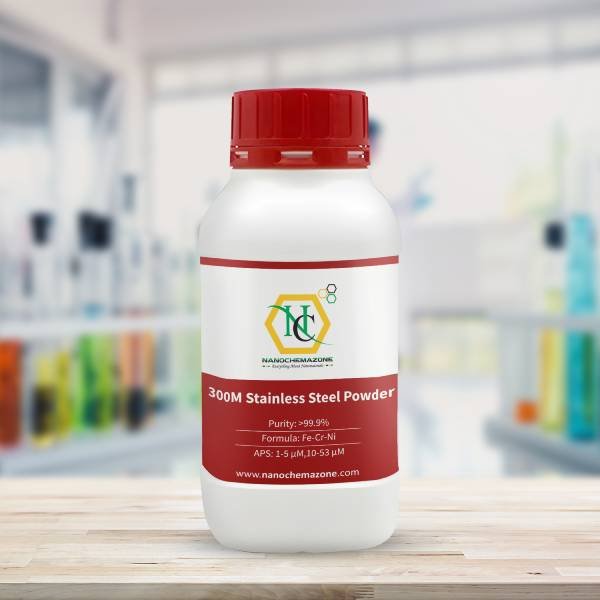
300M Stainless Steel Powder
300M Stainless Steel Powder
| Product | 300M Stainless Steel Powder |
| CAS No. | 12597-68-1 |
| Appearance | Fine Metallic Gray Powder |
| Purity | ≥99%, ≥99.9%, ≥95%(Other purities are also available) |
| APS | 1-5 µM, 10-53 µM (Can be customized), Ask for other available size range. |
| Ingredient | Fe-Cr-Ni |
| Density | 7.9g/cm3 |
| Molecular Weight | N/A |
| Product Codes | NCZ-DCY-168/25 |
300M Stainless Steel Description:
300M Stainless Steel Powder is one of the numerous advanced ceramic materials manufactured by Nanochemazone. Nanochemazone produces too many standard grades when applicable, including Mil Spec (military grade); ACS, Reagent and Technical Grade; Food, Agricultural and Pharmaceutical Grade; Optical Grade, USP and EP/BP (European Pharmacopoeia/British Pharmacopoeia) and follows applicable ASTM testing standards. Typical and custom packaging is available. Additional technical, research and safety (MSDS) information are available. Please request a quote above for more information on lead time and pricing
300M Stainless Steel Powder Related Information :
Storage Conditions:
Airtight sealed, avoid light and keep dry at room temperature.
Please contact us for customization and price inquiry
Email: contact@nanochemazone.com
Note: We supply different size ranges of Nano and micron as per the client’s requirements and also accept customization in various parameters.
300M Stainless Steel Powder
300M stainless steel powder is a specialized material used in powder metallurgy and additive manufacturing applications. This high-alloy austenitic stainless steel exhibits excellent corrosion resistance and high strength properties.
300M powder can be used to create complex metal components using advanced manufacturing techniques like selective laser sintering (SLS), direct metal laser sintering (DMLS), and binder jetting. The fine spherical powders spread easily and sinter uniformly, producing dense parts
300M has a high nickel and chromium content which gives it excellent corrosion resistance comparable to 304 and 316 stainless steel. The composition is controlled within narrow ranges as shown below:
300M Stainless Steel Powder Composition
| Element | Composition Range |
| Carbon (C) | 0.05% max |
| Silicon (Si) | 1.0% max |
| Manganese (Mn) | 2.0% max |
| Phosphorus (P) | 0.03% max |
| Sulfur (S) | 0.01% max |
| Chromium (Cr) | 24.0-26.0% |
| Nickel (Ni) | 19.0-22.0% |
| Molybdenum (Mo) | 4.0-5.0% |
| Nitrogen (N) | 0.10-0.16% |
| Iron (Fe) | Balance |
The key alloying elements like chromium, nickel, and molybdenum give 300M stainless its unique properties. The high chromium content provides excellent corrosion and oxidation resistance. Nickel further enhances this by making the steel more resistant to reducing acids. Molybdenum improves pitting and crevice corrosion resistance in chlorides.
Nitrogen is also added to stabilize the austenitic structure and increase strength through solid solution strengthening. Carbon is restricted to minimize carbide precipitation. The end result is a versatile corrosion resistant steel powder ideal for additive manufacturing.
300M Stainless Steel Powder Properties
300M stainless steel provides an excellent combination of high strength and good ductility along with outstanding corrosion resistance. Some key properties are outlined below:
300M Stainless Steel Powder Properties
| Property | Value |
| Density | 7.9 g/cm3 |
| Melting Point | 1370°C (2500°F) |
| Thermal Conductivity | 12 W/m-K |
| Electrical Resistivity | 72 μΩ-cm |
| Modulus of Elasticity | 200 GPa |
| Poisson’s Ratio | 0.29 |
| Tensile Strength | 165ksi (1140 MPa) |
| Yield Strength | 140ksi (965 MPa) |
| Elongation | 35% |
The austenitic structure gives 300M enhanced toughness and ductility compared to martensitic grades. It also makes the steel non-magnetic. The material has good strength up to 600°C and can be used at cryogenic temperatures. Corrosion resistance is comparable to 316L grade. Wear resistance is lower than martensitic grades but machinability is excellent.
Overall, 300M offers an exceptional balance of strength, ductility, fracture toughness, and corrosion resistance making it suitable for demanding additive manufacturing applications across industries like aerospace, chemical processing, oil & gas, etc.
300M Stainless Steel Powder Applications
| Industry | Common Applications |
| Aerospace | Engine components, structural parts, landing gear |
| Automotive | Valve bodies, pump parts, turbocharger components |
| Medical | Implants, prosthetics, surgical instruments |
| Chemical | Pumps, valves, pipe fittings |
| Oil & Gas | Downhole tools, wellhead parts, offshore components |
| Industrial | Food processing equipment, press plates, dies and molds |
| Consumer | Watch cases, jewelry, decorative artware |
The excellent corrosion resistance allows 300M to withstand harsh operating environments in industries like oil & gas, chemical processing, pollution control, etc. where parts are exposed to acids, alkalis, salts, or chlorides.
In aerospace applications, it offers high strength for weight reduction combined with good creep and fatigue resistance at elevated temperatures. The austenitic structure gives excellent fracture toughness.
In medical uses like implants and surgical tools, the good biocompatibility and high strength of 300M stainless are advantageous. For consumer products, the attractive appearance and ability to polish to a mirror finish make it suitable for decorative applications.
Additive manufacturing enables producing components with complex geometries and internal features which are not possible with conventional fabrication routes. This expands the design freedom and range of applications for 300M stainless steel powder.
300M Stainless Steel Powder Specifications
300M powder is commercially available in different size ranges, morphologies, and blends tailored for various additive manufacturing processes. Some key specifications are provided below:
300M Stainless Steel Powder Specifications
| Parameter | Typical Values |
| Particle shape | Spherical, satellite, irregular |
| Particle size | 15-45 μm, 15-53 μm, 53-150 μm |
| Apparent density | 2.5-4.5 g/cm3 |
| Tap density | 3.5-4.5 g/cm3 |
| Flow rate | 15-25 s/50g |
| Carbon content | < 0.05 wt% |
| Oxygen content | < 0.15 wt% |
| Nitrogen content | 0.10-0.16 wt% |
| Hydrogen content | < 0.0015 wt% |
Spherical powders spread easily and have good flowability for uniform layer deposition. They are ideal for SLS/DMLS processes.
Irregular and satellite morphologies provide better packing density for binder jetting.
Smaller particle sizes (~20 μm) are preferred for better resolution and surface finish.
Larger sizes (~45-150 μm) improve powder flow and reduce recoater jamming.
chemistry, especially of interstitial elements like C, N, O, H is controlled to avoid vaporization and porosity issues during printing.
Gases like nitrogen and argon may be used during atomization to minimize oxidation and hydrogen pickup. Alloying elements are adjusted to compensate for vapor losses during processing.
300M Stainless Steel Powder Handling
300M powder should be handled with care to avoid contamination or mixing with other materials. Some guidelines are provided below:
300M Stainless Steel Powder Handling
Store unopened containers in a dry, inert environment to prevent oxidation and moisture pickup
Open containers inside gloveboxes filled with argon to prevent air exposure
Use tools and containers dedicated only for 300M to prevent cross-contamination
Avoid contact with iron or carbon to prevent composition changes
Measure powder weight accurately before reuse to control blend ratios
Sieve powders before reuse to break up agglomerates and remove large particles
Do not pour powder directly back into the main container to prevent mixing of new and used powder
Clean equipment thoroughly between handling batches to prevent cross-contamination
Proper handling and storage helps maintain the powder composition, morphology, flowability and reuse properties. Contamination can negatively impact material properties or cause printing defects.
300M Stainless Steel Powder Storage
300M powder should be stored in the following conditions:
300M Stainless Steel Powder Storage
Store in original sealed containers until ready to use
Use inert gas sealing or vacuum packaging for long-term storage
Store in a cool, dry location away from direct sunlight
Ambient temperatures between 10-25°C are ideal for storage
Avoid temperature swings and humidity which can cause condensation
Use desiccant bags when opening containers to absorb moisture
Limit storage time to 6-12 months for pre-alloyed powders to avoid oxidation
Rotate stock using a first-in-first-out (FIFO) system
Proper storage is crucial to prevent powder degradation over time by moisture, oxygen, or other environmental factors. Follow the manufacturer’s recommendations for maximum shelf life.
300M Stainless Steel Powder Safety
300M powder requires handling precautions similar to other fine stainless steel powders:
300M Stainless Steel Powder Safety
Use appropriate PPE during handling – gloves, respirators, eye protection
Avoid breathing powder dust – use ventilation and masks
Avoid skin contact to prevent sensitization – use gloves
Use spark-proof tools and vacuum systems designed for combustible dust
Inert gas gloveboxes provide protection during handling
Explosion proof lighting and electrical equipment are recommended
Follow SDS precautions and wear PPE mentioned during processing
Maintain cleanliness to avoid particle accumulation and minimize risks
Use dust collection systems and housekeeping procedures to lower combustible dust hazards
Finely divided powders pose risks like sensitization from prolonged exposure and explosion hazards from dust accumulation. Awareness, training, and safe practices are essential.
300M Stainless Steel Powder Printing
300M requires optimized printing parameters tailored for the alloy:
300M Stainless Steel Printing Parameters
Laser power/energy density: 150-220 W, 50-90 J/mm3
Scan speeds: 600-1200 mm/s
Hatch spacing: 80-120 μm
Layer thickness: 20-50 μm
Counterflow argon is preferred over nitrogen
Oxygen levels below 1000 ppm prevent oxidation
Preheating to 80-150°C reduces residual stresses
Stress relief heat treatments mandatory to prevent cracking
Key considerations include minimizing thermal stresses and avoiding hot cracking issues to achieve high density prints. Some degree of parameter tweaking is needed to optimize for specific printer models.
300M Stainless Steel Powder Post-Processing
Typical post-processing methods for 300M parts include:
300M Stainless Steel Part Post-Processing
Support removal using EDM or sand blasting
Stress relieving at 1065-1120°C for 1-2 hours to prevent cracking
Hot isostatic pressing (HIP) to eliminate internal voids and improve fatigue strength
Heat treatment at 900-950°C to adjust hardness/strength
Sanding, bead blasting, grinding, polishing to improve surface finish
Passivation in nitric acid for removing heat tint and enhancing corrosion resistance
Shot peening to induce compressive stresses and improve fatigue life
Coatings like PVD, CVD can provide wear/corrosion resistance or unique appearances
Multi-step finishing is often necessary to achieve the desired material properties, dimensional accuracy, surface quality, and aesthetics. The process depends on application requirements.
300M Stainless Steel Powder Quality Control
Extensive testing should be performed to ensure powder and printed part quality:
300M Stainless Steel Powder Testing
Proper handling and storage helps maintain the powder composition, morphology, flowability and reuse properties. Contamination can negatively impact material properties or cause printing defects.
300M Stainless Steel Powder Storage
300M powder should be stored in the following conditions:
300M Stainless Steel Powder Storage
Store in original sealed containers until ready to use
Use inert gas sealing or vacuum packaging for long-term storage
Store in a cool, dry location away from direct sunlight
Ambient temperatures between 10-25°C are ideal for storage
Avoid temperature swings and humidity which can cause condensation
Use desiccant bags when opening containers to absorb moisture
Limit storage time to 6-12 months for pre-alloyed powders to avoid oxidation
Rotate stock using a first-in-first-out (FIFO) system
Proper storage is crucial to prevent powder degradation over time by moisture, oxygen, or other environmental factors. Follow the manufacturer’s recommendations for maximum shelf life.
300M Stainless Steel Powder Safety
300M powder requires handling precautions similar to other fine stainless steel powders:
300M Stainless Steel Powder Safety
Use appropriate PPE during handling – gloves, respirators, eye protection
Avoid breathing powder dust – use ventilation and mask
Avoid skin contact to prevent sensitization – use gloves
Use spark-proof tools and vacuum systems designed for combustible dust
Inert gas gloveboxes provide protection during handling
Explosion proof lighting and electrical equipment are recommended
Follow SDS precautions and wear PPE mentioned during processing
Maintain cleanliness to avoid particle accumulation and minimize risks
Use dust collection systems and housekeeping procedures to lower combustible dust hazards
Finely divided powders pose risks like sensitization from prolonged exposure and explosion hazards from dust accumulation. Awareness, training, and safe practices are essential.
300M Stainless Steel Powder Printing
300M requires optimized printing parameters tailored for the alloy:
300M Stainless Steel Printing Parameters
Laser power/energy density: 150-220 W, 50-90 J/mm3
Scan speeds: 600-1200 mm/s
Hatch spacing: 80-120 μm
Layer thickness: 20-50 μm
Counterflow argon is preferred over nitrogen
Oxygen levels below 1000 ppm prevent oxidation
Preheating to 80-150°C reduces residual stresses
Stress relief heat treatments mandatory to prevent cracking
Key considerations include minimizing thermal stresses and avoiding hot cracking issues to achieve high density prints. Some degree of parameter tweaking is needed to optimize for specific printer models.
300M Stainless Steel Powder Post-Processing
Typical post-processing methods for 300M parts include:
300M Stainless Steel Part Post-Processing
Support removal using EDM or sand blasting
Stress relieving at 1065-1120°C for 1-2 hours to prevent cracking
Hot isostatic pressing (HIP) to eliminate internal voids and improve fatigue strength
Heat treatment at 900-950°C to adjust hardness/strength
Sanding, bead blasting, grinding, polishing to improve surface finish
Passivation in nitric acid for removing heat tint and enhancing corrosion resistance
Shot peening to induce compressive stresses and improve fatigue life
Coatings like PVD, CVD can provide wear/corrosion resistance or unique appearances
Multi-step finishing is often necessary to achieve the desired material properties, dimensional accuracy, surface quality, and aesthetics. The process depends on application requirements.
300M Stainless Steel Powder Quality Control
Extensive testing should be performed to ensure powder and printed part quality:
300M Stainless Steel Powder Testing
| Proper handling and storage helps maintain the powder composition, morphology, flowability and reuse properties. Contamination can negatively impact material properties or cause printing defects. | Proper handling and storage helps maintain the powder composition, morphology, flowability and reuse properties. Contamination can negatively impact material properties or cause printing defects. |
| 300M Stainless Steel Powder Storage | 300M Stainless Steel Powder Storage |
| 300M powder should be stored in the following conditions: | 300M powder should be stored in the following conditions: |
| 300M Stainless Steel Powder Storage | 300M Stainless Steel Powder Storage |
| Store in original sealed containers until ready to use | Store in original sealed containers until ready to use |
| Use inert gas sealing or vacuum packaging for long-term storage | Use inert gas sealing or vacuum packaging for long-term storage |
| Store in a cool, dry location away from direct sunlight | Store in a cool, dry location away from direct sunlight |
300M Stainless Steel Part Testing
| Test | Details |
| Density | Archimedes’, Helium pycnometry |
| Surface roughness | Profilometer, interferometry |
| Hardness | Rockwell, Vickers, Brinell |
| Tensile strength | ASTM E8 |
| Microstructure | Optical microscopy, image analysis |
| Layer bonding | Electron microscopy, dye penetrant |
| Porosity | X-ray tomography, image analysis |
| Surface defects | Penetrant testing, microscopy |
Comprehensive testing as per industrial standards ensures consistent powder quality and printed part performance. It minimizes defects and prevents part failures in service.
Advantages of 300M Stainless Steel Powder
Some of the advantages of using 300M powder for additive manufacturing include:
Excellent corrosion resistance comparable to 316L stainless steel
High strength with good ductility and fracture toughness
Can be processed easily using laser powder bed fusion, binder jetting, etc.
Good dimensional accuracy and surface finish in printed parts
Performs well in harsh environments and at elevated temperatures
Can produce complex geometries not possible with conventional methods
Parts can be heat treated to tailor properties like hardness, strength, etc.
Offers design flexibility not limited by typical manufacturing constraints
Saves material, energy, and costs versus subtractive methods
Widely available from leading suppliers to ensure reliable material supply
The combination of outstanding material properties, advanced manufacturability, and customizability make 300M an ideal alloy for mission-critical AM components across industries.
Limitations of 300M Stainless Steel Powder
300M also has some limitations to consider:
More expensive than common alloys like 316L or 17-4PH stainless
Requires optimized processing parameters tailored for the alloy
Sensitive to contamination from improper powder handling
Need for hot isostatic pressing (HIP) to eliminate internal voids
Lower wear resistance than martensitic stainless steel powders
Requires post-processing and finishing operations
High thermal stresses can cause cracking; heat treatments mandatory
Oxidation and nitrogen absorption can occur during processing
Parts may require supports to avoid deformation during printing
Limited number of suppliers compared to more common alloys
The specialized composition, high cost, and need for controlled processing conditions limit its use to critical applications where performance justifies the higher cost.
300M vs 316L vs 17-4PH Stainless Steel Powder
How does 300M compare against other popular stainless steel powders like 316L and 17-4PH?
Comparison of Stainless Steel Powders
| Alloy | Composition | Properties | Applications |
| 300M | High Ni, Cr, Mo | Excellent corrosion resistance, good ductility and toughness, high strength to 600°C | Aerospace, oil & gas, chemical, high temp uses |
| 316L | Medium Ni, Cr | Excellent corrosion resistance, readily weldable, good bio-compatibility | Marine hardware, medical implants, food processing |
| 17-4PH | Medium Ni, Cr + Cu | High hardness and strength, good corrosion resistance, heat treatable | Aerospace, tooling, automotive, plastic molds |
300M provides the best combination of corrosion resistance and useful strength at elevated temperatures. 17-4PH is preferred for applications
300M stainless steel powder is a specialized material used in powder metallurgy and additive manufacturing applications. This high-alloy austenitic stainless steel exhibits excellent corrosion resistance and high strength properties.
300M powder can be used to create complex metal components using advanced manufacturing techniques like selective laser sintering (SLS), direct metal laser sintering (DMLS), and binder jetting. The fine spherical powders spread easily and sinter uniformly, producing dense parts.
Here is more content continuing the comparison between 300M, 316L, and 17-4PH stainless steel powders:
Detailed Comparison
300M has higher tensile strength than 316L and lower ductility. It maintains strength up to 600°C better than 316L.
2 316L has the best all-round corrosion resistance followed by 300M and 17-4PH. 300M resists pitting and crevice corrosion better than 316L.
17-4PH achieves the highest hardness after heat treatment but has lower toughness than 300M and 316L.
300M has higher nickel content than 316L and 17-4PH which improves corrosion resistance. 17-4PH contains copper for precipitation hardening.
300M is used in specialized applications requiring strength at elevated temperatures like aerospace components. 316L is widely used in corrosive environments across industries where high strength is not critical.
17-4PH suits applications requiring high hardness like molds, tooling, and wear-resistant parts for automotive and consumer uses.
300M and 17-4PH powders are more expensive than common 316L powder. 17-4PH is relatively easier to process by laser sintering than 300M.
All three are readily weldable grades in the annealed/solutionized condition. 17-4PH requires aging treatment after welding to restore properties.
300M requires stress relieving heat treatments after printing to prevent cracking. 17-4PH is typically H900 heat treated post-build for optimal properties.
In summary, 300M fills a niche between generalized corrosion resistance of 316L and high strength/hardness of martensitic 17-4PH. It provides the best elevated temperature properties crucial for aerospace applications.
300M Stainless Steel Powder Questions
Here are some common questions asked about 300M stainless steel powder:
300M Stainless Steel Powder FAQs
Q: What particle size is best for printing 300M stainless steel?
A: 15-45 microns is recommended for SLM/DMLS. Larger sizes 45-100 microns improve flowability but reduce resolution.
Q: What is the typical density achieved for 300M parts printed by laser powder bed fusion?
A: Printed density over 99% is achievable with optimized parameters. HIP helps eliminate internal voids.
Q: What is the typical surface roughness of as-printed 300M parts?
A: Around 10-15 microns Ra surface roughness is typical, which can be reduced to under 1 micron by polishing.
Q: Does 300M require any post-processing heat treatments?
A: Yes, stress-relieving at 1065-1120°C to prevent cracking followed by cooling at <50°C/hr is recommended.
Q: What are some typical applications of binder-jet printed 300M parts?
A: Tooling components, jigs, fixtures, plastic injection molds are common applications benefitting from the hardness and corrosion resistance.
Q: How should unused 300M powder be stored for reuse?
A: In a dry, inert atmosphere sealed container at 10-25°C for up to 1 year. Store away from iron contamination.
Q: Can you heat treat 300M to increase its hardness?
A: Yes, aging at 900-950°C can increase hardness up to 38 HRC similar to precipitation hardening grades.
This covers some key questions about 300M powder. Please reach out for any other specific queries.

304l Stainless Steel Powder
304l Stainless Steel Powder
| Product | 304l Stainless Steel Powder |
| CAS No. | 11143-21-4 |
| Appearance | Metallic Gray or Silver Powder |
| Purity | ≥99%, ≥99.9%, ≥95%(Other purities are also available) |
| APS | 1-5 µM, 10-53 µM (Can be customized), Ask for other available size range. |
| Ingredient | Fe-18Cr-8Ni |
| Density | 7.9g/cm3 |
| Molecular Weight | N/A |
| Product Codes | NCZ-DCY-338/25 |
304l Stainless Steel Description:
304l Stainless Steel Powder is one of the numerous advanced ceramic materials manufactured by Nanochemazone. Nanochemazone produces too many standard grades when applicable, including Mil Spec (military grade); ACS, Reagent and Technical Grade; Food, Agricultural and Pharmaceutical Grade; Optical Grade, USP and EP/BP (European Pharmacopoeia/British Pharmacopoeia) and follows applicable ASTM testing standards. Typical and custom packaging is available. Additional technical, research and safety (MSDS) information are available. Please request a quote above for more information on lead time and pricing.
304l Stainless Steel Powder Related Information :
Storage Conditions:
Airtight sealed, avoid light and keep dry at room temperature.
Please contact us for customization and price inquiry
Email: contact@nanochemazone.com
Note: We supply different size ranges of Nano and micron as per the client’s requirements and also accept customization in various parameters.
304l Stainless Steel Powder
304L stainless steel powder is an austenitic chromium-nickel stainless steel powder with low carbon content. It offers excellent corrosion resistance, good formability and weldability, and widely used for powder metallurgy applications. The ‘L’ denotes lower carbon compared to 304 standard grade. The low carbon minimizes carbide precipitation and maximizes corrosion resistance. Powder metallurgy 304L provides a cost-effective alternative to 316L for non-critical applications not needing molybdenum alloying.
Overview
304L stainless steel powder is an austenitic chromium-nickel stainless steel powder with low carbon content. It offers excellent corrosion resistance, good formability and weldability, and widely used for powder metallurgy applications.
The ‘L’ denotes lower carbon compared to 304 standard grade. The low carbon minimizes carbide precipitation and maximizes corrosion resistance. Powder metallurgy 304L provides a cost-effective alternative to 316L for non-critical applications not needing molybdenum alloying.
This article provides an in-depth look at 304L stainless steel powder covering composition, properties, processing, applications, specifications, suppliers, costs, and other technical details.
Composition
The nominal composition of 304L stainless steel powder is listed below:
Table: Typical composition of 304L stainless steel powder
| Element | Weight % |
| Chromium (Cr) | 18-20 |
| Nickel (Ni) | 8-10.5 |
| Manganese (Mn) | <2 |
| Silicon (Si) | <1 |
| Carbon (C) | <0.03 |
| Sulfur (S) | <0.03 |
| Phosphorus (P) | <0.045 |
| Nitrogen (N) | <0.1 |
| Iron (Fe) | Balance |
Chromium and nickel are the main alloying elements. Chromium provides corrosion and oxidation resistance. Nickel enhances ductility, toughness, and weldability.
Manganese and silicon increase strength. Carbon is kept very low for optimum corrosion resistance. Sulfur, phosphorus, and nitrogen are impurities that are minimized.
Properties
Key properties of 304L stainless steel powder in the annealed condition are provided below:
Table: Properties of 304L stainless steel powder
| Property | Value |
| Density | 7.9-8.1 g/cm3 |
| Ultimate Tensile Strength | 505-620 MPa |
| Yield Strength | 205-275 MPa |
| Elongation | ≥40% |
| Hardness | ≤92 HRB |
| Modulus of Elasticity | 190-210 GPa |
| Melting Point | 1400-1450°C |
| Thermal Conductivity | 16 W/m-K |
| Electrical Resistivity | 0.072 μΩ-cm |
The combination of properties make 304L highly useful for a wide range of applications. The austenitic microstructure provides ductility, toughness, and non-magnetic behavior. 304L has excellent corrosion resistance comparable to 316L stainless steel.
By selecting ultra-low carbon powder, carbide precipitation can be avoided to maximize corrosion resistance in critical applications. Strength and hardness can be increased through cold working.
Typical applications for 304L stainless steel powder include:
Food processing equipment
Pharmaceutical tooling
Chemical plant components
Architectural panels, railings
Medical instruments and implants
Marine hardware, fittings, fasteners
Consumer products, appliances
Powder metallurgy mechanical parts
3D printing powders
304L provides cost-effective corrosion resistance versus 316L when molybdenum alloying is not needed for highly corrosive environments. The excellent polishability and non-magnetic properties also suits 304L for architectural cladding and hardware components.
Powder metallurgy is commonly used to produce small precision parts from 304L at high volumes versus machining. Additive manufacturing utilizes 304L powder for prototypes, tooling, and end-use components across industries.
Powder Manufacturing
304L stainless steel powder is commercially manufactured via gas atomization or water atomization processes.
In gas atomization, a high pressure inert gas stream disintegrates the molten metal into fine droplets, producing spherical powders ideal for additive manufacturing and MIM. Particle size distribution is controlled through process parameters.
Water atomization uses high pressure water jets to break up the metal stream into fine particles. This generates irregular, satellite particle shapes. The powder requires post-treatment for additive manufacturing.
Plasma atomization is sometimes used to produce very spherical, clean powders from a metal plasma stream in a controlled inert atmosphere. This ensures high purity and flowability.
Powder Specifications
304L stainless steel powder is commercially available in various size ranges, morphologies, and quality levels. Some typical powder specifications are below:
Table: 304L stainless steel powder specifications
| Attribute | Details |
| Particles sizes | 15-45 μm, 10-100 μm |
| Morphology | Spherical, irregular |
| Apparent density | 2.5-4.5 g/cm3 |
| Tap density | 4-5 g/cm3 |
| Hall flow rate | <30 s/50g |
| Purity | >99.5% |
| Oxygen content | <2000 ppm |
| Moisture content | <0.2% |
Smaller particle sizes below 45 μm are preferred for capturing fine features in additive manufacturing. Spherical particles provide good flowability. Apparent density correlates with powder packing efficiency.
High purity, low oxygen, and controlled moisture levels ensure quality sintered properties. Gas atomized powder offers the best specifications for critical applications.
Standards and Grades
304L stainless steel powder complies with the following standards:
ASTM A240 – Standard for chromium and chromium-nickel stainless steel plate, sheet, and strip
ASTM A313 – Standard for stainless steel spring wire
ASTM A314 – Standard for stainless steel bent wire
AMS 5501 – Stainless steel bars, wire, forgings, tubing with low carbon
AMS 5647 – Stainless steel powder, atomized, 304L
Equivalent grades include:
UNS S30403
Werkstoff No. 1.4306
SUS 304L
SS2348
Powder Storage and Handling
To prevent contamination and maintain powder properties, 304L stainless steel powder should be stored and handled as follows:
Store in sealed containers in a cool, dry environment
Use inert gas purging or vacuum to prevent moisture pickup
Keep away from sparks, flames, and ignition sources
Ground all powder handling and transfer equipment
Avoid contact with contaminants like oil, grease, paints, etc.
Use PPE – mask, gloves, eye protection when handling powder
Powder spills should be promptly cleaned using non-sparking tools and HEPA vacuuming. Powders are moderately sensitive to moisture and air exposure. Proper storage is key.
Metal Injection Molding
304L is widely used for metal injection molding of small, complex parts leveraging powder metallurgy. Key considerations include:
Feedstock: 60-68% powder loading with multi-component binder system
Molding: High shot size, fast injection speed, high holding pressure
Debinding: Solvent debinding followed by thermal debinding
Sintering: 1350-1400°C in hydrogen or vacuum atmosphere
Secondary Operations: Machining, laser marking, passivation, electropolishing
MIM service bureaus have established best practices for high-performance 304L parts with as-sintered properties approaching wrought material.
Design for AM
For additive manufacturing using 304L stainless steel powder, key design guidelines include:
Maintain wall thicknesses above 1 mm
Use self-supporting geometries with angles above 45°
Include drain holes to remove unfused powder
Observe build orientation effects on properties
Account for 20-25% shrinkage when designing mating parts
Include machining allowances of 0.5-1 mm for critical fits
Reduce overhangs, bridges, fine details that require supports
Quality control testing performed on 304L stainless steel powder includes:
Chemical analysis – ICP and OES to verify composition
Particle size analysis – Laser diffraction particle size analyzer
Powder morphology – SEM imaging at high magnifications
Apparent density and tap density – Hall flowmeter method
Powder flow rate – Hall flowmeter funnel method
Loss on ignition – ASTM E sin gravity furnace
Moisture analysis – Karl Fischer titration, LECO analysis
For sintered MIM parts, testing includes:
Dimensional tolerances – CMM inspection
Density – Archimedes method
Microstructure – Optical microscopy, image analysis
Mechanical testing – Hardness, tensile, fatigue, Charpy impact
Like most stainless steel powders and parts, 304L poses little health risk with proper handling:
Wear PPE when handling powder – mask, gloves, goggles
Avoid skin contact to prevent sensitization
Use HEPA-filtered vacuum for clean-up of dust and powder
Avoid breathing any welding or melting fumes
Dispose according to local environmental regulations
Ensure adequate ventilation and respiratory protection if grinding or machining sintered parts
No special disposal precautions are needed for 304L. With sound procedures, it poses minimal hazard for workers and the environment.
FAQ
1.What is the difference between 304 and 304L stainless steel powder?
304L has lower carbon content (<0.03%) than 304 (<0.08%) for better corrosion resistance,especially for welding. 304 is more common.
2.Does 304L powder require a controlled atmosphere?
Not necessarily, but storage in sealed containers with inert gas prevents oxidation and contamination.
3.What particle size is best for AM?
15-45 microns is typical for powder bed fusion AM to provide good flow and high resolution. Larger sizes from 45-100 microns are also used.
4.Is 304L used for metal 3D printing?
Yes, 304L is widely used for powder bed and directed energy deposition 3D printing to make prototypes, tooling, and end-use parts.
5.What causes powder to oxidize and lose reusability?
Exposure to air/moisture causes surface oxidation. Proper sealed storage with desiccant and oxygen absorbers prevents this.
6.Does 304L require solution annealing after laser sintering?
Yes, stress relieving at 1050-1150°C and rapid cooling helps restore ductility and toughness after the rapid solidification.
7.What finish can be expected on as-sintered MIM 304L parts?
Around Ra 3-6 microns initially. Polishing and etching can achieve under 0.5 micron. Plating also gives a smooth finish.
8.What tolerance can be achieved with 304L MIM parts?±0.1-0.3% is typical but tolerances under ±0.1% are possible for high precision components.
9.Why is 304L preferred over 304 stainless steel?
The lower carbon gives 304L better corrosion resistance, especially for weldments, reducing sensitization. It has become the dominant grade.
10.What is the cost premium for 304L vs. 304 powder?
Typically 10-30% higher cost for 304L due to the lower carbon composition. Price also depends on quantities ordered.

A100 Steel Alloy Powder
A100 Steel Alloy Powder
| Product | A100 Steel Alloy Powder |
| CAS No. | 64742-9506 |
| Appearance | Colorless Powder |
| Purity | ≥99%, ≥99.9%, ≥95%(Other purities are also available) |
| APS | 1-5 µM, 10-53 µM (Can be customized), Ask for other available size range. |
| Ingredient | Fe-0.5C-1.5Ni-0.5Cr |
| Density | 0.87g/cm3 |
| Molecular Weight | N/A |
| Product Codes | NCZ-DCY-176/25 |
A100 Steel Alloy Description:
A100 Steel Alloy Powder is one of the numerous advanced ceramic materials manufactured by Nanochemazone. Nanochemazone produces too many standard grades when applicable, including Mil Spec (military grade); ACS, Reagent and Technical Grade; Food, Agricultural and Pharmaceutical Grade; Optical Grade, USP and EP/BP (European Pharmacopoeia/British Pharmacopoeia) and follows applicable ASTM testing standards. Typical and custom packaging is available. Additional technical, research and safety (MSDS) information are available. Please request a quote above for more information on lead time and pricing
A100 Steel Alloy Powder Related Information :
Storage Conditions:
Airtight sealed, avoid light and keep dry at room temperature.
Please contact us for customization and price inquiry
Email:contact@nanochemazone.com
Note: We supply different size ranges of Nano and micron as per the client’s requirements and also accept customization in various parameters.
A100 steel alloy powder
A100 steel alloy powder is a specialized form of steel that consists of a precise blend of iron and other alloying elements. It is manufactured by atomization, a process that involves rapidly solidifying molten metal into fine powder particles. This fine powder exhibits excellent flowability and can be easily consolidated into various shapes using powder metallurgy techniques.
Overview of A100 Steel Alloy Powder
A100 stainless steel contains high levels of nickel and manganese along with chromium, nitrogen and carbon to achieve outstanding low temperature toughness and ductility. It retains excellent impact strength and resistance to cryogenic embrittlement down to the temperature of liquid helium.
Key characteristics of A100 powder include:
Excellent low temperature toughness and ductility
High impact strength at cryogenic temperatures
Good strength and hardness at room temperature
Very good weldability and fabricability
Resistant to cryogenic embrittlement
Available in various particle size distributions
A100 powder is designed for applications requiring thermal stability and toughness at extremely low temperatures such as liquid natural gas storage and transportation. This article provides a detailed overview of this alloy powder.
The typical composition of A100 powder is:
| Element | Weight % |
| Nickel (Ni) | 9-11% |
| Manganese (Mn) | 12-14% |
| Chromium (Cr) | 14-16% |
| Nitrogen (N) | 0.15-0.30% |
| Carbon (C) | 0.08% max |
| Silicon (Si) | 1% max |
| Iron (Fe) | Balance |
The key alloying elements like nickel, manganese, chromium along with nitrogen enable exceptional cryogenic temperature toughness and ductility in A100 steel.
Properties of A100 Powder
| Property | Value |
| Density | 7.9-8.1 g/cm3 |
| Melting Point | 1400-1450°C |
| Thermal Conductivity | 12 W/mK |
| Electrical Resistivity | 0.80 μΩ.cm |
| Young’s Modulus | 190-210 GPa |
| Poisson’s Ratio | 0.29-0.30 |
| Tensile Strength | 620 MPa |
| Yield Strength | 275 MPa |
| Elongation | 35-40% |
| Impact Strength | 50-120 J at -196°C |
A100 maintains excellent ductility and impact strength even at the temperature of liquid helium making it suitable for the most demanding cryogenic applications.
A100 powder can be produced via:
Gas Atomization – High pressure inert gas used to atomize the molten alloy resulting in fine spherical powder ideal for AM.
Water Atomization – High velocity water jet breaks up the molten stream into irregular powder particles. Lower cost but higher oxygen pickup.
Mechanical Alloying – Ball milling of blended elemental powders followed by sintering and secondary atomization.
Gas atomization allows excellent control over particle size distribution, shape, oxygen pickup and micro cleanliness.
Applications of A100 Powder
Additive Manufacturing – Used in laser powder bed fusion and binder jetting for cryogenic parts like valve bodies, pump components, storage tanks etc.
Metal Injection Molding – To manufacture small, complex cryogenic parts needing high ductility and impact strength.
Thermal Spray Coatings – Wire arc spray deposition to produce coatings providing cryogenic resistance.
Cryogenic Vessels – Liners, fittings, fasteners, forged and cast parts for storage, transportation of liquefied natural gas.
Cryocoolers – Powder forged compressor parts, regenerator housings requiring high cryogenic toughness.
Specifications of A100 Powder
A100 powder is available under various size ranges, shapes and grades:
Particle Size: From 10-45 μm for AM methods, up to 150 μm for thermal spray processes.
Morphology: Spherical, irregular and blended shapes. Smooth spherical powder provides optimal flow and packing density.
Purity: From commercial to high purity grades based on application requirements.
Oxygen Content: Levels maintained below 2000 ppm for most applications.
Flow Rate: Powder customized for flow rates above 25 s/50 g.
Storage and Handling of A100 Powder
A100 powder requires controlled storage and handling:
Store in sealed containers under inert gas to prevent oxidation
Avoid accumulation of fine powder to minimize dust explosion risks
Use proper grounding, ventilation, PPE when handling powder
Prevent contact with moisture, acids, strong oxidizers
Follow recommended safety practices from supplier SDS
Inert gas glove box techniques are preferred when handling reactive alloy powders like A100.
Inspection and Testing of A100 Powder
Key quality control tests performed on A100 powder:
Chemical analysis using OES or XRF to ensure composition is within specified limits
Particle size distribution as per ASTM B822 standard
Morphology analysis through SEM imaging
Powder flow rate measured as per ASTM B213 standard
Density determination by helium pycnometry
Impurity testing by ICP-MS
Microstructure characterization by X-ray diffraction
Thorough testing ensures the powder meets the required chemical, physical and microstructural characteristics for cryogenic applications.
Comparison Between A100 and 304L Stainless Steel Powders
A100 and 304L stainless steel powders compared:
| Parameter | A100 | 304L |
| Type | Austenitic | Austenitic |
| Ni content | 9-11% | 8-12% |
| Low temperature toughness | Excellent | Poor |
| Corrosion resistance | Moderate | Excellent |
| Cost | Higher | Lower |
| Weldability | Very good | Excellent |
| Applications | Cryogenic parts | Automotive, appliances |
A100 offers exceptional low temperature toughness whereas 304L provides better overall corrosion resistance at lower cost.
A100 Powder FAQs
Q: How is A100 steel alloy powder produced?
A: A100 powder is commercially produced using gas atomization, water atomization and mechanical alloying followed by sintering. Gas atomization provides the best control of characteristics.
Q: What are the main applications of A100 powder?
A: The major applications include additive manufacturing, thermal spray coatings, metal injection molding, and powder metallurgy of cryogenic parts needing high ductility and impact strength at extremely low temperatures.
Q: What is the typical A100 powder size used for binder jetting AM?
A: For binder jetting process, the common A100 powder size range is 20-45 microns with spherical morphology to enable good powder packing and binder infiltration.
Q: Does A100 powder require any special handling precautions?
A: Yes, it is recommended to handle A100 powder carefully under controlled humidity and inert atmosphere using proper grounding, ventilation and PPE.
Q: Where can I purchase A100 powder suitable for cryogenic storage vessels?
A: For cryogenic applications needing high toughness, A100 powder can be purchased from leading manufacturers.
Al 2024 Powder
Al 2024 Powder
| Product | Al 2024 Powder |
| CAS No. | 7429-90-5 |
| Appearance | Silvery or Metallic Powder |
| Purity | ≥99%, ≥99.9%, ≥95%(Other purities are also available) |
| APS | 1-5 µM, 10-53 µM (Can be customized), Ask for other available size range. |
| Ingredient | Al-4.4Cu-1.5Mg-0.6Mn |
| Density | 2.78g/cm3 |
| Molecular Weight | 110-120g/mol |
| Product Codes | NCZ-DCY-178/25 |
Al 2024 Description:
Al 2024 Powder is one of the numerous advanced ceramic materials manufactured by Nanochemazone. Nanochemazone produces too many standard grades when applicable, including Mil Spec (military grade); ACS, Reagent and Technical Grade; Food, Agricultural and Pharmaceutical Grade; Optical Grade, USP and EP/BP (European Pharmacopoeia/British Pharmacopoeia) and follows applicable ASTM testing standards. Typical and custom packaging is available. Additional technical, research and safety (MSDS) information are available. Please request a quote above for more information on lead time and pricing
Al 2024 Powder Related Information :
Storage Conditions:
Airtight sealed, avoid light and keep dry at room temperature.
Please contact us for customization and price inquiry
Email: contact@nanochemazone.com
Note: We supply different size ranges of Nano and micron as per the client’s requirements and also accept customization in various parameters.
Al 2024 powder
Al 2024 powder is an aluminum alloy that primarily consists of aluminum, copper, and small amounts of magnesium and manganese. This alloy exhibits exceptional strength and excellent fatigue resistance, making it ideal for applications where lightweight materials with high mechanical properties are required. Al 2024 powder is commonly used in industries such as aerospace, automotive, and sporting goods.
Overview of Al 2024 Powder
Al 2024 is one of the most popular 2000 series wrought aluminum alloys known for its strength, fatigue resistance, and excellent machinability and corrosion resistance. The copper additions impart substantial strengthening through precipitation hardening while retaining formability and weldability.
Key characteristics of Al 2024 powder include:
High strength with moderate ductility and toughness
Excellent fatigue and fracture resistance
Very good machinability and polishability
Good weldability and formability
High thermal and electrical conductivity
Available in range of powder sizes and shapes
Al 2024 powder is suitable for aerospace components and other high-performance applications needing strength combined with fabrication capabilities.
Chemical Composition of Al 2024 Powder
| Element | Weight % |
| Aluminum (Al) | 90.7-94.7% |
| Copper (Cu) | 3.8-4.9% |
| Magnesium (Mg) | 1.2-1.8% |
| Manganese (Mn) | 0.3-0.9% |
| Iron (Fe) | 0-0.5% |
| Silicon (Si) | 0-0.5% |
| Zinc (Zn) | 0-0.25% |
| Chromium (Cr) | 0-0.1% |
| Titanium (Ti) | 0-0.15% |
Properties of Al 2024 Powder
| Property | Value |
| Density | 2.77 g/cm3 |
| Melting Point | 500-638°C |
| Thermal Conductivity | 121-190 W/mK |
| Electrical Conductivity | 26-35% IACS |
| Young’s Modulus | 73 GPa |
| Poisson’s Ratio | 0.33 |
| Tensile Strength | 400-500 MPa |
| Yield Strength | 290-385 MPa |
| Elongation | 8-20% |
| Hardness | 90-150 Vickers |
The copper additions result in substantial increase in strength while maintaining moderate ductility and excellent fatigue strength through precipitation hardening. It offers optimal combination of properties for high-performance applications.
Production Method for Al 2024 Powder
Commercial production methods for Al 2024 powder include:
Gas Atomization – Molten alloy stream disintegrated by high pressure inert gas jets into fine spherical powder. Controlled particle size distribution.
Water Atomization – High velocity water jet impacts and disintegrates molten metal stream to produce fine irregular powder.
Mechanical Alloying – Ball milling a mixture of aluminum and alloying element powders followed by cold compaction and sintering.
Electrolysis – Aluminum produced through electrolysis process and then alloyed and atomized.
Gas atomization provides the best control over particle characteristics like size, shape and microstructure.
Applications of Al 2024 Powder
Additive Manufacturing – Used in selective laser melting, direct metal laser sintering to produce complex aerospace and automotive components.
Metal Injection Molding – To manufacture small intricate parts with good mechanical properties and corrosion resistance.
Powder Metallurgy – Press and sinter process to create high performance automotive and machinery parts.
Thermal Spraying – Plasma or arc spraying to deposit protective Al 2024 coatings against wear and corrosion.
Welding Filler – Used as filler wire/rod for arc welding of aluminum alloys. Provides excellent weld strength.
Pyrotechnics – Added to pyrotechnic compositions as fuel due to flammability of aluminum.
Specifications of Al 2024 Powder
Al 2024 powder is available in different size ranges, shapes and grades including:
Particle Size: From 10 – 150 microns for AM, up to 300 microns for thermal spray processes.
Morphology: Spherical, granular, dendritic and irregular shaped particles. Smooth powder flows better.
Grades: Conforming to AMS 4255, ASTM B221, EN 573-3, ISO 209 specifications and other custom grades.
Purity: From commercial to high purity levels based on chemical composition and application needs.
Storage and Handling of Al 2024 Powder
Al 2024 powder requires careful storage and handling to prevent:
Oxidation and reaction with moisture
Dust explosions from ignition of fine powder
Inhalation related health problems
Safety practices recommended by supplier should be followed
Inert gas blanketing, proper grounding, ventilation, and PPE should be used when handling the powder.
Testing and Characterization Methods
Key test methods used for Al 2024 powder include:
Chemical analysis using OES or XRF spectroscopy
Particle size distribution as per ASTM B822 standard
Morphology analysis through scanning electron microscopy
Powder flow rate measurement using Hall flowmeter
Density measurement by helium pycnometry
Impurities testing by ICP-MS
Microstructure examination by X-ray diffraction
These tests ensure the powder meets the required chemistry, physical characteristics, and microstructure as per application needs.
Comparison Between Al 2024 and Al 7075 Powder
Al 2024 and Al 7075 are two high strength aluminum alloy powders compared:
| Parameter | Al 2024 | Al 7075 |
| Alloy type | Heat treatable | Heat treatable |
| Cu content | 3.8-4.9% | 1.2-2% |
| Zn content | 0-0.25% | 5.1-6.1% |
| Strength | High | Very high |
| Fracture toughness | Higher | Moderate |
| Corrosion resistance | Good | Moderate |
| Weldability | Fair | Poor |
| Cost | Lower | Higher |
Al 2024 offers better fabricability whereas Al 7075 provides very high strength after heat treatment. Al 2024 is more cost effective.
Al 2024 Powder FAQs
Q: How is Al 2024 powder produced?
A: Al 2024 powder is commercially produced using gas atomization, water atomization, mechanical alloying, and electrolysis techniques. Gas atomization offers the best control of particle size and morphology.
Q: What are the main applications of Al 2024 powder?
A: The major applications include additive manufacturing, thermal spraying, powder metallurgy, metal injection molding, welding filler, and pyrotechnic compositions where high strength and good corrosion resistance is required.
Q: What is the typical particle size used for Al 2024 powder in AM?
A: In most metal 3D printing processes, the ideal particle size range for Al 2024 powder is 15-45 microns with spherical morphology and good flow characteristics.
Q: Does Al 2024 powder require any special handling precautions?
A: Yes, it is recommended to handle fine aluminum powders under inert gases using proper grounding, ventilation and PPE to prevent risk of fires and explosions.
Q: Where can I buy Al 2024 powder suitable for aerospace components?
A: High purity gas atomized Al 2024 powders meeting aerospace requirements can be sourced from companies like Nanochemazone.

Al 7075 Powder
Al 7075 Powder
| Product | Al 7075 Powder |
| CAS No. | 7429-90-5 |
| Appearance | Gray Metallic Powder |
| Purity | ≥99%, ≥99.9%, ≥95%(Other purities are also available) |
| APS | 1-5 µM, 10-53 µM (Can be customized), Ask for other available size range. |
| Ingredient | Al-5.6Zn-2.5Mg-1.6Cu |
| Density | 2.81g/cm3 |
| Molecular Weight | 270g/mol |
| Product Codes | NCZ-DCY-179/25 |
Al 7075 Description:
Al 7075 Powder is one of the numerous advanced ceramic materials manufactured by Nanochemazone. Nanochemazone produces too many standard grades when applicable, including Mil Spec (military grade); ACS, Reagent and Technical Grade; Food, Agricultural and Pharmaceutical Grade; Optical Grade, USP and EP/BP (European Pharmacopoeia/British Pharmacopoeia) and follows applicable ASTM testing standards. Typical and custom packaging is available. Additional technical, research and safety (MSDS) information are available. Please request a quote above for more information on lead time and pricing
Al 7075 Powder Related Information :
Storage Conditions:
Airtight sealed, avoid light and keep dry at room temperature.
Please contact us for customization and price inquiry
Email: contact@nanochemazone.com
Note: We supply different size ranges of Nano and micron as per the client’s requirements and also accept customization in various parameters.
Al 7075 powder
Al 7075 powder is a high-strength aluminum alloy composed primarily of aluminum, zinc, copper, and small amounts of magnesium and chromium. It is renowned for its impressive mechanical properties, making it an ideal choice for applications that require strength, durability, and lightweight characteristics. Al 7075 powder is typically produced through a process called atomization, where molten aluminum is sprayed and solidified into fine powder particles.
Overview of Al 7075 Powder
Al 7075 is one of the highest strength 7000 series aluminum alloys, offering strength superior to many steels. Zinc is the main alloying addition while magnesium imparts strength through precipitation hardening.
Key properties of Al 7075 powder include:
Exceptionally high tensile and yield strength
High hardness and good fatigue strength
Good toughness and moderate ductility
Excellent finishing characteristics
High corrosion resistance
Available in range of powder sizes and shapes
Al 7075 powder is ideal for high-performance aerospace and defense components needing the optimal combination of strength, hardness, fatigue resistance, and moderate weldability.
Chemical Composition of Al 7075 Powder
| Element | Weight % |
| Aluminum (Al) | 87.1-91.4% |
| Zinc (Zn) | 5.1-6.1% |
| Magnesium (Mg) | 2.1-2.9% |
| Copper (Cu) | 1.2-2.0% |
| Iron (Fe) | 0-0.5% |
| Silicon (Si) | 0-0.4% |
| Manganese (Mn) | 0-0.3% |
| Chromium (Cr) | 0.18-0.28% |
| Titanium (Ti) | 0-0.2% |
Properties of Al 7075 Powder
| Property | Value |
| Density | 2.81 g/cm3 |
| Melting Point | 477–635°C |
| Thermal Conductivity | 130–210 W/mK |
| Electrical Conductivity | 22-30% IACS |
| Young’s Modulus | 71–72 GPa |
| Poisson’s Ratio | 0.33 |
| Tensile Strength | 570–635 MPa |
| Yield Strength | 505–570 MPa |
| Elongation | 7–10% |
| Hardness | 150–190 Brinell |
The zinc additions result in extremely high strength and hardness while maintaining reasonable ductility and toughness. The alloy has excellent finishing characteristics.
Production Method for Al 7075 Powder
Commercial production methods for Al 7075 powder include:
Gas Atomization – Molten alloy stream disintegrated by inert gas jets into fine spherical powder particles with controlled size distribution.
Water Atomization – High pressure water jet used to produce fine Al 7075 powders with irregular shape. Lower cost but higher oxygen pickup.
Mechanical Alloying – Ball milling a blend of aluminum and alloying element powders followed by cold compaction and sintering.
Gas atomization offers superior control over powder characteristics like particle size, shape and microstructure.
Applications of Al 7075 Powder
Additive Manufacturing – Used in selective laser melting, direct metal laser sintering to produce complex, lightweight aerospace and defense parts.
Metal Injection Molding – To manufacture small intricate components with high strength and moderate corrosion resistance.
Powder Metallurgy – Press and sinter process to create high-performance automotive parts and machinery components.
Thermal Spraying – Wire arc spraying to deposit very hard and wear resistant Al 7075 coatings.
Pyrotechnics – Added as fuel constituent in pyrotechnic compositions due to its high reactivity.
Welding Filler – Used as filler wire providing weld strength but limited weldability.
Specifications of Al 7075 Powder
Al 7075 powder is available in various size ranges, shapes, grades and purity levels:
Particle Size: From 10-45 microns for AM methods, up to 120 microns for thermal spray processes.
Morphology: Spherical, irregular and mixed particle shapes. Smooth spherical powder has better flowability.
Purity: From commercial to high purity grades tailored for the specific application.
Grades: Conforming to ASTM B951, AMS 4045, AMS 4282, EN 573-3 and other equivalent standards.
Oxygen Content: Varies between 500-1500 ppm based on production method. Lower is better.
Storage and Handling of Al 7075 Powder
Al 7075 reactive alloy powder must be handled with care to prevent:
Oxidation and reaction with moisture
Dust explosion hazards from fine powder
Inhalation related health problems
Safety practices recommended by supplier should be followed
Inert gas blanketing, proper grounding, ventilation, and PPE should be utilized for safe handling.
Testing and Characterization Methods
Key test methods used for Al 7075 powder include:
Chemical composition analysis using OES or XRF
Particle size distribution as per ASTM B822 standard
Morphology analysis through SEM
Powder flow rate using Hall flowmeter
Density measurement by helium pycnometry
Impurities testing by ICP-MS
Microstructure examination by X-ray diffraction
These tests ensure the powder meets the required chemical, physical, and microstructural characteristics for the specific application.
Comparison Between Al 7075 and Al 6061 Powder
| Parameter | Al 7075 | Al 6061 |
| Alloy type | Heat treatable | Heat treatable |
| Zn content | 5.1-6.1% | 0% |
| Mg content | 2.1-2.9% | 0.8-1.2% |
| Strength | Much higher | Moderate |
| Machinability | Poor | Excellent |
| Weldability | Poor | Very good |
| Corrosion resistance | Moderate | Excellent |
| Cost | Higher | Lower |
Al 7075 offers very high strength whereas Al 6061 provides better corrosion resistance, weldability and machinability at lower cost.
Al 7075 Powder FAQs
Q: How is Al 7075 powder produced?
A: Al 7075 powder is commercially produced using gas atomization, water atomization, mechanical alloying and electrolysis techniques. Gas atomization offers the best control of particle characteristics.
Q: What are the main applications for Al 7075 powder?
A: The major applications for Al 7075 are additive manufacturing, thermal spray coatings, powder metallurgy parts manufacturing, metal injection molding, and pyrotechnic compositions requiring exceptionally high strength.
Q: What is the recommended particle size for Al 7075 powder in AM?
A: For most metal 3D printing processes, the ideal particle size range for Al 7075 is 15-45 microns with spherical morphology and good powder flowability.
Q: Does Al 7075 powder require any special handling precautions?
A: Yes, it is recommended to handle reactive aluminum alloy powders carefully under inert atmosphere using proper grounding, ventilation and PPE.
Q: Where can I purchase ultrafine Al 7075 powder suitable for aerospace components?
A: High purity, gas atomized ultrafine Al 7075 powders meeting aerospace requirements can be sourced from leading supplier.

AlSi10Mg Powder
AlSi10Mg Powder
| Product | AlSi10Mg Powder |
| CAS No. | N/A |
| Appearance | Gray-Silver Metallic Powder |
| Purity | ≥99%, ≥99.9%, ≥95%(Other purities are also available) |
| APS | 1-5 µM, 10-53 µM (Can be customized), Ask for other available size range. |
| Ingredient | AlSi10Mg |
| Density | 1.2-1.5g/cm3 |
| Molecular Weight | N/A |
| Product Codes | NCZ-DCY-192/25 |
AlSi10Mg Description:
AlSi10Mg Powder is one of the numerous advanced ceramic materials manufactured by Nanochemazone. Nanochemazone produces too many standard grades when applicable, including Mil Spec (military grade); ACS, Reagent and Technical Grade; Food, Agricultural and Pharmaceutical Grade; Optical Grade, USP and EP/BP (European Pharmacopoeia/British Pharmacopoeia) and follows applicable ASTM testing standards. Typical and custom packaging is available. Additional technical, research and safety (MSDS) information are available. Please request a quote above for more information on lead time and pricing
ALSi10Mg Powder Related Information :
Storage Conditions:
Airtight sealed, avoid light and keep dry at room temperature.
Please contact us for customization and price inquiry
Email: contact@nanochemazone.com
Note: We supply different size ranges of Nano and micron as per the client’s requirements and also accept customization in various parameters.
mize health and safety risks.
AlSi10Mg powder
AlSi10Mg powder is a composite material composed of aluminum (Al), silicon (Si), and magnesium (Mg). It is specifically designed for use in additive manufacturing processes, where it is used as a feedstock material for 3D printers.
| Metal Powder | Size | Quantity | Price/kg | Size | Quantity | Price/kg |
| AlSi10Mg | 15-45μm | 1KG | 70 | 15-53μm | 1KG | 51 |
| 10KG | 42 | 10KG | 33 | |||
| 100KG | 34.6 | 100KG | 23.5 |
Overview of AlSi10Mg Powder
AlSi10Mg is an aluminum alloy powder composed primarily of aluminum along with silicon and magnesium as the major alloying elements. It is widely used in metal additive manufacturing, also known as 3D printing, due to its excellent strength, durability, weldability, and corrosion resistance.
AlSi10Mg powder can be processed through selective laser melting (SLM), electron beam melting (EBM), and direct metal laser sintering (DMLS) to create complex metal parts with fine details and custom geometries. Its properties make it suitable for aerospace, automotive, medical, and industrial applications.
This article provides a comprehensive technical overview of AlSi10Mg powder covering its composition, properties, applications, pricing, suppliers, and other key information for materials engineers, product designers, and 3D printing professionals.
Composition: Aluminum with 9-11% silicon, 0.2-0.45% magnesium
Particle shape: Spherical, high flowability
Size range: 15-45 microns
Density: 2.67 g/cc
Melting point: ~615°C
Strength: Medium to high
Uses: Aerospace, automotive, industrial 3D printing
Composition of AlSi10Mg Powder
The composition of AlSi10Mg powder consists mainly of aluminum with additions of silicon and magnesium as alloying elements. The nominal composition range is provided below:
| Element | Weight % |
| Aluminum (Al) | Base/remainder |
| Silicon (Si) | 9-11% |
| Magnesium (Mg) | 0.2-0.45% |
| Other (Fe, Mn, etc.) | < 0.55% total |
Silicon is added to aluminum to improve castability and enhance mechanical properties like yield strength and hardness. It increases fluidity during melting and improves feeding characteristics.
The addition of magnesium results in precipitation hardening which strengthens the alloy through heat treatment. Magnesium also improves corrosion resistance.
Trace amounts of iron, manganese, and other elements may be present as impurities up to 0.55% maximum. The levels of alloying additions can be varied within range to tailor the properties as per application requirements.
Nominal composition range of AlSi10Mg alloy powder
| Element | Minimum wt% | Maximum wt% |
| Aluminum | Bal. | Bal. |
| Silicon | 9 | 11 |
| Magnesium | 0.2 | 0.45 |
| Other | – | 0.55 |
Properties of AlSi10Mg Powder
AlSi10Mg exhibits properties making it suitable for demanding applications across aerospace, automotive, and industrial sectors. The key properties are highlighted below:
Mechanical Properties
High strength and hardness
Good ductility in annealed state
Excellent weldability
High fatigue strength
Physical Properties
Density: 2.67 g/cc
Melting point: ~615°C
Thermal conductivity: 130 W/m-K
Coefficient of thermal expansion: 21-24 x 10^-6 K^-1
Other
Good corrosion resistance
Excellent printability and surface finish
Biocompatible per ISO 10993 and ASTM F67
Non-magnetic
The density is comparable to aluminum alloys like AlSi12 and AlSi7Mg. The melting point is also similar to standard Al-Si casting alloys. These properties allow processing and consolidation via sintering and melting.
Overview of key properties of AlSi10Mg powder
| Property | Typical Values |
| Density | 2.67 g/cc |
| Melting Point | ~615°C |
| Thermal Conductivity | 130 W/m-K |
| Electrical Resistivity | 4-8 x 10^-8 Ωm |
| Young’s Modulus | 70-80 GPa |
| Poisson’s Ratio | 0.33 |
| Yield Strength | 215-365 MPa |
| Tensile Strength | 330-430 MPa |
| Elongation | 8-10% |
| Hardness | 80-100 Brinell |
Note: Properties depend on precise composition, manufacturing method, build orientation, heat treatment etc. Values shown are typical or standard.
The mechanical properties like high yield and tensile strength along with good ductility make AlSi10Mg suitable for high-performance parts across industries. The alloy can be age hardened to further enhance strength. Excellent corrosion resistance is achieved by silicon additions creating a protective oxide layer. Overall, AlSi10Mg provides a versatile combination of properties for metal AM.
Applications of AlSi10Mg Powder
The lightweight, strong, and printable characteristics of AlSi10Mg powder make it one of the most widely used alloys in additive manufacturing. Some typical applications include:
Aerospace: Turbine blades, rocket nozzles, structural brackets, satellite components, UAV parts
Automotive: Powertrain parts, pistons, turbochargers, heat exchangers
Industrial: Robotics, tooling, jigs and fixtures, driveshafts
Medical: Orthopedic implants, prosthetics, surgical instruments
Other: Heat sinks, hydraulic manifolds, housings, cooling channels
AlSi10Mg enables complex, optimized geometries that improve performance and efficiency in the above applications. The fine structures possible via 3D printing enhances heat transfer, fluid flow, and other properties.
The excellent strength-to-weight ratio of AlSi10Mg reduces component weight while maintaining mechanical performance. This helps improve fuel economy in vehicles and lower launch costs in space applications.
Overview of AlSi10Mg applications across industries
| Sector | Typical Applications |
| Aerospace | Turbine blades, structural brackets, rocket nozzles, satellites |
| Automotive | Powertrain, pistons, turbochargers, heat exchangers |
| Industrial | Robotics, tooling, jigs and fixtures |
| Medical | Orthopedic implants, prosthetics |
| General | Heat sinks, hydraulic manifolds, housings |
AlSi10Mg is certified for aerospace applications meeting standards like AMS4967 and AMS4169. Extensive qualifications and testing validates its performance under extreme environments. The biocompatibility per ISO 10993 and ASTM F67 allows use in medical devices and implants. Overall, AlSi10Mg provides a versatile lightweight material solution for critical applications.
Processability of AlSi10Mg Powder
AlSi10Mg powder can be processed via major metal additive manufacturing methods like:
Selective Laser Melting (SLM)
Direct Metal Laser Sintering (DMLS)
Electron Beam Melting (EBM)
Laser-based Methods: SLM and DMLS use a high power laser to selectively fuse regions of a powder bed to build up parts layer-by-layer. The consolidated material has properties comparable to conventional aluminum alloys. SLM typically uses higher laser power for full melting. DMLS has lower power for sintering powder particles.
Electron Beam Melting: EBM uses an electron beam as heat source to melt and fuse material. It can achieve higher build rates than laser processes since it fuses each layer rapidly. Material properties are similar to SLM and DMLS.
Print Parameters: Typical SLM parameters – Laser power 175-350 W, Scan speed 700-1500 mm/s, Layer thickness 20-100 μm. For EBM – Beam power 3-7 kW, Scan speed 1000-2500 mm/s, Layer thickness 50-200 μm.
Other methods: AlSi10Mg powder can also be used in binder jetting where a liquid binder is selectively deposited to form the shape. The “green” part is then sintered. Cold spray deposition is also possible.
AM processes compatible with AlSi10Mg alloy powder
| Process | Heat Source | Description |
| SLM | Laser | Selective laser melting |
| DMLS | Laser | Direct metal laser sintering |
| EBM | Electron beam | Electron beam melting |
| Binder jetting | Liquid binder | Binder printed, then sintered |
| Cold spray | Kinetic | Powder sprayed onto substrate |
AlSi10Mg powder has high absorbance to the laser/electron beam, and excellent flow and packing density. This results in good spreadability across powder bed and efficient melting/sintering. The particle size and spherical morphology also plays a key role.
Overall, AlSi10Mg offers excellent processability across PBF and related methods to fabricate complex geometries with good surface finish and feature resolution.
Powder Characteristics and Quality
AlSi10Mg powder used in AM processes exhibits the following characteristics:
Spherical powder morphology with smooth surface
Flowability with minimal agglomeration
Apparent density ~1.2-1.6 g/cc
Tap density ~2.2-2.7 g/cc
Uniform composition distribution
High purity with low internal porosity
Controlled particle size distribution
Particle shape: Spherical powder morphology provides good flow and spreadability across the powder bed. It results in uniform melting and material properties. Gas atomization is commonly used to achieve sphericity >90%.
Flowability: Powders with high flowability spread evenly and pack densely on powder bed platforms. Flow rates of 23-27 s/50g through Hall funnel are typical.
Particle size: The particle size distribution is generally 10-45 μm or 15-45 μm. Larger particles ~35-45 μm improve flow while smaller ones ~15-25 μm enhance density and resolution.
Composition control: Tight control of composition within specification maximizes material performance. Uniform distribution of alloying elements is ensured.
Purity: High purity with low porosity and inclusions prevents process defects. Oxygen content <1000 ppm.
Typical characteristics and properties of AlSi10Mg powders
| Parameter | Typical Value | Role |
| Particle shape | Spherical >90% | Flowability, density |
| Particle size (μm) | 15-45 | Density, resolution |
| Flow rate (s/50g) | 23-27 | Powder bed packing |
| Apparent density (g/cc) | 1.2-1.6 | Recyclability |
| Tap density (g/cc) | 2.2-2.7 | Green density |
| Purity | >99.5% | Defect reduction |
| Oxygen (ppm) | <1000 | Clean melting |
Parameters like particle shape distribution (PSD) and Hausner ratio indicate powder quality. Strict control over gas atomization results in high batch-to-batch consistency. Powder is supplied with composition report and lot-specific certificates of analysis (COA).
Choosing AlSi10Mg Powder
Key considerations for choosing AlSi10Mg powder include:
Application requirements: Performance needs like strength, hardness, ductility, fatigue life, etc. Applications may demand specific material certifications also.
AM process variables: Matching particle size range, shape and distribution to the printer model, layer thickness, beam power and related parameters.
Quality and consistency: Powder batches that reliably meet composition, purity, particle characteristics etc. are critical for production use.
Availability and lead times: For prototype work availability of small quantities may be key while production needs bulk orders and stable long-term supply.
Pricing: Price per kg will depend on quantity, shipment costs, supplier margins etc. Large OEM contracts get better pricing.
Technical support: Manufacturers with strong technical expertise in metal powder production and AM can provide guidance on best powder options.
Working with established suppliers and collaborating early in the AM part design process is advised when selecting AlSi10Mg powder.
Pros and Cons of AlSi10Mg Powder
Pros
High strength with good ductility
Excellent corrosion resistance
Readily weldable and machinable
Good thermal properties
Widely qualified for aerospace use
Biocompatible for medical implants
Cons
Lower yield strength than AlSi7Mg and AlSi12 alloys
Susceptible to porosity defects during printing
High reflectivity demands higher laser power
Not optimal for high temperature applications >150°C
More expensive than unalloyed aluminum powders
FAQs
- What is the chemical composition of AlSi10Mg powder?
- The typical composition is aluminum base with 9-11% silicon and 0.2-0.45% magnesium. Remaining is other trace elements at <0.55% total.
- What is the density of AlSi10Mg and AlSi10Mg powder?
- The density is around 2.67 g/cc for both the bulk alloy and the powder form.
- What are the mechanical properties of AlSi10Mg parts made by AM?
- Printed AlSi10Mg has a tensile strength of 330-430 MPa, yield strength of 215-365 MPa, and elongation of 8-10% in the as-built condition. Heat treatment can further improve properties.
- What particle size is recommended for AlSi10Mg powder in AM?
- A particle size range of 15-45 microns is commonly used, though size distributions can be optimized for specific printers and layer thickness requirements.
- Can you machine/weld AlSi10Mg AM parts?
- Yes, AlSi10Mg parts made by 3D printing can be machined and welded via conventional methods after an appropriate stress relief heat treatment.
- Is AlSi10Mg powder reusable?
- AlSi10Mg powder can typically be recycled 5-10 times before a refresh is needed, depending on AM process and contamination levels.

AlSi50 Powder
AlSi50 Powder
| Product | AlSi50 Powder |
| CAS No. | 11145-27-0 |
| Appearance | Gray Metallic Powder |
| Purity | ≥99%, ≥99.9%, ≥95%(Other purities are also available) |
| APS | 1-5 µM, 10-53 µM (Can be customized), Ask for other available size range. |
| Ingredient | AlSi |
| Density | 2.5-2-7g/cm3 |
| Molecular Weight | N/A |
| Product Codes | NCZ-DCY-194/25 |
AlSi50 Description:
AlSi50 Powder is one of the numerous advanced ceramic materials manufactured by Nanochemazone. Nanochemazone produces too many standard grades when applicable, including Mil Spec (military grade); ACS, Reagent and Technical Grade; Food, Agricultural and Pharmaceutical Grade; Optical Grade, USP and EP/BP (European Pharmacopoeia/British Pharmacopoeia) and follows applicable ASTM testing standards. Typical and custom packaging is available. Additional technical, research and safety (MSDS) information are available. Please request a quote above for more information on lead time and pricing
AlSi50 Powder Related Information :
Storage Conditions:
Airtight sealed, avoid light and keep dry at room temperature.
Please contact us for customization and price inquiry
Email: contact@nanochemazone.com
Note: We supply different size ranges of Nano and micron as per the client’s requirements and also accept customization in various parameters.
AlSi50 Powder
AlSi50 is an aluminum-silicon alloy powder containing 50% silicon and remainder aluminum. It offers an exceptional combination of properties like low density, high fluidity, low thermal expansion, high specific strength, and corrosion resistance.
AlSi50 is an aluminum-silicon alloy powder containing 50% silicon and remainder aluminum. It offers an exceptional combination of properties like low density, high fluidity, low thermal expansion, high specific strength, and corrosion resistance.
AlSi50 Powder Composition
The typical composition of AlSi50 alloy powder is:
| Element | Composition |
| Aluminum (Al) | Balance |
| Silicon (Si) | 48-52% |
Aluminum forms the matrix providing ductility, toughness and corrosion resistance.
Silicon increases hardness, fluidity and reduces the coefficient of thermal expansion.
The high 50% silicon content results in a eutectic composition with the lowest possible melting point and excellent castability. Strict control of the Al to Si ratio is critical.
Properties of AlSi50 Powder
AlSi50 powder possesses a unique mix of properties making it suitable for high performance applications:
| Property | Value |
| Density | 2.55 g/cm3 |
| Melting Point | 577°C |
| Ultimate Tensile Strength | 200-300 MPa |
| Elongation | <1% |
| Hardness | 100-120 HB |
| Thermal Conductivity | 50-90 W/m-K |
| CTE | 12-15 x 10<sup>-6</sup>/°C |
| Young’s Modulus | 80-90 GPa |
| Corrosion Resistance | Excellent |
Low density – Up to 40% lower than titanium alloys and steels.
High fluidity when molten – Enables excellent castability and mold filling.
High strength-to-weight ratio – Specific strength comparable to titanium alloys.
Low coefficient of thermal expansion – Dimensions remain stable over a wide temperature range.
Excellent corrosion resistance – Protective oxide layer prevents corrosion in most environments.
Good thermal conductivity – Twice that of titanium alloys allowing efficient heat dissipation.
This unique property profile makes AlSi50 suitable for applications where low mass, precision, stability, and strength are critical.
Applications of AlSi50 Powder
The key properties of AlSi50 powder make it ideal for:
| Applications | Benefits |
| Automotive components | Low density and excellent castability. |
| Aerospace parts | High specific strength, stable dimensions. |
| Electronic substrates | Thermal management, CTE match with ceramics. |
| Mirror blanks | Low density, machinability, stability. |
| Medical implants | Biocompatible, non-toxic, corrosion resistant. |
Automotive – Used in pistons, engine blocks, drivetrain parts to reduce weight and improve fuel efficiency.
Aerospace – Ideal for precision aerospace components like actuators and turbocharger wheels requiring highest strength-to-weight.
Electronics – Substrates for PCBs, IC packages to manage thermal loads while matching expansion behavior of ceramics.
Optics – Mirror blanks, telescopes benefit from high dimensional stability and machinability.
Medical – Excellent biocompatibility and corrosion resistance for implants like orthopedic devices.
AlSi50 Powder Specifications
AlSi50 powder is available in various size fractions, shapes, and purity levels:
| Parameter | Options |
| Particle size | 10 – 150 microns |
| Particle shape | Irregular, spherical |
| Apparent density | Up to 2.7 g/cm3 |
| Flow rate | Up to 25 s/50g |
| Purity | Up to 99.7% |
| Alloy variants | AlSi40, AlSi30 |
Smaller particles promote higher sintered density while large particles improve flowability.
Spherical morphology enhances powder flow compared to irregular particles.
Higher apparent density increases effective loading in composites manufacturing.
Faster flow rates improve ease of powder handling and processing.
High purity grades minimize contamination issues.
Aluminum-silicon alloys with 30-40% silicon also available.
Powder attributes can be customized based on specific application requirements and processing methods.
Consolidation Methods for AlSi50 Powder
AlSi50 powder can be transformed into full density components using techniques like:
| Method | Details |
| Additive manufacturing | Excellent geometric freedom for complex shapes. |
| Metal injection molding | High precision net shape capability. |
| Press and sinter | Economical for higher volume simpler shapes. |
| Casting | Leverages excellent fluidity and mold filling behavior. |
| Extrusion | For profiles, rods and tubes. |
Powder bed fusion AM techniques like selective laser melting are ideal for low volume complex parts.
Metal injection molding offers closest tolerances and surface finish.
Pressing followed by liquid phase sintering is commonly used but secondary processing needed.
Investment casting provides higher productivity for simpler geometries.
Extrusion is suitable for continuous production of bars, rods and tubes.
The consolidation method strongly influences final properties, microstructure and cost economics.
Heat Treatment of AlSi50 Parts
The following heat treatments can be used to modify AlSi50 properties:
| Heat Treatment | Details | Purpose |
| Solution heat treatment | 500-550°C, quench | Dissolve soluble phases |
| Artificial aging | 150-180°C, 5-10 hrs | Precipitation hardening |
| Stress relieving | 250°C, 2 hrs | Remove residual stresses |
Solution treatment dissolves silicon particles in the aluminum matrix followed by rapid cooling.
Subsequent aging causes silicon to re-precipitate as fine dispersoids imparting strengthening.
Low temperature stress relieving helps reduce residual stresses from prior shaping steps.
Proper heat treatment allows customizing the strength, hardness and ductility as per application requirements.
Comparison of AlSi50 Powder with Alternatives
Here is how AlSi50 compares to other eutectic aluminum-silicon alloys:
| Alloy | AlSi50 | AlSi40 | AlSi30 |
| Fluidity | Highest | High | Medium |
| Castability | Excellent | Very Good | Good |
| Hardness | High | Medium | Low |
| Strength | High | Medium | Low |
| Thermal Conductivity | Medium | High | Highest |
| CTE | Low | Medium | High |
| Cost | High | Medium | Low |
AlSi40 offers the best all-round combination of fluidity, strength and thermal conductivity.
AlSi30 provides highest thermal conductivity but lowest strength and fluidity.
AlSi50 has the highest fluidity, hardness and strength but lower thermal conductivity.
AlSi50 is preferred where maximum castability, dimensional stability, and high specific strength are critical.
Health and Safety Considerations for AlSi50 Powder
Like any metal powder, AlSi50 powder requires safe handling:
| Hazard | Precautions | PPE |
| Skin/eye contact | Avoid direct contact. Rinse if exposed. | Gloves, goggles |
| Inhalation | Avoid breathing dust. Ensure ventilation. | Respirator |
| Ingestion | Avoid hand-mouth transfer. Wash hands. | – |
| Fire | Use sand. Do not use water. | Protective gear |
Wear gloves, goggles, mask when handling powder.
Avoid skin contact. Wash after exposure.
Store in cool, dry place away from sparks, flames.
Ensure proper ventilation and dust collection.
Refer SDS and local regulations for complete guidelines.
With proper precautions and PPE, AlSi50 powder can be safely handled.
Inspection and Testing of AlSi50 Powder
To ensure quality specifications are met, AlSi50 powder should undergo:
| Parameter | Method | Specification |
| Chemical composition | OES, XRF, wet chemistry | Conformance to Al and Si content |
| Particle size distribution | Laser diffraction, sieving | D10, D50, D90 within range |
| Powder morphology | SEM imaging | Shape and flow characteristics |
| Apparent density | Hall flowmeter test | Minimum specified density |
| Flow rate | Hall flowmeter test | Maximum seconds for 50g flow |
| Impurity levels | ICP or LECO analysis | Low oxygen, moisture content |
Testing should be done periodically as per ASTM standards to ensure consistency in production quality and performance in end-use applications.
FAQs
- What is AlSi50 used for?
- AlSi50 is ideal for applications like automotive components, aerospace parts, and electronic substrates where low mass, dimensional stability, and high fluidity are critical.
- Does AlSi50 require heat treatment?
- Optional heat treatment including solutionizing and aging can be done to enhance strength by precipitating silicon particles in the microstructure.
- What methods can consolidate AlSi50 powder?
- AlSi50 powder can be consolidated to full density using metal injection molding, casting, additive manufacturing via SLM/EBM, extrusion, and sintering.
- Is AlSi50 readily weldable?
- AlSi50 has relatively poor weldability owing to high silicon content. Special filler material and techniques are required for welding this alloy.
- Is AlSi50 powder safe to handle?
- Like any fine metal powder, standard safety precautions must be taken when handling AlSi50 powder to minimize health and safety risks.

Reviews
There are no reviews yet.