


FeCoNiCrMo Powder
$0.00
FeCoNiCrMo Powder
| Product | FeCoCrNiMo Powder |
| CAS No. | N/A |
| Appearance | Metallic Gray Powder |
| Purity | ≥99%, ≥99.9%, ≥95%(Other purities are also available) |
| APS | 1-5 µM, 10-53 µM (Can be customized), Ask for other available size range. |
| Ingredient | Fe-Co-Ni-Cr-Mo |
| Density | 8.0-8.5g/mol |
| Molecular Weight | N/A |
| Product Codes | NCZ-DCY-226/25 |
FeCoNiCrMo Description:
FeCoNiCrMo Powder is one of the numerous advanced ceramic materials manufactured by Nanochemazone. Nanochemazone produces too many standard grades when applicable, including Mil Spec (military grade); ACS, Reagent and Technical Grade; Food, Agricultural and Pharmaceutical Grade; Optical Grade, USP and EP/BP (European Pharmacopoeia/British Pharmacopoeia) and follows applicable ASTM testing standards. Typical and custom packaging is available. Additional technical, research and safety (MSDS) information are available. Please request a quote above for more information on lead time and pricing
FeCoNiCrMo Powder Related Information :
Storage Conditions:
Airtight sealed, avoid light and keep dry at room temperature.
Please contact us for customization and price inquiry
Email: contact@nanochemazone.com
Note: We supply different size ranges of Nano and micron as per the client’s requirements and also accept customization in various parameters.
and micron as per the client’s requirements and also accept customization in various parameters.
FeCoNiCrMo Powder
FeCoNiCrMo powder is a complex alloy powder consisting of iron (Fe), cobalt (Co), nickel (Ni), chromium (Cr), and molybdenum (Mo). These elements work synergistically to create a powder with remarkable characteristics suitable for numerous applications.
Overview of FeCoNiCrMo Powder
FeCoNiCrMo belongs to a class of high temperature alloys exhibiting good mechanical properties, microstructural stability and environmental resistance at temperatures exceeding 750°C. Iron and cobalt provide strength. Nickel enhances ductility and toughness. Chromium imparts oxidation and corrosion resistance. Molybdenum further improves high temperature strength and creep resistance.
Key characteristics of FeCoNiCrMo powder include:
Excellent high temperature strength and creep resistance
Good fatigue strength and toughness
High hardness, wear resistance, and abrasion resistance
Outstanding corrosion and oxidation resistance
Available in various particle size distributions and morphologies
FeCoNiCrMo powder is designed for protective coatings, thermal spray, welding, additive manufacturing and other demanding high temperature applications.
Composition of FeCoNiCrMo Powder
FeCoNiCrMo powder has the following nominal composition:
| Element | Composition |
| Iron (Fe) | Balance |
| Cobalt (Co) | 35-50% |
| Nickel (Ni) | 10-30% |
| Chromium (Cr) | 8-12% |
| Molybdenum (Mo) | 1-3% |
| Carbon (C) | <0.5% |
| Silicon (Si) | <1.5% |
| Manganese (Mn) | <1% |
Properties of FeCoNiCrMo Powder
| Property | Value |
| Density | 8.0-8.5 g/cm3 |
| Melting Point | 1350-1450°C |
| Thermal Conductivity | 15-30 W/mK |
| Electrical Resistivity | 70-85 μΩ.cm |
| Young’s Modulus | 190-220 GPa |
| Poisson’s Ratio | 0.28-0.32 |
| Tensile Strength | 650-1200 MPa |
| Yield Strength | 450-900 MPa |
| Elongation | 15-30% |
| Hardness | 30-50 HRC |
The properties like high temperature strength, hardness, wear resistance, and corrosion resistance make it suitable for the most demanding applications.
Production Method for FeCoNiCrMo Powder
FeCoNiCrMo powder can be produced via:
Gas Atomization – High pressure inert gas used to atomize molten alloy resulting in fine spherical powder ideal for AM.
Water Atomization – High velocity water jet breaks up molten metal into fine irregular powder particles. Economical but higher oxygen pickup.
Mechanical Alloying – Ball milling of blended elemental powders followed by sintering and secondary atomization.
Gas atomization provides the best control over particle characteristics like size, shape, purity and microstructure.
Applications of FeCoNiCrMo Powder
Typical applications of FeCoNiCrMo powder include:
Thermal Spray Coatings – HVOF or plasma spraying to deposit thick wear and corrosion resistant coatings on valves, seals, bearings etc. operating at high temperatures.
Additive Manufacturing – Selective laser melting to produce complex components like turbine blades for extreme environments.
Welding Filler – Provides excellent elevated temperature strength, hardness and corrosion resistance in the weld zone.
Brazing Filler – Used to join components operating at very high temperatures requiring oxidation resistance.
Glass Processing – Powder metallurgy conveyor rolls with high temperature strength used in glass melting furnaces.
Specifications of FeCoNiCrMo Powder
FeCoNiCrMo powder is available under various size ranges, shapes, grades and purity levels:
Particle Size: From 15-45 μm for AM methods, up to 150 μm for thermal spray processes.
Morphology: Spherical, irregular and blended shapes. Spherical powder provides optimal flow and packing.
Purity: From commercial to ultra high purity levels based on stringent chemical analysis and application requirements.
Surface Area: Low surface area preferred to minimize oxidation during handling and storage.
Grades: Customized composition and powder characteristics tailored for application and processing method.
Storage and Handling of FeCoNiCrMo Powder
FeCoNiCrMo powder requires careful storage and handling:
Should be stored in sealed containers under inert gas to prevent oxidation
Avoid accumulation of fine powder to minimize explosion risks
Use proper PPE, ventilation, grounding and safety practices during handling
Prevent contact between powder and incompatible materials
Follow applicable safety guidelines from supplier SDS
Proper protective measures are essential when handling this reactive alloy powder.
Inspection and Testing of FeCoNiCrMo Powder
Key quality control tests performed on FeCoNiCrMo powder:
Chemical analysis using OES or XRF to ensure composition is within specified limits
Particle size distribution using laser diffraction as per ASTM B822 standard
Morphology analysis through SEM imaging
Powder flow rate measurement as per ASTM B213 standard
Density determination by helium pycnometry
Impurity testing using ICP-MS
Microstructural characterization by X-ray diffraction
Thorough testing verifies powder quality and consistency for the intended high temperature application.
Comparison Between FeCoNiCrMo and 316L Stainless Steel Powders
FeCoNiCrMo and 316L stainless steel powders compared:
| Parameter | FeCoNiCrMo | 316L SS |
| Composition | High-temp quinary alloy | Fe-Cr-Ni stainless alloy |
| Cost | Higher | Lower |
| High temperature strength | Far superior | Moderate |
| Corrosion resistance | Comparable | Better |
| Thermal conductivity | Higher | Lower |
| Workability | Moderate | Excellent |
| Applications | Thermal spray, AM | Automotive, construction |
FeCoNiCrMo offers much better high temperature strength whereas 316L provides good fabrication characteristics and corrosion resistance at lower cost.
FeCoNiCrMo Powder FAQs
Q: How is FeCoNiCrMo powder produced?
A: FeCoNiCrMo powder is commercially produced using gas atomization, water atomization and mechanical alloying followed by sintering. Gas atomization offers the best powder characteristics.
Q: What are the main applications for FeCoNiCrMo powder?
A: Main applications include thermal spray coatings, additive manufacturing, brazing filler material, powder metallurgy hot work tooling, glass processing equipment where high temperature strength and resistance is required.
Q: What is the recommended particle size for thermal spraying?
A: For most thermal spray processes, a particle size range of 45-150 microns is preferred for FeCoNiCrMo powder to maximize deposition efficiency and coating properties.
Q: Does FeCoNiCrMo powder require special handling precautions?
A: Yes, proper protective measures are essential when handling this reactive fine alloy powder including inert atmosphere, grounding, ventilation, PPE.
Q: Where can I purchase FeCoNiCrMo powder suitable for additive manufacturing?
A: For AM applications requiring high temperature strength, fine FeCoNiCrMo powder can be purchased from leading manufacturer.
Description
Note: For pricing & ordering information, please get in touch with us at sales@nanochemazone.com
Please contact us for quotes on Larger Quantities and customization. E-mail: contact@nanochemazone.com
Customization:
If you are planning to order large quantities for your industrial and academic needs, please note that customization of parameters (such as size, length, purity, functionalities, etc.) is available upon request.
NOTE:
Images, pictures, colors, particle sizes, purity, packing, descriptions, and specifications for the real and actual goods may differ. These are only used on the website for the purposes of reference, advertising, and portrayal. Please contact us via email at sales@nanochemazone.com or by phone at (+1 780 612 4177) if you have any questions.
Only logged in customers who have purchased this product may leave a review.
Related products

17-4PH Stainless Steel Powder
17-4PH Stainless Steel Powder
| Product | 17-4PH Stainless Steel Powder |
| CAS No. | 12597-68-1 |
| Appearance | Fine Metallic Powder |
| Purity | ≥99%, ≥99.9%, ≥95%(Other purities are also available) |
| APS | 1-5 µM, 10-53 µM (Can be customized), Ask for other available size range. |
| Ingredient | Fe-Cr-Ni-Cu-Nb |
| Density | 7.75g/cm3 |
| Molecular Weight | N/A |
| Product Codes | NCZ-DCY-167/25 |
17-4PH Stainless Steel Description:
17-4PH Stainless Steel Powder is one of the numerous advanced ceramic materials manufactured by Nanochemazone. Nanochemazone produces too many standard grades when applicable, including Mil Spec (military grade); ACS, Reagent and Technical Grade; Food, Agricultural and Pharmaceutical Grade; Optical Grade, USP and EP/BP (European Pharmacopoeia/British Pharmacopoeia) and follows applicable ASTM testing standards. Typical and custom packaging is available. Additional technical, research and safety (MSDS) information are available. Please request a quote above for more information on lead time and pricing17-4PH Stainless Powder Related Information :
Storage Conditions: Airtight sealed, avoid light and keep dry at room temperature. Please contact us for customization and price inquiry Email: contact@nanochemazone.com Note: We supply different size ranges of Nano and micron as per the client’s requirements and also accept customization in various parameters. 17-4PH Stainless Steel Powder 17-4PH is a precipitation hardening stainless steel powder widely used in additive manufacturing across aerospace, medical, automotive, and general engineering sectors. It offers an excellent combination of high strength, good corrosion resistance, and weldability. Overview of 17-4PH Stainless Steel Powder 17-4PH is a precipitation hardening stainless steel powder widely used in additive manufacturing across aerospace, medical, automotive, and general engineering sectors. It offers an excellent combination of high strength, good corrosion resistance, and weldability. This article provides a detailed guide to 17-4PH powder covering composition, properties, AM process parameters, applications, specifications, suppliers, handling, inspection, comparisons, pros and cons, and FAQs. Key information is presented in easy-to-reference tables. Composition of 17-4PH Stainless Steel Powder The composition of 17-4PH powder is:| Element | Weight % | Purpose |
| Iron | Balance | Principal matrix element |
| Chromium | 15 – 17.5 | Oxidation resistance |
| Copper | 3 – 5 | Precipitation hardening |
| Nickel | 3 – 5 | Austenite stabilizer |
| Niobium | 0.15 – 0.45 | Carbide former |
| Manganese | 1 max | Deoxidizer |
| Silicon | 1 max | Deoxidizer |
| Carbon | 0.07 max | Strengthener and carbide former |
| Property | Description |
| High strength | Up to 1310 MPa tensile strength when aged |
| Hardness | Up to 40 HRC in aged condition |
| Corrosion resistance | Comparable to 316L stainless in many environments |
| Toughness | Superior to martensitic stainless steels |
| Wear resistance | Better than 300 series stainless steels |
| High temperature stability | Strength maintained up to 300°C |
| Parameter | Typical value | Purpose |
| Layer height | 20-100 μm | Balance speed and resolution |
| Laser power | 150-400 W | Sufficient melting without evaporation |
| Scan speed | 400-1000 mm/s | Density versus production rate |
| Hatch spacing | 100-200 μm | Density and mechanical properties |
| Support structure | Minimal | Easy removal |
| Hot isostatic pressing | 1120°C, 100 MPa, 3 hrs | Eliminate porosity |
| Industry | Applications | Industry |
| Aerospace | Structural brackets, fixtures, actuators | Aerospace |
| Medical | Dental implants, surgical instruments | Medical |
| Automotive | High strength fasteners, gears | Automotive |
| Consumer products | Watch cases, sporting equipment | Consumer products |
| Industrial | End-use metal tooling, jigs, fixtures | Industrial |
| Parameter | Specification |
| Particle size range | 15-45 μm typical |
| Particle shape | Spherical morphology |
| Apparent density | > 4 g/cc |
| Tap density | > 6 g/cc |
| Hall flow rate | > 23 sec for 50 g |
| Purity | >99.9% |
| Oxygen content | <100 ppm |
| Method | Parameters Tested |
| Sieve analysis | Particle size distribution |
| SEM imaging | Particle morphology |
| EDX | Chemistry and composition |
| XRD | Phases present |
| Pycnometry | Density |
| Hall flow rate | Powder flowability |
| Alloy | Strength | Corrosion Resistance | Cost | Printability |
| 17-4PH | Excellent | Good | Medium | Good |
| 316L | Medium | Excellent | Medium | Excellent |
| IN718 | Very High | Good | High | Fair |
| CoCrMo | Medium | Fair | Medium | Good |
| Pros | Cons |
| High strength-to-weight ratio | Lower oxidation resistance than austenitic stainless steels |
| Good combination of strength and corrosion resistance | Required post-processing like HIP and heat treatment |
| Lower cost than exotic alloys | Controlled atmosphere storage needed |
| Established credentials in AM | Difficult to weld and machine |
| Properties match wrought material | Susceptible to pitting and crevice corrosion |

310 Powder
310 Powder
| Product | 310 Powder |
| CAS No. | 12060-00-3 |
| Appearance | Silvery Powder |
| Purity | ≥99%, ≥99.9%, ≥95%(Other purities are also available) |
| APS | 1-5 µM, 10-53 µM (Can be customized), Ask for other available size range. |
| Ingredient | Fe-25Cr-20Ni |
| Density | 7.9g/cm3 |
| Molecular Weight | 150-160 g/mol |
| Product Codes | NCZ-DCY-170/25 |
310 Description:
310 Powder is one of the numerous advanced ceramic materials manufactured by Nanochemazone. Nanochemazone produces too many standard grades when applicable, including Mil Spec (military grade); ACS, Reagent and Technical Grade; Food, Agricultural and Pharmaceutical Grade; Optical Grade, USP and EP/BP (European Pharmacopoeia/British Pharmacopoeia) and follows applicable ASTM testing standards. Typical and custom packaging is available. Additional technical, research and safety (MSDS) information are available. Please request a quote above for more information on lead time and pricing310 Powder Related Information :
Storage Conditions: Airtight sealed, avoid light and keep dry at room temperature. Please contact us for customization and price inquiry Email: contact@nanochemazone.com Note: We supply different size ranges of Nano and micron as per the client’s requirements and also accept customization in various parameters. 310 Powder 310 powder is an austenitic stainless steel powder containing high levels of chromium, nickel and nitrogen for enhanced mechanical properties and corrosion resistance. It offers an excellent combination of strength, hardness, toughness and wear resistance. Overview of 310 Powder 310 powder is an austenitic stainless steel powder containing high levels of chromium, nickel and nitrogen for enhanced mechanical properties and corrosion resistance. It offers an excellent combination of strength, hardness, toughness and wear resistance. 310 Powder Properties and Characteristics| Properties | Details |
| Composition | Fe-25Cr-20Ni-0.25N alloy |
| Density | 8.1 g/cc |
| Particle shape | Irregular, angular |
| Size range | 10-150 microns |
| Apparent density | Up to 50% of true density |
| Flowability | Moderate |
| Strength | Very high for a 300 series powder |
| Wear resistance | Excellent due to work hardening |
| Element | Weight % |
| Iron (Fe) | Balance |
| Chromium (Cr) | 24-26% |
| Nickel (Ni) | 19-22% |
| Nitrogen (N) | 0.2-0.4% |
| Carbon (C) | 0.25% max |
| Silicon (Si) | 1.5% max |
| Manganese (Mn) | 2% max |
| Sulfur (S) | 0.03% max |
| Phosphorus (P) | 0.045% max |
| Property | Values |
| Density | 8.1 g/cc |
| Melting point | 1370-1400°C |
| Electrical resistivity | 0.8 μΩ-m |
| Thermal conductivity | 12 W/mK |
| Thermal expansion | 11 x 10^-6 /K |
| Maximum service temperature | 1150°C |
| Property | Values |
| Tensile strength | 760-900 MPa |
| Yield strength | 450-550 MPa |
| Elongation | 35-40% |
| Hardness | 32-38 HRC |
| Impact strength | 50-100 J |
| Modulus of elasticity | 190-210 GPa |
| Industry | Example Uses | ||
| Petrochemical | Valves, pumps, shafts | ||
| Food processing | Extruder screws, blades | ||
| Automotive | Gears, shafts, fasteners | ||
| Manufacturing | Press tooling, bearing cages | ||
| Medical | Surgical instruments, implants | ||
| Standard | Description |
| ASTM A276 | Standard specification for stainless steel bars and shapes |
| ASTM A314 | Standard for stainless steel bent pipe and tubing |
| ASME SA-479 | Specification for stainless steel tubing |
| AMS 5517 | Annealed corrosion resistant steel bar, wire, forgings |
| AMS 5903 | Precipitation hardening stainless steel bar, wire, forgings |
| Particle Size | Characteristics |
| 10-45 microns | Ultrafine grade for high density and surface finish |
| 45-150 microns | Coarse grade provides good flowability |
| Apparent Density | Details |
| Up to 50% of true density | For irregular powder morphology |
| 4.5-5.5 g/cc typical | Improves with greater packing density |
| Method | Details |
| Gas atomization | High pressure inert gas breaks molten metal stream into fine droplets |
| Water atomization | High pressure water jet breaks metal into fine particles |
| Vacuum induction melting | High purity input materials melted under vacuum |
| Multiple remelting | Improves chemical homogenization |
| Sieving | Classifies powder into different particle size ranges |
| Recommendation | Reason |
| Use PPE and ventilation | Avoid exposure to fine metallic particles |
| Ensure proper grounding | Prevent static discharge while handling |
| Avoid ignition sources | Powder can combust in oxygen atmosphere |
| Use non-sparking tools | Prevent possibility of ignition |
| Follow safety protocols | Reduce risk of burns, inhalation, ingestion |
| Store in stable containers | Prevent contamination or oxidation |
| Parameter | 310 | 316L |
| Density | 8.1 g/cc | 8.0 g/cc |
| Strength | 760-900 MPa | 485-550 MPa |
| Hardness | 32-38 HRC | 79-95 HRB |
| Corrosion resistance | Very good | Excellent |
| Cost | Low | High |
| Uses | Wear parts, tools | Chemical plants, marine |

AerMet100 Stainless Steel Powder
AerMet100 Stainless Steel Powder
| Product | AerMet 100 Stainless Steel Powder |
| CAS No. | 12060-00-3 |
| Appearance | Gray or Metallic Powder |
| Purity | ≥99%, ≥99.9%, ≥95%(Other purities are also available) |
| APS | 1-5 µM, 10-53 µM (Can be customized), Ask for other available size range. |
| Ingredient | Fe-13Cr-3Ni-1Mo-0.25C |
| Density | 8.2g/cm3 |
| Molecular Weight | 155-165 g/mol |
| Product Codes | NCZ-DCY-177/25 |
AerMet100 Stainless Steel Description:
AerMet100 Stainless Steel Powder is one of the numerous advanced ceramic materials manufactured by Nanochemazone. Nanochemazone produces too many standard grades when applicable, including Mil Spec (military grade); ACS, Reagent and Technical Grade; Food, Agricultural and Pharmaceutical Grade; Optical Grade, USP and EP/BP (European Pharmacopoeia/British Pharmacopoeia) and follows applicable ASTM testing standards. Typical and custom packaging is available. Additional technical, research and safety (MSDS) information are available. Please request a quote above for more information on lead time and pricingAerMet100 Stainless Powder Related Information :
Storage Conditions: Airtight sealed, avoid light and keep dry at room temperature. Please contact us for customization and price inquiry Email: contact@nanochemazone.com Note: We supply different size ranges of Nano and micron as per the client’s requirements and also accept customization in various parameters. AerMet100 Stainless Steel Powder AerMet100 stainless steel powder is an advanced high strength and corrosion resistant alloy powder designed for additive manufacturing applications. With its unique composition and properties, AerMet100 enables production of high performance parts using 3D printing processes like laser powder bed fusion and binder jetting. This article provides a comprehensive overview of AerMet100 stainless steel powder covering its composition, properties, applications, specifications, pricing, handling, inspection methods and other technical details. AerMet100 stainless steel powder is a high-performance alloy powder designed for additive manufacturing applications requiring high strength and fatigue resistance. Some key features of this material include: High strength and hardness – AerMet100 has excellent strength with tensile strength over 200 ksi and hardness ranging from 30-36 HRC. Good ductility – Despite the high strength, AerMet100 still retains decent ductility and impact resistance. Elongation values are over 10%. Excellent fatigue resistance – The fatigue limit of AerMet100 is very high at around 50% of tensile strength. This allows durable components exposed to cyclic stresses. Resistance to creep – AerMet100 resists deformation under load at high temperatures up to 700°C making it suitable for elevated temperature service. Corrosion resistance – The stainless steel composition provides corrosion and oxidation resistance for use in harsh environments. Weldability – The low carbon content allows for good weldability using standard fusion welding methods. Cost-effectiveness – AerMet100 is more affordable than other exotic alloys with similar properties. This exceptional balance of properties makes AerMet100 suitable for demanding applications in aerospace, oil & gas, automotive, and industrial sectors. Parts made from AerMet100 powder demonstrate high strength-to-weight ratio, durability, and reliability under operating loads. AerMet100 Stainless Steel Powder Composition AerMet100 has a martensitic stainless steel composition with additions of cobalt, nickel, and molybdenum for strength and hardness. The nominal composition is given below:| Element | Weight % |
| Iron (Fe) | Balance |
| Chromium (Cr) | 15.0 – 17.0 |
| Nickel (Ni) | 7.0 – 10.0 |
| Cobalt (Co) | 8.0 – 10.0 |
| Molybdenum (Mo) | 4.0 – 5.0 |
| Manganese (Mn) | < 1.0 |
| Silicon (Si) | < 1.0 |
| Carbon (C) | < 0.03 |
| Property | As-Built | Heat Treated |
| Density | 7.9 g/cc | 7.9 g/cc |
| Porosity | < 1% | < 1% |
| Surface Roughness (Ra) | 15-25 μm | 15-25 μm |
| Hardness | 30-35 HRC | 34-38 HRC |
| Tensile Strength | 170-190 ksi | 190-220 ksi |
| Yield Strength (0.2% Offset) | 160-180 ksi | 180-210 ksi |
| Elongation | 8-13% | 10-15% |
| Reduction of Area | 15-25% | 15-25% |
| Modulus of Elasticity | 27-30 Msi | 29-32 Msi |
| CTE (70-400°C) | 11-12 μm/m°C | 11-12 μm/m°C |
| Conductivity | 25-30% IACS | 25-30% IACS |
| Specification | Grade/Alloy |
| AMS 7245 | AerMet100 |
| ASTM F3056 | AlloySpec 23A |
| DIN 17224 | X3NiCoMoAl 15-7-3 |
| Particle Size | Distribution |
| 15-53 μm | 98% |
| <106 μm | 99% |
| Test Method | Property Validated |
| Visual inspection | Powder flowability, contamination |
| Scanning electron microscopy | Particle size distribution and morphology |
| Energy dispersive X-ray spectroscopy | Alloy chemistry, contamination |
| X-ray diffraction | Phases present, contamination |
| Hall flowmeter | Powder flow rate |
| Apparent density | Powder packing density |
| Tap density test | Powder flowability |
| Sieve analysis | Particle size distribution per ASTM B214 |
| Chemical analysis | Composition per AMS 7245, oxides |
| Density measurement | Powder density vs AMS 7245 |
| Alloy | Strength | Ductility | Weldability | Cost |
| AerMet100 | Very high | Moderate | Fair | Moderate |
| 17-4PH | High | Low | Poor | Low |
| Custom 465 | Very high | Low | Poor | High |
| 316L | Moderate | High | Excellent | Low |
| Inconel 718 | High | High | Moderate | Very high |

Al 2024 Powder
Al 2024 Powder
| Product | Al 2024 Powder |
| CAS No. | 7429-90-5 |
| Appearance | Silvery or Metallic Powder |
| Purity | ≥99%, ≥99.9%, ≥95%(Other purities are also available) |
| APS | 1-5 µM, 10-53 µM (Can be customized), Ask for other available size range. |
| Ingredient | Al-4.4Cu-1.5Mg-0.6Mn |
| Density | 2.78g/cm3 |
| Molecular Weight | 110-120g/mol |
| Product Codes | NCZ-DCY-178/25 |
Al 2024 Description:
Al 2024 Powder is one of the numerous advanced ceramic materials manufactured by Nanochemazone. Nanochemazone produces too many standard grades when applicable, including Mil Spec (military grade); ACS, Reagent and Technical Grade; Food, Agricultural and Pharmaceutical Grade; Optical Grade, USP and EP/BP (European Pharmacopoeia/British Pharmacopoeia) and follows applicable ASTM testing standards. Typical and custom packaging is available. Additional technical, research and safety (MSDS) information are available. Please request a quote above for more information on lead time and pricingAl 2024 Powder Related Information :
Storage Conditions: Airtight sealed, avoid light and keep dry at room temperature. Please contact us for customization and price inquiry Email: contact@nanochemazone.com Note: We supply different size ranges of Nano and micron as per the client’s requirements and also accept customization in various parameters. Al 2024 powder Al 2024 powder is an aluminum alloy that primarily consists of aluminum, copper, and small amounts of magnesium and manganese. This alloy exhibits exceptional strength and excellent fatigue resistance, making it ideal for applications where lightweight materials with high mechanical properties are required. Al 2024 powder is commonly used in industries such as aerospace, automotive, and sporting goods. Overview of Al 2024 Powder Al 2024 is one of the most popular 2000 series wrought aluminum alloys known for its strength, fatigue resistance, and excellent machinability and corrosion resistance. The copper additions impart substantial strengthening through precipitation hardening while retaining formability and weldability. Key characteristics of Al 2024 powder include: High strength with moderate ductility and toughness Excellent fatigue and fracture resistance Very good machinability and polishability Good weldability and formability High thermal and electrical conductivity Available in range of powder sizes and shapes Al 2024 powder is suitable for aerospace components and other high-performance applications needing strength combined with fabrication capabilities. Chemical Composition of Al 2024 Powder| Element | Weight % |
| Aluminum (Al) | 90.7-94.7% |
| Copper (Cu) | 3.8-4.9% |
| Magnesium (Mg) | 1.2-1.8% |
| Manganese (Mn) | 0.3-0.9% |
| Iron (Fe) | 0-0.5% |
| Silicon (Si) | 0-0.5% |
| Zinc (Zn) | 0-0.25% |
| Chromium (Cr) | 0-0.1% |
| Titanium (Ti) | 0-0.15% |
| Property | Value |
| Density | 2.77 g/cm3 |
| Melting Point | 500-638°C |
| Thermal Conductivity | 121-190 W/mK |
| Electrical Conductivity | 26-35% IACS |
| Young’s Modulus | 73 GPa |
| Poisson’s Ratio | 0.33 |
| Tensile Strength | 400-500 MPa |
| Yield Strength | 290-385 MPa |
| Elongation | 8-20% |
| Hardness | 90-150 Vickers |
| Parameter | Al 2024 | Al 7075 |
| Alloy type | Heat treatable | Heat treatable |
| Cu content | 3.8-4.9% | 1.2-2% |
| Zn content | 0-0.25% | 5.1-6.1% |
| Strength | High | Very high |
| Fracture toughness | Higher | Moderate |
| Corrosion resistance | Good | Moderate |
| Weldability | Fair | Poor |
| Cost | Lower | Higher |

Al 3004 Powder
Al 3004 Powder
| Product | Al 3004 Powder |
| CAS No. | 7429-90-5 |
| Appearance | Silvery-Gray Metallic Powder |
| Purity | ≥99%, ≥99.9%, ≥95%(Other purities are also available) |
| APS | 1-5 µM, 10-53 µM (Can be customized), Ask for other available size range. |
| Ingredient | Al-1.2Mn-1.0Mg |
| Density | 2.73g/cm3 |
| Molecular Weight | 27g/mol |
| Product Codes | NCZ-DCY-180/25 |
Al 3004 Description:
Al 3004 Powder is one of the numerous advanced ceramic materials manufactured by Nanochemazone. Nanochemazone produces too many standard grades when applicable, including Mil Spec (military grade); ACS, Reagent and Technical Grade; Food, Agricultural and Pharmaceutical Grade; Optical Grade, USP and EP/BP (European Pharmacopoeia/British Pharmacopoeia) and follows applicable ASTM testing standards. Typical and custom packaging is available. Additional technical, research and safety (MSDS) information are available. Please request a quote above for more information on lead time and pricingAl 3004 Powder Related Information :
Storage Conditions: Airtight sealed, avoid light and keep dry at room temperature. Please contact us for customization and price inquiry Email: contact@nanochemazone.com Note: We supply different size ranges of Nano and micron as per the client’s requirements and also accept customization in various parameters. Al 3004 powder Al 3004 powder is a specially formulated coating material composed of aluminum alloy. It is created by combining aluminum with a precise blend of alloying elements to ensure optimal performance. The powder form allows for easy application and provides a uniform coating when properly cured. Overview of Al 3004 Powder Al 3004 is a wrought aluminum alloy known for its moderate strength, excellent corrosion resistance, good formability and weldability. Manganese enhances strength through solid solution strengthening while magnesium improves strength through precipitation hardening. Key characteristics of Al 3004 powder include: Moderate tensile strength with excellent ductility Very good formability and weldability Excellent corrosion resistance High thermal and electrical conductivity Low density Available in various particle size distributions Al 3004 powder is suitable for applications requiring moderate strength combined with good weldability, machinability and corrosion resistance. Chemical Composition of Al 3004 Powder| Element | Weight % |
| Aluminum (Al) | Balance |
| Manganese (Mn) | 1.0-1.5% |
| Magnesium (Mg) | 0.2-0.8% |
| Silicon (Si) | 0-0.6% |
| Iron (Fe) | 0-0.7% |
| Copper (Cu) | 0-0.25% |
| Chromium (Cr) | 0-0.10% |
| Zinc (Zn) | 0-0.10% |
| Property | Value |
| Density | 2.73 g/cm3 |
| Melting Point | 630-655°C |
| Thermal Conductivity | 180 W/mK |
| Electrical Conductivity | 41-43 %IACS |
| Young’s Modulus | 68-72 GPa |
| Poisson’s Ratio | 0.33 |
| Tensile Strength | 190-240 MPa |
| Yield Strength | 110-170 MPa |
| Elongation | 10-20% |
| Hardness | 50-65 Brinell |
| Parameter | Al 3004 | Al 6061 |
| Alloy type | Non-heat treatable | Heat treatable |
| Mg content | 0.2-0.8% | 0.8-1.2% |
| Strength | Moderate | Higher |
| Corrosion resistance | Excellent | Excellent |
| Weldability | Excellent | Good |
| Machinability | Good | Excellent |
| Cost | Lower | Higher |
Al 3104 Powder
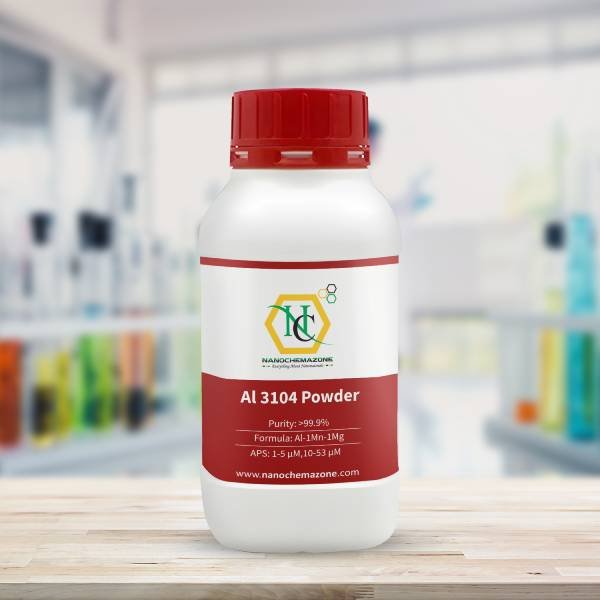
Al 3104 Powder
| Product | Al 3104 Powder |
| CAS No. | 7429-90-5 |
| Appearance | Silvery-Gray Metallic Powder |
| Purity | ≥99%, ≥99.9%, ≥95%(Other purities are also available) |
| APS | 1-5 µM, 10-53 µM (Can be customized), Ask for other available size range. |
| Ingredient | Al-1Mn-1Mg |
| Density | 2.72g/cm3 |
| Molecular Weight | 27g/mol |
| Product Codes | NCZ-DCY-183/25 |
Al 3104 Description:
Al 3104 Powder is one of the numerous advanced ceramic materials manufactured by Nanochemazone. Nanochemazone produces too many standard grades when applicable, including Mil Spec (military grade); ACS, Reagent and Technical Grade; Food, Agricultural and Pharmaceutical Grade; Optical Grade, USP and EP/BP (European Pharmacopoeia/British Pharmacopoeia) and follows applicable ASTM testing standards. Typical and custom packaging is available. Additional technical, research and safety (MSDS) information are available. Please request a quote above for more information on lead time and pricingAl 3104 Powder Related Information :
Storage Conditions: Airtight sealed, avoid light and keep dry at room temperature. Please contact us for customization and price inquiry Email: contact@nanochemazone.com Note: We supply different size ranges of Nano and micron as per the client’s requirements and also accept customization in various parameters. Al 3104 powder Al 3104 powder is an aluminum alloy composed primarily of aluminum (Al) with small additions of manganese (Mn) and magnesium (Mg). This powder form of the alloy offers distinct advantages in terms of its processability and versatility. It is commonly used in various industries due to its excellent combination of strength, corrosion resistance, and formability. Overview of Al 3104 Powder Al 3104 is a 3000 series wrought aluminum alloy known for its good corrosion resistance, excellent formability and weldability. Manganese additions provide strength through solid solution strengthening while maintaining ductility and toughness. Key characteristics of Al 3104 powder include: Moderate strength with excellent ductility Very good weldability and formability Excellent corrosion resistance High thermal and electrical conductivity Low density Available in various particle size distributions Al 3104 powder is suitable for chemical tanks, utensils, heat exchangers and applications needing moderate strength combined with good corrosion resistance. Chemical Composition of Al 3104 Powder| Element | Weight % |
| Aluminum (Al) | Balance |
| Manganese (Mn) | 1.0-1.5% |
| Silicon (Si) | 0.3% max |
| Iron (Fe) | 0.7% max |
| Copper (Cu) | 0.25% max |
| Magnesium (Mg) | 0.25% max |
| Zinc (Zn) | 0.20% max |
| Chromium (Cr) | 0.05-0.20% |
| Property | Value |
| Density | 2.73 g/cm3 |
| Melting Point | 634-643°C |
| Thermal Conductivity | 134 W/mK |
| Electrical Conductivity | 38-42% IACS |
| Young’s Modulus | 70 GPa |
| Poisson’s Ratio | 0.33 |
| Tensile Strength | 150-195 MPa |
| Yield Strength | 95-120 MPa |
| Elongation | 20-30% |
| Hardness | 45-65 Brinell |
| Parameter | Al 3104 | Al 3003 |
| Alloy type | Non-heat treatable | Non-heat treatable |
| Mn content | 1.0-1.5% | 1.0-1.5% |
| Strength | Slightly lower | Slightly higher |
| Corrosion resistance | Excellent | Excellent |
| Weldability | Excellent | Excellent |
| Cost | Lower | Higher |
AlSi7Mg Powder
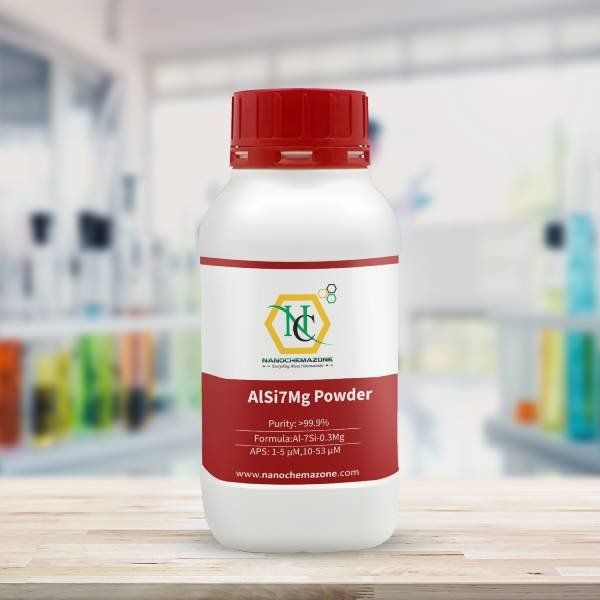
AlSi7Mg Powder
| Product | AlSi7Mg Powder |
| CAS No. | N/A |
| Appearance | Silver-Gray Powder |
| Purity | ≥99%, ≥99.9%, ≥95%(Other purities are also available) |
| APS | 1-5 µM, 10-53 µM (Can be customized), Ask for other available size range. |
| Ingredient | Al-7Si-0.3Mg |
| Density | 2.65-2.68g/cm3 |
| Molecular Weight | N/A |
| Product Codes | NCZ-DCY-195/25 |
AlSi7Mg Description:
AlSi7Mg Powder is one of the numerous advanced ceramic materials manufactured by Nanochemazone. Nanochemazone produces too many standard grades when applicable, including Mil Spec (military grade); ACS, Reagent and Technical Grade; Food, Agricultural and Pharmaceutical Grade; Optical Grade, USP and EP/BP (European Pharmacopoeia/British Pharmacopoeia) and follows applicable ASTM testing standards. Typical and custom packaging is available. Additional technical, research and safety (MSDS) information are available. Please request a quote above for more information on lead time and pricingAlSi7Mg Powder Related Information :
Storage Conditions: Airtight sealed, avoid light and keep dry at room temperature. Please contact us for customization and price inquiry Email: contact@nanochemazone.com Note: We supply different size ranges of Nano and micron as per the client’s requirements and also accept customization in various parameters. AlSi7Mg powder AlSi7Mg powder is an aluminum alloy powder that primarily consists of aluminum (Al), silicon (Si), and magnesium (Mg). The “7” in its name signifies the percentage of silicon, while “Mg” represents the magnesium content. This powder exhibits excellent strength, low density, and impressive thermal properties, making it a preferred choice in multiple industries. Overview of AlSi7Mg Powder AlSi7Mg or A357 alloy is a versatile foundry alloy that possesses properties between pure aluminum and high-silicon hypereutectic alloys. The silicon additions improve castability and enhance mechanical properties while magnesium improves strength. Key characteristics of AlSi7Mg powder include: Good strength and hardness Excellent fluidity and castability Good machinability and polishability High thermal conductivity Good corrosion resistance Low coefficient of thermal expansion Available in range of particle sizes AlSi7Mg powder is used for producing automotive components, hydraulic parts, and other precision castings needing balanced properties. Chemical Composition of AlSi7Mg Powder| Element | Weight % |
| Aluminum (Al) | Balance |
| Silicon (Si) | 6-8% |
| Magnesium (Mg) | 0.4-0.8% |
| Iron (Fe) | 0.15-0.5% |
| Manganese (Mn) | 0.1% max |
| Copper (Cu) | 0.1% max |
| Zinc (Zn) | 0.1% max |
| Titanium (Ti) | 0.25% max |
| Property | Value |
| Density | 2.68 g/cm3 |
| Melting Point | ~600°C |
| Thermal Conductivity | 130-160 W/mK |
| Electrical Resistivity | 3-5 μΩ.cm |
| Young’s Modulus | 70-80 GPa |
| Poisson’s Ratio | 0.33 |
| Tensile Strength | 250-300 MPa |
| Yield Strength | 140-180 MPa |
| Elongation | 4-8% |
| Hardness | 80-100 Brinell |
| Parameter | AlSi7Mg | AlSi10Mg |
| Silicon content | 6-8% | 9-11% |
| Strength | Lower | Higher |
| Castability | Comparable | Comparable |
| Corrosion resistance | Good | Excellent |
| Cost | Lower | Higher |
| Applications | Castings, MIM | Aerospace, AM parts |
| Availability | Readily available | Moderate |

Aluminum Alloy Powder
Aluminum Alloy Powder
| Product | Aluminum Alloy Powder |
| CAS No. | 7429-90-5 |
| Appearance | Silvery-Gray or White Powder |
| Purity | ≥99%, ≥99.9%, ≥95%(Other purities are also available) |
| APS | 1-5 µM, 10-53 µM (Can be customized), Ask for other available size range. |
| Ingredient | Al |
| Density | 2.66g/cm3 |
| Molecular Weight | 26.98g/mol |
| Product Codes | NCZ-DCY-198/25 |
Aluminum Alloy Description:
Aluminum Alloy Powder is one of the numerous advanced ceramic materials manufactured by Nanochemazone. Nanochemazone produces too many standard grades when applicable, including Mil Spec (military grade); ACS, Reagent and Technical Grade; Food, Agricultural and Pharmaceutical Grade; Optical Grade, USP and EP/BP (European Pharmacopoeia/British Pharmacopoeia) and follows applicable ASTM testing standards. Typical and custom packaging is available. Additional technical, research and safety (MSDS) information are available. Please request a quote above for more information on lead time and pricingAluminum Alloy Powder Related Information :
Storage Conditions: Airtight sealed, avoid light and keep dry at room temperature. Please contact us for customization and price inquiry Email: contact@nanochemazone.com Note: We supply different size ranges of Nano and micron as per the client’s requirements and also accept customization in various parameters. Aluminum alloy series The aluminum alloy family is a family of materials with a variety of unique properties and areas of application. Their characteristics mainly depend on the alloying elements contained in them and their proportions. These ranges offer a wide range of opportunities to meet the needs of different industries. Let’s explore the features and typical applications of each series to better understand how to choose the best aluminum alloy material for your project.| roduct | Specification | Apparent Density | Flow Ability | Oxygen Content | Tensile Strength | Yield Strength | Elongation |
| AISi10Mg | 15-53µm 45-105µm 75-150µm | ≥1.35g/cm³ | ≤80s/50g | ≤300ppm | 300±20Mpa | 200±20Mpa | 20±2% |
| AMgScZr | ≥1.30g/cm³ | ≤80s/50g | ≤300ppm | 545±20Mpa | 500±20Mpa | 10±2% | |
| AK400 (can be anodized) | ≥1.30g/cm³ | ≤80s/50g | ≤300ppm | 430±20Mpa | 300±20Mpa | 10±2% | |
| Pure aluminum powder (purity 99.8%) | ≥1.20g/cm³ | ≤100s/50g | ≤1000ppm | \ | \ |
Reviews
There are no reviews yet.