



GH4169 Powder
$0.00
GH4169 Powder
| Product | GH4169 Powder |
| CAS No. | 7440-02-0 |
| Appearance | Gray Dull Silver Powder |
| Purity | ≥99%, ≥99.9%, ≥95%(Other purities are also available) |
| APS | 1-5 µM, 10-53 µM (Can be customized), Ask for other available size range. |
| Ingredient | NiCr22Mo9Nb |
| Density | 8.19g/cm3 |
| Molecular Weight | N/A |
| Product Codes | NCZ-DCY-289/25 |
GH4169 Description:
GH4169 Powder is one of the numerous advanced ceramic materials manufactured by Nanochemazone. Nanochemazone produces too many standard grades when applicable, including Mil Spec (military grade); ACS, Reagent and Technical Grade; Food, Agricultural and Pharmaceutical Grade; Optical Grade, USP and EP/BP (European Pharmacopoeia/British Pharmacopoeia) and follows applicable ASTM testing standards. Typical and custom packaging is available. Additional technical, research and safety (MSDS) information are available. Please request a quote above for more information on lead time and pricing
GH4169 Powder Related Information :
Storage Conditions:
Airtight sealed, avoid light and keep dry at room temperature.
Please contact us for customization and price inquiry
Email: contact@nanochemazone.com
Note: We supply different size ranges of Nano and micron as per the client’s requirements and also accept customization in various parameters.
GH4169 Powder for Additive Manufacturing
GH4169 powder is a precipitation hardening stainless steel powder designed to provide high strength, hardness and corrosion resistance after heat treatment. It contains 17% chromium along with nickel, aluminum, titanium, and niobium additions for enhanced mechanical and corrosion properties.
GH4169 powder is a precipitation hardening stainless steel powder designed to provide high strength, hardness and corrosion resistance after heat treatment. It contains 17% chromium along with nickel, aluminum, titanium, and niobium additions for enhanced mechanical and corrosion properties.
| Size Range | 15-45um/15-53um/20-63 um | 45-105um |
| Form | Spherical | Spherical |
| Flow Ability | ≤25s | |
| Apparent Density | ≥4.0 g/c㎡ | |
| Oxygen Content | ≤200 ppm | |
| Nitrogen Content | ≤150ppm | |
Key characteristics of GH4169 powder:
GH4169 Powder Properties
| Properties | Details |
| Composition | Fe-17Cr-4Ni-1.5Ti-0.7Al-0.25Nb alloy |
| Density | 7.9 g/cc |
| Particle shape | Irregular, angular |
| Size range | 10-150 microns |
| Apparent density | Up to 50% of true density |
| Flowability | Moderate |
| Strength | Very high after aging treatment |
| Corrosion resistance | Excellent, including marine environments |
GH4169’s exceptional strength-to-weight ratio combined with outstanding corrosion resistance make it suitable for critical structural parts across aerospace, marine, nuclear and other demanding applications.
GH4169 Powder Composition
Typical composition of GH4169 precipitation hardening stainless steel:
GH4169 Powder Composition
| Element | Weight % |
| Iron (Fe) | Balance |
| Chromium (Cr) | 16-18% |
| Nickel (Ni) | 3.5-5.5% |
| Titanium (Ti) | 1.2-1.8% |
| Aluminum (Al) | 0.3-1.2% |
| Niobium (Nb) | 0.15-0.45% |
| Carbon (C) | 0.04% max |
| Silicon (Si), Manganese (Mn) | 1% max each |
Iron provides the ferritic matrix
Chromium improves corrosion and oxidation resistance
Nickel, aluminum, titanium and niobium facilitate precipitation hardening
Carbon and other elements limited as tramp impurities
The composition is designed to maximize the precipitation hardening response and corrosion resistance required in structural applications.
GH4169 Powder Physical Properties
| Property | Values |
| Density | 7.9 g/cc |
| Melting point | 1400-1450°C |
| Electrical resistivity | 0.80 μΩ-m |
| Thermal conductivity | 12 W/mK |
| Thermal expansion | 12 x 10^-6 /K |
| Maximum service temperature | 650°C |
High strength-to-weight ratio
Retains strength and hardness up to 650°C
Relatively low thermal conductivity
Resistivity increases after precipitation hardening
Moderate expansion coefficient
The properties allow use of GH4169 in load bearing structural applications requiring corrosion resistance and high temperature strength.
GH4169 Powder Mechanical Properties
| Property | Condition | Values |
| Hardness | Solution annealed | 90 HRB |
| Hardness | Peak aged | 40-45 HRC |
| Tensile strength | Annealed | 550-750 MPa |
| Tensile strength | Peak aged | 1300-1600 MPa |
| Yield strength | Peak aged | 1100-1400 MPa |
| Elongation | Peak aged | 8-13% |
Ages to high strength levels exceeding other precipitation hardening stainless steels
Retains good ductility in peak aged condition
Significant increase in hardness after aging treatment
Strength can be tailored through aging time and temperature
These properties make GH4169 suitable for lightweight, high strength structural parts needing corrosion resistance.
GH4169 Powder Applications
| Industry | Example Uses |
| Aerospace | Airframe and engine components, fasteners |
| Marine | Shafts, fixtures, solenoids, valves |
| Nuclear | Fuel element cladding, internal structures |
| Oil and gas | Structural parts for wellheads, offshore platforms |
| Chemical | Process equipment like vessels and pipes |
Some specific uses:
Bolts, nuts, screws, and studs needing high strength
Critical rotating shaft components
Valve and pump bodies used in corrosive environments
Mixing equipment like impellers and agitators
Nuclear fuel element cladding and vessel internals
GH4169 provides an exceptional combination of strength, hardness and corrosion resistance required in critical structural parts across demanding industries.
GH4169 Powder Standards
| Standard | Description |
| AMS 5922 | Precipitation hardening stainless steel powder for aerospace parts |
| ASTM A580 | Standard for precipitation hardening stainless steel wire |
| ASTM A638 | Standard for precipitation hardening iron-based superalloys |
| AMS 5898 | Bars, forgings, rings of precipitation hardening stainless steels |
These define:
Chemical composition of GH4169 alloy
Permissible impurities like C, S and P
Required mechanical properties in different conditions
Approved powder production methods
Compliance testing protocols
Quality assurance requirements
Powder produced to these standards ensures optimal aging response, ductility, and corrosion resistance.
GH4169 Powder Particle Size Distribution
| Particle Size | Characteristics |
| 10-22 microns | Ultrafine grade for high density |
| 22-75 microns | Most commonly used size range |
| 75-150 microns | Coarser sizes for improved flowability |
Finer particles promote higher sintered density
Coarser particles improve powder flow into die cavities
Gas atomization and water atomization both used
Size distribution tailored to final part properties needed
Controlling particle size distribution optimizes pressing behavior, final density, and mechanical performance.
GH4169 Powder Apparent Density
| Apparent density | Details |
| Up to 50% of true density | For irregular powder morphology |
| 4.5-5.5 g/cc | Higher for spherical powders |
Spherical powders provide higher apparent density
Irregular particles have density around 45%
Higher apparent density improves powder flow and compressibility
Allows higher green density after compaction
Higher powder apparent density leads to better manufacturing productivity and part performance.
GH4169 Powder Production
| Method | Details |
| Gas atomization | High pressure inert gas breaks up molten metal stream into fine droplets |
| Water atomization | High pressure water jet breaks metal into fine particles |
| Vacuum induction melting | High purity input materials melted under vacuum |
| Multiple remelting | Improves chemical homogeneity |
| Sieving | Classifies powder into different particle size ranges |
Gas atomization provides spherical powder shape
Water atomization is lower cost but irregular particles
Vacuum processing minimizes gaseous impurities
Post-processing allows particle size control
Fully automated methods combined with strict quality control ensure reliable and consistent powder suitable for critical applications.
GH4169 Powder Handling and Storage
| Recommendation | Reason |
| Ensure proper ventilation | Prevent exposure to fine metallic particles |
| Avoid ignition sources | Powder can combust in oxygen atmosphere |
| Follow safe protocols | Reduce health and fire hazards |
| Use non-sparking tools | Prevent possibility of ignition |
| Store sealed containers | Prevent contamination or oxidation |
Storage Recommendations
Store in stable containers in a dry, cool area
Limit exposure to moisture and acids
Maintain temperatures below 30°C
With proper precautions during handling and storage, GH4169 powder remains stable and safe to work with.
GH4169 Powder Inspection and Testing
| Test | Details |
| Chemical analysis | ICP and XRF verify composition |
| Particle size analysis | Determines particle size distribution |
| Apparent density | Measured as per ASTM B212 standard |
| Powder morphology | SEM imaging of particle shape |
| Flow rate testing | Gravity flow rate through specified funnel |
| Loss on ignition | Determines moisture content |
Testing ensures the powder meets the required composition, particle characteristics, density specifications, morphology and flow rate as per applicable standards.
GH4169 Powder Pros and Cons
Advantages of GH4169 Powder
Exceptional strength after precipitation hardening
Retains good ductility in peak aged condition
Excellent corrosion resistance including marine environments
High strength maintained up to 650°C
Good combinations of properties for critical structural parts
More cost-effective than superalloys
Limitations of GH4169 Powder
Requires careful heat treatment for optimal properties
Lower fracture toughness than austenitic steels
Subject to sensitization during improper welding
Limited cold heading and forming capability
Strength and corrosion resistance not as high as superalloys
Price higher than common stainless steel grades
Comparison With 17-4PH and 15-5PH Powder
GH4169 vs. 17-4PH and 15-5PH Powder
| Parameter | GH4169 | 17-4PH | 15-5PH |
| Density | 7.9 g/cc | 7.7 g/cc | 7.8 g/cc |
| Hardness | 40-45 HRC | 38-45 HRC | 36-42 HRC |
| Tensile strength | 1300-1600 MPa | 1200-1450 MPa | 1050-1400 MPa |
| Corrosion resistance | Excellent | Very good | Good |
| Cost | High | Moderate | Low |
GH4169 has highest strength after aging treatment
It also provides the best corrosion resistance
17-4PH is moderately stronger than 15-5PH
15-5PH is the most economical of the three
GH4169 preferred for critical structural applications
GH4169 Powder FAQs
Q: What are the main applications of GH4169 precipitation hardening stainless steel powder?
A: Main applications include aerospace structures, marine components like shafts and valves, nuclear fuel element cladding, oil and gas wellhead parts, chemical process equipment, and other structural parts needing high strength and corrosion resistance.
Q: What is the role of aluminum and titanium in GH4169 composition?
A: Aluminum and titanium facilitate precipitation hardening by forming fine coherent precipitates during aging treatment. This imparts substantial strengthening while retaining reasonable ductility.
Q: What precautions are needed when working with GH4169 powder?
A: Recommended precautions include ventilation, avoiding ignition sources, using non-sparking tools, protective gear, following safe protocols, and storing sealed containers away from contaminants or moisture.
Q: How does GH4169 differ from martensitic and ferritic stainless steel grades?
A: GH4169 can be aged to much higher strength levels compared to martensitic or ferritic grades. It also provides excellent corrosion resistance including in marine environments, unlike martensitic grades.
Description
Note: For pricing & ordering information, please get in touch with us at sales@nanochemazone.com
Please contact us for quotes on Larger Quantities and customization. E-mail: contact@nanochemazone.com
Customization:
If you are planning to order large quantities for your industrial and academic needs, please note that customization of parameters (such as size, length, purity, functionalities, etc.) is available upon request.
NOTE:
Images, pictures, colors, particle sizes, purity, packing, descriptions, and specifications for the real and actual goods may differ. These are only used on the website for the purposes of reference, advertising, and portrayal. Please contact us via email at sales@nanochemazone.com or by phone at (+1 780 612 4177) if you have any questions.
Only logged in customers who have purchased this product may leave a review.
Related products

GH 3625 Powder
GH 3625 Powder
| Product | GH 3625 Powder |
| CAS No. | 3526-43-0 |
| Appearance | Gray Powder |
| Purity | ≥99%, ≥99.9%, ≥95%(Other purities are also available) |
| APS | 1-5 µM, 10-53 µM (Can be customized), Ask for other available size range. |
| Ingredient | Ni-Fe-Cr-Mo |
| Density | N/A |
| Molecular Weight | 213.28g/mol |
| Product Codes | NCZ-DCY-287/25 |
GH 3625 Description:
GH 3526 Powder is one of the numerous advanced ceramic materials manufactured by Nanochemazone. Nanochemazone produces too many standard grades when applicable, including Mil Spec (military grade); ACS, Reagent and Technical Grade; Food, Agricultural and Pharmaceutical Grade; Optical Grade, USP and EP/BP (European Pharmacopoeia/British Pharmacopoeia) and follows applicable ASTM testing standards. Typical and custom packaging is available. Additional technical, research and safety (MSDS) information are available. Please request a quote above for more information on lead time and pricing
GH 3625 Powder Related Information :
Storage Conditions:
Airtight sealed, avoid light and keep dry at room temperature.
Please contact us for customization and price inquiry
Email: contact@nanochemazone.com
Note: We supply different size ranges of Nano and micron as per the client’s requirements and also accept customization in various parameters.
GH3625 powder Inconel 625 powder
GH3625 powder Inconel 625 powder is a Mo-Nb reinforced nickel-based high-temperature alloy.
| Metal Powder | Size | Quantity | Price/kg | Size | Quantity | Price/kg |
| Inconel 625 | 0-20μm | 1KG | $59 | 20-63μm | 1KG | $98.30 |
| 10KG | $39 | 10KG | $69.10 | |||
| 100KG | $34 | 100KG | $64.50 |
Overview
GH3625 powder Inconel 625 powder is an alloy powder used for metal additive manufacturing processes like selective laser sintering (SLS) and direct metal laser sintering (DMLS). It is a nickel-based superalloy that offers high strength, corrosion resistance, and excellent high-temperature properties.
GH3625 is designed specifically for additive manufacturing to produce complex, dense parts with exceptional mechanical properties comparable to wrought materials. It enables the production of lightweight components with complex geometries for aerospace, automotive, medical, and industrial applications.
This guide provides a detailed overview of GH3625 powder covering its composition, properties, applications, specifications, pricing, advantages, and limitations. Comparisons are made to other common alloys like Inconel 718 and Satellite 21 to highlight the performance and suitability of GH3625 for different uses. An FAQ section addresses key questions about this material.
GH3625 powder Inconel 625 powder Composition
GH3625 has a complex chemical composition designed to provide a combination of high strength, resistance to thermal fatigue, oxidation, and corrosion resistance. Here is an overview of its composition:
| Element | Weight % |
| Nickel | Balance |
| Chromium | 15-17% |
| Cobalt | 10% |
| Molybdenum | 8-10% |
| Tantalum | 5-6% |
| Aluminum | 1.2-1.7% |
| Titanium | 0.5-1.2% |
| Boron | 0.01% |
Nickel forms the base of this superalloy providing ductility and toughness. Elements like chromium, cobalt, and molybdenum contribute to high temperature strength through solid solution strengthening.
Tantalum provides solid solution strengthening and forms carbide particles for precipitation hardening. Aluminum and titanium form the gamma prime phase Ni3(Al,Ti) to give excellent high temperature mechanical properties. Boron enhances grain boundary strength.
The balanced composition gives GH3625 powder excellent weldability compared to precipitation hardening stainless steels. It can be easily post-processed through hot isostatic pressing (HIP), heat treatment, and machining.
GH3625 powder Inconel 625 powder Properties
GH3625 powder has the following physical and mechanical properties that make it suitable for demanding applications:
GH3625 powder Inconel 625 powder Properties
| Property | Value |
| Density | 8.1-8.5 g/cc |
| Melting Point | 1260-1335°C |
| Thermal Conductivity | 11-12.5 W/mK |
| Coefficient of Thermal Expansion | 12.5-13.5 x 10<sup>-6</sup>/K |
| Modulus of Elasticity | 156-186 GPa |
| Poission’s Ratio | 0.29-0.33 |
| Tensile Strength | 1050-1280 MPa |
| Yield Strength (0.2% offset) | 860-1050 MPa |
| Elongation | 8-15% |
| Hardness | 32-38 HRC |
The high melting point, thermal conductivity, and low coefficient of thermal expansion enable good dimensional stability under high temperature service environments up to 1000°C for limited periods.
The alloy has excellent tensile and yield strength comparable to wrought materials along with good ductility and fracture toughness. It exhibits high hardness, resistance to wear, galling, and abrasion.
The properties allow GH3625 to outperform stainless steels, cobalt alloys, and even rival precipitation hardening nickel superalloys in high temperature strength. It also offers better weldability than Inconel 718.
GH3625 powder Inconel 625 powder Applications
The combination of high strength, hardness, toughness, and thermal stability makes GH3625 suitable for:
GH3625 powder Inconel 625 powder Applications
| Industry | Components |
| Aerospace | Turbine blades, combustor parts, nozzle guide vanes |
| Automotive | Turbocharger wheels, manifolds, valves |
| Oil and Gas | Wellhead parts, downhole tools, valves |
| Power Generation | Heat exchangers, burner components |
| Chemical Processing | Pump impellers, valves, reaction vessels |
| Medical | Dental implants, prosthetics, surgical instruments |
The ability to 3D print complex geometries allows consolidating multiple parts into single components and lightweight lattice structures. This enables faster printing of single-piece components versus assembling multiple sections.
GH3625 is used to print blades, impellers, plates, discs, tubes with conformal cooling channels, and other mission-critical components working under high pressures and temperatures.
GH3625 powder Inconel 625 powder Specifications
GH3625 powder for AM processes is available in different size distributions, shapes, and formulations from various powder manufacturers.
GH3625 Powder Types
| Specification | Details |
| Particle Size Distribution | 15-45 μm, 15-53 μm, 53-150 μm |
| Particle Shape | Spherical, satellite, polyhedral |
| Alloy Modifications | With B, C, Zr, Nb, Ta |
| Manufacturing Method | Gas atomization, plasma atomization |
Gas atomization and plasma atomization produce spherical powders optimal for SLS/DMLS processes. Satellite powders have higher tap density and improve powder flowability.
Smaller 15-45 μm powders provide high resolution and surface finish while larger 53-150 μm allow faster build speeds. Different alloying additions like boron, carbon, zirconium, niobium, and tantalum are used to tailor material properties.
GH3625 powder Inconel 625 powder Standards
| Standard | Description |
| ASTM F3056 | Standard specification for additive manufacturing nickel alloy |
| AMS7016 | Nickel alloy powder for high temperature service |
| ASME B46.1 | Surface texture requirements |
GH3625 powder is qualified based on composition limits, particle size distribution, morphology, flowability, apparent density, and microstructure per ASTM F3056. Additional testing as per application standards is required.
GH3625 powder Inconel 625 powder Pros and Cons
GH3625 has the following advantages that make it a popular choice:
GH3625 Pros
Excellent strength and hardness up to 1000°C
Good corrosion and oxidation resistance
Weldable for post-processing
Higher ductility than Inconel 718
Can be age hardened by heat treatment
Complex geometries enabled by AM
Faster and cheaper than castings
Reduces part count through consolidation
More expensive than stainless steels
Lower strength than Inconel 718 above 550°C
Susceptible to strain-age cracking
Requires hot isostatic pressing (HIP)
Difficult to machine – requires specialist tools
Limited supplier data on long term performance
Proper selection of AM process parameters and post-processing mitigates some of the limitations of GH3625 powder.
Comparison of GH3625 powder Inconel 625 powder with Inconel 718 and Satellite 21
GH3625 occupies a niche between Inconel 718 and Satellite 21 in terms of properties and cost:
Alloy Comparison
| Property | GH3625 | Inconel 718 | Satellite 21 |
| Cost | Medium | High | Low |
| Density | High | Medium | High |
| Strength | Medium | Very High | Medium |
| Hardness | High | Medium | Very High |
| Wear Resistance | Medium | Low | Very High |
| Corrosion Resistance | Medium | High | Medium |
| Oxidation Resistance | Medium | High | Medium |
| Thermal Stability | Up to 1000°C | Up to 700°C | Up to 900°C |
| Weldability | Good | Poor | Medium |
| Manufacturability | Medium | Difficult | Easy |
GH3625 matches or exceeds the performance of Satellite 21 cobalt alloys in wear and corrosion resistance but at lower cost. It approaches the strength of Inconel 718 up to 550°C and offers better weldability and manufacturability.
This makes it a cost-effective alternative for many applications requiring performance between these standard alloys. The ability to 3D print complex geometries also gives it an edge.
GH3625 powder Inconel 625 powder – FAQs
Q: What is GH3625 powder?
A: GH3625 is a nickel-based superalloy powder specifically designed for additive manufacturing processes like selective laser sintering (SLS) and direct metal laser sintering (DMLS). It provides an excellent combination of high temperature strength, hardness, wear and corrosion resistance.
Q: What is GH3625 powder used for?
A: GH3625 powder is used to 3D print critical components like turbine blades, manifolds, impellers, heat exchangers that require high mechanical properties, dimensional stability, and thermal resistance up to 1000°C. It finds applications across aerospace, automotive, energy, chemical processing, and medical industries.
Q: What metal 3D printing processes use GH3625 powder?
A: Selective laser sintering (SLS) and direct metal laser sintering (DMLS) are powder bed fusion 3D printing processes commonly used with GH3625 powder. Binder jetting is also suitable for GH3625.
Q: What are the material properties of GH3625?
A: GH3625 has excellent tensile strength 1050-1280 MPa, yield strength 860-1050 MPa, and hardness 32-38 HRC similar to wrought materials. It has good ductility of 8-15% elongation and high resistance to wear, galling, abrasion, and corrosion. Thermal properties allow use up to 1000°C.
Q: Does GH3625 powder require heat treatment?
A: Yes, GH3625 parts printed using SLS/DMLS require hot isostatic pressing (HIP) followed by heat treatment to achieve optimal mechanical properties, material consolidation, and microstructure. HIP helps close internal pores and voids.
Q: Is GH3625 weldable?
A: GH3625 is designed to have excellent weldability compared to precipitation hardening stainless steels and Inconel 718. This allows repairing and joining AM GH3625 parts through welding. Stress relieving may be required after welding to prevent cracking.
Q: Is GH3625 machinable?
A: GH3625 is difficult to machine compared to stainless steel and requires high-speed machining with specialist carbide tools. Tool wear is higher so optimal feeds, speeds, and tool paths are necessary.
Q: How much does GH3625 powder cost?
A: GH3625 typically costs between $90-250 per kg based on order size, particle size distribution, manufacturing method, and additional testing/qualification requirements. It is more expensive than stainless steel powders but lower cost than Inconel 718.

GH3230 Powder
GH3230 Powder
| Product | GH3230 Powder |
| CAS No. | 3230-94-2 |
| Appearance | Metallic Gray Powder |
| Purity | ≥99%, ≥99.9%, ≥95%(Other purities are also available) |
| APS | 1-5 µM, 10-53 µM (Can be customized), Ask for other available size range. |
| Ingredient | Ni-Cr-Mo-W-Fe |
| Density | 7.8g/cm3 |
| Molecular Weight | N/A |
| Product Codes | NCZ-DCY-285/25 |
GH3230 Description:
GH3230 Powder is one of the numerous advanced ceramic materials manufactured by Nanochemazone. Nanochemazone produces too many standard grades when applicable, including Mil Spec (military grade); ACS, Reagent and Technical Grade; Food, Agricultural and Pharmaceutical Grade; Optical Grade, USP and EP/BP (European Pharmacopoeia/British Pharmacopoeia) and follows applicable ASTM testing standards. Typical and custom packaging is available. Additional technical, research and safety (MSDS) information are available. Please request a quote above for more information on lead time and pricing
GH3230 Powder Related Information :
Storage Conditions:
Airtight sealed, avoid light and keep dry at room temperature.
Please contact us for customization and price inquiry
Email: contact@nanochemazone.com
Note: We supply different size ranges of Nano and micron as per the client’s requirements and also accept customization in various parameters.
GH3230 is a W-Mo reinforced nickel-based high-temperature alloy, which is usually used in an environment of 700-1000°C. GH3230 alloy has high high-temperature strength and good fatigue properties. And due to its excellent organizational stability, it has good anti-oxidation and anti-hot corrosion properties.
GH3230 Powder is a W-Mo reinforced nickel-based high-temperature alloy, which is usually used in an environment of 700-1000°C. GH3230 alloy has high high-temperature strength and good fatigue properties. And due to its excellent organizational stability, it has good anti-oxidation and anti-hot corrosion properties, and is widely used in aerospace engine combustion chambers, ground gas turbine combustion chambers, and some high-temperature and corrosion-resistant components in the chemical industry.
Physical Properties
| Size range | Size distribution | Hall flow rate | Bulk density | Tap density | ||
| D10(μm) | D50(μm) | D90(μm) | ||||
| 15-53μm | 17-22 | 32-38 | 52-58 | ≤18s/50g | ≥4.60g/cm³ | ≥5.20g/cm³ |
Heat Treatment Recommendations
Hot isostatic pressing: 1200±20°C/160Mpa/3h
Solution treatment: 1200±20°C/1h/AC
Mechanical Behavior
| Test temperature | Tensile strength (σb/Mpa) | Yield strength (σp0.2/Mpa) | Elongation (δ5/%) |
| 25℃ | 840 | 450 | 35 |
| 815℃ | 250 | 200 | 35 |
| 1000℃ | 160 | 130 | 30 |
Chemical Composition Range (Wt,-%)
| Element | C | Cr | Ni | Co | W | Mo |
| wt% | 0.05-0.15 | 20.00-24.00 | Bal | ≤5.00 | 13.00-15.00 | 3.15-4.15 |
| Element | Al | Ti | Fe | La | B | Mn |
| wt% | 2.20-0.50 | ≤0.10 | ≤3.00 | 0.005-0.05 | ≤0.015 | 0.30-1.00 |
| Element | Si | P | S | Cu | O | N |
| wt% | 0.25-0.75 | ≤0.01 | ≤0.010 | ≤0.50 | ≤0.025 | ≤0.015 |

GH5188 Powder
GH5188 Powder
| Product | GH5188 Powder |
| CAS No. | N/A |
| Appearance | Metallic Gray or Dark Gray Powder |
| Purity | ≥99%, ≥99.9%, ≥95%(Other purities are also available) |
| APS | 1-5 µM, 10-53 µM (Can be customized), Ask for other available size range. |
| Ingredient | CoCrNiW |
| Density | 9.10g/cm3 |
| Molecular Weight | N/A |
| Product Codes | NCZ-DCY-291/25 |
GH5188 Description:
GH5188 Powder is one of the numerous advanced ceramic materials manufactured by Nanochemazone. Nanochemazone produces too many standard grades when applicable, including Mil Spec (military grade); ACS, Reagent and Technical Grade; Food, Agricultural and Pharmaceutical Grade; Optical Grade, USP and EP/BP (European Pharmacopoeia/British Pharmacopoeia) and follows applicable ASTM testing standards. Typical and custom packaging is available. Additional technical, research and safety (MSDS) information are available. Please request a quote above for more information on lead time and pricing
GH5188 Powder Related Information :
Storage Conditions:
Airtight sealed, avoid light and keep dry at room temperature.
Please contact us for customization and price inquiry
Email: contact@nanochemazone.com
Note: We supply different size ranges of Nano and micron as per the client’s requirements and also accept customization in various parameters.
GH5188 is a W-strengthened diamond-based high-temperature alloy. GH5188 has good mechanical properties and excellent high temperature oxidation resistance. It is suitable for aviation parts that require tensile strength below 980°C and oxidation resistance below 1100°C.
GH5188 is a W-strengthened diamond-based high-temperature alloy. GH5188 has good mechanical properties and excellent high temperature oxidation resistance. It is suitable for aviation parts that require tensile strength below 980°C and oxidation resistance below 1100°C.
Physical Properties
| Size range | Size distribution | Hall flow rate | Bulk density | Tap density | ||
| D10(μm) | D50(μm) | D90(μm) | ||||
| 15-53μm | 17-22 | 32-38 | 52-58 | ≤18s/50g | ≥4.80g/cm³ | ≥5.40g/cm³ |
Heat Treatment Recommendations
Solid solution treatment:1180±20°C/1h/AC
| Test temperature | Tensile strength (σb/Mpa) | Yield strength (σp0.2/Mpa) | Elongation (δ5/%) |
| 25℃ | 900 | 400 | ≥45 |
| 650℃ | 650 | 280 | ≥50 |
| 900℃ | 300 | 240 | ≥50 |
| 950℃ | 200 | 170 | ≥50 |
| 1000℃ | 160 | 130 | ≥50 |
Chemical Composition Range (Wt,-%)
| Element | C | Cr | Ni | Co | W | Fe |
| wt% | 0.05-0.15 | 20.00-24.00 | 20.00-24.00 | Bal | 13.00-16.00 | ≤3.00 |
| Element | B | La | Mn | Si | P | S |
| wt% | ≤0.015 | 0.03-0.12 | ≤1.25 | 0.20-0.50 | ≤0.02 | ≤0.015 |
| Element | Cu | O | N | – | – | – |
| wt% | ≤0.07 | ≤0.025 | ≤0.015 | – | – | – |

Hastelloy X Powder
Hastelloy X Powder
| Product | Hastelloy X Powder |
| CAS No. | N/A |
| Appearance | Silvery-Gray Powder |
| Purity | ≥99%, ≥99.9%, ≥95%(Other purities are also available) |
| APS | 1-5 µM, 10-53 µM (Can be customized), Ask for other available size range. |
| Ingredient | NiCrMoFe |
| Density | 8.22g/cm3 |
| Molecular Weight | N/A |
| Product Codes | NCZ-DCY-276/25 |
Hastelloy X Description:
Hastelloy X Powder is one of the numerous advanced ceramic materials manufactured by Nanochemazone. Nanochemazone produces too many standard grades when applicable, including Mil Spec (military grade); ACS, Reagent and Technical Grade; Food, Agricultural and Pharmaceutical Grade; Optical Grade, USP and EP/BP (European Pharmacopoeia/British Pharmacopoeia) and follows applicable ASTM testing standards. Typical and custom packaging is available. Additional technical, research and safety (MSDS) information are available. Please request a quote above for more information on lead time and pricing
Hastelloy X Powder Related Information :
Storage Conditions:
Airtight sealed, avoid light and keep dry at room temperature.
Please contact us for customization and price inquiry
Email: contact@nanochemazone.com
Note: We supply different size ranges of Nano and micron as per the client’s requirements and also accept customization in various parameters.
Best Hastelloy X Powder丨High temperature alloy Powder for 3D Printing
Hastelloy X Powder holds a special place. It’s a nickel-based superalloy that has an extraordinary blend of properties, thanks to its composition which includes chromium, iron, and molybdenum. The high nickel content offers exceptional resistance to oxidation and corrosion.
Overview of Hastelloy X Powder
Hastelloy X is a nickel-based superalloy powder known for its excellent high temperature strength, oxidation resistance, and fabricability. It has applications in the aerospace, industrial, and energy industries where parts are exposed to extreme environments.
This article provides a comprehensive guide to Hastelloy X powder. It covers the composition, properties, applications, specifications, suppliers, handling, inspection, comparisons, pros and cons, and frequently asked questions about this versatile alloy powder. Quantitative data is presented in easy-to-read tables for quick reference.
Composition of Hastelloy X Powder
Hastelloy X has a complex composition optimized for high temperature performance. The main alloying elements are nickel, chromium, iron, and molybdenum.
| Element | Weight % | Role |
| Nickel | Balance | Matrix element, provides corrosion resistance |
| Chromium | 21.5 – 23.5 | Oxidation resistance, formation of protective Cr2O3 |
| Iron | 17 – 20 | Solid solution strengthening |
| Molybdenum | 8 – 10 | Solid solution strengthening, creep resistance |
| Cobalt | 1 max | Enhances hot workability |
| Manganese | 1 max | Deoxidizer |
| Silicon | 0.5 max | Deoxidizer |
| Carbon | 0.15 max | Carbide former |
Trace additions of boron, zirconium, and carbon are also made to optimize properties like creep resistance. The balance nickel content provides corrosion resistance.
Properties of Hastelloy X Powder
Hastelloy X exhibits an excellent combination of properties for high temperature applications:
| Property | Description |
| High temperature strength | Excellent creep rupture strength up to 1150°C |
| Oxidation resistance | Resists oxidation in air up to 1200°C |
| Thermal fatigue resistance | Resists cracking during thermal cycling |
| Fabricability | Easy to form and weld compared to other superalloys |
| Corrosion resistance | Resists many oxidizing and reducing environments |
Grain size control and thermomechanical processing modifies properties like tensile strength and ductility.
Applications of Hastelloy X Powder
The unique properties of Hastelloy X enable critical applications including:
| Industry | Applications |
| Aerospace | Jet engine combustion liners, afterburners, exhaust parts |
| Industrial | Reformer tubes, heat treatment equipment |
| Energy | Nuclear & fossil fuel power generation, chemical processing |
| Automotive | Exhaust system components, turbocharger parts |
The oxidation resistance allows thin section capabilities needed for jet engine combustion liners. It also suits the extremes of chemical processing vessels and tubing.
Specifications of Hastelloy X Powder
Hastelloy X powder is commercially available with specifications per alloy grade:
| Parameter | Specification |
| Alloy grades | Hastelloy X, B3, BC3, BN |
| Particle size | 15-45 microns, 45-105 microns |
| Particle shape | Spherical, irregular morphology |
| Apparent density | 2.5-4.5 g/cc |
| Tap density | 4-6 g/cc |
| Purity | >99.9% |
| Oxygen content | <1000 ppm |
| Moisture content | <0.2% |
Other custom size distributions, purity levels, particle shapes and alloy modifications are possible for special applications.
Handling and Storage of Hastelloy X Powder
As a reactive metal powder, Hastelloy X requires controlled handling and storage:
Store in sealed containers in a cool, dry environment
Avoid contact with moisture, acids, halogen compounds
Ground containers and transfer equipment to prevent static buildup
Use spark-proof tools and minimize dust generation
Prevent accumulation of dusts to reduce explosion risk
Wear appropriate PPE and avoid inhalation of powders
Proper precautions during handling, storage and processing are critical for safety and quality.
Inspection and Testing of Hastelloy X Powder
Hastelloy X powder batches are tested to ensure they meet specifications:
| Test Method | Parameters Checked |
| Sieve analysis | Particle size distribution |
| Apparent density | Powder flowability |
| Tap density | Packed density |
| Scanning electron microscopy | Particle morphology |
| Energy dispersive X-ray | Chemistry, alloy composition |
| X-ray diffraction | Phases present |
| Inductively coupled plasma | Trace element analysis |
Sampling and testing as per ASTM standards ensures batch-to-batch consistency and quality.
Comparing Hastelloy X to Alternatives
Hastelloy X has advantages and limitations compared to other superalloys:
| Alloy | Oxidation Resistance | Fabricability | Cost |
| Hastelloy X | Excellent | Good | High |
| Inconel 625 | Good | Excellent | Medium |
| Haynes 230 | Excellent | Poor | Very High |
| Inconel 718 | Medium | Fair | Medium |
Hastelloy X provides the best combination of oxidation resistance, fabricability, and cost for many high temperature applications.
Pros and Cons of Hastelloy X Powder
| Pros | Cons |
| Excellent high temperature strength | Expensive compared to stainless steels |
| Outstanding oxidation resistance | Lower fabricability than Inconel 625 |
| Thermal fatigue resistance | Susceptible to embrittlement at lower temperatures |
| Ease of welding and machining | Requires controlled handling and processing |
| Resists many corrosive environments | Limited data available compared to popular alloys |
Hastelloy X enables exceptional performance but requires care in processing and has high material cost.
Frequently Asked Questions about Hastelloy X Powder
Here are answers to some common questions about Hastelloy X powder:
Q: What is Hastelloy X used for?
A: Hastelloy X is used in aircraft engines, industrial furnaces, chemical processing, and power generation applications where strength and oxidation resistance at extreme temperatures are required.
Q: What is the difference between Hastelloy X and Hastelloy C?
A: Hastelloy X has addition of iron and higher molybdenum content. This gives better fabricability and high temperature strength compared to Hastelloy C which relies only on chromium for oxidation resistance.
Q: Is Hastelloy X weldable?
A: Yes, Hastelloy X has good weldability compared to other nickel superalloys, making it suitable for fabrication of complex components. Proper welding process and parameters must be used to avoid cracking.
Q: What is the temperature range of Hastelloy X?
A: It maintains good strength and oxidation resistance up to 1100°C for prolonged service. Shorter exposures up to 1200°C are possible. Lower temperatures can cause embrittlement.
Q: Is Hastelloy X magnetic?
A: No, Hastelloy X is non-magnetic, with magnetic permeability close to 1. This makes it useful for certain electronic and high temperature applications.
Q: What corrosion environments can Hastelloy X withstand?
A: It exhibits excellent corrosion resistance to oxidizing acids, halogens, sulfidation, and stress corrosion cracking environments found in chemical processing.
Q: Does Hastelloy X contain cobalt?
A: Most grades of Hastelloy X contain 1% or less cobalt. Cobalt-free variants are also available for biomedical applications where cobalt can cause negative health effects.
Q: What are the contents of a Hastelloy X powder MSDS?
A: It provides composition data, health and reactivity hazards, handling guidance, storage requirements, spill and firefighting procedures, transport information and disposal guidelines that are essential to review before use.
Q: Can Hastelloy X powder be 3D printed?
A: Yes, Hastelloy X alloy powders can be used in laser and electron beam powder bed fusion additive manufacturing processes. Parameters are optimized to provide dense, crack-free parts.
Q: How is Hastelloy X powder made?
A: Gas atomization is the common production method where the alloy melt is broken into fine droplets and rapidly solidified into powder. Water atomization is also used either by itself or with gas atomization.
Q: What are the alternatives to Hastelloy X?
A: Alternatives include Inconel 617, Haynes 230, Inconel 625, and stainless steels like 310 and 330. They offer lower cost but cannot match the oxidation resistance of Hastelloy X in extreme environments.

IN738LC Powder
IN738LC Powder
| Product | INC738LC Powder |
| CAS No. | N/A |
| Appearance | Gray or Metallic Silver Powder |
| Purity | ≥99%, ≥99.9%, ≥95%(Other purities are also available) |
| APS | 1-5 µM, 10-53 µM (Can be customized), Ask for other available size range. |
| Ingredient | Ni-16Cr-8.5Co-2.4Al-3.4Ti-1.75Mo-1.75w-0.9Nb-0.6Zr-0.1C |
| Density | 8.19g/cm3 |
| Molecular Weight | N/A |
| Product Codes | NCZ-DCY-278/25 |
IN738LC Description:
INC738LC Powder is one of the numerous advanced ceramic materials manufactured by Nanochemazone. Nanochemazone produces too many standard grades when applicable, including Mil Spec (military grade); ACS, Reagent and Technical Grade; Food, Agricultural and Pharmaceutical Grade; Optical Grade, USP and EP/BP (European Pharmacopoeia/British Pharmacopoeia) and follows applicable ASTM testing standards. Typical and custom packaging is available. Additional technical, research and safety (MSDS) information are available. Please request a quote above for more information on lead time and pricing
IN738LC Powder Related Information :
Storage Conditions:
Airtight sealed, avoid light and keep dry at room temperature.
Please contact us for customization and price inquiry
Email: contact@nanochemazone.com
Note: We supply different size ranges of Nano and micron as per the client’s requirements and also accept customization in various parameters.
Best IN738LC powder for 3D printing in 2024
| Alloy | Nominal Composition (wt%) |
| IN738LC | Ni – 16Cr – 8.5Co – 3.4Al – 3.4Ti – 1.7Mo – 2.6W – 1.7Ta – 0.9Nb – 0.05C – 0.03Zr – 0.001B |
Characteristics of IN738LC Powder
| Property | Value |
| Density | 8.19 g/cm³ |
| Melting Range | 1260-1335°C |
| Yield Strength (at 650°C) | >758 MPa |
| Tensile Strength (at 650°C) | >1035 MPa |
| Elongation (at 650°C) | >12% |
| Grain Size | Fine-grained |
| Gamma Prime Phase | High volume fraction |
IN738LC powder exhibits exceptional high-temperature strength, creep resistance, and oxidation resistance due to its unique composition and microstructure. The presence of aluminum, titanium, and refractory elements like tungsten and tantalum contributes to the formation of a high volume fraction of gamma prime (γ’) precipitates, which are responsible for its superior mechanical properties at elevated temperatures.
Benefits of Using IN738LC Powder for 3D Printing
Additive manufacturing with IN738LC powder offers numerous benefits over traditional manufacturing methods, making it an attractive choice for various industries. Let’s explore some of the key advantages:
Design Flexibility: 3D printing allows for the production of complex geometries and intricate internal structures that would be challenging or impossible to manufacture using conventional methods. This design freedom enables the creation of optimized components with improved functionality and performance.
Weight Reduction: By leveraging the design flexibility of additive manufacturing, engineers can produce lightweight yet robust components with optimized topologies, resulting in significant weight savings, particularly in aerospace and automotive applications.
Rapid Prototyping: The ability to quickly produce prototypes and functional parts from IN738LC powder accelerates the product development cycle, enabling faster iterations and reducing time-to-market.
Material Efficiency: Additive manufacturing processes like SLM and EBM have higher material utilization rates compared to subtractive manufacturing methods, leading to less waste and improved resource efficiency.
Customization: 3D printing enables the production of customized components tailored to specific requirements, making it ideal for applications with low-volume or unique demands.
Repair and Remanufacturing: IN738LC powder can be used to repair or remanufacture worn or damaged components, extending their service life and reducing replacement costs.
Applications of IN738LC Powder in 3D Printing
| Application | Industry | Examples |
| Turbine Components | Aerospace, Energy | Blades, Vanes, Nozzles |
| Automotive Components | Automotive | Turbochargers, Exhaust Manifolds |
| Tooling and Molds | Manufacturing | Injection Molds, Die Casting Molds |
| Heat Exchangers | Energy, Chemical | High-Temperature Recuperators |
| Medical Implants | Healthcare | Orthopedic Implants, Dental Restorations |
The exceptional high-temperature properties and corrosion resistance of IN738LC make it suitable for a wide range of applications across various industries. In the aerospace and energy sectors, this superalloy is widely used for producing turbine components, such as blades, vanes, and nozzles, which are subject to extreme temperatures and high stresses. The automotive industry also benefits from IN738LC powder in the manufacturing of turbochargers and exhaust manifolds.
Additionally, IN738LC powder finds applications in tooling and mold making, where its high strength and wear resistance are invaluable. Heat exchangers and recuperators in the energy and chemical industries also utilize this material due to its ability to withstand elevated temperatures and corrosive environments. Moreover, the biocompatibility of IN738LC makes it a promising candidate for medical implants and dental restorations.
3D Printing Processes for IN738LC Powder
Additive manufacturing processes compatible with IN738LC powder include selective laser melting (SLM) and electron beam melting (EBM). These powder bed fusion techniques offer excellent control over the microstructure and properties of the final component.
Selective Laser Melting (SLM): In the SLM process, a high-powered laser selectively melts and fuses the IN738LC powder layer by layer, according to the 3D model data. The build chamber is typically filled with an inert gas, such as argon or nitrogen, to prevent oxidation and maintain the desired material properties.
Electron Beam Melting (EBM): EBM utilizes a focused electron beam to selectively melt the IN738LC powder in a vacuum environment. This process allows for higher build rates and can produce parts with excellent mechanical properties and reduced residual stresses.
Both SLM and EBM processes require careful control of process parameters, such as laser or electron beam power, scan speed, hatch spacing, and layer thickness, to ensure optimal densification, microstructure, and mechanical properties of the final component.
To achieve the desired properties, post-processing steps like stress relief heat treatments, hot isostatic pressing (HIP), and surface finishing may be necessary, depending on the application requirements.
| Powder Specifications |
| Particle Size Distribution: 15-53 μm |
| Flowability: Excellent |
| Sphericity: High |
| Apparent Density: 4.2-4.6 g/cm³ |
| Standards: AMS 5832, AMS 5385 |
| Typical Grades |
| IN738LC – Standard Grade |
| IN738LC-LG – Low Gauge Grade |
| IN738LC-HG – High Gauge Grade |
Pros and Cons of Using IN738LC Powder for 3D Printing
| Pros | Cons |
| Excellent high-temperature strength and creep resistance | Higher material cost compared to some other alloys |
| Superior oxidation and corrosion resistance | Potential for cracking and distortion during printing |
| Ability to produce complex geometries | Strict process control required for optimal properties |
| Lightweight and high strength-to-weight ratio | Limited availability of qualified suppliers |
Advantages of IN738LC Powder for 3D Printing
When compared to traditional manufacturing methods, additive manufacturing with IN738LC powder offers several distinct advantages:
Design Optimization: The ability to produce complex geometries and internal features enables the design of components with optimized topologies, leading to weight reduction and improved performance. For instance, in the aerospace industry, lightweight yet strong turbine blades can be created, resulting in increased fuel efficiency and reduced emissions.
Rapid Prototyping and Iteration: The additive manufacturing process allows for rapid prototyping and iterative design cycles, significantly shortening the product development timeline. This advantage is particularly valuable in industries with stringent testing and certification requirements, such as aerospace and automotive.
Customization and Personalization: 3D printing with IN738LC powder enables the production of customized or patient-specific components, catering to unique requirements in fields like medical implants, tooling, and specialized industrial applications.
Material Efficiency and Waste Reduction: Additive manufacturing processes have higher material utilization rates compared to subtractive methods, resulting in less waste and improved resource efficiency. This not only reduces material costs but also contributes to a more sustainable manufacturing approach.
Repair and Remanufacturing: IN738LC powder can be used to repair or remanufacture worn or damaged components, extending their service life and reducing replacement costs. This capability is particularly beneficial in industries with high-value assets, such as aerospace and energy.
While additive manufacturing with IN738LC powder offers numerous advantages, it is essential to consider potential limitations and challenges. Process control, post-processing requirements, and the availability of qualified suppliers can impact the overall feasibility and cost-effectiveness of using this material for specific applications.
Limitations of IN738LC Powder for 3D Printing
Despite its numerous benefits, using IN738LC powder for 3D printing also presents some limitations and challenges:
Higher Material Cost: Nickel-based superalloys like IN738LC are generally more expensive compared to some other alloys used in additive manufacturing, which can increase the overall cost of production.
Strict Process Control: Achieving optimal mechanical properties and part quality with IN738LC powder requires precise control over various process parameters, such as laser or electron beam power, scan speed, hatch spacing, and layer thickness. Deviations from the optimal parameters can lead to defects or suboptimal performance.
Potential for Cracking and Distortion: Due to the high thermal gradients and residual stresses involved in the additive manufacturing process, IN738LC components can be susceptible to cracking and distortion. Careful design, process optimization, and post-processing techniques like stress relief heat treatments and hot isostatic pressing (HIP) may be necessary to mitigate these issues.
Limited Availability of Qualified Suppliers: While several suppliers offer IN738LC powder, the number of qualified and experienced suppliers may be limited compared to more widely used materials. This can impact the availability, lead times, and pricing of the powder.
Post-Processing Requirements: Depending on the application and performance requirements, post-processing steps like hot isostatic pressing (HIP), heat treatments, and surface finishing may be necessary to achieve the desired mechanical properties and surface quality. These additional steps can increase the overall cost and lead time.

Inconel 718 Powder
Inconel 718 Powder
| Product | Inconel 718 Powder |
| CAS No. | 7440-02-0 |
| Appearance | Gray Metallic Powder |
| Purity | ≥99%, ≥99.9%, ≥95%(Other purities are also available) |
| APS | 1-5 µM, 10-53 µM (Can be customized), Ask for other available size range. |
| Ingredient | Ne-Fe-Cr |
| Density | 8.19g/cm3 |
| Molecular Weight | N/A |
| Product Codes | NCZ-DCY-277/25 |
Inconel 718 Description:
Inconel 718 Powder is one of the numerous advanced ceramic materials manufactured by Nanochemazone. Nanochemazone produces too many standard grades when applicable, including Mil Spec (military grade); ACS, Reagent and Technical Grade; Food, Agricultural and Pharmaceutical Grade; Optical Grade, USP and EP/BP (European Pharmacopoeia/British Pharmacopoeia) and follows applicable ASTM testing standards. Typical and custom packaging is available. Additional technical, research and safety (MSDS) information are available. Please request a quote above for more information on lead time and pricing
Inconel 718 Powder Related Information :
Storage Conditions:
Airtight sealed, avoid light and keep dry at room temperature.
Please contact us for customization and price inquiry
Email: contact@nanochemazone.com
Note: We supply different size ranges of Nano and micron as per the client’s requirements and also accept customization in various parameters.
Best in718 powder inconel 718 powder for metal 3D printing
inconel 718 powder Overview
Inconel 718 powder is a high-performance alloy powder used in additive manufacturing (AM) processes, such as laser powder bed fusion (LPBF) and electron beam powder bed fusion (EBPBF). It is renowned for its exceptional strength, corrosion resistance, and high-temperature capabilities. Inconel 718 powder is widely employed in demanding industries like aerospace, energy, and medical.
inconel 718 powder Composition and Characteristics
Inconel 718 powder is an alloy primarily composed of nickel (Ni), chromium (Cr), iron (Fe), and niobium (Nb). Its specific composition varies slightly depending on the manufacturer and application requirements. The table below highlights the typical composition and characteristics of Inconel 718 powder:
| Property | Value |
| Nickel (Ni) | 50-55% |
| Chromium (Cr) | 17-21% |
| Iron (Fe) | 17-21% |
| Niobium (Nb) | 4.75-5.5% |
| Molybdenum (Mo) | 2.8-3.3% |
| Titanium (Ti) | 0.65-1.15% |
| Aluminum (Al) | 0.2-0.8% |
| Carbon (C) | 0.08% max |
| Silicon (Si) | 0.35% max |
| Manganese (Mn) | 0.35% max |
| Sulfur (S) | 0.015% max |
| Phosphorus (P) | 0.015% max |
inconel 718 powder Applications
Inconel 718 powder finds applications in various industries due to its unique properties. Some of its key applications include:
| Industry | Applications |
| Aerospace | Turbine blades, engine components, structural parts |
| Energy | Gas turbine components, heat exchangers, pressure vessels |
| Medical | Surgical instruments, implants, dental prosthetics |
| Automotive | High-performance engine components, exhaust systems |
| Defense | Armor, weapons, aerospace components |
Specifications, Sizes, and Grades
Inconel 718 powder is available in various specifications, sizes, and grades to meet specific application requirements. The table below provides an overview of these parameters:
| Parameter | Details |
| Specifications | ASTM B163, AMS 5848, ISO 2076 |
| Sizes | 15-150 microns (typical) |
| Grades | Inconel 718, Inconel 718Plus |
Like any material, Inconel 718 powder has its advantages and disadvantages. The table below summarizes the pros and cons:
| Pros | Cons |
| High strength and hardness | Expensive compared to other alloys |
| Excellent corrosion resistance | Difficult to machine |
| High-temperature capabilities | Requires specialized welding techniques |
| Good weldability and formability | Can be susceptible to stress corrosion cracking |
IN718 powder Specific Metal Powder Models
Various metal powder models of Inconel 718 are available in the market. Some of the notable models include:
Met3DP Inconel 718: Optimized for LPBF and EBPBF processes, offering high density and excellent mechanical properties.
Praxair Incoloy 718: Designed for LPBF applications, known for its fine particle size and consistent flowability.
Carpenter Technology Carpenter 718: Suitable for both LPBF and EBPBF, providing high strength and corrosion resistance.
ATI 718Plus: Developed for LPBF, featuring improved strength and ductility compared to standard Inconel 718.
Sandvik Osprey 718: Produced using the Osprey process, resulting in spherical particles with high flowability and packing density.
Höganäs AM 718: Optimized for LPBF, offering high density and excellent mechanical properties.
LPW Technology LPW 718: Specifically designed for LPBF, known for its consistent particle size and low oxygen content.
Arcam AB Arcam 718: Suitable for EBPBF, offering high density and fine particle size.
Renishaw Ren AM 718: Developed for LPBF, providing high strength and corrosion resistance.
EOS GmbH EOS 718: Optimized for LPBF, known for its high density and excellent surface finish.
FAQ
Q: What is the difference between Inconel 718 powder and other nickel-based alloys?
A: Inconel 718 powder is known for its exceptional strength, corrosion resistance, and high-temperature capabilities compared to other nickel-based alloys. It contains a higher percentage of chromium, which contributes to its enhanced corrosion resistance.
Q: How is Inconel 718 powder used in additive manufacturing?
A: Inconel 718 powder is used in LPBF and EBPBF processes. In LPBF, a laser beam selectively melts the powder particles to create the desired shape, while in EBPBF, an electron beam is used for melting.
Q: What are the advantages of using Inconel 718 powder in AM?
A: Using Inconel 718 powder in AM offers advantages such as design flexibility, reduced lead times, and the ability to create complex geometries. It also allows for the production of lightweight components with high strength and durability.
Q: What are the future trends in Inconel 718 powder technology?
A: Research and development efforts are focused on improving the powder’s flowability, packing density, and mechanical properties. Additionally, there is a growing interest in developing new alloys based on Inconel 718 with enhanced performance characteristics.

K465 Alloy Powder
K465 Alloy Powder
| Product | K465 Alloy Powder |
| CAS No. | 7440-02-0 |
| Appearance | Silvery-Gray Powder |
| Purity | ≥99%, ≥99.9%, ≥95%(Other purities are also available) |
| APS | 1-5 µM, 10-53 µM (Can be customized), Ask for other available size range. |
| Ingredient | NiCrMoCo |
| Density | 8.1-8.3g/cm3 |
| Molecular Weight | N/A |
| Product Codes | NCZ-DCY-293/25 |
K465 Alloy Description:
K465 Alloy Powder is one of the numerous advanced ceramic materials manufactured by Nanochemazone. Nanochemazone produces too many standard grades when applicable, including Mil Spec (military grade); ACS, Reagent and Technical Grade; Food, Agricultural and Pharmaceutical Grade; Optical Grade, USP and EP/BP (European Pharmacopoeia/British Pharmacopoeia) and follows applicable ASTM testing standards. Typical and custom packaging is available. Additional technical, research and safety (MSDS) information are available. Please request a quote above for more information on lead time and pricing
K465 Alloy Powder Related Information :
Storage Conditions:
Airtight sealed, avoid light and keep dry at room temperature.
Please contact us for customization and price inquiry
Email: contact@nanochemazone.com
Note: We supply different size ranges of Nano and micron as per the client’s requirements and also accept customization in various parameters.
K465 Alloy Powder
K465 alloy powder is a nickel-based superalloy that offers high strength and corrosion resistance at elevated temperatures. It is widely used in aerospace, power generation, and chemical processing industries.
K465 Alloy Powder: Composition, Properties, Applications, and Specifications
K465 has become a popular choice for aerospace, power generation, and chemical processing industries where components are subjected to high temperatures or aggressive environments. It allows complex geometries to be 3D printed for optimal performance.
This article provides detailed information on the composition, properties, applications, specifications, availability, processing, and comparisons of K465 superalloy powder for additive manufacturing.
The nominal composition of K465 nickel-based superalloy powder is given below:
| Element | Weight % |
| Nickel (Ni) | Balance |
| Chromium (Cr) | 15 – 17% |
| Cobalt (Co) | 9 – 10% |
| Molybdenum (Mo) | 3% |
| Tantalum (Ta) | 4.5 – 5.5% |
| Aluminum (Al) | 5 – 6% |
| Titanium (Ti) | 0.5 – 1% |
| Boron (B) | 0.01% max |
| Carbon (C) | 0.03% max |
| Zirconium (Zr) | 0.01% max |
| Niobium (Nb) | 1% max |
Nickel forms the base of the alloy and provides a face-centered cubic matrix for high temperature strength. Elements like chromium, cobalt, and molybdenum contribute to solid solution strengthening and enable precipitation hardening.
Aluminum and titanium are added to form gamma prime precipitates Ni3(Al,Ti) to provide hardness and creep resistance up to 700°C. Tantalum provides solid solution strengthening and forms carbides for grain structure control. Boron facilitates precipitation of complex carbides.
The balanced composition of K465 nickel superalloy powder results in a combination of strength, ductility, corrosion resistance, and weldability required for high performance additive manufactured components. The optimized levels of alloying elements can be tailored based on final part requirements.
K465 Alloy Powder Properties
K465 superalloy powder processed via laser powder bed fusion or electron beam melting exhibits the following properties in as-built and heat treated states:
Mechanical Properties
| Property | As-Built Condition | After Heat Treatment |
| Tensile Strength | 1050 – 1250 MPa | 1150 – 1350 MPa |
| Yield Strength | 750 – 950 MPa | 1000 – 1200 MPa |
| Elongation | 10 – 25% | 8 – 15% |
| Hardness | 35 – 45 HRC | 42 – 48 HRC |
High strength levels comparable to cast and wrought Ni-based superalloys
Ductility retained after heat treatment allows some forming/forging
Precipitation hardening by gamma prime phase after solution treatment
Physical Properties
| Property | Value |
| Density | 8.1 – 8.3 g/cc |
| Melting Point | 1260 – 1350°C |
| Thermal Conductivity | 11 – 16 W/m-K |
| Thermal Expansion Coefficient | 12 – 16 x 10<sup>-6</sup> /K |
| Property | Value |
| Service Temperature | Up to 700°C |
| Oxidation Resistance | Good up to 850°C |
| Phase Stability | Retains strength up to 70% of melting point |
| Creep Rupture Strength | 140 MPa at 700°C for 1000 hours |
Retains over half its strength at maximum service temperature
Resists oxidation and hot corrosion in gas turbine environments
Excellent creep rupture strength under load at high temperature
Other Notable Properties
Weldable using conventional fusion welding methods
Good surface finish and dimensional accuracy in AM builds
Customizable with different heat treatments
High thermal fatigue and crack growth resistance
The balanced set of mechanical, physical, and thermal properties make K465 suitable for extreme environments faced in aerospace engines, power generation systems, and chemical processing equipment. The properties can be fine-tuned based on application requirements.
K465 Alloy Powder Applications
The major applications of additive manufactured K465 superalloy parts include:
Aerospace:
Combustor liners, augmentors, flame holders in jet engines
Structural brackets, frames, housings, fittings
Hot section components like turbine blades and vanes
Rocket propulsion systems and spacecraft engines
Power Generation:
Heat exchangers, piping, valves, manifolds in boilers and heat recovery systems
Gas turbine hot gas path components like nozzles, shrouds
Solar power receivers and collectors
Automotive:
Turbocharger wheels and housings
Exhaust system manifolds and components
Chemical Processing:
Reformer tubes, reaction vessels, heat exchanger components
Piping, valves, pumps for corrosive chemicals
Tooling like mandrels, fixtures for composite parts
Benefits:
Withstands sustained use at over 700°C lower density than competing alloys
Oxidation and corrosion resistance in hot gas environments
Reduces component weight compared to cast nickel alloys
Enables complex optimized geometries not possible with casting
Consolidates multiple parts into one printed component
Saves material waste relative to subtractive methods
Shorter lead times compared to traditional processing
K465 is frequently used as substitute for heavier, costlier superalloys in aerospace engines and land-based power systems. The alloy powder can be tailored to meet requirements in extreme temperature, pressure, and corrosive service conditions.
K465 Alloy Powder Specifications
K465 alloy powder for AM processes is supplied by various manufacturers to the following nominal specifications:
| Parameter | Specification |
| Particle size distribution | 15 – 53 microns |
| Oxygen content | 0.05% max |
| Nitrogen content | 0.05% max |
| Morphology | Spheroidal |
| Apparent density | 4.0 – 4.5 g/cc |
| Tap density | 4.5 – 5.0 g/cc |
| Flow rate | 15 – 25 s/50g |
Powder particle size distribution optimized for AM processes
High powder flowability ensures uniform layer spreading
Low oxygen content minimizes risk of defects in builds
Spherical morphology provides good packing and powder bed density
Additional Requirements:
Powder should be handled in an inert atmosphere to prevent contamination
Moisture content must be kept below 0.1 wt% for good powder flow
Temporary storage life up to 1 year in sealed containers with argon
Open containers to be used within 1 week to avoid degradation
Meeting powder specifications in terms of size, shape, chemistry, and handling is critical to achieving high density AM parts with expected mechanical properties.
K465 Alloy Powder Availability
K465 superalloy powder can be sourced from major suppliers like:
| Manufacturer | Product Name |
| Praxair | TA1 |
| Carpenter Additive | Car Tech K465 |
| Sandvik Osprey | K465-TCP |
| Erasteel | Satellite AM K465 |
The alloy powder is sold in various sizes ranging from 1 kg containers for R&D purposes up to 1000 kg containers for production volumes. Prices range from $90-150 per kg based on quantity and manufacturer.
Lead times for procurement typically range from 2-8 weeks after order confirmation. Customized particle size distributions and special handling may require a longer lead time.
K465 powder inventory should be monitored closely and reordered well in advance of running out. Shortages can cause costly AM machine downtime. Consider spacing out orders over time to maintain stock.
K465 Alloy Powder Processing
Parameter Ranges for AM Processes:
| Process | Preheating Temp | Layer Thickness | Laser Power | Scan Speed | Hatch Spacing |
| DMLS | 150 – 180°C | 20 – 60 μm | 195 – 250 W | 600 – 1200 mm/s | 0.08 – 0.12 mm |
| EBM | 1000 – 1100°C | 50 – 200 μm | 5 – 25 mA | 50 – 200 mm/s | 0.1 – 0.2 mm |
DMLS = Direct metal laser sintering
EBM = Electron beam melting
A wider range of parameters allows flexibility to optimize for surface finish, build time, or mechanical properties
Preheating reduces residual stresses; higher for EBM due to higher temperatures
Slower scan speeds improve density but prolong build time
Fine hatch spacing reduces porosity but requires more scan passes
Post-Processing:
Removal of parts from build plate using EDM wire cutting
Removal of residual powder via glass bead blasting
Stress relief heat treatment at 870°C for 1 hour
HIP treatment at 1160°C under 100 MPa pressure for 4 hours
Age hardening heat treatment at 760°C for 10 hours
Benefits of Post-Processing:
HIP closes internal voids and minimizes porosity
Heat treatments relieve residual stress and achieve optimal hardness
Yields close to 100% dense parts with mechanical properties equivalent to cast and wrought
Additional hot isostatic pressing (HIP) and heat treatments can further enhance properties
Parameter selection, support structures, build orientation, post-processing steps are all optimizable based on AM technology used and properties required.
How K465 Compares with Other Superalloy Powders
K465 vs Inconel 718
| Alloy | K465 | Inconel 718 |
| Density | Higher | Lower |
| Tensile Strength | Similar | Similar |
| Service Temperature | 100°C higher | Up to 650°C |
| Cost | 2X more expensive | More economical |
K465 chosen for higher temperature capability where cost increase is justified
Inconel 718 more economical for lower temperature applications
K465 vs Haynes 282
| Alloy | K465 | Haynes 282 |
| Processability | Better | More difficult |
| Thermal conductivity | Higher | Lower |
| Service temperature | Similar | Similar |
| Cost | Similar | Similar |
K465 easier to laser print and post-process without cracking
Haynes 282 more prone to solidification cracks during builds
K465 vs CM 247 LC
| Alloy | K465 | CM 247 LC |
| Density | Lower | Higher |
| Strength | Similar | Similar |
| Ductility | Higher | Lower |
| Cost | Lower | Higher |
K465 has better combinaton of strength and ductility
Lower cost alloy alternative to CM 247 LC
K465 vs Inconel 625
| Alloy | K465 | Inconel 625 |
| Service Temperature | Higher | Up to 700°C |
| Corrosion Resistance | Moderate | Excellent |
| Cost | Higher | Lower |
| Availability | More limited | Readily available |
Inconel 625 chosen where corrosion resistance trumps high temperature capability
K465 preferred for jet engine parts seeing extreme temperatures
Understanding where K465 excels or falls short compared to alternatives aids material selection for AM components. The alloy can be tailored to shift the balance between cost, availability, processability, and properties.
K465 Alloy Powder – Frequently Asked Questions
Q: What pre-processing steps are required for K465 powder?
A: K465 powder needs to be dried for 1-4 hours at 100-150°C to remove moisture absorbed during shipping and storage. Sieving between 20-63 microns will eliminate large particles that can cause recoater issues.
Q: Does K465 require hot isostatic pressing (HIP) post-processing?
A: HIP is recommended but not mandatory for K465. It helps close internal voids and achieve maximum density and mechanical properties. HIP at 1160°C under 100 MPa for 4 hours is typical.
Q: What heat treatments can be used to tailor K465 properties?
A: Solution treatment at 1150°C plus single or double aging between 700-850°C is used to optimize strength and ductility. Rapid cooling after solution treatment enhances properties.
Q: Is K465 superalloy weldable for repair purposes?
A: Yes, K465 can be welded using ER NiCrMo-10 filler metal. Solution treatment at 1175°C and aging at 845°C is required after welding to restore properties.
Q: What manufacturing defects can occur with K465 builds?
A: Lack of fusion porosity, cracking between layers, delamination, and distortion are potential defects requiring parameter optimization. Lower preheat and faster scan speeds increase risk.
Q: What finishing methods can be used on additively manufactured K465 parts?
A: Machining, shot peening, chemical etching, and electropolishing allow surface roughness improvement. This facilitates NDE inspection and improves fatigue life.
Q: Does K465 alloy powder require special storage precautions?
A: K465 powder rapidly absorbs moisture, so storage in sealed argon purged containers is required. Use within 1 week of opening container to prevent degradation.
Q: What safety precautions are needed when handling K465 powder?
A: K465 powder is not flammable but may cause skin/eye irritation. Use protective gloves, clothing, face shields. Avoid inhalation and install proper ventilation.
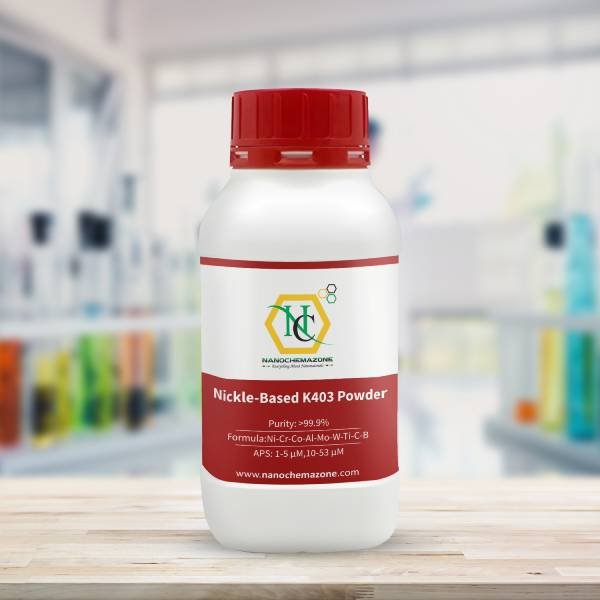
Nickel-based K403 Powder
Nickel-based K403 Powder
| Product | Nickel-based K403 Powder |
| CAS No. | 7440-02-0 |
| Appearance | Gray Powder |
| Purity | ≥99%, ≥99.9%, ≥95%(Other purities are also available) |
| APS | 1-5 µM, 10-53 µM (Can be customized), Ask for other available size range. |
| Ingredient | Ni-Cr-Co-Al-Mo-W-Ti-C-B |
| Density | 8.2g/cm3 |
| Molecular Weight | N/A |
| Product Codes | NCZ-DCY-294/25 |
Nickel-based K403 Description:
Nickel-based K403 Powder is one of the numerous advanced ceramic materials manufactured by Nanochemazone. Nanochemazone produces too many standard grades when applicable, including Mil Spec (military grade); ACS, Reagent and Technical Grade; Food, Agricultural and Pharmaceutical Grade; Optical Grade, USP and EP/BP (European Pharmacopoeia/British Pharmacopoeia) and follows applicable ASTM testing standards. Typical and custom packaging is available. Additional technical, research and safety (MSDS) information are available. Please request a quote above for more information on lead time and pricing
Nickel-based K403 Powder Related Information :
Storage Conditions:
Airtight sealed, avoid light and keep dry at room temperature.
Please contact us for customization and price inquiry
Email: contact@nanochemazone.com
Note: We supply different size ranges of Nano and micron as per the client’s requirements and also accept customization in various parameters.
Nickel-based K403 Powder
K403 powder is a nickel-chromium-iron-molybdenum alloy powder. It offers excellent resistance to oxidation, corrosion and thermal fatigue cracking. K403 has good phase stability at high temperatures. K403 powder is designed for protective coatings, thermal spray, welding, brazing, and other high temperature applications.
Overview of Nickel-based K403 Powder
K403 powder is a nickel-chromium-iron-molybdenum alloy powder. It offers excellent resistance to oxidation, corrosion and thermal fatigue cracking. K403 has good phase stability at high temperatures.
Key features of K403 powder include:
Outstanding high temperature strength and creep resistance
Resists oxidation and hot corrosion up to 1150°C
Retains properties under cyclic heating conditions
Compatible coefficient of expansion with common alloys
Available in various size ranges and morphologies
K403 powder is designed for protective coatings, thermal spray, welding, brazing, and other high temperature applications.
This article provides a detailed look at the composition, properties, applications, specifications, pricing, safety, and other essential information about nickel-based K403 powder.
Composition of Nickel-based K403 Powder
The typical composition of nickel-based K403 powder is:
| Element | Composition |
| Nickel (Ni) | Balance |
| Chromium (Cr) | 21-23% |
| Iron (Fe) | 17-20% |
| Molybdenum (Mo) | 8-10% |
| Tungsten (W) | 1-2% |
| Manganese (Mn) | ≤0.5% |
| Silicon (Si) | ≤0.5% |
| Carbon (C) | ≤0.1% |
Nickel gives corrosion resistance. Chromium and iron provide oxidation resistance. Molybdenum and tungsten impart strength at high temperatures.
The exact composition is tailored based on the powder production method and application requirements.
Properties of Nickel-based K403 Powder
K403 powder exhibits the following properties:
| Property | Details |
| Density | 8.2 g/cm3 |
| Melting Point | 1350-1400°C |
| Thermal Conductivity | 11 W/m.K |
| Electrical Resistivity | 94 microhm-cm |
| Young’s Modulus | 207 GPa |
| Poisson’s Ratio | 0.29-0.30 |
| Tensile Strength | ≥ 550 MPa up to 1050°C |
| Elongation | 15-25% |
| Hardness | 30-35 HRC |
| Oxidation Resistance | Excellent isothermal up to 1150°C |
The alloy maintains high strength and hardness at elevated temperatures. It has good ductility for deformation processing. The material resists thermal fatigue cracking.
Applications of Nickel-based K403 Powder
Nickel-based K403 powder is designed for use in high temperature environments. Typical applications include:
Thermal Spray Coatings: Used to apply thick coatings resistant to wear, corrosion and oxidation at high temperatures via wire/powder flame or electric arc spraying.
Welding: Used as filler material for joining high temperature alloys providing oxidation and corrosion resistance.
Brazing: Excellent filler alloy for brazing assemblies operating at over 1000°C like turbine components, heat exchangers etc.
Additive Manufacturing: Selective laser melting and other powder bed fusion processes can utilize K403 powder to fabricate parts.
Gas Turbines: Powder metallurgy turbine components exposed to hot gas paths like blades, vanes, seals.
Chemical Industry: K403 coated components in fluidized bed reactors, heat exchangers, cyclone separators.
Glass Industry: Powder sprayed rolls, guides, baffles used in glass melting furnaces and forehearths.
Heat Treatment: Fixtures, trays, baskets operating under high temperature applications.
Specifications and Grades of K403 Powder
K403 powder is available in various size ranges, morphologies and grades:
Particle Size: Ranging from 10-45 microns for AM methods, up to 150 microns for thermal spray processes.
Morphology: Spherical, irregular and dendritic particle shapes available. Spherical powders have better flowability.
Grades: Powder can be tailored as per AMS 7875, AMS 5887 or other high temperature alloy specifications.
Purity: High purity argon gas atomized powder available for critical applications.
Customization: Alloy chemistry and particle characteristics can be customized as per application requirements.
Health and Safety Considerations for K403 Powder
As a metallic alloy powder, K403 poses some health and safety risks:
Fine powders can be a dust explosion hazard. Prevent dust accumulation and ignition sources.
May cause skin and eye irritation upon prolonged exposure. Use personal protective equipment.
Inhalation must be avoided. Use respiratory protection while handling powder.
Powder may catalyze reactions with oxidizers. Prevent contact between incompatible materials.
Proper grounding of equipment, ventilation, hygiene practices essential when handling the powder.
Refer to applicable safety data sheets from suppliers for complete health hazard information.
Safety procedures for metallic powders like inert gas gloveboxes, explosion suppression systems may be implemented for worker protection.
Inspection and Testing of K403 Powder
To ensure the K403 nickel alloy powder conforms to specifications, various tests and inspections should be performed:
Chemical Composition – Verify composition of major alloying elements using optical emission or X-ray fluorescence spectroscopy.
Particle Size Distribution – Assess particle size range as per ASTM B822 standard using laser diffraction.
Morphology – Inspect particle shape and surface defects under SEM. Check for satellites, porosity.
Flow Rate – Evaluate flowability and apparent density as per ASTM B213 using Hall flowmeter.
Impurities – Measure oxygen and nitrogen content using inert gas fusion analysis. Minimize impurities.
Microstructure – Check phases present using X-ray diffraction analysis.
Mechanical Properties – Perform tensile and hardness testing for powder metallurgy parts.
Qualification and batch testing ensures consistent powder quality and performance.
Comparison of K403 Powder with IN738 Powder
K403 and IN738 are two alloy powders used for high temperature applications:
| Parameter | K403 Powder | IN738 Powder |
| Composition | Ni-Cr-Fe-Mo | Ni-Cr-Co-Al-Ti |
| Oxidation Resistance | Excellent up to 1150°C | Very Good up to 1100°C |
| Cost | Higher | Lower |
| Phase Stability | Very Good | Poor |
| Mechanical Strength | High up to 1050°C | Good up to 750°C |
| Fabrication | Medium | Easy |
| Applications | Thermal spray, welding | Turbine components, AM parts |
| Availability | Moderate | Readily available |
For extreme temperatures exceeding 1100°C requiring phase stability, K403 is preferred despite higher cost. IN738 offers easier fabrication and lower cost.
FAQs
Q: What is nickel-based K403 powder used for?
A: K403 powder is designed for high temperature applications like thermal spray coatings, brazing, welding, additive manufacturing where oxidation and corrosion resistance up to 1150°C is required.
Q: What particle size is used for thermal spraying K403 powder?
A: Coarser K403 powder up to 150 microns is commonly used for thermal spray processes like wire arc spraying to maximize deposition efficiency and coating thickness.
Q: Is K403 suitable for laser powder bed fusion additive manufacturing?
A: Yes, fine K403 powder can be used in selective laser melting machines to fabricate complex geometry parts that perform well in high temperature environments.
Q: How does K403 compare with Haynes 214 alloy?
A: K403 has slightly better high temperature strength and oxidation resistance than Haynes 214. But Haynes 214 offers excellent fabrication characteristics and lower cost.
Q: What are the main health hazards of K403 powder?
A: Fine K403 powder poses dust explosion risks. It can also irritate skin and eyes. Inhalation must be prevented. Use proper protective equipment when handling K403 powder.
Q: Where can I purchase K403 powder for high temperature brazing application?
A: Leading suppliers like Nanochemazone Supply carry K403 nickel alloy powder suitable for high temperature brazing. Consider recommended particle size and purity levels based on your specific application.

Reviews
There are no reviews yet.