
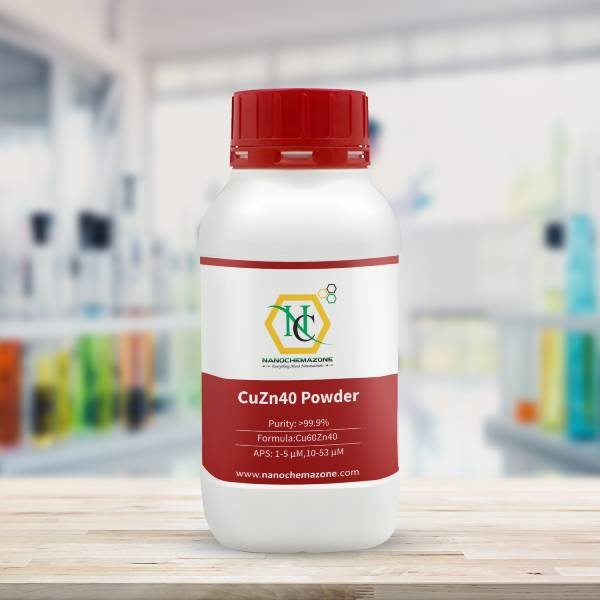


CuZn40 Powder
$0.00
CuZn40 Powder
| Product | CuZn40 Powder |
| CAS No. | 7440-50-8 |
| Appearance | Yellowish Metallic Powder |
| Purity | ≥99%, ≥99.9%, ≥95%(Other purities are also available) |
| APS | 1-5 µM, 10-53 µM (Can be customized), Ask for other available size range. |
| Ingredient | Cu60Zn40 |
| Density | 8.4-8.7g/cm3 |
| Molecular Weight | N/A |
| Product Codes | NCZ-DCY-221/25 |
CuZn40 Description:
CuZn40 Powder is one of the numerous advanced ceramic materials manufactured by Nanochemazone. Nanochemazone produces too many standard grades when applicable, including Mil Spec (military grade); ACS, Reagent and Technical Grade; Food, Agricultural and Pharmaceutical Grade; Optical Grade, USP and EP/BP (European Pharmacopoeia/British Pharmacopoeia) and follows applicable ASTM testing standards. Typical and custom packaging is available. Additional technical, research and safety (MSDS) information are available. Please request a quote above for more information on lead time and pricing
CuZn40 Powder Related Information :
Storage Conditions:
Airtight sealed, avoid light and keep dry at room temperature.
Please contact us for customization and price inquiry
Email: contact@nanochemazone.com
Note: We supply different size ranges of Nano and micron as per the client’s requirements and also accept customization in various parameters.
and micron as per the client’s requirements and also accept customization in various parameters.
CuZn40 Powder
CuZn40, also known as brass powder, is a copper-zinc alloy composed of 40% zinc and remainder copper. It offers an excellent combination of strength, ductility, corrosion resistance, machinability, and economical pricing making it one of the most widely used alloy powders.
CuZn40 Powder Overview
CuZn40, also known as brass powder, is a copper-zinc alloy composed of 40% zinc and remainder copper. It offers an excellent combination of strength, ductility, corrosion resistance, machinability, and economical pricing making it one of the most widely used alloy powders.
CuZn40 Powder Composition
The composition of CuZn40 brass powder is:
| Element | Composition |
| Copper (Cu) | Balance |
| Zinc (Zn) | 39-41% |
Copper forms the primary matrix imparting ductility and corrosion resistance.
Zinc provides solid solution strengthening and improves machinability.
This composition is referred as ‘Free machining brass’ or ‘High machinability brass’ owing to the enhancements from the 40% zinc content.
Small additions of lead up to 0.5% may be present in some varieties to further augment machinability. Lead-free CuZn40 powder is preferred for food contact and environmental safety.
Properties of CuZn40 Powder
CuZn40 powder offers a versatile mix of properties making suitable for wide usage across industries:
| Property | Value |
| Density | 8.4-8.8 g/cm3 |
| Melting Point | 900-920°C |
| Electrical Conductivity | 26% IACS |
| Thermal Conductivity | 120 W/m-K |
| Coefficient of Thermal Expansion | 20 x 10<sup>-6</sup> /°C |
| Modulus of Elasticity | 97-110 GPa |
| Tensile Strength | 330-550 MPa |
| Elongation | 15-40% |
| Hardness | 80-90 Brinell |
| Thermal Stability | Good, up to 400°C |
Excellent formability and ductility – High elongation enables extensive cold working and forming.
Good machinability and finish – Reduction in machining forces compared to copper alloys with lower or no zinc.
High strength – Up to twice the strength of copper due to zinc in solid solution.
Corrosion resistant -Forms protective oxide layer in atmosphere. Better than plain carbon steels.
Non-magnetic – Suitable for applications requiring minimal magnetic properties.
Good thermal stability – Dimensions stable during thermal cycling up to 400°C range.
This combination of strength, ductility, thermal and electrical properties makes CuZn40 suitable for wide usage in electrical, automotive, marine and industrial applications.
Applications of CuZn40 Powder
The versatile properties of CuZn40 powder make suitable for the following applications:
| Application | Benefits |
| Electrical connectors | High strength, good conductivity, corrosion resistance |
| Fasteners, gears | Good machinability, wear resistance |
| Bearings, bushings | Compatible with rotating shafts, good lubricity |
| Welding rods | Compatibility with steel, good brazeability |
| Decorative parts | Attractive gold color, good finish |
| Thermal management | Higher thermal conductivity than steels |
Electrical connectors and contacts – Used widely in pins, connectors due to strength, conductivity and cost advantage over alternatives.
Machined parts – Suitable for nuts, bolts, gears, valves etc. owing to excellent machinability.
Bearings and bushings – Compatible with steel shafts while providing good wear resistance and lubricity.
Welding consumables – Popular in Cu-Zn filler rods and brazing alloys to join steel components.
Decorative accessories – Provides aesthetic gold finish for decorative parts and jewelry.
Thermal components – Used in heat exchangers and thermal management parts leveraging its higher thermal conductivity.
CuZn40 powder is widely accepted across industrial sectors owing to its versatile properties, performance and economical pricing.
CuZn40 Powder Specifications
CuZn40 powder is available in various size ranges, shapes and purity levels:
| Specification | Options |
| Particle size distribution | 10 – 150 microns |
| Mean particle size | 20, 45, 60, 100 microns |
| Powder shape | Irregular, spherical |
| Apparent density | Up to 75% theoretical |
| Flow rate | Up to 25 s/50g |
| Purity | Up to 99.9% |
| Alloy variants | CuZn10, CuZn30, CuZn37 |
Smaller particle sizes below 45 microns allow greater densification but reduces flowability.
Spherical powder provides better flow and packing density suited for additive manufacturing.
Higher apparent density and flow rates improve powder handling and processing.
High purity variants available for more demanding applications.
Range of zinc levels between 10-40% available for varying strength-ductility.
CuZn40 powder can be customized in terms of particle size, shape, density, flow characteristics and alloy composition based on application requirements.
Consolidation Methods for CuZn40 powder
CuZn40 powder can be processed into full density components using techniques like:
| Method | Details |
| Compaction + Sintering | Older economical method with shape limits. |
| Metal Injection Molding (MIM) | Net shape parts with excellent precision and surface finish. |
| Additive Manufacturing | Direct printing of complex, dense parts from CAD models. |
| Hot Extrusion | For simple, axisymmetric shapes like rods and tubes. |
| Roll compaction | For sheet and strips requiring good ductility. |
Pressing followed by sintering is commonly used but requires secondary processing for full densification.
MIM offers highest precision and surface finish but needs high volumes to justify tooling costs.
Additive manufacturing methods like binder jetting and fused deposition modeling are gaining popularity for design flexibility.
Extrusion and rolling well suited for simple geometries like bars, sheets etc. leveraging ductility.
The consolidation method controls final properties like density, precision, surface finish and microstructure.
Heat Treatment of CuZn40 Parts
Heat treatment of CuZn40 parts helps tailor a range of mechanical properties:
| Heat Treatment | Purpose |
| Solution annealing | Restores ductility after cold working |
| Stress relieving | Removes residual stresses |
| Precipitation hardening | Strengthening by aging after solutionizing |
Annealing at 700-900°C followed by slow cooling softens the alloy by removing effects of cold work allowing further forming.
Low temperature age hardening in 150-350°C range causes precipitation of copper-rich phase increasing strength up to 50% but with loss of ductility.
Stress relieving around 300-500°C helps reduce residual stresses from prior shaping.
Heat treatment expands the versatility of CuZn40 alloy by enabling property enhancements as per application needs.
Comparison of CuZn40 with Alternatives
Here is how CuZn40 compares to other popular copper alloy powders:
| Alloy | CuZn40 | CuSn6 | CuNi18Zn20 | Bronze |
| Strength | High | Medium | Highest | Medium |
| Ductility | High | Medium | Low | Medium |
| Corrosion Resistance | Good | Excellent | Excellent | Excellent |
| Thermal Conductivity | 120 W/m-K | 50 W/m-K | 20 W/m-K | 60 W/m-K |
| Cost | Low | High | High | Medium |
CuSn6 has superior corrosion resistance but lower strength and thermal conductivity. More expensive.
CuNi18Zn20 has the highest strength but lowest ductility and thermal conductivity.
Bronzes like CuSn10 offer excellent corrosion resistance but only moderate strength.
CuZn40 provides the most balanced overall properties and has the lowest cost.
Owing to its well-rounded properties, excellent formability, machinability and low cost, CuZn40 is the most popular copper alloy powder for wide usage across industrial segments.
Health and Safety Precautions for CuZn40 Powder
Like any fine metal powder, CuZn40 powder requires safe handling:
| Hazard | Precautions | PPE |
| Inhalation | Avoid breathing powder dust. Ensure ventilation | Respirator mask |
| Skin contact | Wear gloves. Wash after contact. | Gloves |
| Eye contact | Wear safety glasses. Rinse if contacted. | Safety goggles |
| Ingestion | Avoid hand-mouth contact. Wash hands. | – |
| Dust explosion | Avoid powder clouds. Ground equipment. | – |
Use PPE – respirator, gloves, goggles when handling powder.
Avoid skin contact. Wash after exposure.
Store sealed containers away from sparks, flames.
Ensure proper ventilation and dust collection.
Refer SDS and local regulations for complete safety guidelines.
Proper precautions and PPE during storage, handling and processing minimize health and safety risks.
Inspection and Testing of CuZn40 Powder
To ensure quality, CuZn40 powder should be tested as follows:
| Parameter | Method | Specification |
| Chemical composition | Combustion analysis or XRF | Zn 40% ± 1%, Pb < 1000 ppm |
| Particle size distribution | Sieving, laser diffraction | D10, D50, D90 within range |
| Apparent density | Hall flowmeter | Minimum specified |
| Flow rate | Hall flowmeter | Maximum specified |
| Impurities | ICP or LECO analysis | Low oxygen and nitrogen |
Routine testing as per ASTM standards ensures consistency in production and high quality powder suitable for end applications.
Buyers must insist on quality certificates from reputable manufacturers. In-house testing periodically is also recommended.
FAQs
- What is CuZn40 used for?
- CuZn40 finds wide usage in electrical connectors, plumbing fittings, gears, decorative parts etc. leveraging its strength, ductility, corrosion resistance and machinability.
- What is the difference between regular and leaded brass alloy?
- Leaded brass contains a small amount of lead up to 3% to enhance machinability while regular brass is lead-free. Lead-free is preferred for food contact and environmental safety reasons.
- Does CuZn40 require heat treatment?
- Optional heat treatment can be done to soften and restore ductility via annealing or to strengthen by precipitation hardening.
- What methods are used to make parts from CuZn40 powder?
- Compaction followed by sintering, metal injection molding and additive manufacturing processes like binder jetting and FDM are popular techniques to consolidate CuZn40 powder into dense components.
- Is CuZn40 powder safe to handle?
- Like any fine metal powder, precautions should be taken to avoid inhalation and skin contact. Proper ventilation, PPE and safe handling procedures minimize risks.
Description
Note: For pricing & ordering information, please get in touch with us at sales@nanochemazone.com
Please contact us for quotes on Larger Quantities and customization. E-mail: contact@nanochemazone.com
Customization:
If you are planning to order large quantities for your industrial and academic needs, please note that customization of parameters (such as size, length, purity, functionalities, etc.) is available upon request.
NOTE:
Images, pictures, colors, particle sizes, purity, packing, descriptions, and specifications for the real and actual goods may differ. These are only used on the website for the purposes of reference, advertising, and portrayal. Please contact us via email at sales@nanochemazone.com or by phone at (+1 780 612 4177) if you have any questions.
Only logged in customers who have purchased this product may leave a review.
Related products

17-4PH Stainless Steel Powder
17-4PH Stainless Steel Powder
| Product | 17-4PH Stainless Steel Powder |
| CAS No. | 69139-99-1 |
| Appearance | Metallic Powder |
| Purity | ≥99%, ≥99.9%, ≥95%(Other purities are also available) |
| APS | 1-5 µM, 10-53 µM (Can be customized), Ask for other available size range. |
| Ingredient | Fe-Cr-Ni-Cu-Nb |
| Density | 7.75-7.85g/cm3 |
| Molecular Weight | N/A |
| Product Codes | NCZ-DCY-200/25 |
17-4PH Stainless Steel Description:
17-4PH Stainless Steel Powder is one of the numerous advanced ceramic materials manufactured by Nanochemazone. Nanochemazone produces too many standard grades when applicable, including Mil Spec (military grade); ACS, Reagent and Technical Grade; Food, Agricultural and Pharmaceutical Grade; Optical Grade, USP and EP/BP (European Pharmacopoeia/British Pharmacopoeia) and follows applicable ASTM testing standards. Typical and custom packaging is available. Additional technical, research and safety (MSDS) information are available. Please request a quote above for more information on lead time and pricing
17-4PH Stainless Steel Powder Related Information :
Storage Conditions:
Airtight sealed, avoid light and keep dry at room temperature.
Please contact us for customization and price inquiry
Email: contact@nanochemazone.com
Note: We supply different size ranges of Nano and micron as per the client’s requirements and also accept customization in various parameters.
Best 17-4PH stainless steel powder for 3D Printing
17-4PH powder, also known as 17-4 Precipitation Hardening stainless steel powder, is a high-strength, corrosion-resistant material used in various industries. It belongs to the martensitic stainless steel family and offers an excellent combination of mechanical properties and corrosion resistance. The “17-4PH” designation refers to the composition of the alloy, which consists of approximately 17% chromium, 4% nickel, 4% copper, and a small amount of other elements.
Overview of 17-4PH Stainless Steel Powder for 3D Printing
17-4PH is a precipitation hardening stainless steel powder widely used for additive manufacturing of high-strength, corrosion-resistant components across aerospace, medical, automotive, and general engineering applications.
This article provides a detailed guide to 17-4PH powder for 3D printing. It covers composition, properties, print parameters, applications, specifications, suppliers, handling, inspection, comparisons, pros and cons, and FAQs. Key information is presented in easy-to-reference tables.
Composition of 17-4PH Powder
17-4PH is a chromium-copper precipitation hardening stainless steel with a composition of:
| Element | Weight % | Purpose |
| Iron | Balance | Principal matrix element |
| Chromium | 15 – 17.5 | Oxidation resistance |
| Copper | 3 – 5 | Precipitation hardening |
| Nickel | 3 – 5 | Austenite stabilizer |
| Niobium | 0.15 – 0.45 | Carbide former |
| Manganese | 1 max | Deoxidizer |
| Silicon | 1 max | Deoxidizer |
| Carbon | 0.07 max | Strengthener and carbide former |
The copper provides precipitation hardening while chromium imparts corrosion resistance.
17-4PH possesses a versatile combination of properties:
| Property | Description |
| High strength | Tensile strength up to 1310 MPa in aged condition |
| Hardness | Up to 40 HRC when aged |
| Corrosion resistance | Comparable to 316L stainless in many environments |
| Toughness | Superior to martensitic stainless steels |
| Wear resistance | Better than 300 series stainless steels |
| High temperature stability | Strength maintained up to 300°C |
3D Printing Parameters for 17-4PH Powder
Typical parameters for printing 17-4PH include:
| Parameter | Typical value | Purpose |
| Layer height | 20-100 μm | Balance speed and resolution |
| Laser power | 150-400 W | Sufficient melting without evaporation |
| Scan speed | 400-1000 mm/s | Productivity vs density |
| Hatch spacing | 100-200 μm | Density and properties |
| Support structure | Minimal | Easy removal |
| Hot isostatic pressing | 1120°C, 100 MPa, 3h | Eliminate porosity |
Parameters are optimized for properties, time, and post-processing requirements.
Applications of 3D Printed 17-4PH Parts
Additively manufactured 17-4PH components are used in:
| Industry | Applications |
| Aerospace | Structural brackets, fixtures, actuators |
| Medical | Dental implants, surgical instruments |
| Automotive | High strength fasteners, gears |
| Consumer | Watch cases, sporting equipment |
| Industrial | End-use metal tooling, jigs, fixtures |
Benefits of AM include complex geometries, customization, reduced lead time and machining.
Specifications of 17-4PH Powder for 3D Printing
17-4PH powder must meet strict specifications:
| Parameter | Specification |
| Particle size range | 15-45 μm typical |
| Particle shape | Spherical morphology |
| Apparent density | > 4 g/cc |
| Tap density | > 6 g/cc |
| Hall flow rate | > 23 sec for 50 g |
| Purity | >99.9% |
| Oxygen content | <100 ppm |
Custom size distributions and controlled moisture levels available.
Handling and Storage of 17-4PH Powder
As a reactive material, 17-4PH powder requires controlled handling:
Store in cool, dry, inert environments away from moisture
Prevent oxidation and contamination during handling
Use conductive containers grounded to prevent static buildup
Avoid dust accumulation to minimize explosion risk
Local exhaust ventilation recommended
Wear PPE and avoid inhalation
Careful storage and handling ensures optimal powder condition.
Inspection and Testing of 17-4PH Powder
Quality testing methods include:
| Method | Parameters Checked |
| Sieve analysis | Particle size distribution |
| SEM imaging | Particle morphology |
| EDX | Chemistry and composition |
| XRD | Phases present |
| Pycnometry | Density |
| Hall flow rate | Powder flowability |
Testing per ASTM standards verifies powder quality and batch consistency.
Comparing 17-4PH to Alternative Powders
17-4PH compares to other alloys as:
| Alloy | Strength | Corrosion Resistance | Cost | Weldability |
| 17-4PH | Excellent | Good | Medium | Fair |
| 316L | Medium | Excellent | Medium | Excellent |
| IN718 | Good | Good | High | Fair |
| CoCr | Medium | Fair | Medium | Excellent |
With balanced properties, 17-4PH provides the best combination of strength, corrosion resistance, and cost for many applications.
Pros and Cons of 17-4PH Powder for 3D Printing
| Pros | Cons |
| High strength-to-weight ratio | Lower oxidation resistance than austenitic stainless steels |
| Good combination of strength and corrosion resistance | Required post-processing like HIP and heat treatment |
| Lower cost than exotic alloys | Controlled atmosphere storage needed |
| Established credentials in AM | Difficult to weld and machine |
| Comparable properties to wrought material | Susceptible to pitting and crevice corrosion |
17-4PH enables high-performance printed parts across industries, though not suited for extreme environments.
Frequently Asked Questions about 17-4PH Powder for 3D Printing
Q: What particle size range works best for printing 17-4PH alloy?
A: A range of 15-45 microns provides optimal powder flow while enabling high resolution and density in the printed parts.
Q: What post-processing is required after printing with 17-4PH?
A: Hot isostatic pressing and heat treatment are usually necessary to eliminate internal voids, relieve stresses, and achieve optimal properties.
Q: What material is 17-4PH most comparable to for AM applications?
A: It is closest to 316L in corrosion resistance but much stronger. 17-4PH provides the best overall combination for many high-strength applications above 300 series stainless.
Q: Does 17-4PH require supports when 3D printing?
A: Minimal supports are recommended on overhangs and complex inner channels to prevent deformation during printing and allow easy removal.
Q: What industries use additively manufactured 17-4PH components?
A: Aerospace, medical, automotive, industrial tooling, and consumer products are the major application areas benefitting from 3D printed 17-4PH parts.
Q: What accuracy and finish is achievable with 17-4PH AM parts?
A: After post-processing, 17-4PH printed components can achieve dimensional tolerances and surface finish comparable to CNC machined parts.
Q: What density can be expected with optimized 17-4PH prints?
A: Densities exceeding 99% are routinely achieved with 17-4PH using ideal parameters tailored for the alloy, matching wrought properties.
Q: Is 17-4PH compatible with powder bed fusion processes?
A: Yes, it can be processed using selective laser melting (SLM), direct metal laser sintering (DMLS), and electron beam melting (EBM).
Q: What defects can occur when printing 17-4PH components?
A: Potential defects are cracking, distortion, porosity, incomplete fusion, and surface roughness. They can be minimized through optimized print parameters.
Q: Can support structures be removed easily from 17-4PH printed parts?
A: Properly designed minimal supports are easy to detach given the excellent mechanical properties of the alloy in the aged condition.

317L Powder
317L Powder
| Product | 317L Powder |
| CAS No. | 12597-67-6 |
| Appearance | Silvery Powder |
| Purity | ≥99%, ≥99.9%, ≥95%(Other purities are also available) |
| APS | 1-5 µM, 10-53 µM (Can be customized), Ask for other available size range. |
| Ingredient | Fe-18Cr-12Ni-3Mo |
| Density | 7.9g/cm3 |
| Molecular Weight | 150-160 g/mol |
| Product Codes | NCZ-DCY-172/25 |
317L Description:
317L Powder is one of the numerous advanced ceramic materials manufactured by Nanochemazone. Nanochemazone produces too many standard grades when applicable, including Mil Spec (military grade); ACS, Reagent and Technical Grade; Food, Agricultural and Pharmaceutical Grade; Optical Grade, USP and EP/BP (European Pharmacopoeia/British Pharmacopoeia) and follows applicable ASTM testing standards. Typical and custom packaging is available. Additional technical, research and safety (MSDS) information are available. Please request a quote above for more information on lead time and pricing
317L Powder Related Information :
Storage Conditions:
Airtight sealed, avoid light and keep dry at room temperature.
Please contact us for customization and price inquiry
Email: contact@nanochemazone.com
Note: We supply different size ranges of Nano and micron as per the client’s requirements and also accept customization in various parameters.
317L Powder
317L powder is an austenitic stainless steel powder containing 18% chromium, 3% molybdenum, and 0.08% carbon. It offers an excellent combination of corrosion resistance, strength, weldability and cost.
Overview of 317L Powder
317L powder is an austenitic stainless steel powder containing 18% chromium, 3% molybdenum, and 0.08% carbon. It offers an excellent combination of corrosion resistance, strength, weldability and cost.
Key properties and advantages of 317L powder include:
317L Powder Properties and Characteristics
| Properties | Details |
| Composition | Fe-18Cr-3Mo-0.08C alloy |
| Density | 8.0 g/cc |
| Particle shape | Irregular, angular |
| Size range | 10-150 microns |
| Apparent density | Up to 50% of true density |
| Flowability | Moderate |
| Corrosion resistance | Excellent in many environments |
| Strengthening | Cold working and solid solution strengthening |
317L powder is widely used in chemical processing, marine applications, pulp and paper industry, nuclear power generation, and architectural features needing weathering resistance.
317L Powder Composition
| Element | Weight % |
| Iron (Fe) | Balance |
| Chromium (Cr) | 17-19% |
| Nickel (Ni) | 11-15% |
| Molybdenum (Mo) | 2.5-3.5% |
| Manganese (Mn) | <2% |
| Carbon (C) | 0.08% max |
| Silicon (Si) | 1% max |
| Nitrogen (N) | 0.10% max |
| Sulfur (S) | 0.03% max |
Iron provides the ferritic matrix and ductility
Chromium enhances corrosion and oxidation resistance
Nickel stabilizes the austenitic structure
Molybdenum further improves pitting resistance
Carbon, nitrogen and sulfur controlled as tramp elements
317L Powder Physical Properties
| Property | Values |
| Density | 8.0 g/cc |
| Melting point | 1370-1400°C |
| Electrical resistivity | 0.8 μΩ-m |
| Thermal conductivity | 16 W/mK |
| Thermal expansion | 16 x 10^-6 /K |
| Maximum service temperature | 900°C |
High density compared to ferritic stainless steels
Maintains strength and corrosion resistance at elevated temperatures
Resistivity higher than pure iron or carbon steels
Lower thermal conductivity than carbon steel
Can withstand continuous service up to 900°C
The physical properties make 317L suitable for high temperature applications requiring corrosion resistance.
317L Powder Mechanical Properties
| Property | Values |
| Tensile strength | 515-620 MPa |
| Yield strength | 205-275 MPa |
| Elongation | 40-50% |
| Hardness | 88-95 HRB |
| Impact strength | 100-150 J |
| Modulus of elasticity | 190-210 GPa |
Excellent combination of strength and ductility
Can be work hardened significantly to increase strength
Very high toughness and impact strength
Strength can be further improved through cold working
Hardness is relatively low in annealed condition
The properties provide an excellent balance of strength, ductility and toughness required for many corrosive environments.
317L Powder Applications
| Industry | Example Uses |
| Chemical | Tanks, valves, pipes, pumps |
| Petrochemical | Process equipment, tubing, valves |
| Marine | Propeller shafts, fasteners, deck hardware |
| Nuclear | Reactor vessels, fuel element cladding |
| Architectural | Railings, wall panels, roofing |
Some specific product uses:
Pollution control equipment handling hot acids
Nuclear reactor internal structures
Marine propeller shafts, deck fittings
Pulp and paper industry piping, valves
Architectural paneling, roofing, cladding
Its excellent corrosion resistance combined with good manufacturability make 317L widely used across demanding industries.
317L Powder Standards
| Standard | Description |
| ASTM A276 | Standard for stainless steel bars and shapes |
| ASTM A479 | Standard for stainless steel tubing |
| AMS 5524 | Annealed stainless steel bar, wire, forgings |
| ASME SA-276 | Specification for stainless steel bars and shapes |
| AISI 630 | Standard for 17Cr-4Ni precipitation hardening stainless steel |
These standards define:
Chemical composition limits of 317L alloy
Permissible impurity levels like S, P
Required mechanical properties
Approved production methods
Compliance testing protocols
Proper packaging, labeling and documentation
Meeting certification requirements ensures suitability of the powder for the intended applications.
317L Powder Particle Size Distribution
| Particle Size | Characteristics |
| 10-45 microns | Ultrafine grade for high density and surface finish |
| 45-150 microns | Coarse grade provides good flowability |
| 15-150 microns | Standard grade for pressing and sintering |
Finer particles allow greater densification during sintering
Coarser powder flows better and fills die cavities uniformly
Size range is tailored based on final part properties needed
Both gas and water atomized powders are available
Controlling particle size distribution allows optimizing processing behavior and final part performance.
317L Powder Apparent Density
| Apparent Density | Details |
| Up to 50% of true density | For irregular powder morphology |
| 4.5-5.5 g/cc typical | Improves with greater packing density |
Higher apparent density improves powder flow and compressibility
Irregular morphology limits maximum packing density
Values up to 60% are possible with spherical powder
High apparent density improves press filling efficiency
Higher apparent density leads to better manufacturing productivity and part quality.
317L Powder Production Method
| Method | Details |
| Gas atomization | High pressure inert gas breaks molten metal stream into fine droplets |
| Water atomization | High pressure water jet breaks metal into fine particles |
| Vacuum induction melting | High purity input materials melted under vacuum |
| Multiple remelting | Improves chemical homogenization |
| Sieving | Classifies powder into different particle size ranges |
Gas atomization provides clean, spherical powder morphology
Water atomization is a lower cost process with irregular particles
Vacuum melting and remelting minimizes gaseous impurities
Post-processing allows customization of particle sizes
Automated production and stringent quality control result in consistent powder suitable for critical applications.
317L Powder Handling and Storage
| Recommendation | Reason |
| Use PPE and ventilation | Avoid exposure to fine metallic particles |
| Ensure proper grounding | Prevent static discharge while handling |
| Avoid ignition sources | Powder can combust in oxygen atmosphere |
| Use non-sparking tools | Prevent possibility of ignition |
| Follow safety protocols | Reduce risk of burns, inhalation, ingestion |
| Store in stable containers | Prevent contamination or oxidation |
As 317L powder is flammable, ignition and explosion risks should be controlled during handling and storage. Otherwise it is relatively safe with proper precautions.
317L Powder Testing
| Test | Details |
| Chemical analysis | ICP and XRF verify composition |
| Particle size distribution | Laser diffraction determines size distribution |
| Apparent density | Hall flowmeter test per ASTM B212 standard |
| Powder morphology | SEM imaging shows particle shape |
| Flow rate analysis | Gravity flow rate through specified nozzle |
| Loss on ignition | Determines residual moisture content |
Stringent testing ensures the powder meets the required chemical purity, particle characteristics, density, morphology, and flowability per applicable specifications.
317L Powder Pros and Cons
Advantages of 317L Powder
Excellent corrosion resistance in many environments
High temperature strength and oxidation resistance
Good ductility, toughness and weldability
More cost-effective than high nickel austenitic grades
Readily formable using conventional techniques
Can be work hardened through cold/warm working
Disadvantages of 317L Powder
Lower high temperature creep strength than some ferritic grades
Lower hardness and wear resistance than martensitic grades
Susceptible to chloride stress corrosion cracking
Requires post weld annealing to prevent sensitization
Limited cold heading and forming capability
Surface discoloration over time in outdoor exposure
Comparison With 316L Powder
317L vs 316L Stainless Steel Powder
| Parameter | 317L | 316L |
| Density | 8.0 g/cc | 8.0 g/cc |
| Strength | 515-620 MPa | 485-550 MPa |
| Corrosion resistance | Excellent | Outstanding |
| Pitting resistance | Very good | Excellent |
| Cost | Low | High |
| Uses | Process industry, marine | Chemical, pharmaceutical |
317L provides higher strength at lower cost
316L offers better pitting corrosion resistance
317L has good chloride stress corrosion resistance
316L preferred for ultra-corrosive environments
317L suited for marine applications and nuclear industry
317L Powder FAQs
Q: What are the main applications of 317L stainless steel powder?
A: Main applications include chemical processing, petrochemical, marine, nuclear, pulp & paper, and architectural. It is used for equipment like tanks, valves, pipes, pumps, shafts, and cladding.
Q: What precautions should be taken when handling 317L powder?
A: Recommended precautions include ventilation, grounding, avoiding ignition sources, using non-sparking tools, protective gear, safe storage, and controlling dust exposure.
Q: How does molybdenum improve the corrosion resistance of 317L?
A: Molybdenum enhances pitting and crevice corrosion resistance in chloride environments. It stabilizes the passive film protecting the surface.
Q: What is the main difference between 304L and 317L stainless steel powder?
A: 317L contains 3% molybdenum giving it significantly better corrosion resistance compared to 304L, especially in marine and other chloride environments.

Al 3003 Powder
Al 3003 Powder
| Product | Al 3003 Powder |
| CAS No. | 7429-90-5 |
| Appearance | Gray Metallic Powder |
| Purity | ≥99%, ≥99.9%, ≥95%(Other purities are also available) |
| APS | 1-5 µM, 10-53 µM (Can be customized), Ask for other available size range. |
| Ingredient | Al-1.2Mn-0.12Cu |
| Density | 2.73g/cm3 |
| Molecular Weight | 27g/mol |
| Product Codes | NCZ-DCY-179/25 |
Al 3003 Description:
Al 3003 Powder is one of the numerous advanced ceramic materials manufactured by Nanochemazone. Nanochemazone produces too many standard grades when applicable, including Mil Spec (military grade); ACS, Reagent and Technical Grade; Food, Agricultural and Pharmaceutical Grade; Optical Grade, USP and EP/BP (European Pharmacopoeia/British Pharmacopoeia) and follows applicable ASTM testing standards. Typical and custom packaging is available. Additional technical, research and safety (MSDS) information are available. Please request a quote above for more information on lead time and pricing
Al 3003 Powder Related Information :
Storage Conditions:
Airtight sealed, avoid light and keep dry at room temperature.
Please contact us for customization and price inquiry
Email: contact@nanochemazone.com
Note: We supply different size ranges of Nano and micron as per the client’s requirements and also accept customization in various parameters.
Al 3003 powder
Al 3003 powder is an aluminum alloy powder composed mainly of aluminum and manganese. It belongs to the 3xxx series of aluminum alloys, which are known for their excellent workability and corrosion resistance. The powder form allows for easy handling and processing, making it suitable for various manufacturing techniques.
Overview of Al 3003 Powder
Al 3003 or 3A21 aluminum is a wrought alloy known for its good cold formability, weldability and corrosion resistance. The manganese additions enhance strength through solid solution strengthening while maintaining workability.
Key characteristics of Al 3003 powder include:
Moderate strength with good ductility
Excellent formability and weldability
Good corrosion resistance
High thermal and electrical conductivity
Low density
Available in a range of powder sizes and shapes
Al 3003 powder is used widely in chemical tanks, pipeline, automotive parts, heat exchangers, utensils, and other applications needing moderate strength, formability and corrosion resistance.
Chemical Composition of Al 3003 Powder
| Element | Weight % |
| Aluminum (Al) | Balance |
| Manganese (Mn) | 1.0-1.5% |
| Iron (Fe) | 0.7% max |
| Silicon (Si) | 0.6% max |
| Copper (Cu) | 0.05-0.20% |
| Zinc (Zn) | 0.10% max |
| Magnesium (Mg) | 0.10% max |
| Chromium (Cr) | 0.10% max |
Properties of Al 3003 Powder
| Property | Value |
| Density | 2.73 g/cm3 |
| Melting Point | 645-650°C |
| Thermal Conductivity | 180 W/mK |
| Electrical Conductivity | 43-44% IACS |
| Young’s Modulus | 68-72 GPa |
| Poisson’s Ratio | 0.33 |
| Tensile Strength | 145-185 MPa |
| Yield Strength | 110-140 MPa |
| Elongation | 12-20% |
| Hardness | 35-55 Brinell |
The alloy offers moderate strength with excellent ductility and formability. It has good resistance to atmospheric corrosion. Thermal and electrical conductivity is high.
Production Method for Al 3003 Powder
Commercial production processes used for Al 3003 powder include:
Gas Atomization – Molten alloy stream disintegrated by high pressure inert gas jets into fine spherical powders.
Water Atomization – High velocity water jet impacts and disintegrates molten metal stream to produce fine powders.
Mechanical Milling – Ball milling of aluminum flakes/powders to achieve finer particle sizes and powder characteristics.
Electrolysis – Aluminum produced through electrolysis process and ground to fine powder. Lower purity.
Gas atomization provides the best control over particle size distribution, morphology and microstructure of the powder.
Applications of Al 3003 Powder
Additive Manufacturing – Selective laser melting, binder jetting and other 3D printing processes to produce complex components.
Powder Metallurgy – Compaction and sintering to create parts with good mechanical properties and machinability.
Metal Injection Molding – To manufacture small intricate components for automotive and electronics industry.
Thermal Spraying – Wire arc spraying to deposit Al 3003 coatings offering moderate wear and corrosion resistance.
Welding Filler – Used as filler wire for arc welding and repair of aluminum components.
Pigments – Used in paints and coatings to provide luster and corrosion protection.
Pyrotechnics – Added to pyrotechnic compositions as fuel due to flammability of aluminum.
Specifications of Al 3003 Powder
Al 3003 powder is available under different size ranges, shapes and purity levels:
Particle Size: From 10-150 microns for AM methods, up to 300 microns for thermal spray.
Morphology: Spherical, granular, flake and irregular particle shapes. Smooth powder flows better.
Purity: From commercial to high purity (99.8%) grades tailored for applications.
Flowability: Powder customized for flow rates above 25 s/50 g.
Grades: Conforming to ASTM B209, EN 573-3, ISO 209:2007 etc. Custom grades offered.
Storage and Handling of Al 3003 Powder
Al 3003 powder should be properly stored and handled to prevent:
Oxidation and reaction with moisture
Dust explosions from powder ignition
Inhalation of fine powder causing health issues
Safety practices advised by supplier should be followed
Inert gas storage, adequate ventilation, grounding, and PPE is recommended when handling the powder.
Testing and Characterization Methods
Key test methods used for Al 3003 powder include:
Chemical analysis using OES or XRF for composition
Particle size distribution as per ASTM B822 standard
Morphology analysis through SEM imaging
Flow rate measurement using Hall flow funnel
Density determination by helium pycnometry
Impurities testing by ICP-MS
Microstructure examination by X-ray diffraction
These testing methods ensure reliable and consistent quality of the aluminum alloy powder.
Comparison Between Al 3003 and Al 6061 Powders
Al 3003 and Al 6061 are two aluminum alloy powders compared:
| Parameter | Al 3003 | Al 6061 |
| Alloy type | Non-heat treatable | Heat treatable |
| Mn content | 1.0-1.5% | 0.15% max |
| Mg content | 0.1% max | 0.8-1.2% |
| Strength | Moderate | Higher |
| Corrosion resistance | Good | Excellent |
| Weldability | Excellent | Good |
| Cost | Lower | Higher |
| Applications | Chemical tanks, utensils | Aerospace, automotive parts |
Al 6061 offers higher strength while Al 3003 provides better weldability and formability at a lower cost.
Al 3003 Powder FAQs
Q: How is Al 3003 powder produced?
A: Al 3003 powder is commercially produced using gas atomization, water atomization, mechanical milling, and electrolysis processes. Gas atomization offers the best control of particle characteristics.
Q: What are the main applications for Al 3003 powder?
A: Key applications include additive manufacturing, thermal spraying, powder metallurgy, metal injection molding, welding filler, pigments, and pyrotechnic compositions.
Q: What is the typical Al 3003 powder size used for laser sintering?
A: For selective laser sintering process, the common Al 3003 powder size range is 20-53 microns with spherical morphology for optimal powder bed density.
Q: Does Al 3003 powder require any special handling precautions?
A: Yes, aluminum powders can be flammable and pose explosion risks. It is recommended to handle them carefully under inert atmosphere using proper grounding, ventilation and PPE.
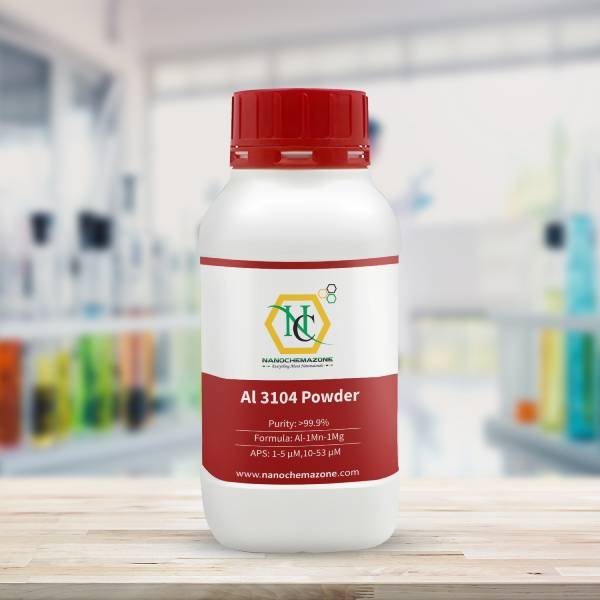
Al 3104 Powder
Al 3104 Powder
| Product | Al 3104 Powder |
| CAS No. | 7429-90-5 |
| Appearance | Silvery-Gray Metallic Powder |
| Purity | ≥99%, ≥99.9%, ≥95%(Other purities are also available) |
| APS | 1-5 µM, 10-53 µM (Can be customized), Ask for other available size range. |
| Ingredient | Al-1Mn-1Mg |
| Density | 2.72g/cm3 |
| Molecular Weight | 27g/mol |
| Product Codes | NCZ-DCY-183/25 |
Al 3104 Description:
Al 3104 Powder is one of the numerous advanced ceramic materials manufactured by Nanochemazone. Nanochemazone produces too many standard grades when applicable, including Mil Spec (military grade); ACS, Reagent and Technical Grade; Food, Agricultural and Pharmaceutical Grade; Optical Grade, USP and EP/BP (European Pharmacopoeia/British Pharmacopoeia) and follows applicable ASTM testing standards. Typical and custom packaging is available. Additional technical, research and safety (MSDS) information are available. Please request a quote above for more information on lead time and pricing
Al 3104 Powder Related Information :
Storage Conditions:
Airtight sealed, avoid light and keep dry at room temperature.
Please contact us for customization and price inquiry
Email: contact@nanochemazone.com
Note: We supply different size ranges of Nano and micron as per the client’s requirements and also accept customization in various parameters.
Al 3104 powder
Al 3104 powder is an aluminum alloy composed primarily of aluminum (Al) with small additions of manganese (Mn) and magnesium (Mg). This powder form of the alloy offers distinct advantages in terms of its processability and versatility. It is commonly used in various industries due to its excellent combination of strength, corrosion resistance, and formability.
Overview of Al 3104 Powder
Al 3104 is a 3000 series wrought aluminum alloy known for its good corrosion resistance, excellent formability and weldability. Manganese additions provide strength through solid solution strengthening while maintaining ductility and toughness.
Key characteristics of Al 3104 powder include:
Moderate strength with excellent ductility
Very good weldability and formability
Excellent corrosion resistance
High thermal and electrical conductivity
Low density
Available in various particle size distributions
Al 3104 powder is suitable for chemical tanks, utensils, heat exchangers and applications needing moderate strength combined with good corrosion resistance.
Chemical Composition of Al 3104 Powder
| Element | Weight % |
| Aluminum (Al) | Balance |
| Manganese (Mn) | 1.0-1.5% |
| Silicon (Si) | 0.3% max |
| Iron (Fe) | 0.7% max |
| Copper (Cu) | 0.25% max |
| Magnesium (Mg) | 0.25% max |
| Zinc (Zn) | 0.20% max |
| Chromium (Cr) | 0.05-0.20% |
Properties of Al 3104 Powder
| Property | Value |
| Density | 2.73 g/cm3 |
| Melting Point | 634-643°C |
| Thermal Conductivity | 134 W/mK |
| Electrical Conductivity | 38-42% IACS |
| Young’s Modulus | 70 GPa |
| Poisson’s Ratio | 0.33 |
| Tensile Strength | 150-195 MPa |
| Yield Strength | 95-120 MPa |
| Elongation | 20-30% |
| Hardness | 45-65 Brinell |
The alloy offers moderate strength with high ductility and excellent formability. It has very good resistance to atmospheric corrosion and marine environments.
Production Method for Al 3104 Powder
Common production methods for Al 3104 powder include:
Gas Atomization – Molten alloy stream disintegrated with high pressure inert gas jets into fine spherical powder. Controlled particle size distribution.
Water Atomization – High velocity water jet used to produce fine irregular Al 3104 particles. More economical but higher oxygen pickup.
Mechanical Alloying – Ball milling of aluminum and manganese powder blends followed by cold compaction and sintering.
Gas atomization provides the best control over powder characteristics like particle size, shape and microstructure.
Applications of Al 3104 Powder
Typical applications of Al 3104 powder include:
Metal Injection Molding – To manufacture small intricate components needing moderate strength and good corrosion resistance.
Additive Manufacturing – Suitable for binder jetting and selective laser melting processes to produce complex aluminum parts.
Powder Metallurgy – Press and sinter process to create parts with good mechanical properties and machinability.
Thermal Spraying – Wire arc spray deposition to produce protective coatings offering moderate wear and corrosion resistance.
Welding Filler – Used as filler wire to provide weld strength similar to base metal.
Pigments – Added to paints and plastics to provide shine and corrosion protection.
Specifications of Al 3104 Powder
Al 3104 powder is available under different size ranges, shapes, purity levels and grades:
Particle Size: From 10-150 microns for AM methods, up to 300 microns for thermal spray processes.
Morphology: Spherical, granular, dendritic and irregular powder shapes. Smooth powder has better flowability.
Purity: From commercial to high purity (99.8%) grades tailored for application.
Grades: Conforming to ASTM B209, EN 573, ISO 209 specifications. Custom grades offered.
Flowability: Powder can be customized for excellent flow rates above 25 s/50g.
Storage and Handling of Al 3104 Powder
Al 3104 powder should be properly handled and stored to prevent:
Oxidation and reaction with moisture
Dust explosion hazards from fine powder
Inhalation related health problems
Safety practices from supplier SDS should be followed
Inert gas blanketing, proper grounding, ventilation, and PPE is recommended when handling the powder.
Testing and Characterization Methods
Key test methods used for Al 3104 powder include:
Chemical analysis using OES or XRF for composition
Particle size distribution as per ASTM B822 standard
Morphology analysis through SEM
Powder flow rate measured by Hall flow funnel
Density determination by helium pycnometry
Impurity testing by ICP-MS
Microstructure examination by X-ray diffraction
These tests ensure batch consistency and compliance with application requirements.
Comparison Between Al 3104 and Al 3003 Powders
Al 3104 and Al 3003 are two aluminum alloy powders compared:
| Parameter | Al 3104 | Al 3003 |
| Alloy type | Non-heat treatable | Non-heat treatable |
| Mn content | 1.0-1.5% | 1.0-1.5% |
| Strength | Slightly lower | Slightly higher |
| Corrosion resistance | Excellent | Excellent |
| Weldability | Excellent | Excellent |
| Cost | Lower | Higher |
Al 3104 offers slightly better formability whereas Al 3003 provides marginally higher strength. Both offer excellent corrosion resistance.
Al 3104 Powder FAQs
Q: How is Al 3104 powder produced?
A: Al 3104 powder is commercially produced using gas atomization, water atomization, and mechanical alloying followed by sintering. Gas atomization provides the best control of particle characteristics.
Q: What are the main applications of Al 3104 powder?
A: The major applications of Al 3104 powder include metal injection molding, additive manufacturing, thermal spray coatings, powder metallurgy parts, pigments, and welding filler wire.
Q: What is the recommended Al 3104 powder size for binder jet 3D printing?
A: For binder jetting process, the typical Al 3104 powder size range is 20-45 microns with near-spherical morphology to enable good powder bed density.
Q: Does Al 3104 powder require any special handling precautions?
A: Yes, it is recommended to handle aluminum powders carefully in inert atmosphere using proper grounding, ventilation and PPE to prevent fire or explosion hazards.
Q: Where can I purchase Al 3104 powder suitable for marine applications?
A: Al 3104 powder with high corrosion resistance tailored for marine environments can be purchased from leading manufacturer.

Al 7075 Powder
Al 7075 Powder
| Product | Al 7075 Powder |
| CAS No. | 7429-90-5 |
| Appearance | Gray Metallic Powder |
| Purity | ≥99%, ≥99.9%, ≥95%(Other purities are also available) |
| APS | 1-5 µM, 10-53 µM (Can be customized), Ask for other available size range. |
| Ingredient | Al-5.6Zn-2.5Mg-1.6Cu |
| Density | 2.81g/cm3 |
| Molecular Weight | 270g/mol |
| Product Codes | NCZ-DCY-179/25 |
Al 7075 Description:
Al 7075 Powder is one of the numerous advanced ceramic materials manufactured by Nanochemazone. Nanochemazone produces too many standard grades when applicable, including Mil Spec (military grade); ACS, Reagent and Technical Grade; Food, Agricultural and Pharmaceutical Grade; Optical Grade, USP and EP/BP (European Pharmacopoeia/British Pharmacopoeia) and follows applicable ASTM testing standards. Typical and custom packaging is available. Additional technical, research and safety (MSDS) information are available. Please request a quote above for more information on lead time and pricing
Al 7075 Powder Related Information :
Storage Conditions:
Airtight sealed, avoid light and keep dry at room temperature.
Please contact us for customization and price inquiry
Email: contact@nanochemazone.com
Note: We supply different size ranges of Nano and micron as per the client’s requirements and also accept customization in various parameters.
Al 7075 powder
Al 7075 powder is a high-strength aluminum alloy composed primarily of aluminum, zinc, copper, and small amounts of magnesium and chromium. It is renowned for its impressive mechanical properties, making it an ideal choice for applications that require strength, durability, and lightweight characteristics. Al 7075 powder is typically produced through a process called atomization, where molten aluminum is sprayed and solidified into fine powder particles.
Overview of Al 7075 Powder
Al 7075 is one of the highest strength 7000 series aluminum alloys, offering strength superior to many steels. Zinc is the main alloying addition while magnesium imparts strength through precipitation hardening.
Key properties of Al 7075 powder include:
Exceptionally high tensile and yield strength
High hardness and good fatigue strength
Good toughness and moderate ductility
Excellent finishing characteristics
High corrosion resistance
Available in range of powder sizes and shapes
Al 7075 powder is ideal for high-performance aerospace and defense components needing the optimal combination of strength, hardness, fatigue resistance, and moderate weldability.
Chemical Composition of Al 7075 Powder
| Element | Weight % |
| Aluminum (Al) | 87.1-91.4% |
| Zinc (Zn) | 5.1-6.1% |
| Magnesium (Mg) | 2.1-2.9% |
| Copper (Cu) | 1.2-2.0% |
| Iron (Fe) | 0-0.5% |
| Silicon (Si) | 0-0.4% |
| Manganese (Mn) | 0-0.3% |
| Chromium (Cr) | 0.18-0.28% |
| Titanium (Ti) | 0-0.2% |
Properties of Al 7075 Powder
| Property | Value |
| Density | 2.81 g/cm3 |
| Melting Point | 477–635°C |
| Thermal Conductivity | 130–210 W/mK |
| Electrical Conductivity | 22-30% IACS |
| Young’s Modulus | 71–72 GPa |
| Poisson’s Ratio | 0.33 |
| Tensile Strength | 570–635 MPa |
| Yield Strength | 505–570 MPa |
| Elongation | 7–10% |
| Hardness | 150–190 Brinell |
The zinc additions result in extremely high strength and hardness while maintaining reasonable ductility and toughness. The alloy has excellent finishing characteristics.
Production Method for Al 7075 Powder
Commercial production methods for Al 7075 powder include:
Gas Atomization – Molten alloy stream disintegrated by inert gas jets into fine spherical powder particles with controlled size distribution.
Water Atomization – High pressure water jet used to produce fine Al 7075 powders with irregular shape. Lower cost but higher oxygen pickup.
Mechanical Alloying – Ball milling a blend of aluminum and alloying element powders followed by cold compaction and sintering.
Gas atomization offers superior control over powder characteristics like particle size, shape and microstructure.
Applications of Al 7075 Powder
Additive Manufacturing – Used in selective laser melting, direct metal laser sintering to produce complex, lightweight aerospace and defense parts.
Metal Injection Molding – To manufacture small intricate components with high strength and moderate corrosion resistance.
Powder Metallurgy – Press and sinter process to create high-performance automotive parts and machinery components.
Thermal Spraying – Wire arc spraying to deposit very hard and wear resistant Al 7075 coatings.
Pyrotechnics – Added as fuel constituent in pyrotechnic compositions due to its high reactivity.
Welding Filler – Used as filler wire providing weld strength but limited weldability.
Specifications of Al 7075 Powder
Al 7075 powder is available in various size ranges, shapes, grades and purity levels:
Particle Size: From 10-45 microns for AM methods, up to 120 microns for thermal spray processes.
Morphology: Spherical, irregular and mixed particle shapes. Smooth spherical powder has better flowability.
Purity: From commercial to high purity grades tailored for the specific application.
Grades: Conforming to ASTM B951, AMS 4045, AMS 4282, EN 573-3 and other equivalent standards.
Oxygen Content: Varies between 500-1500 ppm based on production method. Lower is better.
Storage and Handling of Al 7075 Powder
Al 7075 reactive alloy powder must be handled with care to prevent:
Oxidation and reaction with moisture
Dust explosion hazards from fine powder
Inhalation related health problems
Safety practices recommended by supplier should be followed
Inert gas blanketing, proper grounding, ventilation, and PPE should be utilized for safe handling.
Testing and Characterization Methods
Key test methods used for Al 7075 powder include:
Chemical composition analysis using OES or XRF
Particle size distribution as per ASTM B822 standard
Morphology analysis through SEM
Powder flow rate using Hall flowmeter
Density measurement by helium pycnometry
Impurities testing by ICP-MS
Microstructure examination by X-ray diffraction
These tests ensure the powder meets the required chemical, physical, and microstructural characteristics for the specific application.
Comparison Between Al 7075 and Al 6061 Powder
| Parameter | Al 7075 | Al 6061 |
| Alloy type | Heat treatable | Heat treatable |
| Zn content | 5.1-6.1% | 0% |
| Mg content | 2.1-2.9% | 0.8-1.2% |
| Strength | Much higher | Moderate |
| Machinability | Poor | Excellent |
| Weldability | Poor | Very good |
| Corrosion resistance | Moderate | Excellent |
| Cost | Higher | Lower |
Al 7075 offers very high strength whereas Al 6061 provides better corrosion resistance, weldability and machinability at lower cost.
Al 7075 Powder FAQs
Q: How is Al 7075 powder produced?
A: Al 7075 powder is commercially produced using gas atomization, water atomization, mechanical alloying and electrolysis techniques. Gas atomization offers the best control of particle characteristics.
Q: What are the main applications for Al 7075 powder?
A: The major applications for Al 7075 are additive manufacturing, thermal spray coatings, powder metallurgy parts manufacturing, metal injection molding, and pyrotechnic compositions requiring exceptionally high strength.
Q: What is the recommended particle size for Al 7075 powder in AM?
A: For most metal 3D printing processes, the ideal particle size range for Al 7075 is 15-45 microns with spherical morphology and good powder flowability.
Q: Does Al 7075 powder require any special handling precautions?
A: Yes, it is recommended to handle reactive aluminum alloy powders carefully under inert atmosphere using proper grounding, ventilation and PPE.
Q: Where can I purchase ultrafine Al 7075 powder suitable for aerospace components?
A: High purity, gas atomized ultrafine Al 7075 powders meeting aerospace requirements can be sourced from leading supplier.

Alloy Series Powder
Alloy Series Powder
| Product | Alloy Series Powder |
| CAS No. | 65997-19-5 |
| Appearance | Gray Metallic Powder |
| Purity | ≥99%, ≥99.9%, ≥95%(Other purities are also available) |
| APS | 1-5 µM, 10-53 µM (Can be customized), Ask for other available size range. |
| Ingredient | NiCrCoMoFeAl |
| Density | 8.2-8.5g/cm3 |
| Molecular Weight | N/A |
| Product Codes | NCZ-DCY-240/25 |
Alloy Series Description:
Alloy Series Powder is one of the numerous advanced ceramic materials manufactured by Nanochemazone. Nanochemazone produces too many standard grades when applicable, including Mil Spec (military grade); ACS, Reagent and Technical Grade; Food, Agricultural and Pharmaceutical Grade; Optical Grade, USP and EP/BP (European Pharmacopoeia/British Pharmacopoeia) and follows applicable ASTM testing standards. Typical and custom packaging is available. Additional technical, research and safety (MSDS) information are available. Please request a quote above for more information on lead time and pricing
Alloy Series Powder Related Information :
Storage Conditions:
Airtight sealed, avoid light and keep dry at room temperature.
Please contact us for customization and price inquiry
Email: contact@nanochemazone.com
Note: We supply different size ranges of Nano and micron as per the client’s requirements and also accept customization in various parameters.
High-temperature alloy series powders are designed to handle extreme high-temperature environments, providing excellent performance and heat-resistant properties. Let’s explore this range of products and understand their potential for high temperature applications.
| Product | Specification | Apparent Density | Flow Ability | Oxygen Content | Tensile Strength | Yield Strength | Elongation |
| GH3625 | 15-53µm 45-105µm 75-150µm |
≥4.40g/cm³ | ≤20s/50g | ≤300ppm | 1000±50Mpa | 600±50Mpa | 35±5% |
| GH4169 | ≥4.20g/cm³ | ≤20s/50g | ≤300ppm | 1250±30Mpa | 1000±30Mpa | 18±3% | |
| GH3230 | ≥4.40g/cm³ | ≤20s/50g | ≤300ppm | 930±30Mpa | 930±30Mpa | 25±5% | |
| GH3536 | ≥4.40g/cm³ | ≤20s/50g | ≤300ppm | 850±30Mpa | 550±20Mpa | 42±5% |
Process: Vacuum air atomization method
Advantages: high sphericity, small satellite powder, good fluidity, and high bulk density. The printed product has good fatigue resistance, anti-oxidation performance and structural stability
Applications: aerospace and industrial turbine discs, rings, blades, machine and other structures, aerospace engine combustion chambers
Packaging: ordinary packaging such as aluminum foil bags/plastic bottles/iron drums, vacuum packaging or inert gas-filled packaging, etc.
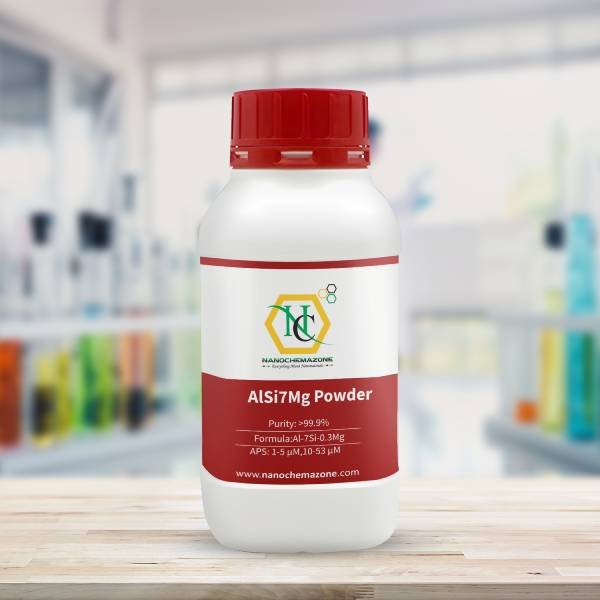
AlSi7Mg Powder
AlSi7Mg Powder
| Product | AlSi7Mg Powder |
| CAS No. | N/A |
| Appearance | Silver-Gray Powder |
| Purity | ≥99%, ≥99.9%, ≥95%(Other purities are also available) |
| APS | 1-5 µM, 10-53 µM (Can be customized), Ask for other available size range. |
| Ingredient | Al-7Si-0.3Mg |
| Density | 2.65-2.68g/cm3 |
| Molecular Weight | N/A |
| Product Codes | NCZ-DCY-195/25 |
AlSi7Mg Description:
AlSi7Mg Powder is one of the numerous advanced ceramic materials manufactured by Nanochemazone. Nanochemazone produces too many standard grades when applicable, including Mil Spec (military grade); ACS, Reagent and Technical Grade; Food, Agricultural and Pharmaceutical Grade; Optical Grade, USP and EP/BP (European Pharmacopoeia/British Pharmacopoeia) and follows applicable ASTM testing standards. Typical and custom packaging is available. Additional technical, research and safety (MSDS) information are available. Please request a quote above for more information on lead time and pricing
AlSi7Mg Powder Related Information :
Storage Conditions:
Airtight sealed, avoid light and keep dry at room temperature.
Please contact us for customization and price inquiry
Email: contact@nanochemazone.com
Note: We supply different size ranges of Nano and micron as per the client’s requirements and also accept customization in various parameters.
AlSi7Mg powder
AlSi7Mg powder is an aluminum alloy powder that primarily consists of aluminum (Al), silicon (Si), and magnesium (Mg). The “7” in its name signifies the percentage of silicon, while “Mg” represents the magnesium content. This powder exhibits excellent strength, low density, and impressive thermal properties, making it a preferred choice in multiple industries.
Overview of AlSi7Mg Powder
AlSi7Mg or A357 alloy is a versatile foundry alloy that possesses properties between pure aluminum and high-silicon hypereutectic alloys. The silicon additions improve castability and enhance mechanical properties while magnesium improves strength.
Key characteristics of AlSi7Mg powder include:
Good strength and hardness
Excellent fluidity and castability
Good machinability and polishability
High thermal conductivity
Good corrosion resistance
Low coefficient of thermal expansion
Available in range of particle sizes
AlSi7Mg powder is used for producing automotive components, hydraulic parts, and other precision castings needing balanced properties.
Chemical Composition of AlSi7Mg Powder
| Element | Weight % |
| Aluminum (Al) | Balance |
| Silicon (Si) | 6-8% |
| Magnesium (Mg) | 0.4-0.8% |
| Iron (Fe) | 0.15-0.5% |
| Manganese (Mn) | 0.1% max |
| Copper (Cu) | 0.1% max |
| Zinc (Zn) | 0.1% max |
| Titanium (Ti) | 0.25% max |
| Property | Value |
| Density | 2.68 g/cm3 |
| Melting Point | ~600°C |
| Thermal Conductivity | 130-160 W/mK |
| Electrical Resistivity | 3-5 μΩ.cm |
| Young’s Modulus | 70-80 GPa |
| Poisson’s Ratio | 0.33 |
| Tensile Strength | 250-300 MPa |
| Yield Strength | 140-180 MPa |
| Elongation | 4-8% |
| Hardness | 80-100 Brinell |
The silicon additions increase the strength while retaining good ductility and machinability. The alloy has excellent castability and thermal properties.
Production Method of AlSi7Mg Powder
Commercial production processes used for AlSi7Mg powder include:
Gas Atomization – Molten alloy stream broken into fine droplets by inert gas jets. Produces spherical powder.
Water Atomization – High pressure water jet impacts molten metal to yield fine powders. Cost effective but higher oxygen pickup.
Mechanical Alloying – Ball milling of aluminum and silicon powders followed by cold compaction and sintering.
Gas atomization provides the most control over powder characteristics like particle size distribution, morphology, and microstructure.
Applications of AlSi7Mg Powder
Metal Injection Molding – To manufacture small intricate parts with tight tolerances and good mechanical properties.
Additive Manufacturing – Used in binder jetting, laser melting and other AM processes to produce complex components.
Castings – Added to melts to improve fluidity. Used to manufacture automotive parts requiring durability.
Powder Metallurgy – Press and sinter process to create high performance parts.
Thermal Spraying – Deposited as protective coatings on metal surfaces to provide wear and corrosion resistance.
Welding Filler – For joining aluminum components while retaining weld strength.
Pyrotechnics – Added to pyrotechnic compositions as a fuel constituent.
Specifications of AlSi7Mg Powder
AlSi7Mg powder is available under different size ranges, grades and purity levels:
Particle Size: From 10 – 150 microns for AM, under 45 microns for MIM.
Morphology: Spherical, granular and irregular particle shapes. Smooth powder flows better.
Purity: From commercial to high purity (99.9%) grades.
Oxygen Content: Levels range from 400 – 1500 ppm for different production methods.
Flowability: Powder customized for excellent flow rates of 25 s/50 g or better.
Grades: Custom alloy chemistry and powder characteristics offered.
Handling and Storage of AlSi7Mg Powder
AlSi7Mg powder should be properly handled and stored to prevent:
Moisture contact leading to oxidation
Fire hazards from dust accumulation
Health hazards from inhaling fine powders
Safety practices recommended by supplier should be followed
Sealed containers under inert atmosphere along with proper grounding and PPE is recommended.
Testing and Characterization Methods
Key test methods for AlSi7Mg powder include:
Chemical analysis using OES or XRF for composition
Particle size distribution as per ASTM B822 standard
Morphology analysis through SEM
Flow rate measurement using Hall flowmeter
Density determination by helium pycnometry
Impurity levels tested by ICP-MS
Microstructure examined by XRD phase analysis
Thorough testing ensures powder quality for application requirements is met.
Comparison of AlSi7Mg and AlSi10Mg Powders
AlSi7Mg and AlSi10Mg are two aluminum alloy powders compared:
| Parameter | AlSi7Mg | AlSi10Mg |
| Silicon content | 6-8% | 9-11% |
| Strength | Lower | Higher |
| Castability | Comparable | Comparable |
| Corrosion resistance | Good | Excellent |
| Cost | Lower | Higher |
| Applications | Castings, MIM | Aerospace, AM parts |
| Availability | Readily available | Moderate |
AlSi10Mg offers higher strength but at increased cost. AlSi7Mg provides well-balanced properties at lower cost where high strength is not critical.
AlSi7Mg Powder FAQs
Q: How is AlSi7Mg powder produced?
A: AlSi7Mg powder is commercially produced using gas atomization, water atomization, or mechanical alloying followed by sintering. Gas atomization offers better control over particle characteristics.
Q: What are the main applications for AlSi7Mg powder?
A: The key applications for AlSi7Mg powder include metal injection molding, aluminum die casting, additive manufacturing, powder metallurgy, thermal spray coatings, and filler welding wire.
Q: What is the typical particle size used for AlSi7Mg powder in AM?
A: For most metal 3D printing processes like DMLS and binder jetting, the common particle size range for AlSi7Mg powder is 20-45 microns.
Q: Does AlSi7Mg powder require any special handling precautions?
A: Yes, it is recommended to handle aluminum powders under inert atmosphere using proper grounding, ventilation, and PPE to prevent fire and explosion hazards.
Q: Where can I buy AlSi7Mg powder suitable for making precision castings?
A: Leading powder suppliers Like Nanochemazone AlSi7Mg powder suitable for foundry applications like precision castings.

Aluminum Alloy Powder
Aluminum Alloy Powder
| Product | Aluminum Alloy Powder |
| CAS No. | 7429-90-5 |
| Appearance | Silvery-Gray or White Powder |
| Purity | ≥99%, ≥99.9%, ≥95%(Other purities are also available) |
| APS | 1-5 µM, 10-53 µM (Can be customized), Ask for other available size range. |
| Ingredient | Al |
| Density | 2.66g/cm3 |
| Molecular Weight | 26.98g/mol |
| Product Codes | NCZ-DCY-198/25 |
Aluminum Alloy Description:
Aluminum Alloy Powder is one of the numerous advanced ceramic materials manufactured by Nanochemazone. Nanochemazone produces too many standard grades when applicable, including Mil Spec (military grade); ACS, Reagent and Technical Grade; Food, Agricultural and Pharmaceutical Grade; Optical Grade, USP and EP/BP (European Pharmacopoeia/British Pharmacopoeia) and follows applicable ASTM testing standards. Typical and custom packaging is available. Additional technical, research and safety (MSDS) information are available. Please request a quote above for more information on lead time and pricing
Aluminum Alloy Powder Related Information :
Storage Conditions:
Airtight sealed, avoid light and keep dry at room temperature.
Please contact us for customization and price inquiry
Email: contact@nanochemazone.com
Note: We supply different size ranges of Nano and micron as per the client’s requirements and also accept customization in various parameters.
The aluminum alloy family is a family of materials with a variety of unique properties and areas of application. Their characteristics mainly depend on the alloying elements contained in them and their proportions. These ranges offer a wide range of opportunities to meet the needs of different industries. Let’s explore the features and typical applications of each series to better understand how to choose the best aluminum alloy material for your project.
| roduct | Specification | Apparent Density | Flow Ability | Oxygen Content | Tensile Strength | Yield Strength | Elongation |
| AISi10Mg | 15-53µm 45-105µm 75-150µm |
≥1.35g/cm³ | ≤80s/50g | ≤300ppm | 300±20Mpa | 200±20Mpa | 20±2% |
| AMgScZr | ≥1.30g/cm³ | ≤80s/50g | ≤300ppm | 545±20Mpa | 500±20Mpa | 10±2% | |
| AK400 (can be anodized) | ≥1.30g/cm³ | ≤80s/50g | ≤300ppm | 430±20Mpa | 300±20Mpa | 10±2% | |
| Pure aluminum powder (purity 99.8%) | ≥1.20g/cm³ | ≤100s/50g | ≤1000ppm | \ | \ |
Process: Vacuum air atomization method
Advantages: low satellite powder/hollow powder ratio, good fluidity, high sphericity, and high bulk density. Printed finished parts have high corrosion resistance, low density and mechanical strength
High degree of heat treatment, requiring less heat treatment than castings
Application: 3D printing lightweight, brackets and other structural parts, heat dissipation components, etc. in aerospace, automobile manufacturing and other industries
Packaging: aluminum foil bags/plastic bottles/iron drums and other ordinary packaging or vacuum packaging, etc.

Reviews
There are no reviews yet.