

Shop

Europium Oxide (Eu2O3) Micron Powder
Europium Oxide (Eu2O3) Micron Powder, Purity: 99.99%, Size: 325 mesh
Europium Oxide (Eu2O3) Micron Powder
Purity: 99.99 %, Size: 325 mesh
Technical Properties:
| Product Number | NCZ-RE-119-19 |
| PURITY | 99.99 % |
| COLOR | White |
| PARTICLE SIZE | 325 Mesh |
Note: We can manufacture and supply different particle sizes (Nano size range, Micron, Submicron, and different Mesh size) products of Alloy powders (Multi-Element, Multi-Element Oxide and Mixture of Rare Earth Elements) according to client’s requirements. Kindly ask for the customization in size and Element ratio composition.

Europium Oxide (Eu2O3) Nanopowder/Nanoparticles
Europium Oxide (Eu2O3) Nanopowder/Nanoparticles, Purity: 99.995%, Size: 8-90 nm, Cubic
Europium Oxide (Eu2O3) Nanopowder/Nanoparticles
Purity: 99.995 %, Size: 70-90 nm
Technical Properties:
| Product Number | NCZ-RE-119A-19 |
| PURITY | 99.995 % |
| COLOR | White |
| AVERAGE PARTICLE SIZE | 70-90 nm |
| MORPHOLOGY | Spherical |
| SPECIFIC SURFACE AREA (m2g) | >20 |
| MELTING POINT | 2400 oC |
| BULK DENSITY (g/cm3) | 0,5 |
| TRUE DENSITY (g/cm3) | 8 |
| ELEMENT ANALYSIS (%) | |
| Fe2O3 | ≤0.003 |
| CaO | ≤0.006 |
| NiO | ≤0.005 |
| Dy2O3 | ≤0.005 |
| La2O3 | ≤0.005 |
| TiO2 | ≤0.001 |
Note: We can manufacture and supply different particle sizes (Nano size range, Micron, Submicron, and different Mesh size) products of Alloy powders (Multi-Element, Multi-Element Oxide and Mixture of Rare Earth Elements) according to client’s requirements. Kindly ask for the customization in size and Element ratio composition.


Europium Oxide Nanoparticles
Europium Oxide Nanopowder
Europium Oxide Nanoparticles
Nano Europium Oxide powder
| MF: | Eu2O3 |
| Chemical Name: | Europium Oxide |
| Purity: | > 99.99% |
| APS: | 25 nm (Size Customization possible) |
| Form: | Nanopowder/Dispersion |
| Product Number: | #NCZ2701 |
| CAS Number | 1308-96-9 |
Europium Oxide Nanoparticles
Note: We can supply different size products of microparticles and Nanoparticles Size range powder according to the client’s requirements.

Europium Oxide Powder
Product Name: Europium Oxide Powder
| Product | Europium Oxide Powder |
| CAS No. | 1308-96-9 |
| Appearance | Powder |
| Purity | 99.9% |
| APS | 1 – 5 Microns (Can be customized) |
| Ingredient | Eu2O3 |
| Product Code | NCZ-AE-161 |
RELATED INFORMATION
Storage Conditions:
Airtight sealed, avoid light, and keep dry at room temperature.
Please email us for the customization.
Email: contact@nanochemazone.com

Europium Powder
Product Name: Europium Powder
| Product | Europium Powder |
| CAS No. | 10025-76-0 |
| Appearance | Powder |
| Purity | 99.9% |
| APS | 1 – 5 microns (can be customized) |
| Ingredient | Eu |
| Product Code | NCZ-AE-221 |
RELATED INFORMATION
Storage Conditions:
Airtight sealed, avoid light, and keep dry at room temperature.
Please email us for the customization.
Email: contact@nanochemazone.com

Europium Sulfate Octahydrate Powder
Europium Sulfate Octahydrate Powder
| Product | Sulfate Octahydrate Powder |
| CAS No. | 10031-55-7 |
| Appearance | White Powder |
| Purity | 99.9% |
| APS | 1 – 5 Microns (Can be customized) |
| Ingredient | Eu2(SO4)3•8H2O |
| Product Code | NCZ-NSC-312/20 |
Europium Sulfate Octahydrate Powder Description :
Europium sulfate octahydrate is used as a phosphor activator for color cathode-ray tubes and liquid-crystal displays.
It is used in computer monitors and televisions Europium is a chemical element with the symbol Eu and atomic number.
Europium Sulfate Octahydrate Powder is the properties of europium that are strongly influenced by its half
Europium Sulfate Octahydrate Powder is a chemical element with the symbol and atomic number. Europium is the most reactive lanthanide by far, having to be stored under an inert fluid to protect it from atmospheric oxygen or moisture.
Europium is also the softest lanthanide, as it can be dented with a fingernail and easily cut with a knife. When oxidation is removed a shiny-white metal is visible.
Europium was isolated in 1901 and is named after the continent of Europe. Being a typical member of the lanthanide series, europium usually assumes the oxidation state, but the oxidation state is also common.
All europium compounds with oxidation state are slightly reducing. Europium has no significant biological role and is relatively non-toxic compared to other heavy metals.
Most applications of europium exploit the phosphorescence of europium compounds. Europium is one of the rarest of the rare earth elements on Earth.
Europium Sulfate Octahydrate Powder Related Information
Storage Conditions:
Airtight sealed, avoid light, and keep dry at room temperature.
Please contact us for customization and price inquiry
Email: contact@nanochemazone.com
Note: We supply different size ranges of Nano and micron as per the client’s requirements and also accept customization in various parameters.
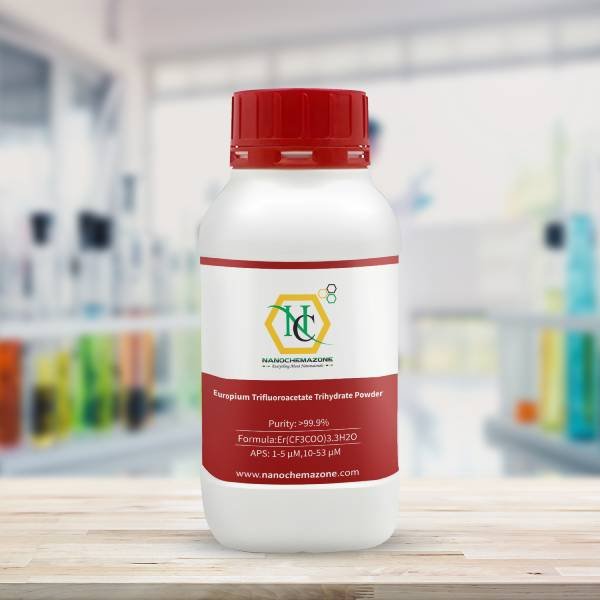
Europium Trifluoroacetate Trihydrate Powder
Europium Trifluoroacetate Trihydrate Powder
| Product | Europium Trifluoroacetate Trihydrate Powder |
| CAS No. | 94079-71-7 |
| Appearance | White Powder |
| Purity | ≥99%, ≥99.9%, ≥95%(Other purities are also available) |
| APS | 1-5 µM, 10-53 µM (Can be customized), Ask for other available size range. |
| Ingredient | Er(CF3COO)3.3H2O |
| Density | N/A |
| Molecular Weight | 545.06g/mol |
| Product Code | NCZ-CAS-159/25 |
Europium Trifluoroacetate Trihydrate Description:
Europium Trifluoroacetate Trihydrate Powder is one of the numerous advanced ceramic materials manufactured by Nanochemazone. Nanochemazone produces too many standard grades when applicable, including Mil Spec (military grade); ACS, Reagent and Technical Grade; Food, Agricultural and Pharmaceutical Grade; Optical Grade, USP and EP/BP (European Pharmacopoeia/British Pharmacopoeia) and follows applicable ASTM testing standards. Typical and custom packaging is available. Additional technical, research and safety (MSDS) information are available. Please request a quote above for more information on lead time and pricing.
Europium Trifluoroacetate Trihydrate Powder Related Information:
Storage Conditions:
Airtight sealed, avoid light and keep dry at room temperature.
Please contact us for customization and price inquiry
Email: contact@nanochemazone.com
Note: We supply different size ranges of Nano and micron as per the client’s requirements and also accept customization in various parameters.
Europium Trifluoroacetate Trihydrate
CAS #: 94079-71-7
Linear Formula:(CF3CO2)3Eu • 3H2O
MDL Number:MFCD00192171
EC No.: N/A
Europium Trifluoroacetate Trihydrate Properties (Theoretical)
| Compound Formula | C6H6EuF9O9 |
| Molecular Weight | 545.06 |
| Appearance | White powder |
| Melting Point | N/A |
| Boiling Point | N/A |
| Density | N/A |
| Solubility in H2O | N/A |
| Exact Mass | 548.931516 |
| Monoisotopic Mass | 548.931516 |

Europium(III) Acetate Hydrate Powder
Europium(III) Acetate Hydrate Powder
| Product | Europium(III) Acetate Hydrate Powder |
| CAS No. | 62667-64-5 |
| Appearance | White Powder |
| Purity | ≥99%, ≥99.9%, ≥95%(Other purities are also available) |
| APS | 1-5 µM, 10-53 µM (Can be customized), Ask for other available size range. |
| Ingredient | Eu(CH3CO2)2.xH2O |
| Density | N/A |
| Molecular Weight | 347.11g/mol |
| Product Code | NCZ-CAS-160/25 |
Europium(III) Acetate Hydrate Description:
Europium(III) Acetate Hydrate Powder is one of the numerous advanced ceramic materials manufactured by Nanochemazone. Nanochemazone produces too many standard grades when applicable, including Mil Spec (military grade); ACS, Reagent and Technical Grade; Food, Agricultural and Pharmaceutical Grade; Optical Grade, USP and EP/BP (European Pharmacopoeia/British Pharmacopoeia) and follows applicable ASTM testing standards. Typical and custom packaging is available. Additional technical, research and safety (MSDS) information are available. Please request a quote above for more information on lead time and pricing.
Europium(III) Acetate Hydrate Powder Related Information:
Storage Conditions:
Airtight sealed,avoid light and keep dry at room temperature.
Please contact us for customization and price inquiry
Email: contact@nanochemazone.com
Note: We supply different size ranges of Nano and micron as per the client’s requirements and also accept customization in various parameters.
CAS #: 62667-64-5
Linear Formula: Eu(CH3CO2)3• xH2O
MDL Number:MFCD00150115
EC No.:214-670-9
Europium(III) Acetate Hydrate Properties (Theoretical)
| Compound Formula | C6H11EuO7 |
| Molecular Weight | 347.11 |
| Appearance | White powder or chunks |
| Melting Point | N/A |
| Boiling Point | N/A |
| Density | N/A |
| Solubility in H2O | N/A |
| Exact Mass | 347.971708 |
| Monoisotopic Mass | 347.971708 |


EVA Foam (Ethylene Vinyl Acetate and blended copolymers)
Product: EVA Foam Sheet (Ethylene Vinyl Acetate and blended copolymers)
CAS No.: 24937-78-8
Stock Number: NCZFF111
| Product Name | EVA Foam Sheet |
| Purity | >99.9% |
| Density | 30 kg/m3 |
| Surface Hardness | 40 °C |
| Tear Strength | 0.35 N/mm m² |
| Tensile Strength | 780 Kpa |
| Elongation at break | 100 % |
| Compression Strength | 78 Kpa |
| Compression deformation | 25 % |
| Size Change Rate | 0.8 % |
| Rebound Rate | 26.00 % |
| Elongation | 130 % |
| Service Temperature | -30 to 180 °F |
| Thermal Conductivity | 0.038 W/mK |
| Adhesive Thickness | 0.15 mm |
| Adhesive Weight | 80 g/m³ |
| Adhesion | 18 N/25 mm |
| Application | 10 °C min |
| Service | -50~ 100 °C |
| Short peak | 120 °C |
| Storage Life | 3 year |
Ask for customization while ordering

Fe doped Ti3AlC2 MXene
Product Name: Fe doped Ti3AlC2 MXene
Product Code: NCZ-MX-213
| Product | Fe doped Ti3AlC2 MXene |
| Colour | Black Powder |
| Purity | ≥98 wt% |
| Ingredient | Fe doped Ti3AlC2, Also available other doping such as Co, Mn, S (Ask for the customization) |
| CAS NO | 12316-56-2 |
Fe doped Ti3AlC2 MXene APPLICATION FIELDS:
High-temperature coating, Mxene precursor, conductive self-lubricating ceramic, lithium-ion battery, supercapacitor, electrochemical catalysis.
RELATED INFORMATION
Storage Conditions:
Airtight sealed, avoid light and keep dry at room temperature.
Please email us for the customization.
Email: contact@nanochemazone.com

Fe3O4 Slurry
Fe3O4 Slurry
Product Name: Fe3O4 Slurry
| Product | Fe3O4 Slurry |
| Colour | Black transparent |
| Purity | ≥ 99.9% |
| Particle size | 1-10 µM (customizable) |
| Ingredient/MF | Fe3O4 |
| Product Code | NCZ-CE-155/20 |
| CAS Number | 2227-89-3 |
Fe3O4 Slurry Application :
sealing, lubrication, medicine, speakers, printing, energy conversion, aerospace, military, etc.
Storage conditions:
Nano Magnetic Fluid should be sealed and stored in a dry and cool environment. It should not be exposed to the air for a long time, to prevent agglomeration due to moisture, affecting the dispersion performance and use effect, and should avoid the heavy pressure, do not contact with the oxidant, and transport according to ordinary goods
Please email us for the customization.
Email: contact@nanochemazone.com
Please contact us for customization and price inquiry
Note: We supply different size ranges of Nano and micron as per the client’s requirements and also accept customization in various parameters.

FeCoNiCr Powder
FeCoNiCr Powder
| Product | FeCoNiCr Powder |
| CAS No. | 7439-89-6 |
| Appearance | Dark and White Gray Powder |
| Purity | ≥99%, ≥99.9%, ≥95%(Other purities are also available) |
| APS | 1-5 µM, 10-53 µM (Can be customized), Ask for other available size range. |
| Ingredient | C42H62O16 |
| Density | 7.5-8.2g/cm3 |
| Molecular Weight | N/A |
| Product Codes | NCZ-DCY-326/25 |
FeCoNiCr Description:
FeCoNiCr Powder is one of the numerous advanced ceramic materials manufactured by Nanochemazone. Nanochemazone produces too many standard grades when applicable, including Mil Spec (military grade); ACS, Reagent and Technical Grade; Food, Agricultural and Pharmaceutical Grade; Optical Grade, USP and EP/BP (European Pharmacopoeia/British Pharmacopoeia) and follows applicable ASTM testing standards. Typical and custom packaging is available. Additional technical, research and safety (MSDS) information are available. Please request a quote above for more information on lead time and pricing.
FeCoNiCr Powder Related Information :
Storage Conditions:
Airtight sealed, avoid light and keep dry at room temperature.
Please contact us for customization and price inquiry
Email: contact@nanochemazone.com
Note: We supply different size ranges of Nano and micron as per the client’s requirements and also accept customization in various parameters.
FeCoNiCr powder
FeCoNiCr powder refers to an alloy composed of iron (Fe), cobalt (Co), nickel (Ni), and chromium (Cr). The combination of these elements brings forth a host of desirable characteristics, making it an ideal material for additive manufacturing processes. The powder is finely granulated and specifically formulated to enable efficient utilization in 3D printers, where it can be selectively deposited layer by layer to create intricate and complex structures.
Overview of FeCoNiCr Powder
FeCoNiCr belongs to a class of high performance alloys that exhibit good mechanical properties, microstructural stability and environmental resistance at elevated temperatures exceeding 750°C. Iron and cobalt provide strength. Nickel enhances ductility and toughness. Chromium provides oxidation and corrosion resistance.
Key characteristics of FeCoNiCr powder include:
Excellent high temperature strength and creep resistance
Good fatigue strength and toughness
High hardness, wear resistance, and abrasion resistance
Outstanding corrosion and oxidation resistance
Available in various particle size distributions and morphologies
FeCoNiCr powder is designed for protective coatings, thermal spray, welding, additive manufacturing and other high temperature applications requiring strength, hardness and environmental resistance.
Composition of FeCoNiCr Powder
FeCoNiCr powder has the following nominal composition:
| Element | Composition |
| Iron (Fe) | Balance |
| Cobalt (Co) | 35-50% |
| Nickel (Ni) | 10-30% |
| Chromium (Cr) | 8-12% |
| Carbon (C) | <0.5% |
| Silicon (Si) | <1.5% |
| Manganese (Mn) | <1% |
Properties of FeCoNiCr Powder
Key properties of FeCoNiCr powder include:
| Property | Value |
| Density | 7.5-8.2 g/cm3 |
| Melting Point | 1300-1400°C |
| Thermal Conductivity | 10-30 W/mK |
| Electrical Resistivity | 65-85 μΩ.cm |
| Young’s Modulus | 190-220 GPa |
| Poisson’s Ratio | 0.28-0.32 |
| Tensile Strength | 600-1100 MPa |
| Yield Strength | 450-800 MPa |
| Elongation | 15-30% |
| Hardness | 30-50 HRC |
The properties like high temperature strength, hardness, wear resistance, and corrosion resistance make it suitable for the most demanding applications.
Production Method for FeCoNiCr Powder
FeCoNiCr powder can be produced via:
Gas Atomization – High pressure inert gas used to atomize molten alloy resulting in fine spherical powder ideal for AM.
Water Atomization – High velocity water jet breaks up molten metal into fine irregular powder particles. Economical but higher oxygen pickup.
Mechanical Alloying – Ball milling of blended elemental powders followed by sintering and secondary atomization.
Gas atomization provides the best control over particle size, shape, purity and microstructure.
Applications of FeCoNiCr Powder
Typical applications of FeCoNiCr powder include:
Thermal Spray Coatings – HVOF or plasma spraying to deposit thick wear and corrosion resistant coatings on tools, molds, valves, bearings etc.
Additive Manufacturing – Selective laser melting to produce complex components for high temperature environments.
Welding Filler – Provides excellent elevated temperature strength, hardness and corrosion resistance in the weld zone.
Brazing Filler – Used to join components operating at very high temperatures requiring oxidation resistance.
Glass Processing – Powder metallurgy conveyor rolls with high temperature strength used in glass melting furnaces.
Specifications of FeCoNiCr Powder
FeCoNiCr powder is available under various size ranges, shapes, grades and purity levels:
Particle Size: From 15-45 μm for AM methods, up to 150 μm for thermal spray processes.
Morphology: Spherical, irregular and blended shapes. Spherical powder provides optimal flow and packing.
Purity: From commercial purity to ultra high purity grades based on stringent chemical analysis and application requirements.
Surface Area: Low surface area preferred to minimize oxidation during handling and storage.
Grades: Customized composition and powder metallurgy tailored for intended application and processing method.
Storage and Handling of FeCoNiCr Powder
Proper storage and handling procedures for FeCoNiCr powder include:
Store in sealed containers under inert gas to prevent oxidation
Avoid accumulation of fine powder to control explosion risks
Use appropriate PPE, ventilation, safety practices when handling
Prevent contact between powder and incompatible materials
Follow applicable safety guidelines from supplier SDS
Caution and protective measures are essential when handling this reactive alloy powder.
Inspection and Testing of FeCoNiCr Powder
Key quality control tests performed on FeCoNiCr powder:
Chemical analysis using OES or XRF to ensure composition is within specified limits
Particle size distribution using laser diffraction as per ASTM B822 standard
Morphology analysis through SEM imaging
Powder flow rate measurement as per ASTM B213 standard
Density determination by helium pycnometry
Impurity testing using ICP-MS
Microstructural characterization by XRD phase analysis
Thorough testing verifies powder quality and consistency for the intended high temperature application.
Comparison Between FeCoNiCr and 316L Stainless Steel Powders
FeCoNiCr and 316L stainless steel powders compared:
| Parameter | FeCoNiCr | 316L SS |
| Composition | Quaternary high-temp alloy | Fe-Cr-Ni stainless alloy |
| Cost | Higher | Lower |
| High temperature strength | Much better | Moderate |
| Corrosion resistance | Comparable | Better |
| Thermal conductivity | Higher | Lower |
| Workability | Moderate | Excellent |
| Applications | Thermal spray, AM | Automotive, construction |
FeCoNiCr offers far superior high temperature strength whereas 316L provides better fabrication characteristics and corrosion resistance at lower cost.
FeCoNiCr Powder FAQs
Q: How is FeCoNiCr powder produced?
A: FeCoNiCr powder is commercially produced using gas atomization, water atomization and mechanical alloying followed by sintering. Gas atomization offers the best powder characteristics.
Q: What are the main applications for FeCoNiCr powder?
A: Main applications include thermal spray coatings, additive manufacturing, brazing filler material, powder metallurgy hot work tooling, glass processing equipment where high temperature strength and resistance is required.
Q: What is the recommended particle size for thermal spraying?
A: For most thermal spray processes, a particle size range of 45-150 microns is preferred for FeCoNiCr powder to maximize deposition efficiency and coating properties.
Q: Does FeCoNiCr powder require any special handling precautions?
A: Yes, proper protective measures are essential when handling this reactive fine alloy powder including inert atmosphere, grounding, ventilation, PPE.
Q: Where can I purchase FeCoNiCr powder suitable for additive manufacturing?
A: For AM applications requiring high temperature strength, fine FeCoNiCr powder can be purchased from leading manufacturers including Nanochemazone.
FeCoNiCr Powder
FeCoNiCr Powder
| Product | FeCoCrNi Powder |
| CAS No. | 68916-91-6 |
| Appearance | White-Gray Powder |
| Purity | ≥99%, ≥99.9%, ≥95%(Other purities are also available) |
| APS | 1-5 µM, 10-53 µM (Can be customized), Ask for other available size range. |
| Ingredient | C42H62O16 |
| Density | 6.96-8.0g/cm3 |
| Molecular Weight | N/A |
| Product Codes | NCZ-DCY-223/25 |
FeCoNiCr Description:
FeCoNiCr Powder is one of the numerous advanced ceramic materials manufactured by Nanochemazone. Nanochemazone produces too many standard grades when applicable, including Mil Spec (military grade); ACS, Reagent and Technical Grade; Food, Agricultural and Pharmaceutical Grade; Optical Grade, USP and EP/BP (European Pharmacopoeia/British Pharmacopoeia) and follows applicable ASTM testing standards. Typical and custom packaging is available. Additional technical, research and safety (MSDS) information are available. Please request a quote above for more information on lead time and pricing
FeCoNiCr Powder Related Information :
Storage Conditions:
Airtight sealed, avoid light and keep dry at room temperature.
Please contact us for customization and price inquiry
Email: contact@nanochemazone.com
Note: We supply different size ranges of Nano and micron as per the client’s requirements and also accept customization in various parameters.
FeCoNiCr powder
FeCoNiCr powder refers to an alloy composed of iron (Fe), cobalt (Co), nickel (Ni), and chromium (Cr). The combination of these elements brings forth a host of desirable characteristics, making it an ideal material for additive manufacturing processes. The powder is finely granulated and specifically formulated to enable efficient utilization in 3D printers, where it can be selectively deposited layer by layer to create intricate and complex structures.
Overview of FeCoNiCr Powder
FeCoNiCr belongs to a class of high performance alloys that exhibit good mechanical properties, microstructural stability and environmental resistance at elevated temperatures exceeding 750°C. Iron and cobalt provide strength. Nickel enhances ductility and toughness. Chromium provides oxidation and corrosion resistance.
Key characteristics of FeCoNiCr powder include:
Excellent high temperature strength and creep resistance
Good fatigue strength and toughness
High hardness, wear resistance, and abrasion resistance
Outstanding corrosion and oxidation resistance
Available in various particle size distributions and morphologies
FeCoNiCr powder is designed for protective coatings, thermal spray, welding, additive manufacturing and other high temperature applications requiring strength, hardness and environmental resistance.
Composition of FeCoNiCr Powder
FeCoNiCr powder has the following nominal composition:
| Element | Composition |
| Iron (Fe) | Balance |
| Cobalt (Co) | 35-50% |
| Nickel (Ni) | 10-30% |
| Chromium (Cr) | 8-12% |
| Carbon (C) | <0.5% |
| Silicon (Si) | <1.5% |
| Manganese (Mn) | <1% |
| Property | Value |
| Density | 7.5-8.2 g/cm3 |
| Melting Point | 1300-1400°C |
| Thermal Conductivity | 10-30 W/mK |
| Electrical Resistivity | 65-85 μΩ.cm |
| Young’s Modulus | 190-220 GPa |
| Poisson’s Ratio | 0.28-0.32 |
| Tensile Strength | 600-1100 MPa |
| Yield Strength | 450-800 MPa |
| Elongation | 15-30% |
| Hardness | 30-50 HRC |
The properties like high temperature strength, hardness, wear resistance, and corrosion resistance make it suitable for the most demanding applications.
Production Method for FeCoNiCr Powder
FeCoNiCr powder can be produced via:
Gas Atomization – High pressure inert gas used to atomize molten alloy resulting in fine spherical powder ideal for AM.
Water Atomization – High velocity water jet breaks up molten metal into fine irregular powder particles. Economical but higher oxygen pickup.
Mechanical Alloying – Ball milling of blended elemental powders followed by sintering and secondary atomization.
Gas atomization provides the best control over particle size, shape, purity and microstructure.
Applications of FeCoNiCr Powder
Typical applications of FeCoNiCr powder include:
Thermal Spray Coatings – HVOF or plasma spraying to deposit thick wear and corrosion resistant coatings on tools, molds, valves, bearings etc.
Additive Manufacturing – Selective laser melting to produce complex components for high temperature environments.
Welding Filler – Provides excellent elevated temperature strength, hardness and corrosion resistance in the weld zone.
Brazing Filler – Used to join components operating at very high temperatures requiring oxidation resistance.
Glass Processing – Powder metallurgy conveyor rolls with high temperature strength used in glass melting furnaces.
Specifications of FeCoNiCr Powder
FeCoNiCr powder is available under various size ranges, shapes, grades and purity levels:
Particle Size: From 15-45 μm for AM methods, up to 150 μm for thermal spray processes.
Morphology: Spherical, irregular and blended shapes. Spherical powder provides optimal flow and packing.
Purity: From commercial purity to ultra high purity grades based on stringent chemical analysis and application requirements.
Surface Area: Low surface area preferred to minimize oxidation during handling and storage.
Grades: Customized composition and powder metallurgy tailored for intended application and processing method.
Storage and Handling of FeCoNiCr Powder
Proper storage and handling procedures for FeCoNiCr powder include:
Store in sealed containers under inert gas to prevent oxidation
Avoid accumulation of fine powder to control explosion risks
Use appropriate PPE, ventilation, safety practices when handling
Prevent contact between powder and incompatible materials
Follow applicable safety guidelines from supplier SDS
Caution and protective measures are essential when handling this reactive alloy powder.
Inspection and Testing of FeCoNiCr Powder
Key quality control tests performed on FeCoNiCr powder:
Chemical analysis using OES or XRF to ensure composition is within specified limits
Particle size distribution using laser diffraction as per ASTM B822 standard
Morphology analysis through SEM imaging
Powder flow rate measurement as per ASTM B213 standard
Density determination by helium pycnometry
Impurity testing using ICP-MS
Microstructural characterization by XRD phase analysis
Thorough testing verifies powder quality and consistency for the intended high temperature application.
Comparison Between FeCoNiCr and 316L Stainless Steel Powders
FeCoNiCr and 316L stainless steel powders compared:
| Parameter | FeCoNiCr | 316L SS |
| Composition | Quaternary high-temp alloy | Fe-Cr-Ni stainless alloy |
| Cost | Higher | Lower |
| High temperature strength | Much better | Moderate |
| Corrosion resistance | Comparable | Better |
| Thermal conductivity | Higher | Lower |
| Workability | Moderate | Excellent |
| Applications | Thermal spray, AM | Automotive, construction |
FeCoNiCr offers far superior high temperature strength whereas 316L provides better fabrication characteristics and corrosion resistance at lower cost.
FeCoNiCr Powder FAQs
Q: How is FeCoNiCr powder produced?
A: FeCoNiCr powder is commercially produced using gas atomization, water atomization and mechanical alloying followed by sintering. Gas atomization offers the best powder characteristics.
Q: What are the main applications for FeCoNiCr powder?
A: Main applications include thermal spray coatings, additive manufacturing, brazing filler material, powder metallurgy hot work tooling, glass processing equipment where high temperature strength and resistance is required.
Q: What is the recommended particle size for thermal spraying?
A: For most thermal spray processes, a particle size range of 45-150 microns is preferred for FeCoNiCr powder to maximize deposition efficiency and coating properties.
Q: Does FeCoNiCr powder require any special handling precautions?
A: Yes, proper protective measures are essential when handling this reactive fine alloy powder including inert atmosphere, grounding, ventilation, PPE.
Q: Where can I purchase FeCoNiCr powder suitable for additive manufacturing?
A: For AM applications requiring high temperature strength, fine FeCoNiCr powder can be purchased from leading manufacturer.

FeCoNiCrAl Powder
FeCoNiCrAl Powder
| Product | FeCoNiCrAl Powder |
| CAS No. | N/A |
| Appearance | Reddish-Brown or Rust Powder |
| Purity | ≥99%, ≥99.9%, ≥95%(Other purities are also available) |
| APS | 1-5 µM, 10-53 µM (Can be customized), Ask for other available size range. |
| Ingredient | Fe-Co-Ni-Cr-Al |
| Density | 2.5-5.5g/cm3 |
| Molecular Weight | N/A |
| Product Codes | NCZ-DCY-327/25 |
FeCoNiCrAl Description:
FeCoNiCrAl Powder is one of the numerous advanced ceramic materials manufactured by Nanochemazone. Nanochemazone produces too many standard grades when applicable, including Mil Spec (military grade); ACS, Reagent and Technical Grade; Food, Agricultural and Pharmaceutical Grade; Optical Grade, USP and EP/BP (European Pharmacopoeia/British Pharmacopoeia) and follows applicable ASTM testing standards. Typical and custom packaging is available. Additional technical, research and safety (MSDS) information are available. Please request a quote above for more information on lead time and pricing.
FeCoNiCrAl Powder Related Information :
Storage Conditions:
Airtight sealed, avoid light and keep dry at room temperature.
Please contact us for customization and price inquiry
Email: contact@nanochemazone.com
Note: We supply different size ranges of Nano and micron as per the client’s requirements and also accept customization in various parameters.
FeCoNiCrAl powder
FeCoNiCrAl powder is a high-performance alloy powder containing iron, cobalt, nickel, chromium, and aluminum. It offers excellent strength, hardness, wear resistance and corrosion resistance at high temperatures. The powder is finely granulated and specifically formulated to enable efficient utilization in 3D printers, where it can be selectively deposited layer by layer to create intricate and complex structures.
Overview of FeCoNiCrAl Powder
FeCoNiCrAl is a quinary alloy that exhibits good mechanical properties, oxidation resistance, and microstructural stability at elevated temperatures. Iron and cobalt provide strength. Nickel enhances toughness and ductility. Chromium imparts excellent oxidation and corrosion resistance. Aluminum improves high temperature mechanical properties.
Key characteristics of FeCoNiCrAl powder include:
Excellent high temperature strength and creep resistance
Good environmental stability and thermal fatigue strength
High hardness, wear resistance, and abrasion resistance
Good ductility and fabricability
Available in range of particle sizes and morphologies
FeCoNiCrAl powder is suitable for protective coatings, thermal spray, welding, brazing, and high temperature structural applications requiring thermal and environmental resistance.
Composition of FeCoNiCrAl Powder
FeCoNiCrAl powder has the nominal composition:
| Element | Composition |
| Iron (Fe) | Balance |
| Cobalt (Co) | 35-50% |
| Nickel (Ni) | 10-30% |
| Chromium (Cr) | 8-12% |
| Aluminum (Al) | 1-5% |
| Carbon (C) | <0.5% |
| Silicon (Si) | <1.5% |
| Manganese (Mn) | <1% |
Properties of FeCoNiCrAl Powder
Key properties of FeCoNiCrAl powder include:
| Property | Value |
| Density | 7.5-8.2 g/cm3 |
| Melting Point | 1300-1400°C |
| Thermal Conductivity | 10-30 W/mK |
| Electrical Resistivity | 65-85 μΩ.cm |
| Young’s Modulus | 190-220 GPa |
| Poisson’s Ratio | 0.28-0.32 |
| Tensile Strength | 600-1100 MPa |
| Yield Strength | 450-800 MPa |
| Elongation | 15-30% |
| Hardness | 30-50 HRC |
The excellent high temperature strength, hardness, wear resistance, and environmental stability make it suitable for the most demanding applications.
Production Method for FeCoNiCrAl Powder
FeCoNiCrAl powder is produced using:
Gas Atomization – High pressure inert gas used to atomize molten alloy into fine spherical powder for excellent flow and packing density.
Water Atomization – High velocity water jet impacts molten stream to produce fine irregular powder particles. Lower cost but higher oxygen pickup.
Mechanical Alloying – Ball milling of elemental/pre-alloyed powders followed by sintering and gas atomization.
Gas atomization provides the best control over particle size distribution, morphology and purity.
Applications of FeCoNiCrAl Powder
Typical applications of FeCoNiCrAl powder include:
Thermal Spray Coatings – HVOF or plasma spraying to deposit thick, wear resistant coatings on components operating at high temperatures.
Additive Manufacturing – Selective laser melting to produce complex parts for extreme environments needing high temperature resistance.
Brazing Filler – For joining assemblies and sealing cracks in parts subjected to high temperatures during service.
Welding Consumables – Used as filler material to provide excellent elevated temperature strength in welded components.
Wear Parts – Powder metallurgy hot work tooling and fixtures resisting wear and thermal fatigue cracking.
Glass Processing – Chutes, conveyors and handlers used in glass melting furnaces.
Specifications of FeCoNiCrAl Powder
FeCoNiCrAl powder is available under various size ranges, morphologies and grades:
Particle Size: From 10-45 microns for AM methods, up to 150 microns for thermal spray processes.
Morphology: Spherical, irregular and blended shapes. Spherical powder has excellent flowability.
Purity: Ranging from commercial purity to ultra high purity grades based on stringent chemical analysis.
Surface Area: Low surface area preferred to minimize oxidation during handling and storage.
Grades: Customized composition and powder metallurgy tailored for application.
Storage and Handling of FeCoNiCrAl Powder
Proper storage and handling procedures for FeCoNiCrAl powder include:
Store in sealed containers under inert gas to prevent oxidation
Avoid accumulation of fine powder to control explosion risks
Use appropriate PPE, ventilation, safety practices when handling
Prevent contact between powder and incompatible materials
Follow applicable safety guidelines from supplier SDS
Caution and protective measures are essential when handling this reactive alloy powder.
Inspection and Testing of FeCoNiCrAl Powder
Key quality control tests performed on FeCoNiCrAl powder:
Chemical analysis using OES or XRF to ensure composition is within specified limits
Particle size distribution using laser diffraction as per ASTM B822 standard
Morphology analysis through SEM imaging
Powder flow rate measurement as per ASTM B213 standard
Density determination by helium pycnometry
Impurity testing using ICP-MS
Microstructural characterization by XRD phase analysis
Thorough testing verifies powder quality and consistency meeting performance requirements.
Comparison Between FeCoNiCrAl and 316L Stainless Steel Powder
FeCoNiCrAl and 316L stainless steel powder compared:
| Parameter | FeCoNiCrAl | 316L SS |
| Composition | Quinary high-temp alloy | Fe-Cr-Ni stainless alloy |
| Cost | Higher | Lower |
| High temperature strength | Much better | Moderate |
| Corrosion resistance | Comparable | Better |
| Thermal conductivity | Higher | Lower |
| Workability | Moderate | Excellent |
| Applications | Thermal spray, AM | Automotive, construction |
FeCoNiCrAl offers far superior high temperature strength whereas 316L provides better fabrication and corrosion resistance at lower cost.
FeCoNiCrAl Powder FAQs
Q: How is FeCoNiCrAl powder produced?
A: FeCoNiCrAl powder is commercially produced using gas atomization, water atomization and mechanical alloying followed by sintering. Gas atomization offers the best powder characteristics.
Q: What are the main applications for FeCoNiCrAl powder?
A: Main applications include thermal spray coatings, additive manufacturing, brazing filler, powder metallurgy hot work tooling, glass processing equipment where high temperature strength and environmental resistance is needed.
Q: What is the recommended particle size for thermal spraying?
A: For most thermal spray processes, a particle size range of 45-150 microns is preferred for FeCoNiCrAl powder to maximize deposition efficiency and coating properties.
Q: Does FeCoNiCrAl powder require special handling precautions?
A: Yes, proper protective measures are essential when handling this reactive fine alloy powder including inert atmosphere, grounding, ventilation, PPE.
Q: Where can I purchase FeCoNiCrAl powder for additive manufacturing?
A: For AM applications requiring high temperature strength, fine FeCoNiCrAl powder can be purchased from leading manufacturer.
FeCoNiCrAl Powder
FeCoNiCrAl Powder
| Product | FeCoCrNiAl Powder |
| CAS No. | N/A |
| Appearance | Black-Gray Powder |
| Purity | ≥99%, ≥99.9%, ≥95%(Other purities are also available) |
| APS | 1-5 µM, 10-53 µM (Can be customized), Ask for other available size range. |
| Ingredient | Fe-Co-Ni-Cr-Al |
| Density | 7.8-8.0g/cm3 |
| Molecular Weight | N/A |
| Product Codes | NCZ-DCY-224/25 |
FeCoNiCrAl Description:
FeCoNiCrAl Powder is one of the numerous advanced ceramic materials manufactured by Nanochemazone. Nanochemazone produces too many standard grades when applicable, including Mil Spec (military grade); ACS, Reagent and Technical Grade; Food, Agricultural and Pharmaceutical Grade; Optical Grade, USP and EP/BP (European Pharmacopoeia/British Pharmacopoeia) and follows applicable ASTM testing standards. Typical and custom packaging is available. Additional technical, research and safety (MSDS) information are available. Please request a quote above for more information on lead time and pricing
FeCoNiCrAl Powder Related Information :
Storage Conditions:
Airtight sealed, avoid light and keep dry at room temperature.
Please contact us for customization and price inquiry
Email: contact@nanochemazone.com
Note: We supply different size ranges of Nano and micron as per the client’s requirements and also accept customization in various parameters.
and micron as per the client’s requirements and also accept customization in various parameters.
FeCoNiCrAl powder
FeCoNiCrAl powder is a high-performance alloy powder containing iron, cobalt, nickel, chromium, and aluminum. It offers excellent strength, hardness, wear resistance and corrosion resistance at high temperatures. The powder is finely granulated and specifically formulated to enable efficient utilization in 3D printers, where it can be selectively deposited layer by layer to create intricate and complex structures.
Overview of FeCoNiCrAl Powder
FeCoNiCrAl is a quinary alloy that exhibits good mechanical properties, oxidation resistance, and microstructural stability at elevated temperatures. Iron and cobalt provide strength. Nickel enhances toughness and ductility. Chromium imparts excellent oxidation and corrosion resistance. Aluminum improves high temperature mechanical properties.
Key characteristics of FeCoNiCrAl powder include:
Excellent high temperature strength and creep resistance
Good environmental stability and thermal fatigue strength
High hardness, wear resistance, and abrasion resistance
Good ductility and fabricability
Available in range of particle sizes and morphologies
FeCoNiCrAl powder is suitable for protective coatings, thermal spray, welding, brazing, and high temperature structural applications requiring thermal and environmental resistance.
Composition of FeCoNiCrAl Powder
FeCoNiCrAl powder has the nominal composition:
| Element | Composition |
| Iron (Fe) | Balance |
| Cobalt (Co) | 35-50% |
| Nickel (Ni) | 10-30% |
| Chromium (Cr) | 8-12% |
| Aluminum (Al) | 1-5% |
| Carbon (C) | <0.5% |
| Silicon (Si) | <1.5% |
| Manganese (Mn) | <1% |
Properties of FeCoNiCrAl Powder
| Property | Value |
| Density | 7.5-8.2 g/cm3 |
| Melting Point | 1300-1400°C |
| Thermal Conductivity | 10-30 W/mK |
| Electrical Resistivity | 65-85 μΩ.cm |
| Young’s Modulus | 190-220 GPa |
| Poisson’s Ratio | 0.28-0.32 |
| Tensile Strength | 600-1100 MPa |
| Yield Strength | 450-800 MPa |
| Elongation | 15-30% |
| Hardness | 30-50 HRC |
The excellent high temperature strength, hardness, wear resistance, and environmental stability make it suitable for the most demanding applications.
Production Method for FeCoNiCrAl Powder
Gas Atomization – High pressure inert gas used to atomize molten alloy into fine spherical powder for excellent flow and packing density.
Water Atomization – High velocity water jet impacts molten stream to produce fine irregular powder particles. Lower cost but higher oxygen pickup.
Mechanical Alloying – Ball milling of elemental/pre-alloyed powders followed by sintering and gas atomization.
Gas atomization provides the best control over particle size distribution, morphology and purity.
Applications of FeCoNiCrAl Powder
Thermal Spray Coatings – HVOF or plasma spraying to deposit thick, wear resistant coatings on components operating at high temperatures.
Additive Manufacturing – Selective laser melting to produce complex parts for extreme environments needing high temperature resistance.
Brazing Filler – For joining assemblies and sealing cracks in parts subjected to high temperatures during service.
Welding Consumables – Used as filler material to provide excellent elevated temperature strength in welded components.
Wear Parts – Powder metallurgy hot work tooling and fixtures resisting wear and thermal fatigue cracking.
Glass Processing – Chutes, conveyors and handlers used in glass melting furnaces.
Specifications of FeCoNiCrAl Powder
FeCoNiCrAl powder is available under various size ranges, morphologies and grades:
Particle Size: From 10-45 microns for AM methods, up to 150 microns for thermal spray processes.
Morphology: Spherical, irregular and blended shapes. Spherical powder has excellent flowability.
Purity: Ranging from commercial purity to ultra high purity grades based on stringent chemical analysis.
Surface Area: Low surface area preferred to minimize oxidation during handling and storage.
Grades: Customized composition and powder metallurgy tailored for application.
Storage and Handling of FeCoNiCrAl Powder
Store in sealed containers under inert gas to prevent oxidation
Avoid accumulation of fine powder to control explosion risks
Use appropriate PPE, ventilation, safety practices when handling
Prevent contact between powder and incompatible materials
Follow applicable safety guidelines from supplier SDS
Caution and protective measures are essential when handling this reactive alloy powder.
Inspection and Testing of FeCoNiCrAl Powder
Key quality control tests performed on FeCoNiCrAl powder:
Chemical analysis using OES or XRF to ensure composition is within specified limits
Particle size distribution using laser diffraction as per ASTM B822 standard
Morphology analysis through SEM imaging
Powder flow rate measurement as per ASTM B213 standard
Density determination by helium pycnometry
Impurity testing using ICP-MS
Microstructural characterization by XRD phase analysis
Thorough testing verifies powder quality and consistency meeting performance requirements.
Comparison Between FeCoNiCrAl and 316L Stainless Steel Powder
FeCoNiCrAl and 316L stainless steel powder compared:
| Parameter | FeCoNiCrAl | 316L SS |
| Composition | Quinary high-temp alloy | Fe-Cr-Ni stainless alloy |
| Cost | Higher | Lower |
| High temperature strength | Much better | Moderate |
| Corrosion resistance | Comparable | Better |
| Thermal conductivity | Higher | Lower |
| Workability | Moderate | Excellent |
| Applications | Thermal spray, AM | Automotive, construction |
FeCoNiCrAl offers far superior high temperature strength whereas 316L provides better fabrication and corrosion resistance at lower cost.
FeCoNiCrAl Powder FAQs
Q: How is FeCoNiCrAl powder produced?
A: FeCoNiCrAl powder is commercially produced using gas atomization, water atomization and mechanical alloying followed by sintering. Gas atomization offers the best powder characteristics.
Q: What are the main applications for FeCoNiCrAl powder?
A: Main applications include thermal spray coatings, additive manufacturing, brazing filler, powder metallurgy hot work tooling, glass processing equipment where high temperature strength and environmental resistance is needed.
Q: What is the recommended particle size for thermal spraying?
A: For most thermal spray processes, a particle size range of 45-150 microns is preferred for FeCoNiCrAl powder to maximize deposition efficiency and coating properties.
Q: Does FeCoNiCrAl powder require special handling precautions?
A: Yes, proper protective measures are essential when handling this reactive fine alloy powder including inert atmosphere, grounding, ventilation, PPE.
Q: Where can I purchase FeCoNiCrAl powder for additive manufacturing?
A: For AM applications requiring high temperature strength, fine FeCoNiCrAl powder can be purchased from leading manufacturer

FeCoNiCrMn Powder
FeCoNiCrMn Powder
| Product | FeCoNiCrMn Powder |
| CAS No. | N/A |
| Appearance | Metallic Gray to Dark Gray Powder |
| Purity | ≥99%, ≥99.9%, ≥95%(Other purities are also available) |
| APS | 1-5 µM, 10-53 µM (Can be customized), Ask for other available size range. |
| Ingredient | Fe-Co-Ni-Cr-Mn |
| Density | 7.98g/cm3 |
| Molecular Weight | N/A |
| Product Codes | NCZ-DCY-328/25 |
FeCoNiCrMn Description:
FeCoNiCrMn Powder is one of the numerous advanced ceramic materials manufactured by Nanochemazone. Nanochemazone produces too many standard grades when applicable, including Mil Spec (military grade); ACS, Reagent and Technical Grade; Food, Agricultural and Pharmaceutical Grade; Optical Grade, USP and EP/BP (European Pharmacopoeia/British Pharmacopoeia) and follows applicable ASTM testing standards. Typical and custom packaging is available. Additional technical, research and safety (MSDS) information are available. Please request a quote above for more information on lead time and pricing.
FeCoNiCrMn Powder Related Information :
Storage Conditions:
Airtight sealed, avoid light and keep dry at room temperature.
Please contact us for customization and price inquiry
Email: contact@nanochemazone.com
Note: We supply different size ranges of Nano and micron as per the client’s requirements and also accept customization in various parameters.
FeCoNiCrMn powder
FeCoNiCrMn belongs to a class of multi-principal element alloys known as high entropy alloys. The near-equiatomic composition provides high configurational entropy leading to excellent strength, toughness, and stability at high temperatures.
Overview of FeCoNiCrMn Powder
FeCoNiCrMn belongs to a class of multi-principal element alloys known as high entropy alloys. The near-equiatomic composition provides high configurational entropy leading to excellent strength, toughness, and stability at high temperatures.
Key properties of FeCoNiCrMn powder include:
Exceptional high temperature strength and creep resistance
Excellent fatigue strength and fracture toughness
Outstanding oxidation and corrosion resistance
High microstructural stability at elevated temperatures
Available in range of particle size distributions and morphologies
FeCoNiCrMn powder is suitable for high temperature structural parts, protective coatings, thermal spray, welding, additive manufacturing, and other demanding applications at elevated temperatures.
Composition of FeCoNiCrMn Powder
FeCoNiCrMn powder has the nominal composition:
| Element | Composition |
| Iron (Fe) | 20-25% |
| Cobalt (Co) | 20-25% |
| Nickel (Ni) | 20-25% |
| Chromium (Cr) | 15-20% |
| Manganese (Mn) | 10-15% |
| Carbon (C) | <0.5% |
| Silicon (Si) | <1% |
Properties of FeCoNiCrMn Powder
FeCoNiCrMn powder possesses the following properties:
| Property | Value |
| Density | 8.0-8.3 g/cm3 |
| Melting Point | 1300-1400°C |
| Thermal Conductivity | 15-25 W/mK |
| Electrical Resistivity | 70-90 μΩ.cm |
| Young’s Modulus | 200-220 GPa |
| Poisson’s Ratio | 0.28-0.30 |
| Tensile Strength | 750-1200 MPa |
| Yield Strength | 500-900 MPa |
| Elongation | 20-35% |
| Hardness | 35-50 HRC |
The properties like strength, ductility, fatigue strength, and hardness are maintained up to temperatures exceeding 1000°C.
Production Method for FeCoNiCrMn Powder
Typical production methods for FeCoNiCrMn powder include:
Gas Atomization – High pressure inert gas used to atomize molten alloy to produce fine spherical powder with good flow and packing density.
Water Atomization – High velocity water jet breaks up molten metal stream into fine irregular powder particles. Lower cost but higher oxygen pickup.
Mechanical Alloying – Ball milling of blended elemental powders followed by sintering and secondary atomization.
Gas atomization provides the best control over powder characteristics like particle size distribution, morphology, purity and microstructure.
Applications of FeCoNiCrMn Powder
FeCoNiCrMn powder is used in high temperature applications including:
Additive Manufacturing – Selective laser melting to produce complex parts needing exceptional high temperature strength for aerospace, automotive, etc.
Thermal Spray Coatings – Wire arc spraying to deposit thick protective coatings providing wear/corrosion resistance at elevated temperatures exceeding 750°C.
Brazing Filler – For joining high temperature alloys and ceramics due to its oxidation resistance.
Welding Consumables – Provides excellent weld strength and durability in high temperature or corrosive service conditions.
Heat Treatment Fixtures – Powder metallurgy trays, baskets, fixtures used in heat treatment furnaces.
Specifications of FeCoNiCrMn Powder
FeCoNiCrMn powder is available under various size ranges, shapes, grades and purity levels:
Particle Size: From 10-45 μm for AM methods, up to 150 μm for thermal spray processes.
Morphology: Spherical, irregular and blended shapes. Spherical powder provides optimal flow and packing density.
Purity: From commercial purity to ultra-high purity grades based on stringent chemical analysis and application requirements.
Surface Area: Low surface area preferred to minimize oxidation during handling and storage.
Grades: Customized composition and powder characteristics tailored for intended application and processing method.
Storage and Handling of FeCoNiCrMn Powder
FeCoNiCrMn powder requires careful storage and handling:
Should be stored in sealed containers under inert gas to prevent oxidation
Need to control dust explosion hazards from fine powder accumulation
Use proper PPE, ventilation, safety practices during powder handling
Prevent contact between powder and incompatible materials
Follow applicable safety guidelines from supplier SDS
Proper protective measures are essential when handling this reactive alloy powder.
Inspection and Testing of FeCoNiCrMn Powder
Key quality control tests performed on FeCoNiCrMn powder:
Chemical analysis using OES or XRF to ensure composition is within specified limits
Particle size distribution using laser diffraction as per ASTM B822 standard
Morphology analysis through SEM imaging
Powder flow rate measurement as per ASTM B213 standard
Density determination by helium pycnometry
Impurity testing using ICP-MS
Microstructural characterization by XRD phase analysis
Thorough testing verifies powder quality and consistency for the intended high temperature application.
Comparison Between FeCoNiCrMn and Inconel 718 Powders
FeCoNiCrMn and Inconel 718 powders compared:
| Parameter | FeCoNiCrMn | Inconel 718 |
| Composition | High entropy alloy | Ni-Cr-Nb alloy |
| Cost | Higher | Lower |
| High temperature strength | Much better | Very good up to 700°C |
| Corrosion resistance | Comparable | Comparable |
| Workability | Moderate | Excellent |
| Applications | Thermal spray, AM | Aerospace components, springs |
| Availability | Moderate | Readily available |
FeCoNiCrMn offers superior high temperature strength, whereas Inconel 718 has better workability and availability.
FeCoNiCrMn Powder FAQs
Q: How is FeCoNiCrMn powder produced?
A: FeCoNiCrMn powder is commercially produced using gas atomization, water atomization and mechanical alloying followed by sintering. Gas atomization offers the best powder characteristics.
Q: What are the main applications for FeCoNiCrMn powder?
A: Main applications include additive manufacturing, thermal spray coatings, brazing filler material, high temperature welding, powder metallurgy hot work tooling where exceptional high temperature strength is needed.
Q: What is the recommended particle size for thermal spraying?
A: For most thermal spray processes, a particle size range of 45-150 microns is preferred for FeCoNiCrMn powder to maximize deposition efficiency and coating properties.
Q: Does FeCoNiCrMn powder require special handling precautions?
A: Yes, proper protective measures are essential when handling this reactive fine alloy powder including inert atmosphere, grounding, ventilation, PPE.
Q: Where can I buy FeCoNiCrMn powder suitable for additive manufacturing?
A: For AM applications requiring high temperature strength, fine FeCoNiCrMn powder can be purchased from leading manufacturer.
FeCoNiCrMn Powder
FeCoNiCrMn Powder
| Product | FeCoCrNiMn Powder |
| CAS No. | N/A |
| Appearance | Black-Gray Powder |
| Purity | ≥99%, ≥99.9%, ≥95%(Other purities are also available) |
| APS | 1-5 µM, 10-53 µM (Can be customized), Ask for other available size range. |
| Ingredient | Fe-Co-Ni-Cr-Mn |
| Density | 6.8-8.0g/cm3 |
| Molecular Weight | N/A |
| Product Codes | NCZ-DCY-225/25 |
FeCoNiCrMn Description:
FeCoNiCrMn Powder is one of the numerous advanced ceramic materials manufactured by Nanochemazone. Nanochemazone produces too many standard grades when applicable, including Mil Spec (military grade); ACS, Reagent and Technical Grade; Food, Agricultural and Pharmaceutical Grade; Optical Grade, USP and EP/BP (European Pharmacopoeia/British Pharmacopoeia) and follows applicable ASTM testing standards. Typical and custom packaging is available. Additional technical, research and safety (MSDS) information are available. Please request a quote above for more information on lead time and pricing
FeCoNiCrMn Powder Related Information :
Storage Conditions:
Airtight sealed, avoid light and keep dry at room temperature.
Please contact us for customization and price inquiry
Email: contact@nanochemazone.com
Note: We supply different size ranges of Nano and micron as per the client’s requirements and also accept customization in various parameters.
and micron as per the client’s requirements and also accept customization in various parameters.
FeCoNiCrMn powder
FeCoNiCrMn belongs to a class of multi-principal element alloys known as high entropy alloys. The near-equiatomic composition provides high configurational entropy leading to excellent strength, toughness, and stability at high temperatures.
Overview of FeCoNiCrMn Powder
FeCoNiCrMn belongs to a class of multi-principal element alloys known as high entropy alloys. The near-equiatomic composition provides high configurational entropy leading to excellent strength, toughness, and stability at high temperatures.
Key properties of FeCoNiCrMn powder include:
Exceptional high temperature strength and creep resistance
Excellent fatigue strength and fracture toughness
Outstanding oxidation and corrosion resistance
High microstructural stability at elevated temperatures
Available in range of particle size distributions and morphologies
FeCoNiCrMn powder is suitable for high temperature structural parts, protective coatings, thermal spray, welding, additive manufacturing, and other demanding applications at elevated temperatures.
Composition of FeCoNiCrMn Powder
| Element | Composition |
| Iron (Fe) | 20-25% |
| Cobalt (Co) | 20-25% |
| Nickel (Ni) | 20-25% |
| Chromium (Cr) | 15-20% |
| Manganese (Mn) | 10-15% |
| Carbon (C) | <0.5% |
| Silicon (Si) | <1% |
Properties of FeCoNiCrMn Powder
| Property | Value |
| Density | 8.0-8.3 g/cm3 |
| Melting Point | 1300-1400°C |
| Thermal Conductivity | 15-25 W/mK |
| Electrical Resistivity | 70-90 μΩ.cm |
| Young’s Modulus | 200-220 GPa |
| Poisson’s Ratio | 0.28-0.30 |
| Tensile Strength | 750-1200 MPa |
| Yield Strength | 500-900 MPa |
| Elongation | 20-35% |
| Hardness | 35-50 HRC |
The properties like strength, ductility, fatigue strength, and hardness are maintained up to temperatures exceeding 1000°C.
Production Method for FeCoNiCrMn Powder
Typical production methods for FeCoNiCrMn powder include:
Gas Atomization – High pressure inert gas used to atomize molten alloy to produce fine spherical powder with good flow and packing density.
Water Atomization – High velocity water jet breaks up molten metal stream into fine irregular powder particles. Lower cost but higher oxygen pickup.
Mechanical Alloying – Ball milling of blended elemental powders followed by sintering and secondary atomization.
Gas atomization provides the best control over powder characteristics like particle size distribution, morphology, purity and microstructure.
Applications of FeCoNiCrMn Powder
FeCoNiCrMn powder is used in high temperature applications including:
Additive Manufacturing – Selective laser melting to produce complex parts needing exceptional high temperature strength for aerospace, automotive, etc.
Thermal Spray Coatings – Wire arc spraying to deposit thick protective coatings providing wear/corrosion resistance at elevated temperatures exceeding 750°C.
Brazing Filler – For joining high temperature alloys and ceramics due to its oxidation resistance.
Welding Consumables – Provides excellent weld strength and durability in high temperature or corrosive service conditions.
Heat Treatment Fixtures – Powder metallurgy trays, baskets, fixtures used in heat treatment furnaces.
Specifications of FeCoNiCrMn Powder
FeCoNiCrMn powder is available under various size ranges, shapes, grades and purity levels:
Particle Size: From 10-45 μm for AM methods, up to 150 μm for thermal spray processes.
Morphology: Spherical, irregular and blended shapes. Spherical powder provides optimal flow and packing density.
Purity: From commercial purity to ultra-high purity grades based on stringent chemical analysis and application requirements.
Surface Area: Low surface area preferred to minimize oxidation during handling and storage.
Grades: Customized composition and powder characteristics tailored for intended application and processing method.
Storage and Handling of FeCoNiCrMn Powder
FeCoNiCrMn powder requires careful storage and handling:
Should be stored in sealed containers under inert gas to prevent oxidation
Need to control dust explosion hazards from fine powder accumulation
Use proper PPE, ventilation, safety practices during powder handling
Prevent contact between powder and incompatible materials
Follow applicable safety guidelines from supplier SDS
Proper protective measures are essential when handling this reactive alloy powder.
Inspection and Testing of FeCoNiCrMn Powder
Key quality control tests performed on FeCoNiCrMn powder:
Chemical analysis using OES or XRF to ensure composition is within specified limits
Particle size distribution using laser diffraction as per ASTM B822 standard
Morphology analysis through SEM imaging
Powder flow rate measurement as per ASTM B213 standard
Density determination by helium pycnometry
Impurity testing using ICP-MS
Microstructural characterization by XRD phase analysis
Thorough testing verifies powder quality and consistency for the intended high temperature application.
Comparison Between FeCoNiCrMn and Inconel 718 Powders
FeCoNiCrMn and Inconel 718 powders compared:
| Parameter | FeCoNiCrMn | Inconel 718 |
| Composition | High entropy alloy | Ni-Cr-Nb alloy |
| Cost | Higher | Lower |
| High temperature strength | Much better | Very good up to 700°C |
| Corrosion resistance | Comparable | Comparable |
| Workability | Moderate | Excellent |
| Applications | Thermal spray, AM | Aerospace components, springs |
| Availability | Moderate | Readily available |
FeCoNiCrMn offers superior high temperature strength, whereas Inconel 718 has better workability and availability.
FeCoNiCrMn Powder FAQs
Q: How is FeCoNiCrMn powder produced?
A: FeCoNiCrMn powder is commercially produced using gas atomization, water atomization and mechanical alloying followed by sintering. Gas atomization offers the best powder characteristics.
Q: What are the main applications for FeCoNiCrMn powder?
A: Main applications include additive manufacturing, thermal spray coatings, brazing filler material, high temperature welding, powder metallurgy hot work tooling where exceptional high temperature strength is needed.
Q: What is the recommended particle size for thermal spraying?
A: For most thermal spray processes, a particle size range of 45-150 microns is preferred for FeCoNiCrMn powder to maximize deposition efficiency and coating properties.
Q: Does FeCoNiCrMn powder require special handling precautions?
A: Yes, proper protective measures are essential when handling this reactive fine alloy powder including inert atmosphere, grounding, ventilation, PPE.
Q: Where can I buy FeCoNiCrMn powder suitable for additive manufacturing?
A: For AM applications requiring high temperature strength, fine FeCoNiCrMn powder can be purchased from leading manufacturer.

FeCoNiCrMo Powder
FeCoNiCrMo Powder
| Product | FeCoNiCrMo Powder |
| CAS No. | N/A |
| Appearance | Bright Grey Powder |
| Purity | ≥99%, ≥99.9%, ≥95%(Other purities are also available) |
| APS | 1-5 µM, 10-53 µM (Can be customized), Ask for other available size range. |
| Ingredient | Fe-Co-Ni-Cr-Mo |
| Density | 6.8-7.2g/cm3 |
| Molecular Weight | N/A |
| Product Codes | NCZ-DCY-329/25 |
FeCoNiCrMo Description:
FeCoNiCrMo Powder is one of the numerous advanced ceramic materials manufactured by Nanochemazone. Nanochemazone produces too many standard grades when applicable, including Mil Spec (military grade); ACS, Reagent and Technical Grade; Food, Agricultural and Pharmaceutical Grade; Optical Grade, USP and EP/BP (European Pharmacopoeia/British Pharmacopoeia) and follows applicable ASTM testing standards. Typical and custom packaging is available. Additional technical, research and safety (MSDS) information are available. Please request a quote above for more information on lead time and pricing.
FeCoNiCrMo Powder Related Information :
Storage Conditions:
Airtight sealed, avoid light and keep dry at room temperature.
Please contact us for customization and price inquiry
Email: contact@nanochemazone.com
Note: We supply different size ranges of Nano and micron as per the client’s requirements and also accept customization in various parameters.
FeCoNiCrMo Powder
FeCoNiCrMo powder is a complex alloy powder consisting of iron (Fe), cobalt (Co), nickel (Ni), chromium (Cr), and molybdenum (Mo). These elements work synergistically to create a powder with remarkable characteristics suitable for numerous applications.
Overview of FeCoNiCrMo Powder
FeCoNiCrMo belongs to a class of high temperature alloys exhibiting good mechanical properties, microstructural stability and environmental resistance at temperatures exceeding 750°C. Iron and cobalt provide strength. Nickel enhances ductility and toughness. Chromium imparts oxidation and corrosion resistance. Molybdenum further improves high temperature strength and creep resistance.
Key characteristics of FeCoNiCrMo powder include:
Excellent high temperature strength and creep resistance
Good fatigue strength and toughness
High hardness, wear resistance, and abrasion resistance
Outstanding corrosion and oxidation resistance
Available in various particle size distributions and morphologies
FeCoNiCrMo powder is designed for protective coatings, thermal spray, welding, additive manufacturing and other demanding high temperature applications.
Composition of FeCoNiCrMo Powder
FeCoNiCrMo powder has the following nominal composition:
| Element | Composition |
| Iron (Fe) | Balance |
| Cobalt (Co) | 35-50% |
| Nickel (Ni) | 10-30% |
| Chromium (Cr) | 8-12% |
| Molybdenum (Mo) | 1-3% |
| Carbon (C) | <0.5% |
| Silicon (Si) | <1.5% |
| Manganese (Mn) | <1% |
The levels of alloying elements can be adjusted to optimize mechanical properties and environmental resistance based on application requirements. Impurities are minimized.
Properties of FeCoNiCrMo Powder
Key properties of FeCoNiCrMo powder include:
| Property | Value |
| Density | 8.0-8.5 g/cm3 |
| Melting Point | 1350-1450°C |
| Thermal Conductivity | 15-30 W/mK |
| Electrical Resistivity | 70-85 μΩ.cm |
| Young’s Modulus | 190-220 GPa |
| Poisson’s Ratio | 0.28-0.32 |
| Tensile Strength | 650-1200 MPa |
| Yield Strength | 450-900 MPa |
| Elongation | 15-30% |
| Hardness | 30-50 HRC |
The properties like high temperature strength, hardness, wear resistance, and corrosion resistance make it suitable for the most demanding applications.
Production Method for FeCoNiCrMo Powder
FeCoNiCrMo powder can be produced via:
Gas Atomization – High pressure inert gas used to atomize molten alloy resulting in fine spherical powder ideal for AM.
Water Atomization – High velocity water jet breaks up molten metal into fine irregular powder particles. Economical but higher oxygen pickup.
Mechanical Alloying – Ball milling of blended elemental powders followed by sintering and secondary atomization.
Gas atomization provides the best control over particle characteristics like size, shape, purity and microstructure.
Applications of FeCoNiCrMo Powder
Typical applications of FeCoNiCrMo powder include:
Thermal Spray Coatings – HVOF or plasma spraying to deposit thick wear and corrosion resistant coatings on valves, seals, bearings etc. operating at high temperatures.
Additive Manufacturing – Selective laser melting to produce complex components like turbine blades for extreme environments.
Welding Filler – Provides excellent elevated temperature strength, hardness and corrosion resistance in the weld zone.
Brazing Filler – Used to join components operating at very high temperatures requiring oxidation resistance.
Glass Processing – Powder metallurgy conveyor rolls with high temperature strength used in glass melting furnaces.
Specifications of FeCoNiCrMo Powder
FeCoNiCrMo powder is available under various size ranges, shapes, grades and purity levels:
Particle Size: From 15-45 μm for AM methods, up to 150 μm for thermal spray processes.
Morphology: Spherical, irregular and blended shapes. Spherical powder provides optimal flow and packing.
Purity: From commercial to ultra high purity levels based on stringent chemical analysis and application requirements.
Surface Area: Low surface area preferred to minimize oxidation during handling and storage.
Grades: Customized composition and powder characteristics tailored for application and processing method.
Storage and Handling of FeCoNiCrMo Powder
FeCoNiCrMo powder requires careful storage and handling:
Should be stored in sealed containers under inert gas to prevent oxidation
Avoid accumulation of fine powder to minimize explosion risks
Use proper PPE, ventilation, grounding and safety practices during handling
Prevent contact between powder and incompatible materials
Follow applicable safety guidelines from supplier SDS
Proper protective measures are essential when handling this reactive alloy powder.
Inspection and Testing of FeCoNiCrMo Powder
Key quality control tests performed on FeCoNiCrMo powder:
Chemical analysis using OES or XRF to ensure composition is within specified limits
Particle size distribution using laser diffraction as per ASTM B822 standard
Morphology analysis through SEM imaging
Powder flow rate measurement as per ASTM B213 standard
Density determination by helium pycnometry
Impurity testing using ICP-MS
Microstructural characterization by X-ray diffraction
Thorough testing verifies powder quality and consistency for the intended high temperature application.
Comparison Between FeCoNiCrMo and 316L Stainless Steel Powders
FeCoNiCrMo and 316L stainless steel powders compared:
| Parameter | FeCoNiCrMo | 316L SS |
| Composition | High-temp quinary alloy | Fe-Cr-Ni stainless alloy |
| Cost | Higher | Lower |
| High temperature strength | Far superior | Moderate |
| Corrosion resistance | Comparable | Better |
| Thermal conductivity | Higher | Lower |
| Workability | Moderate | Excellent |
| Applications | Thermal spray, AM | Automotive, construction |
FeCoNiCrMo offers much better high temperature strength whereas 316L provides good fabrication characteristics and corrosion resistance at lower cost.
FeCoNiCrMo Powder FAQs
Q: How is FeCoNiCrMo powder produced?
A: FeCoNiCrMo powder is commercially produced using gas atomization, water atomization and mechanical alloying followed by sintering. Gas atomization offers the best powder characteristics.
Q: What are the main applications for FeCoNiCrMo powder?
A: Main applications include thermal spray coatings, additive manufacturing, brazing filler material, powder metallurgy hot work tooling, glass processing equipment where high temperature strength and resistance is required.
Q: What is the recommended particle size for thermal spraying?
A: For most thermal spray processes, a particle size range of 45-150 microns is preferred for FeCoNiCrMo powder to maximize deposition efficiency and coating properties.
Q: Does FeCoNiCrMo powder require special handling precautions?
A: Yes, proper protective measures are essential when handling this reactive fine alloy powder including inert atmosphere, grounding, ventilation, PPE.
Q: Where can I purchase FeCoNiCrMo powder suitable for additive manufacturing?
A: For AM applications requiring high temperature strength, fine FeCoNiCrMo powder can be purchased from leading manufacturer.
FeCoNiCrMo Powder
FeCoNiCrMo Powder
| Product | FeCoCrNiMo Powder |
| CAS No. | N/A |
| Appearance | Metallic Gray Powder |
| Purity | ≥99%, ≥99.9%, ≥95%(Other purities are also available) |
| APS | 1-5 µM, 10-53 µM (Can be customized), Ask for other available size range. |
| Ingredient | Fe-Co-Ni-Cr-Mo |
| Density | 8.0-8.5g/mol |
| Molecular Weight | N/A |
| Product Codes | NCZ-DCY-226/25 |
FeCoNiCrMo Description:
FeCoNiCrMo Powder is one of the numerous advanced ceramic materials manufactured by Nanochemazone. Nanochemazone produces too many standard grades when applicable, including Mil Spec (military grade); ACS, Reagent and Technical Grade; Food, Agricultural and Pharmaceutical Grade; Optical Grade, USP and EP/BP (European Pharmacopoeia/British Pharmacopoeia) and follows applicable ASTM testing standards. Typical and custom packaging is available. Additional technical, research and safety (MSDS) information are available. Please request a quote above for more information on lead time and pricing
FeCoNiCrMo Powder Related Information :
Storage Conditions:
Airtight sealed, avoid light and keep dry at room temperature.
Please contact us for customization and price inquiry
Email: contact@nanochemazone.com
Note: We supply different size ranges of Nano and micron as per the client’s requirements and also accept customization in various parameters.
and micron as per the client’s requirements and also accept customization in various parameters.
FeCoNiCrMo Powder
FeCoNiCrMo powder is a complex alloy powder consisting of iron (Fe), cobalt (Co), nickel (Ni), chromium (Cr), and molybdenum (Mo). These elements work synergistically to create a powder with remarkable characteristics suitable for numerous applications.
Overview of FeCoNiCrMo Powder
FeCoNiCrMo belongs to a class of high temperature alloys exhibiting good mechanical properties, microstructural stability and environmental resistance at temperatures exceeding 750°C. Iron and cobalt provide strength. Nickel enhances ductility and toughness. Chromium imparts oxidation and corrosion resistance. Molybdenum further improves high temperature strength and creep resistance.
Key characteristics of FeCoNiCrMo powder include:
Excellent high temperature strength and creep resistance
Good fatigue strength and toughness
High hardness, wear resistance, and abrasion resistance
Outstanding corrosion and oxidation resistance
Available in various particle size distributions and morphologies
FeCoNiCrMo powder is designed for protective coatings, thermal spray, welding, additive manufacturing and other demanding high temperature applications.
Composition of FeCoNiCrMo Powder
FeCoNiCrMo powder has the following nominal composition:
| Element | Composition |
| Iron (Fe) | Balance |
| Cobalt (Co) | 35-50% |
| Nickel (Ni) | 10-30% |
| Chromium (Cr) | 8-12% |
| Molybdenum (Mo) | 1-3% |
| Carbon (C) | <0.5% |
| Silicon (Si) | <1.5% |
| Manganese (Mn) | <1% |
Properties of FeCoNiCrMo Powder
| Property | Value |
| Density | 8.0-8.5 g/cm3 |
| Melting Point | 1350-1450°C |
| Thermal Conductivity | 15-30 W/mK |
| Electrical Resistivity | 70-85 μΩ.cm |
| Young’s Modulus | 190-220 GPa |
| Poisson’s Ratio | 0.28-0.32 |
| Tensile Strength | 650-1200 MPa |
| Yield Strength | 450-900 MPa |
| Elongation | 15-30% |
| Hardness | 30-50 HRC |
The properties like high temperature strength, hardness, wear resistance, and corrosion resistance make it suitable for the most demanding applications.
Production Method for FeCoNiCrMo Powder
FeCoNiCrMo powder can be produced via:
Gas Atomization – High pressure inert gas used to atomize molten alloy resulting in fine spherical powder ideal for AM.
Water Atomization – High velocity water jet breaks up molten metal into fine irregular powder particles. Economical but higher oxygen pickup.
Mechanical Alloying – Ball milling of blended elemental powders followed by sintering and secondary atomization.
Gas atomization provides the best control over particle characteristics like size, shape, purity and microstructure.
Applications of FeCoNiCrMo Powder
Typical applications of FeCoNiCrMo powder include:
Thermal Spray Coatings – HVOF or plasma spraying to deposit thick wear and corrosion resistant coatings on valves, seals, bearings etc. operating at high temperatures.
Additive Manufacturing – Selective laser melting to produce complex components like turbine blades for extreme environments.
Welding Filler – Provides excellent elevated temperature strength, hardness and corrosion resistance in the weld zone.
Brazing Filler – Used to join components operating at very high temperatures requiring oxidation resistance.
Glass Processing – Powder metallurgy conveyor rolls with high temperature strength used in glass melting furnaces.
Specifications of FeCoNiCrMo Powder
FeCoNiCrMo powder is available under various size ranges, shapes, grades and purity levels:
Particle Size: From 15-45 μm for AM methods, up to 150 μm for thermal spray processes.
Morphology: Spherical, irregular and blended shapes. Spherical powder provides optimal flow and packing.
Purity: From commercial to ultra high purity levels based on stringent chemical analysis and application requirements.
Surface Area: Low surface area preferred to minimize oxidation during handling and storage.
Grades: Customized composition and powder characteristics tailored for application and processing method.
Storage and Handling of FeCoNiCrMo Powder
FeCoNiCrMo powder requires careful storage and handling:
Should be stored in sealed containers under inert gas to prevent oxidation
Avoid accumulation of fine powder to minimize explosion risks
Use proper PPE, ventilation, grounding and safety practices during handling
Prevent contact between powder and incompatible materials
Follow applicable safety guidelines from supplier SDS
Proper protective measures are essential when handling this reactive alloy powder.
Inspection and Testing of FeCoNiCrMo Powder
Key quality control tests performed on FeCoNiCrMo powder:
Chemical analysis using OES or XRF to ensure composition is within specified limits
Particle size distribution using laser diffraction as per ASTM B822 standard
Morphology analysis through SEM imaging
Powder flow rate measurement as per ASTM B213 standard
Density determination by helium pycnometry
Impurity testing using ICP-MS
Microstructural characterization by X-ray diffraction
Thorough testing verifies powder quality and consistency for the intended high temperature application.
Comparison Between FeCoNiCrMo and 316L Stainless Steel Powders
FeCoNiCrMo and 316L stainless steel powders compared:
| Parameter | FeCoNiCrMo | 316L SS |
| Composition | High-temp quinary alloy | Fe-Cr-Ni stainless alloy |
| Cost | Higher | Lower |
| High temperature strength | Far superior | Moderate |
| Corrosion resistance | Comparable | Better |
| Thermal conductivity | Higher | Lower |
| Workability | Moderate | Excellent |
| Applications | Thermal spray, AM | Automotive, construction |
FeCoNiCrMo offers much better high temperature strength whereas 316L provides good fabrication characteristics and corrosion resistance at lower cost.
FeCoNiCrMo Powder FAQs
Q: How is FeCoNiCrMo powder produced?
A: FeCoNiCrMo powder is commercially produced using gas atomization, water atomization and mechanical alloying followed by sintering. Gas atomization offers the best powder characteristics.
Q: What are the main applications for FeCoNiCrMo powder?
A: Main applications include thermal spray coatings, additive manufacturing, brazing filler material, powder metallurgy hot work tooling, glass processing equipment where high temperature strength and resistance is required.
Q: What is the recommended particle size for thermal spraying?
A: For most thermal spray processes, a particle size range of 45-150 microns is preferred for FeCoNiCrMo powder to maximize deposition efficiency and coating properties.
Q: Does FeCoNiCrMo powder require special handling precautions?
A: Yes, proper protective measures are essential when handling this reactive fine alloy powder including inert atmosphere, grounding, ventilation, PPE.
Q: Where can I purchase FeCoNiCrMo powder suitable for additive manufacturing?
A: For AM applications requiring high temperature strength, fine FeCoNiCrMo powder can be purchased from leading manufacturer.

FeCoNiCrTi Powder
FeCoNiCrTi Powder
| Product | FeCoNiCrTi Powder |
| CAS No. | N/A |
| Appearance | Black Powder |
| Purity | ≥99%, ≥99.9%, ≥95%(Other purities are also available) |
| APS | 1-5 µM, 10-53 µM (Can be customized), Ask for other available size range. |
| Ingredient | FeCoNiCrTi |
| Density | 8.0-8.5g/cm3 |
| Molecular Weight | N/A |
| Product Codes | NCZ-DCY-330/25 |
FeCoNiCrTi Description:
FeCoNiCrTi Powder is one of the numerous advanced ceramic materials manufactured by Nanochemazone. Nanochemazone produces too many standard grades when applicable, including Mil Spec (military grade); ACS, Reagent and Technical Grade; Food, Agricultural and Pharmaceutical Grade; Optical Grade, USP and EP/BP (European Pharmacopoeia/British Pharmacopoeia) and follows applicable ASTM testing standards. Typical and custom packaging is available. Additional technical, research and safety (MSDS) information are available. Please request a quote above for more information on lead time and pricing.
FeCoNiCrTi Powder Related Information :
Storage Conditions:
Airtight sealed, avoid light and keep dry at room temperature.
Please contact us for customization and price inquiry
Email: contact@nanochemazone.com
Note: We supply different size ranges of Nano and micron as per the client’s requirements and also accept customization in various parameters.
FeCoNiCrTi Powder
FeCoNiCrTi powder is an alloy composed of iron (Fe), cobalt (Co), nickel (Ni), chromium (Cr), and titanium (Ti). It belongs to the class of high-entropy alloys (HEAs), which are a relatively new class of materials with unique properties. HEAs are characterized by their exceptional strength, hardness, and resistance to wear and corrosion. FeCoNiCrTi powder is typically produced through a powder metallurgy process, allowing for precise control over its composition and particle size.
Overview of FeCoNiCrTi Powder
FeCoNiCrTi is a high-performance alloy exhibiting good mechanical properties and corrosion resistance at elevated temperatures. Iron and cobalt impart excellent high temperature strength. Nickel enhances ductility and toughness. Chromium provides outstanding oxidation and corrosion resistance.
Key characteristics of FeCoNiCrTi powder include:
Excellent high temperature strength and creep resistance
Good ductility, toughness and fabricability
Outstanding oxidation and corrosion resistance
High thermal stability and microstructural stability
Available in various particle size distributions and morphologies
FeCoNiCrTi powder is suitable for high temperature structural parts, protective coatings, and other demanding applications requiring temperature capability, strength, and environmental resistance.
Composition of FeCoNiCrTi Powder
FeCoNiCrTi powder has the following nominal composition:
| Element | Composition |
| Iron (Fe) | Balance |
| Cobalt (Co) | 35-50% |
| Nickel (Ni) | 10-30% |
| Chromium (Cr) | 8-12% |
| Titanium (Ti) | 0.5-2% |
| Carbon (C) | 0.5% max |
| Silicon (Si) | 1% max |
| Manganese (Mn) | 1% max |
Properties of FeCoNiCrTi Powder
FeCoNiCrTi powder possesses the following properties:
| Property | Value |
| Density | 8.0-8.5 g/cm3 |
| Melting Point | 1300-1400°C |
| Thermal Conductivity | 10-30 W/mK |
| Electrical Resistivity | 70-90 μΩ.cm |
| Young’s Modulus | 180-220 GPa |
| Poisson’s Ratio | 0.28-0.32 |
| Tensile Strength | 650-1100 MPa |
| Yield Strength | 450-750 MPa |
| Elongation | 10-30% |
| Hardness | 25-50 HRC |
The properties like tensile strength, creep resistance, and microstructural stability are maintained at temperatures exceeding 1000°C making it suitable for high temperature applications.
Production Method for FeCoNiCrTi Powder
Common production methods for FeCoNiCrTi powder include:
Gas Atomization – High pressure inert gas jet used to disintegrate molten alloy stream into fine spherical powder particles providing good flow and packing density.
Water Atomization – High velocity water jet impacts and disintegrates molten stream to produce fine irregular powders. Lower cost but higher oxygen pickup.
Mechanical Alloying – Ball milling of elemental metal powders followed by sintering to synthesize the alloy powder.
Gas atomization provides the best control over powder characteristics. Particle size distribution can be tailored as per application requirements.
Applications of FeCoNiCrTi Powder
FeCoNiCrTi powder is used in high temperature applications like:
Additive Manufacturing – Selective laser melting, electron beam melting to produce complex parts for extreme environments requiring high temperature strength.
Thermal Spray Coatings – Wire arc spraying to deposit thick coatings providing wear and corrosion resistance at elevated temperatures.
Brazing Filler – For joining high temperature alloys and ceramics needing oxidation resistance.
Glass Processing – Powder metallurgy conveyor rolls with high temperature strength used in glass melting furnaces.
Powder Metallurgy – High strength structural parts like turbine blades and vanes produced through press and sinter process.
Welding Consumables – Used as filler material to provide excellent weld strength and corrosion resistance.
Specifications of FeCoNiCrTi Powder
FeCoNiCrTi powder is available in various size ranges, morphologies and grades:
Particle Size: Ranging from 10-45 microns for AM methods, up to 150 microns for thermal spray processes.
Morphology: Spherical, irregular and blended powder shapes. Spherical powder provides optimal flow and packing.
Purity: From commercial to high purity grades based on impurity levels and application requirements.
Surface Area: Low surface area preferred to minimize oxidation during handling and storage.
Grades: Customized composition and powder characteristics based on intended application and processing method.
Storage and Handling of FeCoNiCrTi Powder
FeCoNiCrTi powder requires careful storage and handling:
Should be stored in sealed containers under inert gas to prevent oxidation
Avoid accumulation of fine powder to minimize risk of dust explosions
Use appropriate PPE, ventilation and safety practices when handling
Prevent contact between powder and incompatible materials
Follow applicable safety data sheet from the supplier
Proper grounding, blanketing, and caution must be exercised when handling this reactive alloy powder.
Inspection and Testing of FeCoNiCrTi Powder
Key tests used for quality control of FeCoNiCrTi powder include:
Chemical analysis using OES or XRF to ensure composition meets specifications
Particle size distribution analysis as per ASTM B822 standard
Morphology analysis through SEM imaging
Powder flow rate measurement using Hall flowmeter as per ASTM B213
Density measurement by helium pycnometry
Impurity testing using ICP-MS
Microstructural characterization by X-ray diffraction
Thorough testing and inspection ensures reliable and consistent powder quality meeting performance requirements.
Comparison Between FeCoNiCrTi and Inconel 718 Powder
FeCoNiCrTi and Inconel 718 are two high temperature alloy powders compared:
| Parameter | FeCoNiCrTi | Inconel 718 |
| Composition | Quinary alloy | Ni-Cr-Fe-Nb alloy |
| Cost | Higher | Lower |
| Strength | Higher at very high temperatures | Excellent up to 700°C |
| Oxidation resistance | Comparable | Comparable |
| Workability | Moderate | Excellent |
| Applications | Thermal spray, welding | Aerospace components, springs |
| Availability | Moderate | Readily available |
FeCoNiCrTi offers better high temperature strength whereas Inconel 718 has good fabricability and availability.
FeCoNiCrTi Powder FAQs
Q: How is FeCoNiCrTi powder produced?
A: FeCoNiCrTi powder is commercially produced using gas atomization, water atomization, and mechanical alloying followed by sintering. Gas atomization provides the best control of particle characteristics.
Q: What is FeCoNiCrTi powder used for?
A: FeCoNiCrTi finds use in high temperature applications like additive manufacturing, thermal spray coatings, brazing filler, powder metallurgy parts, welding consumables where temperature resistance, strength and environmental resistance is needed.
Q: What is the recommended powder size for thermal spraying?
A: For most thermal spray processes, a particle size range of 45-150 microns is preferred for FeCoNiCrTi powder to maximize deposition efficiency and coating properties.
Q: Does FeCoNiCrTi powder require special handling precautions?
A: Yes, it is recommended to carefully handle this reactive fine alloy powder using inert atmosphere, proper grounding, ventilation and PPE to control hazards.
Q: Where can I buy FeCoNiCrTi powder suitable for additive manufacturing?
A: Fine gas atomized FeCoNiCrTi powder meeting AM requirements can be purchased from leading manufacturers.
FeCoNiCrTi Powder
FeCoNiCrTi Powder
| Product | FeCoCrNiTi Powder |
| CAS No. | N/A |
| Appearance | Metallic Gray Powder |
| Purity | ≥99%, ≥99.9%, ≥95%(Other purities are also available) |
| APS | 1-5 µM, 10-53 µM (Can be customized), Ask for other available size range. |
| Ingredient | FeCoNiCrTi |
| Density | 8.0-8.5g/mol |
| Molecular Weight | 54.67g/mol |
| Product Codes | NCZ-DCY-228/25 |
FeCoNiCrTi Description:
FeCoNiCrTi Powder is one of the numerous advanced ceramic materials manufactured by Nanochemazone. Nanochemazone produces too many standard grades when applicable, including Mil Spec (military grade); ACS, Reagent and Technical Grade; Food, Agricultural and Pharmaceutical Grade; Optical Grade, USP and EP/BP (European Pharmacopoeia/British Pharmacopoeia) and follows applicable ASTM testing standards. Typical and custom packaging is available. Additional technical, research and safety (MSDS) information are available. Please request a quote above for more information on lead time and pricing.
FeCoNiCrTi Powder Related Information:
Storage Conditions:
Airtight sealed, avoid light and keep dry at room temperature.
Please contact us for customization and price inquiry
Email: contact@nanochemazone.com
Note: We supply different size ranges of Nano and micron as per the client’s requirements and also accept customization in various parameters.
and micron as per the client’s requirements and also accept customization in various parameters.
FeCoNiCrTi Powder
FeCoNiCrTi powder is an alloy composed of iron (Fe), cobalt (Co), nickel (Ni), chromium (Cr), and titanium (Ti). It belongs to the class of high-entropy alloys (HEAs), which are a relatively new class of materials with unique properties. HEAs are characterized by their exceptional strength, hardness, and resistance to wear and corrosion. FeCoNiCrTi powder is typically produced through a powder metallurgy process, allowing for precise control over its composition and particle size.
FeCoNiCrTi is a high-performance alloy exhibiting good mechanical properties and corrosion resistance at elevated temperatures. Iron and cobalt impart excellent high temperature strength. Nickel enhances ductility and toughness. Chromium provides outstanding oxidation and corrosion resistance.
Key characteristics of FeCoNiCrTi powder include:
Excellent high temperature strength and creep resistance
Good ductility, toughness and fabricability
Outstanding oxidation and corrosion resistance
High thermal stability and microstructural stability
Available in various particle size distributions and morphologies
FeCoNiCrTi powder is suitable for high temperature structural parts, protective coatings, and other demanding applications requiring temperature capability, strength, and environmental resistance.
Composition of FeCoNiCrTi Powder
| Element | Composition |
| Iron (Fe) | Balance |
| Cobalt (Co) | 35-50% |
| Nickel (Ni) | 10-30% |
| Chromium (Cr) | 8-12% |
| Titanium (Ti) | 0.5-2% |
| Carbon (C) | 0.5% max |
| Silicon (Si) | 1% max |
| Manganese (Mn) | 1% max |
Properties of FeCoNiCrTi Powder
| Property | Value |
| Density | 8.0-8.5 g/cm3 |
| Melting Point | 1300-1400°C |
| Thermal Conductivity | 10-30 W/mK |
| Electrical Resistivity | 70-90 μΩ.cm |
| Young’s Modulus | 180-220 GPa |
| Poisson’s Ratio | 0.28-0.32 |
| Tensile Strength | 650-1100 MPa |
| Yield Strength | 450-750 MPa |
| Elongation | 10-30% |
| Hardness | 25-50 HRC |
The properties like tensile strength, creep resistance, and microstructural stability are maintained at temperatures exceeding 1000°C making it suitable for high temperature applications.
Production Method for FeCoNiCrTi Powder
Common production methods for FeCoNiCrTi powder include:
Gas Atomization – High pressure inert gas jet used to disintegrate molten alloy stream into fine spherical powder particles providing good flow and packing density.
Water Atomization – High velocity water jet impacts and disintegrates molten stream to produce fine irregular powders. Lower cost but higher oxygen pickup.
Mechanical Alloying – Ball milling of elemental metal powders followed by sintering to synthesize the alloy powder.
Gas atomization provides the best control over powder characteristics. Particle size distribution can be tailored as per application requirements.
Applications of FeCoNiCrTi Powder
FeCoNiCrTi powder is used in high temperature applications like:
Additive Manufacturing – Selective laser melting, electron beam melting to produce complex parts for extreme environments requiring high temperature strength.
Thermal Spray Coatings – Wire arc spraying to deposit thick coatings providing wear and corrosion resistance at elevated temperatures.
Brazing Filler – For joining high temperature alloys and ceramics needing oxidation resistance.
Glass Processing – Powder metallurgy conveyor rolls with high temperature strength used in glass melting furnaces.
Powder Metallurgy – High strength structural parts like turbine blades and vanes produced through press and sinter process.
Welding Consumables – Used as filler material to provide excellent weld strength and corrosion resistance.
Specifications of FeCoNiCrTi Powder
FeCoNiCrTi powder is available in various size ranges, morphologies and grades:
Particle Size: Ranging from 10-45 microns for AM methods, up to 150 microns for thermal spray processes.
Morphology: Spherical, irregular and blended powder shapes. Spherical powder provides optimal flow and packing.
Purity: From commercial to high purity grades based on impurity levels and application requirements.
Surface Area: Low surface area preferred to minimize oxidation during handling and storage.
Grades: Customized composition and powder characteristics based on intended application and processing method.
Storage and Handling of FeCoNiCrTi Powder
FeCoNiCrTi powder requires careful storage and handling:
Should be stored in sealed containers under inert gas to prevent oxidation
Avoid accumulation of fine powder to minimize risk of dust explosions
Use appropriate PPE, ventilation and safety practices when handling
Prevent contact between powder and incompatible materials
Follow applicable safety data sheet from the supplier
Proper grounding, blanketing, and caution must be exercised when handling this reactive alloy powder.
Inspection and Testing of FeCoNiCrTi Powder
Key tests used for quality control of FeCoNiCrTi powder include:
Chemical analysis using OES or XRF to ensure composition meets specifications
Particle size distribution analysis as per ASTM B822 standard
Morphology analysis through SEM imaging
Powder flow rate measurement using Hall flowmeter as per ASTM B213
Density measurement by helium pycnometry
Impurity testing using ICP-MS
Microstructural characterization by X-ray diffraction
Thorough testing and inspection ensures reliable and consistent powder quality meeting performance requirements.
Comparison Between FeCoNiCrTi and Inconel 718 Powder
FeCoNiCrTi and Inconel 718 are two high temperature alloy powders compared:
| Parameter | FeCoNiCrTi | Inconel 718 |
| Composition | Quinary alloy | Ni-Cr-Fe-Nb alloy |
| Cost | Higher | Lower |
| Strength | Higher at very high temperatures | Excellent up to 700°C |
| Oxidation resistance | Comparable | Comparable |
| Workability | Moderate | Excellent |
| Applications | Thermal spray, welding | Aerospace components, springs |
| Availability | Moderate | Readily available |
FeCoNiCrTi offers better high temperature strength whereas Inconel 718 has good fabricability and availability.
FeCoNiCrTi Powder FAQs
Q: How is FeCoNiCrTi powder produced?
A: FeCoNiCrTi powder is commercially produced using gas atomization, water atomization, and mechanical alloying followed by sintering. Gas atomization provides the best control of particle characteristics.
Q: What is FeCoNiCrTi powder used for?
A: FeCoNiCrTi finds use in high temperature applications like additive manufacturing, thermal spray coatings, brazing filler, powder metallurgy parts, welding consumables where temperature resistance, strength and environmental resistance is needed.
Q: What is the recommended powder size for thermal spraying?
A: For most thermal spray processes, a particle size range of 45-150 microns is preferred for FeCoNiCrTi powder to maximize deposition efficiency and coating properties.
Q: Does FeCoNiCrTi powder require special handling precautions?
A: Yes, it is recommended to carefully handle this reactive fine alloy powder using inert atmosphere, proper grounding, ventilation and PPE to control hazards.
Q: Where can I buy FeCoNiCrTi powder suitable for additive manufacturing?
A: Fine gas atomized FeCoNiCrTi powder meeting AM requirements can be purchased from leading manufacturer.

Ferric oxide Powder
Product Name: Ferric oxide Powder
| Product | Ferric oxide Powder |
| CAS No. | 1309-37-1 |
| Appearance | Red Powder |
| Purity | 99.9% |
| APS | 30nm (Can be customized) |
| Ingredient | Fe2O3 |
| Product Code | NCZ-NSC-168/20 |
Ferric oxide Powder Description :
It can be broadly used for pigmentation in building man-made marble, and colorful cement. Its pigment for watercolor, paint color, paint, and rubber, plastic color, also can be used for the magnetic material industry. ferric oxide.
The inorganic compound with the formula Fe2O3. It is one of the three main oxides of iron, the other two being iron oxide (FeO), which is rare; and iron oxide (Fe3O4), which also occurs naturally as the mineral magnetite.
As the mineral known as hematite, Fe2O3 is the main source of iron for the steel industry. Fe2O3 is readily attacked by acids.
Iron oxide is often called rust, and to some extent, this label is useful because rust shares several properties and has a similar composition.
To a chemist, rust is considered an ill-defined material, described as hydrated ferric oxide
Ferric oxide Powder Related Information
Ferric oxide Powder Storage Conditions:
Airtight sealed, avoid light, and keep dry at room temperature.
Please email us for the customization.
Email: contact@nanochemazone.com
Note: We supply different size ranges of nano and micron size powder as per the client’s requirements and also accept customization in various parameters.

Ferro Manganese Nitride Powder
Product Name: Ferro Manganese Nitride Powder
| Product | Ferro Manganese Nitride Powder |
| Colour | Gray |
| Purity | ≥ 99.9% |
| Particle size | 1-10 µM (customizable) |
| Ingredient/MF | FeMnN |
| Product Code | NCZ-CN-150/20 |
| CAS Number | 7439-89-6 / 7439-96-5 |
Ferro Manganese Nitride Powder Description:
Ferro Manganese Nitride ferro alloy powder FeMnN is an essential alloy agent for special alloy steel, stainless steel, and heat resistant steel.
It is usually obtained by filling nitrogen with medium and low carbon ferromanganese.
There is the high content of the main elements of nitride ferromanganese, low content of phosphorus, and other harmful impurities.
Ferro Manganese Nitride Powder Application:
Mainly used for steel production ferromanganese nitride nitrogen additive, which can improve the mechanical properties, such as the strength of steel, refined grains, and stabilize austenite. Mainly used for special alloy steel high strength stainless steel heat-resistant steel production.
Please email us for the customization.
Email: contact@nanochemazone.com
Please contact us for customization and price inquiry
Note: We supply different size ranges of Nano and micron as per the client’s requirements and also accept customization in various parameters.

Ferro Titanium Carbide Powder
Product Name: Ferro Titanium Carbide Powder
| Product | Ferro Titanium Carbide Powder |
| Colour | Gray Powder |
| Purity | ≥ 99.9% |
| Particle size | 1-10 µM (customizable) |
| Ingredient/MF | FeTiC |
| Product Code | NCZ-C-102/20 |
| CAS Number | 12604-56-7 |
Ferro Titanium Carbide Powder Applications Fields:
Ferro Titanium Carbide Powder is a ferroalloy, an alloy of iron and titanium with between 10–20% iron and 45–75% titanium and sometimes a small amount of carbon. Ferrotitanium can be manufactured by mixing titanium sponge and scrap with iron and melting them together in an induction furnace.
During steelmaking, titanium is usually introduced as ferrotitanium because of its relatively low melting temperature and high density.
Ferrotitanium is usually produced by induction melting of titanium scrap with iron or steel; however, it also is produced directly from titanium mineral concentrates.
Application of Ferro Titanium carbide powder:
In the present study, Fe-based hardfacing coating reinforced by TiC particles was obtained by manual shielded metal arc welding (SMAW) in which H08A bare electrode was coated with fluxes, to which different measures of ferrotitanium, rutile, graphite, calcium carbonate, and calcium fluoride had been added.
The microstructure and wear properties of the hardfacing coating were studied through scanning electron microscopy (SEM), transmission electron microscopy (TEM), an X-ray diffractometer (XRD), and a wear test.
The results indicate that TiC particles are produced by a direct metallurgical reaction between ferrotitanium and graphite during welding.
TiC particles are uniformly dispersed in the matrix of lath martensite and retained austenite with particle sizes in the range of 3–5 μm. Fe-based hardfacing coating reinforced by TiC particles is found to possess better wear resistance and a lower coefficient of friction than that of the AISI 1045 steel substrate.
Please email us for the customization.
Email: contact@nanochemazone.com
Please contact us for customization and price inquiry
Note: We supply different size ranges of Nano and micron as per the client’s requirements and also accept customization in various parameters.

Ferrochrome Nitride Powder
Ferrochrome Nitride Powder
Product Name: Ferrochrome Nitride Powder
| Product | Ferrochrome Nitride Powder |
| Colour | Black Powder |
| Purity | ≥ 99.9% |
| Particle size | 1-10 µM (customizable) |
| Ingredient/MF | FeCrN |
| Product Code | NCZ-CN-151/20 |
| CAS Number | 7439-89-6, / 24094-93-7 |
Ferrochrome Nitride Powder Description:
Ferrochrome nitride is widely used in electric furnace and oxygen converter smelting nitrogen steel. Nitrogen is an element of austenite formation,
It is used as a component to add chromium manganese and chromium manganese nickel stainless steel to replace the shortage of nickel.
Ferrochrome Nitride Powder Application:
Ferrochrome, or ferrochromium (FeCr) is a type of ferroalloy, that is, an alloy of chromium and iron, generally containing 50 to 70% chromium by weight.
Ferrochrome is produced by electric arc carbothermic reduction of chromite. Most of the global output is produced in and India, which have large domestic chromite resources. Increasing amounts are coming from Russia and China.
Production of steel, especially that of stainless steel with a chromium content of 10 to 20%, is the largest consumer and the main application of ferrochrome.
Ferrochrome production is essentially a carbothermic reduction operation taking place at high temperatures. Chromium ore (an oxide of Cr and Fe) is reduced by coal and coke to form the iron-chromium alloy.
The heat for this reaction can come from several forms, but typically from the electric arc formed between the tips of electrodes at the bottom of the furnace and the furnace hearth.
This arc creates temperatures of about 2,800 °C (5,070 °F). In the process of smelting, huge amounts of electricity are consumed, making production very expensive in countries where power costs are high.
The tapping of the material from the furnace takes place intermittently. When enough smelted ferrochrome has accumulated in the furnace hearth.
The tap hole is drilled open and a stream of molten metal and slag rushes down a trough into a chill or ladle. Ferrochrome solidifies in large castings that are crushed for sale or further processed.
Ferrochrome is generally classified by the amount of carbon and chrome it contains.
The vast majority of FeCr produced is "charge chrome" from South Africa, with high carbon being the second largest segment followed by the smaller sectors of low carbon and intermediate carbon material.
Ferrochrome Nitride Powder Related Information
Please email us for the customization.
Email: contact@nanochemazone.com
Please contact us for customization and price inquiry
Note: We supply different size ranges of Nano and micron as per the client’s requirements and also accept customization in various parameters.

Ferrochrome Nitride Powder
Product Name: Ferrochrome Nitride Powder
| Product | Ferrochrome Nitride Powder |
| Colour | Black |
| Purity | ≥ 99.9% |
| Particle size | 1-10 µM (customizable) |
| Ingredient/MF | FeCrN |
| Product Code | NCZ-CN-151/20 |
| CAS Number | 7439-89-6, / 24094-93-7 |
Ferrochrome Nitride Powder Description:
Ferrochrome nitride is widely used in electric furnace and oxygen converter smelting nitrogen steel. Nitrogen is an element of austenite formation,
It is used as a component to add chromium manganese and chromium manganese nickel stainless steel to replace the shortage of nickel.
Ferrochrome Nitride Powder Application:
- Widely used in stainless steel, heat resistant steel, corrosion-resistant steel, alloy steel, and other special steel smelting production
- Used in steelmaking industrial, casting foundry
Please email us for the customization.
Email: contact@nanochemazone.com
Please contact us for customization and price inquiry
Note: We supply different size ranges of Nano and micron as per the client’s requirements and also accept customization in various parameters.

Ferrotungsten Iron Alloy Powder
Product Name: Ferrotungsten Iron Alloy Powder
| Product | Ferrotungsten Iron Alloy Powder |
| CAS No. | 12604-57-8 |
| Appearance | Powder |
| Purity | 99.9% |
| APS | 1 – 5 microns (can be customized) |
| Ingredient | FeW |
| Product Code | NCZ-AE-197 |
RELATED INFORMATION
Storage Conditions:
Airtight sealed, avoid light, and keep dry at room temperature.
Please email us for the customization.
Email: contact@nanochemazone.com


Ferrous Metal Organic Framework (MIL-53)
| Product Name |
Ferrous Metal Organic Framework |
| Stock No. | NCZMOF104 |
| CAS | 7439-89-6 |
| Purity | 99% |
| APS | 30-40 µm |
| Molecular Formula | Fe(OH)(O2C-C6H4-CO2) |
| Molecular Weight | 229.60g/ mol |
| Odour | Odorless |
| Color | White |
| Density | 0.35 g/ cm3 |
| Pore Size | ~10Å |
| SSA | ~1300 m2/g (BET) |
| Solubility | Ethanol |
| Application | Liquid Adsorption: Methanol, ethanol, Gas Adsorption |
| Linker | TPA, H2BDC, BDC (Terephthalic acid) |
Please contact us for customization and price inquiry.
Note: We supply different size products of micro and Nano Size range powder according to client’s requirements.

Ferrovanadium Nitride Powder
Product Name: Ferrovanadium Nitride Powder
| Product | Ferrovanadium Nitride Powder |
| Colour | Greyish silver |
| Purity | ≥ 99.9% |
| Particle size | 1-10 µM (customizable) |
| Ingredient/MF | FeVN |
| Product Code | NCZ-CN-149/20 |
| CAS Number | 7439-89-6 / 24646-85-3 |
Ferrovanadium Nitride Powder Description:
Ferrovanadium Nitride (Vanadium-Nitrogen alloy) is a composition ferrovanadium nitride.
Ferrovanadium nitride is proposed for joint nitrogen and vanadium steel doping.
Ferrovanadium Nitride (Vanadium-Nitrogen Alloy) is a new type of alloy additive,
It can substitute Ferro Vanadium used in the production of Micro alloying-steel.
Ferrovanadium Nitride Powder Application:
- FeVN alloy powder can be used for structural steel, tool steel, pipeline steel, steel, and cast iron.
- It is used for nitrogen-containing steel melting: high- strength low-alloy steel (HSLA), rail steel, quick cutting steel, etc.
- Ferrovanadium Nitride adding to the steel can increase the strength, tough, tactility, anti-thermal fatigue, etc.
- It also can make the steel be able to fulfill solderability to attain the same strength, adding Ferrovanadium Nitride could save 30-40% of Vanadium, thereby saving the cost.
Ferrovanadium Nitride Powder Advantages:
- Low melting point, high-density products, under the condition of the same production, vanadium and nitrogen yield is higher than similar products.
- Low nitrogen vanadium than more reasonable, high strengthening ability.
- Stable high product purity, ingredients, production has smaller fluctuation, the mechanical performance of steel performance has higher reliability.
Please email us for the customization.
Email: contact@nanochemazone.com
Please contact us for customization and price inquiry
Note: We supply different size ranges of Nano and micron as per the client’s requirements and also accept customization in various parameters.

Fine Polypropylene Powder
Product Name: Fine Polypropylene Powder
| Product | Fine Polypropylene Powder |
| CAS No. | 9003-07-0 |
| Appearance | Powder |
| Purity | 99.9% |
| APS | 1 – 5 Microns (Can be customized) |
| Ingredient | PP |
| Product Code | NCZ-AE-171 |
DESCRIPTION
Polypropylene resin is one of the most dynamic resins available today. There are three types of polypropylene resin; Homopolymer, Random Copolymer, and Impact Copolymer. Polypropylene resin can be used in a wide range of products and applications; blow moulding (bottles and makeup containers), non-woven (band aids and diapers), extrusion (rope and carpet), and Injection moulding (cups and housewares).
1.Properties: Polypropylene granule has the advantages of excellent comprehensive properties, good chemical stability, good shape processing performance and relatively low cost. It can adapt to wider range of application requirements through modifying, copolymerization, grafting, blending, reinforced filling, transparency, filling, weather resistance.
- Application of virgin PP polypropylene
1). Injection: valve, fittings, crates, automotive, closure, appliances, kettles, food containers, housewares, toys, non-prefilled syringe.
2). Extrusion: thick sheet, sheet, pipe, straw, strapping, Stationery sheet, BOPP Film, band.
3). Blow Moulding: bottles.
4). Thermoforming: tray, bowl, jelly cup, water cups.
5). Flat yarn: woven bag, jumbo bag, carpet.
6). Fiber: multifilament, carpet, Spun bond, non-woven.
7). Film: Cast film (CPP), Blown film (IPP).
RELATED INFORMATION
Storage Conditions:
Airtight sealed, avoid light, and keep dry at room temperature.
Please email us for the customization.
Email: contact@nanochemazone.com

Fluoride Phosphor Powder
Fluoride Phosphor Powder
| Product | Fluoride Phosphor Powder |
| CAS No. | 7647-19-0 |
| Appearance | Red Powder |
| Purity | ≥99%, ≥99.9%, ≥95%
(Other purities are also available) |
| APS | 1-5 µM, 10-53 µM (Can be customized), Ask for other available size range. |
| Ingredient | A2MF6 |
| Density | 2.5-3.5g/cm3 |
| Molecular Weight | N/A |
| Product Codes | NCZ-MNO-174/25 |
Fluoride Phosphor Description:
Fluoride Phosphor Powder is one of the numerous advanced ceramic materials manufactured by Nanochemazone. Nanochemazone produces too many standard grades when applicable, including Mil Spec (military grade); ACS, Reagent and Technical Grade; Food, Agricultural and Pharmaceutical Grade; Optical Grade, USP and EP/BP (European Pharmacopoeia/British Pharmacopoeia) and follows applicable ASTM testing standards. Typical and custom packaging is available. Additional technical, research and safety (MSDS) information are available. Please request a quote above for more information on lead time and pricing.
Fluoride Phosphor Powder Related Information :
Storage Conditions:
Airtight sealed, avoid light and keep dry at room temperature.
Please contact us for customization and price inquiry
Email: contact@nanochemazone.com
Note: We supply different size ranges of Nano and micron as per the client’s requirements and also accept customization in various parameters.
Fluoride Phosphor Powder
| Catalog No. | NCZ-MNO-174/25 |
| Color | Red |
| Particle Size | D50 15-40 um |
| Excitation Range | 440nm-470nm |
| Color Point (x,y) | 0.691-0.693, 0.308-0.306 |
| Emission Peak Wavelength | 630nm-640nm |
Fluoride Phosphor Description
It Fluoride Phosphor (KSF phosphor) is a kind of narrow-band emission red phosphor, which is mainly used in the packaging of high-color gamut liquid crystal backlights and high-color rendering white LEDs. It has the characteristics of high light efficiency and high color purity. The unique crystal synthesis technology ensures good resistance to degradation. Our KSF phosphors enable increased color gamut and superior brightness for display backlighting. The narrowband emission enables up to 30% better color filter throughput, higher screen brightness, and lower energy consumption.
Fluoride Phosphor Specifications
| Product | Peak Wavelength | Color Point | Particle Size | |
| p (nm) | CIEx | CIEy | D50V (μm) | |
| FR6931-04A | 632 | 0.693 | 0.307 | 23 |
| FR6931-04B | 632 | 0.693 | 0.307 | 25 |
| FR 6931-04C | 628 | 0.693 | 0.307 | 25 |
Fluoride Phosphor Spectrum
Fluoride Phosphor Applications
-General Lighting
-LED retrofit lamps
-Architectural
-Retail display
-Commercial / industrial
-Entertainment
-Automotive interior lighting
-Display Backlighting
-TV and monitor
-Tablet PC and mobile display, etc.

Foam Copper 3D MXene
Product Name: Foam Copper 3D MXene
| Product | Foam Copper 3D MXene |
| CAS No. | 12316-56-2 |
| Appearance | Powder |
| Purity | 99% |
| Size | 1 * 1 cm (can be customized) |
| Ingredient | 3D Copper Foam |
| Product Code | NCZ-MX-305 |
Foam Copper 3D MXene MATERIAL:
Three-dimensional MXene network is to grow the MXene film layer on the foam metal substrate through high temperature and grow into MXene three-dimensional network with the help of the three-dimensional porous skeleton of the foam substrate. Three-dimensional MXene has the characteristics of large body surface area, good electrical conductivity, and lightweight.
Foam Copper 3D MXene APPLICATION:
1) It is suitable for electrochemical energy storage devices such as supercapacitors, lithium-ion batteries, aluminum batteries, and nano batteries.
2) Suitable for chemical sensors and gas sensors.
RELATED INFORMATION
Storage Conditions:
Airtight sealed, avoid light and keep dry at room temperature.
Please email us for the customization.
Email: contact@nanochemazone.com

FTO coated Glass
Product Name: FTO coated Glass
| Product : | FTO coated Glass |
| Cat. No. | NCZ-NSC 324/20 |
| Resistance | 15+2.5ohm |
| Purity | 99.9% |
| Size | 25*25mm |
| Ingredient | F/SnO2 |
| Thickness | 3.2mm |
| Length | 150 mm |
| Transmittance around | 80% |
| Width | 100 mm |
Description
FTO (Fluorine-doped Tin Oxide) glass is a transparent conductive metal oxide that can be used in the fabrication of transparent electrodes for thin film photovoltaics, such as organic photovoltaic, amorphous silicon, cadmium telluride, dye-sensitized solar cells, and hybrid perovskites. FTO glass also has a varied range of other applications, including touch screen displays, electromagnetic interference/radio frequency interference shielding, heated glass, anti-static coatings, and light-emitting diodes. There are several properties of FTO glass that make it suitable for the fabrication of a wide range of optoelectronic devices: these include low surface resistivity, high optical transmittance, scratch and abrasion resistant, thermally stable up to high temperatures, and inert to a wide range of chemicals.
RELATED INFORMATION
Storage Conditions:
Airtight sealed, avoid light and keep dry at room temperature.
Please email us for the customization.
Email: contact@nanochemazone.com
Note: We supply different size ranges of nano and micron size powder as per the client’s requirements and also accept customization in various parameters.

Full Hydroxyl MXene – V2C
Product Name: Full Hydroxyl MXene – V2C
| Product |
Full Hydroxyl MXene – V2C |
| CAS No. | 12316-56-2 |
| Appearance | Powder |
| Purity | 99% |
| APS | 1 – 5 microns (can be customized) |
| Ingredient | V2C |
| Product Code | NCZ-MX-314 |
RELATED INFORMATION:
Storage Conditions:
Airtight sealed, avoid light and keep dry at room temperature.
Please email us for the customization.
Email: contact@nanochemazone.com


Functionalized MWCNT-Multi Walled Carbon Nanotubes
Functionalization of Multiwalled Carbon Nanotubes
Functionalized Multiwalled Carbon Nanotubes
| Chemical Name: | Multi Walled Carbon Nanotubes |
| Purity: | >98% (MWCNT) |
| Length: | 5-30 µm (Customization possible) |
| Diameter: | 20-30 nm (O.D), 5-7 nm (I.D) (Customization possible) |
| SSA: | >580 m2/g (BET) |
| Ash: | <1.0 wt% |
| Tap density: | 0.27g/cm3 |
| True density: | ~ 2.1g/cm3 |
| Form: | Nanopowder |
| Conductivity: | 100 S/cm (Electric); 50-200 W/m.K (Thermal) |
| Color: | Black |
| Product Number: | NCZCNT107 |
| CAS Number: | 308068-56-6 |
| Functional Groups |
-OH, -COOH, NH2, -SH, PABS, -COCL, PEG, ODA Customization is possible |
Contact us for Customization: sales@nanochemazone.com


Functionalized Short MWCNT-Multi Walled Carbon Nanotubes
Multiwalled Carbon Nanotubes
Short Size Functionalized Multiwalled Carbon Nanotubes
| MF: | C |
| Chemical Name: | Multi Walled Carbon Nanotubes |
| Purity: | >99% (MWNT) |
| Length: | 0.5 -2 µm (Size Customization possible) |
| Diameter: | 20-30 nm (O.D), 3-5 nm (I.D) |
| SSA: | >580 m2/g (BET) |
| Ash: | <2.0 wt% |
| Tap density: | 0.14g/cm3 |
| True density: | ~ 2.1g/cm3 |
| Form: | Nanopowder/Nanodispersion |
| Conductivity: | 100 S/cm (Electric); 50-200 W/m.K (Thermal) |
| Color: | Black |
| Product Number: | NCZCNT108 |
| CAS Number: | 3308068-56-6 |
| Functional Groups |
-OH, -COOH, NH2, -SH, PABS, -COCL, PEG, ODACustomization is possible |
Contact us for Customization: sales@nanochemazone.com


Functionalized Short SWCNT-Single Walled Carbon Nanotubes
Functionalized Short SWCNT-Single Walled Carbon Nanotubes
| MF: | C |
| Chemical Name: | Single-Walled Carbon Nanotubes |
| Purity: | >98% (SWNT) |
| Length: | 0.5 -2 µm (Size Customization possible) |
| Diameter: | 1-2 nm (O.D), 0.8 -1.6 nm (I.D) |
| SSA: | >580 m2/g (BET) |
| Ash: | <2.0 wt% |
| Tap density: | 0.14g/cm3 |
| True density: | ~ 2.1g/cm3 |
| Form: | Nanopowder/Nanodispersion |
| Conductivity: | 100 S/cm (Electric); 50-200 W/m.K (Thermal) |
| Color: | Black |
| Product Number: | NCZ-SS-CNT103 |
| CAS Number: | 308068-56-6 |
Functional Groups: -OH, -COOH, NH2, -SH, PABS, -COCl, PEG, ODA etc. customization available.
Contact us for Customization: sales@nanochemazone.com


Functionalized SWCNT-Single Walled Carbon Nanotubes
Functionalized SWCNT-Single Walled Carbon Nanotubes
| MF: | C |
| Chemical Name: | Single-Walled Carbon Nanotubes |
| Purity: | >98% (SWNT) |
| Length: | 1-10 µm (Size Customization possible) |
| Diameter: | 1-2 nm (O.D), 0.8 -1.6 nm (I.D) Customization possible |
| SSA: | >580 m2/g (BET) |
| Ash: | <2.0 wt% |
| Tap density: | 0.14g/cm3 |
| True density: | ~ 2.1g/cm3 |
| Form: | Nanopowder/Nanodispersion |
| Conductivity: | 100 S/cm (Electric); 50-200 W/m.K (Thermal) |
| Color: | Black |
| Product Number: | NCZCNT103 |
| CAS Number: | 308068-56-6 |
Functional Groups: -OH, -COOH, NH2, -SH, PABS, -COCl, PEG, ODA etc. customization available.
Contact us for Customization: sales@nanochemazone.com

Gadolinium (Gd) Micron Powder
Gadolinium (Gd) Micron Powder, Purity: 99.5 %, Size: 325 mesh
Gadolinium (Gd) Micron Powder
Purity: 99.5 %, Size: 325 mesh
Technical Properties:
| Product Number | NCZ-RE-105-19 |
| PURITY | 99.5 % |
| PARTICLE SIZE | 325 mesh |
| MELTING POINT | 1313 °C |
| BOILING POINT | 3266 °C |
| DENSITY | 7.9004 gm/cc |
| FORM | Powder |
| ELECTRIC RESISTIVITY | 140.5 micro ohm-cm @ 25 °C |
Note: We can manufacture and supply different particle sizes (Nano size range, Micron, Submicron, and different Mesh size) products of Alloy powders (Multi-Element, Multi-Element Oxide and Mixture of Rare Earth Elements) according to client’s requirements. Kindly ask for the customization in size and Element ratio composition.
Gadolinium Acetate Powder
Gadolinium Acetate Powder
| Product | Gadolinium Acetate Powder |
| CAS No. | 16056-77-2 |
| Appearance | White Powder |
| Purity | ≥99%, ≥99.9%, ≥95%(Other purities are also available) |
| APS | 1-5 µM, 10-53 µM (Can be customized), Ask for other available size range. |
| Ingredient | Gd(CH3COO)3 |
| Density | N/A |
| Molecular Weight | 334.38g/mol |
| Product Code | NCZ-CAS-161/25 |
Gadolinium Acetate Description:
Gadolinium Acetate Powder is one of the numerous advanced ceramic materials manufactured by Nanochemazone. Nanochemazone produces too many standard grades when applicable, including Mil Spec (military grade); ACS, Reagent and Technical Grade; Food, Agricultural and Pharmaceutical Grade; Optical Grade, USP and EP/BP (European Pharmacopoeia/British Pharmacopoeia) and follows applicable ASTM testing standards. Typical and custom packaging is available. Additional technical, research and safety (MSDS) information are available. Please request a quote above for more information on lead time and pricing.
Gadolinium Acetate Powder Related Information:
Storage Conditions:
Airtight sealed, avoid light and keep dry at room temperature.
Please contact us for customization and price inquiry
Email: contact@nanochemazone.com
Note: We supply different size ranges of Nano and micron as per the client’s requirements and also accept customization in various parameters.
CAS #: 16056-77-2
Linear Formula: Gd(O2C2H3)3
MDL Number:MFCD00150116
EC No.:240-204-9
Gadolinium Acetate Properties (Theoretical)
| Compound Formula | C6H9GdO6 |
| Molecular Weight | 334.38 |
| Appearance | White |
| Melting Point | N/A |
| Boiling Point | N/A |
| Density | N/A |
| Solubility in H2O | N/A |
| Exact Mass | 334.964 g/mol |
| Monoisotopic Mass | 334.964 g/mol |

Gadolinium Chloride Powder
Product Name: Gadolinium Chloride Powder
| Product | Gadolinium Chloride Powder |
| CAS No. | 10138-52-0 |
| Appearance | Powder |
| Purity | 99.9% |
| APS | 1 – 5 Microns (Can be customized) |
| Ingredient | GdCl3 |
| Product Code | NCZ-AE-164 |
RELATED INFORMATION
Storage Conditions:
Airtight sealed, avoid light, and keep dry at room temperature.
Please email us for the customization.
Email: contact@nanochemazone.com

Gadolinium Nitrate Powder
Product Name: Gadolinium Nitrate Powder
| Product | Gadolinium Nitrate Powder |
| Colour | White Powder |
| Purity | ≥ 99.9% |
| Particle size | 1-10 µM (customizable) |
| Ingredient/MF | Gd(NO3)3 • 6H2O |
| Product Code | NCZ-CR-129/20 |
| CAS Number | 19598-90-4 |
Gadolinium Nitrate Powder Description
Gadolinium Nitrate was used at the heavy water nuclear reactors and has to be separated from the heavy water for storage or reuse.
The Gadolinium nitrate a pressurized heavy water reactor also uses gadolinium nitrate as a water-soluble neutron poison in heavy-duty.
Gadolinium nitrate is also used as a raw material in the production of other gadolinium compounds, for the production of specialty glasses and ceramics and as a phosphor.
Gadolinium Nitrate Powder Related Information
Please email us for the customization.
Email: contact@nanochemazone.com
Please contact us for customization and price inquiry
Note: We supply different size ranges of Nano and micron as per the client’s requirements and also accept customization in various parameters.

Gadolinium oxalate hydrate Powder
Gadolinium oxalate hydrate Powder
| Product | Gadolinium oxalate hydrate Powder |
| CAS No. | 100655-00-3 |
| Appearance | White Powder |
| Purity | 99.9% |
| APS | 1 – 5 Microns (Can be customized) |
| Ingredient | Gd2(C2O4)3•xH2O |
| Product Code | NCZ-NSC-315/20 |
Gadolinium Oxalate Hydrate Powder Description:
Gadolinium Oxalate Hydrate Powder is a common raw material for making rare earth oxides, especially for the preparation of photoluminescent phosphors.
Cathode-ray phosphors. Gadolinium Oxalate Hydrate is a chemical element with the symbol Gd and atomic number.
It is a silvery-white metal when oxidation is removed. It is only slightly malleable and is a ductile rare-earth element. Gadolinium reacts with atmospheric oxygen or moisture slowly to form a black coating.
It below its Curie point of 20 °C (68 °F) is ferromagnetic, with an attraction to a magnetic field higher than that of nickel.
Above this temperature, it is the most paramagnetic element. It is found in nature only in an oxidized form.
When separated, it usually has impurities of the other rare-earths because of their similar chemical properties. Gadolinium oxide by using spectroscopy.
It is named after the mineral gadolinite, one of the minerals in which gadolinium is found, itself named for the chemist. Pure gadolinium was first isolated by the chemist.
It process unusual metallurgical properties, to the extent that as little as 1% of gadolinium can significantly improve the workability and resistance to oxidation at high temperatures of iron, chromium, and related metals.
Gadolinium is a metal or a salt absorbs neutrons and is, therefore, used sometimes for shielding in neutron radiography and nuclear reactors.
Like most of the rare earth, gadolinium forms trivalent ions with fluorescent properties, and salts of gadolinium are used as phosphors in various applications.
The kinds of gadolinium occurring in water-soluble salts are toxic to mammals. However, chelated gadolinium compounds are far less toxic because they carry gadolinium through the kidneys and out of the body before the free ion can be released into the tissues. Because of its paramagnetic properties, solutions of chelated.
Gadolinium complexes are used as intravenously administered gadolinium-based MRI contrast agents in medical magnetic.
Gadolinium oxalate hydrate Powder related Information:
Storage Conditions:
Airtight sealed, avoid light, and keep dry at room temperature.
Please contact us for customization and price inquiry
Email: contact@nanochemazone.com
Note: We supply different size ranges of Nano and micron as per the client’s requirements and also accept customization in various parameters.

Gadolinium Oxide (Gd2O3) Micron Powder
Gadolinium Oxide (Gd2O3) Micron Powder, Purity: 99.99%, Size: 325 mesh
Gadolinium Oxide (Gd2O3) Micron Powder
Purity: 99.99 %, Size: 325 mesh
Technical Properties:
| Product Number | NCZ-RE-120-19 |
| PURITY | 99.99 % |
| COLOR | White |
Note: We can manufacture and supply different particle sizes (Nano size range, Micron, Submicron, and different Mesh size) products of Alloy powders (Multi-Element, Multi-Element Oxide and Mixture of Rare Earth Elements) according to client’s requirements. Kindly ask for the customization in size and Element ratio composition.

Gadolinium Oxide (Gd2O3) Nanopowder/Nanoparticles
Gadolinium Oxide (Gd2O3) Nanopowder/Nanoparticles, Purity: 99.99%, Size: 13-95 nm
Gadolinium Oxide (Gd2O3) Nanopowder/Nanoparticles
Purity: 99.99 %, Size: 13-95 nm, Cubic
Technical Properties:
| Product Number | NCZ-RE-120A-19 |
| PURITY | 99.99 % |
| COLOR | White |
| AVERAGE PARTICLE SIZE | 13-95 nm |
| SPECIFIC SURFACE AREA (m2g) | >50 |
| BULK DENSITY (g/cm3) | < 0.2 |
| TRUE DENSITY (g/cm3) | 7,5 |
| ELEMENT ANALYSIS (%) | |
| Fe2O3 | <0.003 |
| CaO | <0.005 |
| SiO2 | <0.01 |
| Cl | <0.01 |
| Others | <0.05 |
Note: We can manufacture and supply different particle sizes (Nano size range, Micron, Submicron, and different Mesh size) products of Alloy powders (Multi-Element, Multi-Element Oxide and Mixture of Rare Earth Elements) according to client’s requirements. Kindly ask for the customization in size and Element ratio composition.


Gadolinium Oxide Nanoparticles
Nano Gadolinium Oxide powder
Gadolinium Oxide Nanopowder
Gadolinium Oxide Nanoparticles
| MF: | Gd2O3 |
| Chemical Name: | Gadolinium Oxide |
| Purity: | > 99.99% |
| APS: | 50 nm (Size Customization possible) |
| Form: | Nanopowder |
| Product Number: | #NCZ2801 |
| CAS Number | 12064-62-9 |
Note: We supply different products of microparticles and Nanoparticles powder in all size range according to client’s requirements.

Gadolinium Oxide Powder
Product Name: Gadolinium Oxide Powder
| Product | Gadolinium Oxide Powder |
| CAS No. | 12064-62-9 |
| Appearance | Powder |
| Purity | 99.9% |
| APS | 1 – 5 Microns (Can be customized) |
| Ingredient | Gd2O3 |
| Product Code | NCZ-AE-116 |
RELATED INFORMATION
Storage Conditions:
Airtight sealed, avoid light, and keep dry at room temperature.
Please email us for the customization.
Email: contact@nanochemazone.com

Gadolinium Powder
Product Name: Gadolinium Powder
| Product | Gadolinium Powder |
| CAS No. | 7440-54-2 |
| Appearance | Powder |
| Purity | 99.9% |
| APS | 1 – 5 microns (can be customized) |
| Ingredient | Gd |
| Product Code | NCZ-AE-254 |
RELATED INFORMATION
Storage Conditions:
Airtight sealed, avoid light, and keep dry at room temperature.
Please email us for the customization.
Email: contact@nanochemazone.com

Gadolinium Sulfate Powder
Product Name: Gadolinium Sulfate Powder
| Product | Gadolinium Sulfate Powder |
| CAS No. | 13450-87-8 |
| Appearance | White Powder |
| Purity | 99.9% |
| APS | 1 – 5 Microns (Can be customized) |
| Ingredient | Gd2(SO4)3. 8H2O |
| Product Code | NCZ-NSC-341/20 |
Gadolinium Sulfate Powder Description
Nanochemazone specializes in produce various specifications of high purity rare earth elements and compounds. Including lanthanum, cerium, gadolinium, europium, neodymium, yttrium, lutetium, thulium, erbium, ytterbium, and other elemental elements, oxides, halides, and other compounds.
Product particles uniform, no agglomeration, good dispersion, can be used in MLCC, ceramics, crystal materials, luminescent materials, and other fields.
Gadolinium possesses unusual metallurgical properties, to the extent that as little as 1% of gadolinium can significantly improve the workability and resistance to oxidation at high temperatures of iron, chromium, and related metals.
Gadolinium is a metal or a salt absorbs neutrons and is, therefore, used sometimes for shielding in neutron radiography and nuclear reactors.
Like most of the rare earth, gadolinium forms trivalent ions with fluorescent properties, and salts of gadolinium are used as phosphors in various applications.
The kinds of gadolinium ions occurring in water-soluble salts are toxic to mammals. However, chelated gadolinium compounds are far less toxic because they carry gadolinium through the kidneys and out of the body before the free ion can be released into the tissues. Because of its paramagnetic properties, solutions of chelated organic gadolinium complexes are used as intravenously administered gadolinium-based MRI contrast agents in medical magnetic
Gadolinium Sulfate Powder Related Information
Storage Conditions:
Airtight sealed, avoid light, and keep dry at room temperature.
Please contact us for customization and price inquiry
Email: contact@nanochemazone.com
Note: We supply different size ranges of Nano and micron as per the client’s requirements and also accept customization in various parameters.

Gadolinium Titanate Powder
Product Name: Gadolinium Titanate Powder
| Product | Gadolinium Titanate Powder |
| CAS No. | 12024-89-4 |
| Appearance | Black Powder |
| Purity | 99.9% |
| APS | 1 – 5 Microns (Can be customized) |
| Ingredient | Gd2Ti2O7 |
| Product Code | NCZ-NSC-340/20 |
Gadolinium Titanate Powder Description:
Nanochemazone specializes in produce high-quality sputtering targets, ceramic targets, metal targets. Gadolinium Titanate Powder is applied to various fields of vacuum coating by various methods magnetron sputtering, vacuum plating, etc.
Scientific research, aerospace, automotive, microelectronics, integrated circuit industry, light source, optics, decoration, flat panel display industry, information storage industry, data storage, and so on.
Related Information
Storage Conditions:
Airtight sealed, avoid light, and keep dry at room temperature.
Please contact us for customization and price inquiry
Email: contact@nanochemazone.com
Note: We supply different size ranges of Nano and micron as per the client’s requirements and also accept customization in various parameters.

Gadolinium(III) Acetate Hydrate Powder
Gadolinium(III) Acetate Hydrate Powder
| Product | Gadolinium(III) Acetate Hydrate Powder |
| CAS No. | 100587-93-7 |
| Appearance | Crystalline Powder |
| Purity | ≥99%, ≥99.9%, ≥95%(Other purities are also available) |
| APS | 1-5 µM, 10-53 µM (Can be customized), Ask for other available size range. |
| Ingredient | Gd(CH3COO)3.xH2O |
| Density | N/A |
| Molecular Weight | 352.39g/mol |
| Product Code | NCZ-CAS-163/25 |
Gadolinium(III) Acetate Hydrate Description:
Gadolinium(III) Acetate Hydrate Powder is one of the numerous advanced ceramic materials manufactured by Nanochemazone. Nanochemazone produces too many standard grades when applicable, including Mil Spec (military grade); ACS, Reagent and Technical Grade; Food, Agricultural and Pharmaceutical Grade; Optical Grade, USP and EP/BP (European Pharmacopoeia/British Pharmacopoeia) and follows applicable ASTM testing standards. Typical and custom packaging is available. Additional technical, research and safety (MSDS) information are available. Please request a quote above for more information on lead time and pricing.
Gadolinium(III) Acetate Hydrate Powder Related Information:
Storage Conditions:
Airtight sealed, avoid light and keep dry at room temperature.
Please contact us for customization and price inquiry
Email: contact@nanochemazone.com
Note: We supply different size ranges of Nano and micron as per the client’s requirements and also accept customization in various parameters.
Gadolinium(III) Acetate Hydrate
CAS #: 100587-93-7
Linear Formula: Gd(CH3CO2)3 • xH2O
MDL Number:MFCD00150116
EC No.:240-204-9
Gadolinium(III) Acetate Hydrate Properties (Theoretical)
| Compound Formula | C6H11GdO7 |
| Molecular Weight | 352.39734 |
| Appearance | crystalline powder |
| Melting Point | N/A |
| Boiling Point | N/A |
| Density | N/A |
| Solubility in H2O | N/A |
| Exact Mass | 352.974582 |
| Monoisotopic Mass | 352.974582 |
Gadolinium(III) Acetate Tetrahydrate Powder
Gadolinium(III) Acetate Tetrahydrate Powder
| Product | Gadolinium(III) Acetate Tetrahydrate Powder |
| CAS No. | 15280-53-2 |
| Appearance | White Crystal Powder |
| Purity | ≥99%, ≥99.9%, ≥95%(Other purities are also available) |
| APS | 1-5 µM, 10-53 µM (Can be customized), Ask for other available size range. |
| Ingredient | Gd(CH3COO)3.4H2O |
| Density | N/A |
| Molecular Weight | 406.45g/mol |
| Product Code | NCZ-CAS-164/25 |
Gadolinium(III) Acetate Tetrahydrate Description:
Gadolinium(III) Acetate Tetrahydrate Powder is one of the numerous advanced ceramic materials manufactured by Nanochemazone. Nanochemazone produces too many standard grades when applicable, including Mil Spec (military grade); ACS, Reagent and Technical Grade; Food, Agricultural and Pharmaceutical Grade; Optical Grade, USP and EP/BP (European Pharmacopoeia/British Pharmacopoeia) and follows applicable ASTM testing standards. Typical and custom packaging is available. Additional technical, research and safety (MSDS) information are available. Please request a quote above for more information on lead time and pricing.
Gadolinium(III) Acetate Tetrahydrate Powder Related Information:
Storage Conditions:
Airtight sealed, avoid light and keep dry at room temperature.
Please contact us for customization and price inquiry
Email: contact@nanochemazone.com
Note: We supply different size ranges of Nano and micron as per the client’s requirements and also accept customization in various parameters.
Gadolinium(III) Acetate Tetrahydrate
CAS #: 15280-53-2
Linear Formula: Gd(CH3CO2)3 • 4H2O
MDL Number:MFCD00150117
EC No.: N/A
Gadolinium(III) Acetate Tetrahydrate Properties (Theoretical)
| Compound Formula | C6H17GdO10 |
| Molecular Weight | 406.45 |
| Appearance | White crystals |
| Melting Point | N/A |
| Boiling Point | N/A |
| Density | 1.611 g/cm3 |
| Solubility in H2O | N/A |
| Exact Mass | 407.006276 g/mol |
| Monoisotopic Mass | 407.006276 g/mol |
| Charge | 0 |
Gallium Acetate Powder
Gallium Acetate Powder
| Product | Gallium Acetate Powder |
| CAS No. | 2571-06-4 |
| Appearance | White Crystal Powder |
| Purity | ≥99%, ≥99.9%, ≥95%(Other purities are also available) |
| APS | 1-5 µM, 10-53 µM (Can be customized), Ask for other available size range. |
| Ingredient | C6H9GaO6 |
| Density | 1.57g/cm3 |
| Molecular Weight | 1452.37g/mol |
| Product Code | NCZ-CAS-165/25 |
Gallium Acetate Description:
Gallium Acetate Powder is one of the numerous advanced ceramic materials manufactured by Nanochemazone. Nanochemazone produces too many standard grades when applicable, including Mil Spec (military grade); ACS, Reagent and Technical Grade; Food, Agricultural and Pharmaceutical Grade; Optical Grade, USP and EP/BP (European Pharmacopoeia/British Pharmacopoeia) and follows applicable ASTM testing standards. Typical and custom packaging is available. Additional technical, research and safety (MSDS) information are available. Please request a quote above for more information on lead time and pricing.
Gallium Acetate Powder Related Information:
Storage Conditions:
Airtight sealed, avoid light and keep dry at room temperature.
Please contact us for customization and price inquiry
Email: contact@nanochemazone.com
Note: We supply different size ranges of Nano and micron as per the client’s requirements and also accept customization in various parameters.
CAS #: 2571-06-4
Linear Formula: Ga(C2H3O2)3
MDL Number:MFCD00156533
EC No.:219-915-3
Gallium Acetate Properties (Theoretical)
| Compound Formula | C6H9GaO6 |
| Molecular Weight | 1452.37 |
| Appearance | White Crystals |
| Melting Point | N/A |
| Boiling Point | N/A |
| Density | 1.57 g/cm3 |
| Solubility in H2O | N/A |
| Exact Mass | 245.965 g/mol |
| Monoisotopic Mass | 245.965 g/mol |

Gallium Acetate Solution Powder
Gallium Acetate Solution Powder
| Product | Gallium Acetate Solution Powder |
| CAS No. | 2571-06-4 |
| Appearance | White Crystal Powder |
| Purity | ≥99%, ≥99.9%, ≥95%(Other purities are also available) |
| APS | 1-5 µM, 10-53 µM (Can be customized), Ask for other available size range. |
| Ingredient | Ga(C2H3O2)3 |
| Density | N/A |
| Molecular Weight | 1452.37g/mol |
| Product Code | NCZ-CAS-166/25 |
Gallium Acetate Solution Description:
Gallium Acetate Solution Powder is one of the numerous advanced ceramic materials manufactured by Nanochemazone. Nanochemazone produces too many standard grades when applicable, including Mil Spec (military grade); ACS, Reagent and Technical Grade; Food, Agricultural and Pharmaceutical Grade; Optical Grade, USP and EP/BP (European Pharmacopoeia/British Pharmacopoeia) and follows applicable ASTM testing standards. Typical and custom packaging is available. Additional technical, research and safety (MSDS) information are available. Please request a quote above for more information on lead time and pricing.
Gallium Acetate Solution Powder Related Information:
Storage Conditions:
Airtight sealed,avoid light and keep dry at room temperature.
Please contact us for customization and price inquiry
Email: contact@nanochemazone.com
Note: We supply different size ranges of Nano and micron as per the client’s requirements and also accept customization in various parameters.
Gallium Acetate Solution
CAS #: 2571-06-4
Linear Formula: Ga(C2H3O2)3
MDL Number: N/A
EC No.:219-915-3
Gallium Acetate Solution Properties (Theoretical)
| Compound Formula | C6H9GaO6 |
| Molecular Weight | 1452.37 |
| Appearance | liquid |
| Melting Point | N/A |
| Boiling Point | N/A |
| Density | N/A |
| Solubility in H2O | N/A |
| Exact Mass | 245.965 g/mol |
| Monoisotopic Mass | 245.965 g/mol |

Gallium Acetylacetonate
Product Name: Gallium Acetylacetonate
| Product | Gallium Acetylacetonate |
| CAS No. | 14405-43-7 |
| Form | Powder |
| Purity | ≥ 99 % |
| APS | 1 – 5 micron (can be customised) |
| Ingredient | [CH3COCH=C(O-)CH3]3Ga |
| Product Code | NCZ-MS-119 |
RELATED INFORMATION
Storage Conditions:
Airtight sealed, avoid light, and keep dry at room temperature.
Please email us for the customization.
Email: contact@nanochemazone.com

Gallium Arsenide Powder
Product Name: Gallium Arsenide Powder
| Product | Gallium Arsenide Powder |
| CAS No. | 1303-00-0 |
| Appearance | Gray Powder |
| Purity | 99.9% |
| APS | 1 – 5 Microns (Can be customized) |
| Ingredient |
GaAs |
| Product Code | NCZ-NSC-232/20 |
Gallium Arsenide Powder Description :
Gallium arsenide Powder is used in semiconductor applications. It is also used in the manufacture of devices such as microwave frequency integrated circuits, Gunn diodes, monolithic microwave integrated circuits, infrared light-emitting diodes, laser diodes, and optical windows. Further.
It is used for single-crystalline thin-film solar cells and multi-junction solar cells. In addition, it is used for the detection of X-rays.
Related Information
Storage Conditions:
Airtight sealed, avoid light, and keep dry at room temperature.
Please contact us for customization and price inquiry
Email: contact@nanochemazone.com
Note: We supply different size ranges of Nano and micron as per the client’s requirements and also accept customization in various parameters.

Gallium Nanoparticles Dispersion
Gallium Nanoparticles Dispersion
Product: Gallium Nanoparticles Dispersion (Purity: 99.9%, APS: 80-100 nm)
| Product | Gallium Nano Dispersion |
| Product Number | NCZ-D-1506N |
| CAS | 7440-55-3 |
| APS | 80-100 nm (Size customization is possible) |
| Purity | 99.9% |
| Molecular Formula | C8H10N4O2 |
| Molecular Weight | 69.72g/mol |
| Form | Liquid |
| Density | 5.90g/cm3 |
| Concentration | 1 mg/ml |
| Solubility | Soluble in Water/DMF/Ethanol |
Please contact us for customization and price inquiry.
Note: We supply different size products of micro and Nano Size range dispersion according to client’s requirements.

Gallium Nitride Powder
Product Name: Gallium Nitride Powder
| Product | Gallium Nitride |
| CAS No. | 25617-97-4 |
| Appearance | Yellow Powder |
| Purity | 99.9% |
| APS | 1 – 5 Microns (Can be customized) |
| Ingredient | GaN |
| Product Code | NCZ-NSC-135/20 |
Description :
Materials research and application of the current global semiconductor research front and hot is the development of microelectronic devices, optoelectronic devices of new semiconductor materials. It has a wide direct bandgap, strong atomic bonds, high thermal conductivity, good chemical stability (almost no acid corrosion), and other properties and strong anti-radiation ability in optoelectronics, high temperature, and high power devices and high-Frequency microwave device applications have a broad prospect.
RELATED INFORMATION
Storage Conditions:
Airtight sealed, avoid light, and keep dry at room temperature.
Please email us for the customization.
Email: contact@nanochemazone.com
Note: We supply different size ranges of nano and micron size powder as per the client’s requirements and also accept customization in various parameters.

Gallium Oxide Powder
Product Name: Gallium Oxide Powder
| Product | Gallium Oxide Powder |
| CAS No. | 12024-21-4 |
| Appearance | Powder |
| Purity | 99.9% |
| APS | 1 – 5 microns (can be customized) |
| Ingredient | Ga2O3 |
| Product Code | NCZ-AE-235 |
RELATED INFORMATION
Storage Conditions:
Airtight sealed, avoid light, and keep dry at room temperature.
Please email us for the customization.
Email: contact@nanochemazone.com

Gallium Powder
Gallium Powder (Ga, Purity: 99.9%)
Gallium Powder
Product: Gallium Powder (Ga, Purity: 99.9%)
| Product | Gallium Powder |
| Product Number | NCZM135-18 |
| CAS | 7440-55-3 |
| APS | 40-60 µm (Size customization is available) |
| Purity | 99.9% |
| Molecular Formula | Ga |
| Molecular Weight | 69.72 g/mol |
| Form | Powder |
| Colour | Grey |
| Density | 5.9 g/cm3 |
| Melting Point | 29.8 °C |
| Boiling Point | 2403 °C |
| Solubility | Insoluble in water |
Note: We can supply different size products of micro and Nano Size range powder according to client’s requirements.