

Shop

Nickel Stearate Powder
Nickel Stearate Powder
Product Name: Nickel Stearate Powder
| Product | Nickel Stearate |
| CAS No. | 2223-95-2 |
| Appearance | White Powder |
| Purity | 99.9% |
| APS | 1 – 5 Microns (Can be customized) |
| Ingredient | C36H70NiO4 |
| Product Code | NCZ-NSC-151/20 |

Nickel Sulfide Powder
Product Name: Nickel Sulfide Powder
| Product | Nickel Sulfide Powder |
| CAS No. | 16812-54-7 |
| Appearance | Powder |
| Purity | 99.9% |
| APS | 1 – 5 microns (can be customized) |
| Ingredient | Ni3S2 |
| Product Code | NCZ-AE-215 |


Nickel Titanium Alloy Nanoparticles
Nickel Zinc Iron Oxide Alloy Powder
Nickel-Based K403 Powder
Nickel-Based K403 Powder
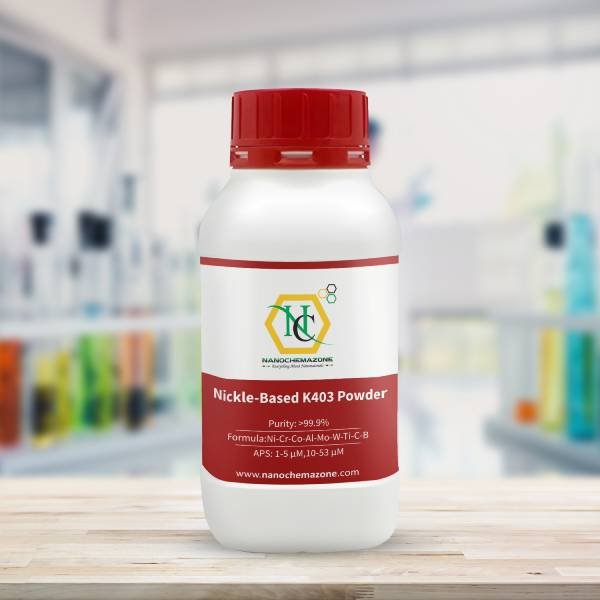
| Product | Nickel-Based K403 Powder |
| CAS No. | 7440-02-0 |
| Appearance | Silver-White Powder |
| Purity | ≥99%, ≥99.9%, ≥95%(Other purities are also available) |
| APS | 1-5 µM, 10-53 µM (Can be customized), Ask for other available size range. |
| Ingredient | Ni-Cr-Co-Al-Mo-W-Ti-C-B |
| Density | 8.2g/cm3 |
| Molecular Weight | N/A |
| Product Codes | NCZ-DCY-245/25 |
Nickel-Based K403 Description:
Nickel-Based K403 Powder is one of the numerous advanced ceramic materials manufactured by Nanochemazone. Nanochemazone produces too many standard grades when applicable, including Mil Spec (military grade); ACS, Reagent and Technical Grade; Food, Agricultural and Pharmaceutical Grade; Optical Grade, USP and EP/BP (European Pharmacopoeia/British Pharmacopoeia) and follows applicable ASTM testing standards. Typical and custom packaging is available. Additional technical, research and safety (MSDS) information are available. Please request a quote above for more information on lead time and pricingNickel-Based K403 Powder Related Information :
Storage Conditions: Airtight sealed, avoid light and keep dry at room temperature. Please contact us for customization and price inquiry Email: contact@nanochemazone.com Note: We supply different size ranges of Nano and micron as per the client’s requirements and also accept customization in various parameters. Nickel-based K403 Powder K403 powder is a nickel-chromium-iron-molybdenum alloy powder. It offers excellent resistance to oxidation, corrosion and thermal fatigue cracking. K403 has good phase stability at high temperatures. K403 powder is designed for protective coatings, thermal spray, welding, brazing, and other high temperature applications. Overview of Nickel-based K403 Powder K403 powder is a nickel-chromium-iron-molybdenum alloy powder. It offers excellent resistance to oxidation, corrosion and thermal fatigue cracking. K403 has good phase stability at high temperatures. Key features of K403 powder include: Outstanding high temperature strength and creep resistance Resists oxidation and hot corrosion up to 1150°C Retains properties under cyclic heating conditions Compatible coefficient of expansion with common alloys Available in various size ranges and morphologies K403 powder is designed for protective coatings, thermal spray, welding, brazing, and other high temperature applications. This article provides a detailed look at the composition, properties, applications, specifications, pricing, safety, and other essential information about nickel-based K403 powder. Composition of Nickel-based K403 Powder The typical composition of nickel-based K403 powder is:| Element | Composition |
| Nickel (Ni) | Balance |
| Chromium (Cr) | 21-23% |
| Iron (Fe) | 17-20% |
| Molybdenum (Mo) | 8-10% |
| Tungsten (W) | 1-2% |
| Manganese (Mn) | ≤0.5% |
| Silicon (Si) | ≤0.5% |
| Carbon (C) | ≤0.1% |
| Property | Details |
| Density | 8.2 g/cm3 |
| Melting Point | 1350-1400°C |
| Thermal Conductivity | 11 W/m.K |
| Electrical Resistivity | 94 microhm-cm |
| Young’s Modulus | 207 GPa |
| Poisson’s Ratio | 0.29-0.30 |
| Tensile Strength | ≥ 550 MPa up to 1050°C |
| Elongation | 15-25% |
| Hardness | 30-35 HRC |
| Oxidation Resistance | Excellent isothermal up to 1150°C |
| Parameter | K403 Powder | IN738 Powder |
| Composition | Ni-Cr-Fe-Mo | Ni-Cr-Co-Al-Ti |
| Oxidation Resistance | Excellent up to 1150°C | Very Good up to 1100°C |
| Cost | Higher | Lower |
| Phase Stability | Very Good | Poor |
| Mechanical Strength | High up to 1050°C | Good up to 750°C |
| Fabrication | Medium | Easy |
| Applications | Thermal spray, welding | Turbine components, AM parts |
| Availability | Moderate | Readily available |
Nickel-based K403 Powder
Nickel-based K403 Powder
| Product | Nickel-based K403 Powder |
| CAS No. | 7440-02-0 |
| Appearance | Gray Powder |
| Purity | ≥99%, ≥99.9%, ≥95%(Other purities are also available) |
| APS | 1-5 µM, 10-53 µM (Can be customized), Ask for other available size range. |
| Ingredient | Ni-Cr-Co-Al-Mo-W-Ti-C-B |
| Density | 8.2g/cm3 |
| Molecular Weight | N/A |
| Product Codes | NCZ-DCY-294/25 |
Nickel-based K403 Description:
Nickel-based K403 Powder is one of the numerous advanced ceramic materials manufactured by Nanochemazone. Nanochemazone produces too many standard grades when applicable, including Mil Spec (military grade); ACS, Reagent and Technical Grade; Food, Agricultural and Pharmaceutical Grade; Optical Grade, USP and EP/BP (European Pharmacopoeia/British Pharmacopoeia) and follows applicable ASTM testing standards. Typical and custom packaging is available. Additional technical, research and safety (MSDS) information are available. Please request a quote above for more information on lead time and pricingNickel-based K403 Powder Related Information :
Storage Conditions: Airtight sealed, avoid light and keep dry at room temperature. Please contact us for customization and price inquiry Email: contact@nanochemazone.com Note: We supply different size ranges of Nano and micron as per the client’s requirements and also accept customization in various parameters. Nickel-based K403 Powder K403 powder is a nickel-chromium-iron-molybdenum alloy powder. It offers excellent resistance to oxidation, corrosion and thermal fatigue cracking. K403 has good phase stability at high temperatures. K403 powder is designed for protective coatings, thermal spray, welding, brazing, and other high temperature applications. Overview of Nickel-based K403 Powder K403 powder is a nickel-chromium-iron-molybdenum alloy powder. It offers excellent resistance to oxidation, corrosion and thermal fatigue cracking. K403 has good phase stability at high temperatures. Key features of K403 powder include: Outstanding high temperature strength and creep resistance Resists oxidation and hot corrosion up to 1150°C Retains properties under cyclic heating conditions Compatible coefficient of expansion with common alloys Available in various size ranges and morphologies K403 powder is designed for protective coatings, thermal spray, welding, brazing, and other high temperature applications. This article provides a detailed look at the composition, properties, applications, specifications, pricing, safety, and other essential information about nickel-based K403 powder. Composition of Nickel-based K403 Powder The typical composition of nickel-based K403 powder is:| Element | Composition |
| Nickel (Ni) | Balance |
| Chromium (Cr) | 21-23% |
| Iron (Fe) | 17-20% |
| Molybdenum (Mo) | 8-10% |
| Tungsten (W) | 1-2% |
| Manganese (Mn) | ≤0.5% |
| Silicon (Si) | ≤0.5% |
| Carbon (C) | ≤0.1% |
| Property | Details |
| Density | 8.2 g/cm3 |
| Melting Point | 1350-1400°C |
| Thermal Conductivity | 11 W/m.K |
| Electrical Resistivity | 94 microhm-cm |
| Young’s Modulus | 207 GPa |
| Poisson’s Ratio | 0.29-0.30 |
| Tensile Strength | ≥ 550 MPa up to 1050°C |
| Elongation | 15-25% |
| Hardness | 30-35 HRC |
| Oxidation Resistance | Excellent isothermal up to 1150°C |
| Parameter | K403 Powder | IN738 Powder |
| Composition | Ni-Cr-Fe-Mo | Ni-Cr-Co-Al-Ti |
| Oxidation Resistance | Excellent up to 1150°C | Very Good up to 1100°C |
| Cost | Higher | Lower |
| Phase Stability | Very Good | Poor |
| Mechanical Strength | High up to 1050°C | Good up to 750°C |
| Fabrication | Medium | Easy |
| Applications | Thermal spray, welding | Turbine components, AM parts |
| Availability | Moderate | Readily available |
Nickel(II) Acetate Anhydrous Powder
Nickel(II) Acetate Anhydrous Powder
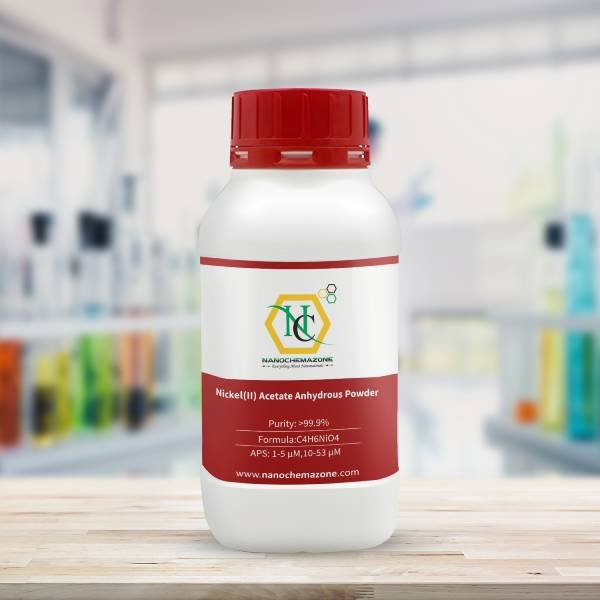
| Product | Nickel(II) Acetate Anhydrous Powder |
| CAS No. | 6018-89-9 |
| Appearance | Green-Blue Powder |
| Purity | ≥99%, ≥99.9%, ≥95%(Other purities are also available) |
| APS | 1-5 µM, 10-53 µM (Can be customized), Ask for other available size range. |
| Ingredient | C4H6NiO4 |
| Density | 1.798 g/cm3 |
| Molecular Weight | 176.78g/mol |
| Product Code | NCZ-CAS-221/25 |
Nickel(II) Acetate Anhydrous Description:
Nickel(II) Acetate Anhydrous Powder is one of the numerous advanced ceramic materials manufactured by Nanochemazone. Nanochemazone produces too many standard grades when applicable, including Mil Spec (military grade); ACS, Reagent and Technical Grade; Food, Agricultural and Pharmaceutical Grade; Optical Grade, USP and EP/BP (European Pharmacopoeia/British Pharmacopoeia) and follows applicable ASTM testing standards. Typical and custom packaging is available. Additional technical, research and safety (MSDS) information are available. Please request a quote above for more information on lead time and pricing.Nickel(II) Acetate Anhydrous Powder Related Information:
Storage Conditions: Airtight sealed, avoid light and keep dry at room temperature. Please contact us for customization and price inquiry Email: contact@nanochemazone.com Note: We supply different size ranges of Nano and micron as per the client’s requirements and also accept customization in various parameters. Nickel(II) Acetate Anhydrous CAS #: 373-02-4 Linear Formula: Ni(C2H3O2)2 MDL Number:MFCD00012451 EC No.:206-761-7 Nickel(II) Acetate Anhydrous Properties (Theoretical)| Compound Formula | C4H6NiO4 |
| Molecular Weight | 176.78 |
| Appearance | Blue-green powder |
| Melting Point | Decomposes |
| Boiling Point | N/A |
| Density | 1.798 g/cm3 |
| Solubility in H2O | Soluble |
| Exact Mass | 175.96195 g/mol |
| Monoisotopic Mass | 175.96195 g/mol |
Nickel(II) Acetate Tetrahydrate Powder
Nickel(II) Acetate Tetrahydrate Powder
| Product | Nickel(II) Acetate Tetrahydrate Powder |
| CAS No. | 6018-89-9 |
| Appearance | Green-Blue Powder |
| Purity | ≥99%, ≥99.9%, ≥95%(Other purities are also available) |
| APS | 1-5 µM, 10-53 µM (Can be customized), Ask for other available size range. |
| Ingredient | Ni(CH3COO)2·4H2O |
| Density | 1.798 g/cm3 |
| Molecular Weight | 248.85g/mol |
| Product Code | NCZ-CAS-222/25 |
Nickel(II) Acetate Tetrahydrate Description:
Nickel(II) Acetate Tetrahydrate Powder is one of the numerous advanced ceramic materials manufactured by Nanochemazone. Nanochemazone produces too many standard grades when applicable, including Mil Spec (military grade); ACS, Reagent and Technical Grade; Food, Agricultural and Pharmaceutical Grade; Optical Grade, USP and EP/BP (European Pharmacopoeia/British Pharmacopoeia) and follows applicable ASTM testing standards. Typical and custom packaging is available. Additional technical, research and safety (MSDS) information are available. Please request a quote above for more information on lead time and pricing.Nickel(II) Acetate Tetrahydrate Powder Related Information:
Storage Conditions: Airtight sealed, avoid light and keep dry at room temperature. Please contact us for customization and price inquiry Email: contact@nanochemazone.com Note: We supply different size ranges of Nano and micron as per the client’s requirements and also accept customization in various parameters. Nickel(II) Acetate Tetrahydrate CAS #: 6018-89-9 Linear Formula: Ni(C2H3O2)2 • 4H2O MDL Number:MFCD00066973 EC No.:206-761-7 Nickel(II) Acetate Tetrahydrate Properties (Theoretical)| Compound Formula | C4H14NiO8 |
| Molecular Weight | 248.85 |
| Appearance | Blue-green powder |
| Melting Point | N/A |
| Boiling Point | N/A |
| Density | 1.798 g/cm3 |
| Solubility in H2O | N/A |
| Exact Mass | 248.004209 g/mol |
| Monoisotopic Mass | 248.004209 g/mol |

NiCrCoAly Ceramic Thermal Spray Alloy Powder
Product Name: NiCrCoAly Ceramic Thermal Spray Alloy Powder
| Product | NiCrCoAly Ceramic Thermal Spray Alloy Powder |
| CAS No. | N.A. |
| Appearance | Powder |
| Purity | 99.9% |
| APS | 1 – 5 microns (can be customized) |
| Ingredient | NiCrCoAly |
| Product Code | NCZ-AE-232 |

Niobium Aluminum Carbide for Mxene Powder
Product Name: Niobium Aluminum Carbide for Mxene Powder
| Product | Niobium Aluminum Carbide for Mxene Powder |
| CAS No. | 60687-94-7 |
| Appearance | Powder |
| Purity | 99.9% |
| APS | 1 – 5 microns (can be customized) |
| Ingredient | Nb2AlC |
| Product Code | NCZ-AE-241 |

Niobium Ammonium Oxalate Powder
Niobium Ammonium Oxalate Powder
Product Name: Niobium Ammonium Oxalate Powder
| Product | Niobium Ammonium |
| CAS No | 168547-43-1 |
| Appearance | White Powder |
| Purity | 99.9% |
| APS | 1 – 5 Microns (Can be customized) |
| Ingredient | C4H4NNbO9-P |
| Product Code | NCZ-NSC-155/20 |
Mainly used for chemical, oil chemical industry catalyst and additives of ferrite materials, the dielectric material production process of additives and additive of lithium battery cathode material
RELATED INFORMATION Storage Conditions: Airtight sealed, avoid light, and keep dry at room temperature. Please email us for the customization. Email: contact@nanochemazone.com Note: We supply different size ranges of nano and micron size powder as per the client’s requirements and also accept customization in various parameters.
Niobium Ball Shape Powder
Product Name: Niobium Ball Shape Powder
| Product | Niobium Ball Shape Powder |
| CAS No. | 12007-29-3 |
| Appearance | Powder |
| Purity | 99.9% |
| APS | 1 – 5 microns (can be customized) |
| Ingredient | Nb |
| Product Code | NCZ-AE-225 |

Niobium Boride Powder
Niobium Boride Powder
Product Name: Niobium Boride Powder
| MF | NbB |
| Chemical Name | Niobium Boride Powder |
| EINECS | 235-723-2 |
| Purity | 99.9% |
| Molecular weight | 103.72 |
| Product Number | NCZ-SC-112/20 |
| Cas Number | 12619-90-8 |
| Density | 7.39g/ml |
Niobium Boride Powder
Niobium boride Powders having NbB, NbB2, and Nb3B4 phases in various amounts and single-phase NbB powders were successfully synthesized by using powder metallurgy methods from related metal oxide raw materials in the presence of a strong reducing agent. Nb2O5, B2O3, and Mg powder blends were milled at room temperature by a high-energy ball mill for a different time. Subsequently, an undesired MgO phase was removed from the milled powders by HCl leaching to constitute NbB–NbB2–Nb3B4 as final products, and they were subjected to an annealing process at 1500 °C for 4 h to observe probable boride transformation. Characterization was carried out by XRD, DSC, PSA, SEM/EDX, TEM, and VSM.
The effects of milling time (up to 9 h) on the formation, microstructure, and thermal behavior of the final products were investigated. The reduction reaction took place after milling stoichiometric powder blends for 2 h. Nano-sized NbB–NbB2–Nb3B4 powders in high purity were obtained in the absence of any secondary phase and any impurity via mechanochemistry by milling for 5 h and leaching with 4 mol/L HCl. After annealing, pure and nano-sized NbB–NbB2–Nb3B4 powders transformed to a single NbB phase without leaving behind NbB2 and Nb3B4 phases.
RELATED INFORMATION Please email us for the customization. Email: contact@nanochemazone.com Please contact us for customization and price inquiry Note: We supply different size ranges of Nano and micron as per the client’s requirements and also accept customization in various parameters.
Niobium Boride Powder
Niobium Boride Powder
Product Name: Niobium Boride Powder
| MF: | NbB |
| Chemical Name | Niobium Boride Powder |
| EINECS: | 235-723-2 |
| Purity: | 99.9% |
| Molecular weight: | 103.72 |
| Product Number: | NCZ-SC-112/20 |
| Cas Number: | 12619-90-8 |
| Density | 7.39g/ml |
Niobium Boride Powder Related Information
Niobium boride powders having NbB, NbB2 and Nb3B4 phases in various amounts and single phase NbB powders were successfully synthesized by using powder metallurgy methods from related metal oxide raw materials in the presence of a strong reducing agent. Nb2O5, B2O3 and Mg powder blends were milled at room temperature
A high-energy ball mill for different time. Subsequently, an undesired MgO phase was removed from the milled powders by HCl leaching to constitute NbB–NbB2–Nb3B4 as final products, and they were subjected to an annealing process at 1500 °C for 4 h to observe probable boride transformation. Characterization was carried out by XRD, DSC, PSA, SEM/EDX, TEM, and VSM. The effects of milling time (up to 9 h) on the formation, microstructure, and thermal behavior of the final products were investigated.
The reduction reaction took place after milling stoichiometric powder blends for 2 h. Nano-sized NbB–NbB2–Nb3B4 powders in high purity were obtained in the absence of any secondary phase and any impurity via mechanochemistry by milling for 5 h and leaching with 4 mol/L HCl. After annealing, pure and nano-sized NbB–NbB2–Nb3B4 powders transformed into a single NbB phase without leaving behind NbB2 and Nb3B4 phases.
Please email us for the customization. Email: contact@nanochemazone.com Please contact us for customization and price inquiry Note: We supply different size ranges of Nano and micron as per the client’s requirements and also accept customization in various parameters.
Niobium Carbide Powder
Product Name: Niobium Carbide Powder
| Product | Niobium Carbide Powder |
| CAS No. | 12069-94-2 |
| Appearance | Powder |
| Purity | 99.9% |
| APS | 1 – 5 microns (can be customized) |
| Ingredient | NbC |
| Product Code | NCZ-AE-194 |
Niobium Carbide Powder
Niobium Carbide Powder
| Product | Niobium Carbide Powder |
| CAS No. | 12069-94-2 |
| Appearance | Gray to Dark Brown Powder |
| Purity | ≥99%, ≥99.9%, ≥95%(Other purities are also available) |
| APS | 1-5 µM, 10-53 µM (Can be customized), Ask for other available size range. |
| Ingredient | NbC |
| Density | 7.6g/cm3 |
| Molecular Weight | 104.92g/mol |
| Product Codes | NCZ-DCY-159/25 |
Niobium Carbide Description:
Niobium Carbide is one of the numerous advanced ceramic materials manufactured by Nanochemazone. Nanochemazone produces too many standard grades when applicable, including Mil Spec (military grade); ACS, Reagent and Technical Grade; Food, Agricultural and Pharmaceutical Grade; Optical Grade, USP and EP/BP (European Pharmacopoeia/British Pharmacopoeia) and follows applicable ASTM testing standards. Typical and custom packaging is available. Additional technical, research and safety (MSDS) information are available. Please request a quote above for more information on lead time and pricing.Niobium Carbide Powder Related Information :
Storage Conditions: Airtight sealed, avoid light and keep dry at room temperature. Please contact us for customization and price inquiry Email: contact@nanochemazone.com Note: We supply different size ranges of Nano and micron as per the client’s requirements and also accept customization in various parameters. Spherical Niobium Carbide (NbC) powder 15-53µm Niobium powder is used as a nuclear fuel cladding material, nuclear fuel alloy additive, and heat exchanger knot manufacture valves, nozzles and other high temperature parts. Hunan Huawei provides high-quality Niobium powder at competitive prices. Specification Niobium is the refractory metal with high melting point, high temperature strength and specific strength, but no radioactivity. It is the preferred thermal protection material and structural material for aerospace engines. Radio frequency plasma spheroidized niobium powder has the characteristics of high sphericity, good fluidity, high purity, high bulk density, full density inside the particle, and no hollow powder. It is widely used in palladium materials, vacuum coating and thermal spraying coating, cold spraying, and other fields. TRM provides Spherical Niobium Powder, Nano Niobium Powder, and Micro Niobium Powder. Please contact us for more details. Synonyms: Nb spherical particles, niobium Spherical particles, niobium spherical powders, niobium metal spherical powder Powder characteristics: High purity (99.9% min.) Low oxygen (can be less than 600 ppm) High sphericity (98% min.) Smooth surface, no satellite Uniform particle size distribution, excellent flowability (Hall Flow Rate ≤ 15.0 s/50 g) High bulk density (≥ 4.5 g/cm3) and tap density (≥ 5.5 g/cm3) Applicable Processes: Selective laser melting / electron beam melting (SLM / EBM) Direct laser deposition (DLD) Powder hot isostatic pressing (HIP) Metal injection molding (MIM) Powder metallurgy (PM) Laser cladding (LC), etc.
Niobium Dioxide Powder
Niobium Dioxide Powder
| Product | Niobium Dioxide Powder |
| CAS No. | 12034-59-2 |
| Appearance | Bluish Black Powder |
| Purity  | ≥99%, ≥99.9%, ≥95% (Other purities are also available) |
| APS   | 1-5 µM, 10-53 µM (Can be customized), Ask for other available size range. |
| Ingredient | NbO2 |
| Density | N/A |
| Molecular Weight | 124.91g/mol |
| Product Codes | NCZ-MNO-114/25 |
Niobium Dioxide Description:
Niobium Dioxide Powder is one of the numerous advanced ceramic materials manufactured by Nanochemazone. Nanochemazone produces too many standard grades when applicable, including Mil Spec (military grade); ACS, Reagent and Technical Grade; Food, Agricultural and Pharmaceutical Grade; Optical Grade, USP and EP/BP (European Pharmacopoeia/British Pharmacopoeia) and follows applicable ASTM testing standards. Typical and custom packaging is available. Additional technical, research and safety (MSDS) information are available. Please request a quote above for more information on lead time and pricingNiobium Dioxide Powder Related Information :
Storage Conditions: Airtight sealed, avoid light and keep dry at room temperature. Please contact us for customization and price inquiry Email: contact@nanochemazone.com Note: We supply different size ranges of Nano and micron as per the client’s requirements and also accept customization in various parameters. Niobium Dioxide (NbO2) Powder (CAS No. 12034-59-2)| Catalog No. | NCZ-MNO-114/25 |
| Product Name | Niobium Dioxide, Niobium(IV) Oxide |
| Chemical Formula | NbO2 |
| CAS Number | 12034-59-2 |
| Molecular Weight | 124.91 |
| Appearance | Bluish black solid |
| Purity | 99.9% |
| CAS Number | 12034-59-2 |
| Chemical Formula | NbO2 |
| Molecular Weight | 124.91 |
| Form | bluish black powder |
| Density | 5.9g/cm3 |
| Melting Point | 1901℃ |
| Solubility | Insoluble in water. |

Niobium Disilicide Powder
Product Name: Niobium Disilicide Powder
| Product | Niobium Disilicide |
| CAS No. | 12034-80-9 |
| Appearance | Powder |
| Purity | 99.9% |
| APS | 1 – 5 Microns (Can be customized) |
| Ingredient | NbSi2 |
| Product Code | NCZ-NSC-134/20 |
Niobium Disilicide Powder Related Information
Our high-quality niobium silicide is in submicron & nanoparticle forms. It is widely used in ceramic materials, electrode materials, thin-film materials and refractory Storage Conditions: Airtight sealed, avoid light and keep dry at room temperature. Please email us for the customization. Email: contact@nanochemazone.com Note: We supply different size ranges of nano and micron size powder as per the client’s requirements and also accept customization in various parameters.

Niobium Doped Titanium Dioxide Dispersion
| Product | Niobium Doped TiO2 Dispersion |
| Product Number | NCZ-D109-N |
| CAS | 13463-67-7 |
| HS Code | 32061110 |
| APS | 2-5 µm (Size customization is possible) |
| Purity | 99.9% |
| Molecular Formula | Nb/TiO2 |
| Form | Dispersion (Also available in powder form) |
| PH value | 7.5±1.5 |
| Solvent | IPA/Ethanol |
| Content | 3-5 wt% |
| Density | 1.7 g/mL±0.1 g/mL at 25 °C |
| Doping | Niobium (Nb) Doped |

Niobium Iron Powder
Product Name: Niobium Iron Powder
| Product | Niobium Iron Powder |
| CAS No. | 7440-03-1 |
| Appearance | Powder |
| Purity | 99.9% |
| APS | 1 – 5 microns (can be customized) |
| Ingredient | FeNb70 |
| Product Code | NCZ-AE-233 |


Niobium Micropowder
Niobium Powder
Niobium Metal Powder
Niobium Metal Powder in Nano and Micron Size range
| MF: | Niobium |
| Chemical Name: | Niobium Micropowder |
| Purity: | > >99.99% |
| APS: | 40-50 µm (Size Customization possible) |
| Form: | Micro powder |
| Product Number: | NCZM116 |
| CAS Number | 7440-03-1 |


Niobium Nanopowder Dispersion with EDA Ligand
| MF: | Nb |
| Chemical Name: | Niobium Nanoparticles Dispersion |
| Purity: | > 99.99% |
| APS: | 80-100 nm (Size Customization possible) |
| Form: | nanodispersion |
| Product Number: | NCZD801 |
| CAS Number | 7440-03-1 |
Niobium Nitride Powder
Niobium Nitride Powder
| Product | Niobium Nitride Powder |
| CAS No. | 24621-21-4 |
| Appearance | Gray Powder |
| Purity | ≥99%, ≥99.9%, ≥95%(Other purities are also available) |
| APS | 1-5 µM, 10-53 µM (Can be customized), Ask for other available size range. |
| Ingredient | NbN |
| Density | 8.47g/cm3 |
| Molecular Weight | 106.91g/mol |
| Product Codes | NCZ-DCY-160/25 |
Niobium Nitride Description:
Niobium Nitride is one of the numerous advanced ceramic materials manufactured by Nanochemazone. Nanochemazone produces too many standard grades when applicable, including Mil Spec (military grade); ACS, Reagent and Technical Grade; Food, Agricultural and Pharmaceutical Grade; Optical Grade, USP and EP/BP (European Pharmacopoeia/British Pharmacopoeia) and follows applicable ASTM testing standards. Typical and custom packaging is available. Additional technical, research and safety (MSDS) information are available. Please request a quote above for more information on lead time and pricing.Niobium Nitride Powder Related Information :
Storage Conditions: Airtight sealed, avoid light and keep dry at room temperature. Please contact us for customization and price inquiry Email: contact@nanochemazone.com Note: We supply different size ranges of Nano and micron as per the client’s requirements and also accept customization in various parameters. Specification Niobium is the refractory metal with high melting point, high temperature strength and specific strength, but no radioactivity. It is the preferred thermal protection material and structural material for aerospace engines. Radio frequency plasma spheroidized niobium powder has the characteristics of high sphericity, good fluidity, high purity, high bulk density, full density inside the particle, and no hollow powder. It is widely used in palladium materials, vacuum coating and thermal spraying coating, cold spraying, and other fields. TRM provides Spherical Niobium Powder, Nano Niobium Powder, and Micro Niobium Powder. Please contact us for more details. Synonyms: Nb spherical particles, niobium Spherical particles, niobium spherical powders, niobium metal spherical powder Powder characteristics: High purity (99.9% min.) Low oxygen (can be less than 600 ppm) High sphericity (98% min.) Smooth surface, no satellite Uniform particle size distribution, excellent flowability (Hall Flow Rate ≤ 15.0 s/50 g) High bulk density (≥ 4.5 g/cm3) and tap density (≥ 5.5 g/cm3) Applicable Processes: Selective laser melting / electron beam melting (SLM / EBM) Direct laser deposition (DLD) Powder hot isostatic pressing (HIP) Metal injection molding (MIM) Powder metallurgy (PM) Laser cladding (LC), etc.
Niobium Oxide Nano Powder
Niobium Oxide Nano Powder
Product Name: Niobium Oxide Nano Powder
| Product | Niobium Oxide Nano Powder |
| Colour | White |
| Purity | ≥ 99.9% |
| Particle size | 1-10µM (customizable) |
| Ingredient/MF | Nb2O5 |
| Product Code | NCZ-CS-178/20 |
| CAS Number | 1313-96-8 |
Description of Niobium Oxide Nano Powder:
Also known as niobium oxide, niobium pentoxide, or diniobium pentoxide nanopowder, this material appears as an extremely fine powder. Composed of niobium (v) oxide nanoparticles with diameters of approximately 500nm, this nanopowder is available in a wide variety of dispersions, purities, and coatings. If you’d like to learn more about ordering, handling, and utilizing niobium (v) oxide nanopowder (nb2o5, 500 nm), you can contact SS Nano directly.
Applications of Niobium Oxide Nano Powder:
Coating applications: Like many nanopowders, this material can be used in a number of specialty coatings and paints.
Material production applications: In addition to its role in producing certain compound materials such as plastics, this nanoparticle is of particular interest in the production of nanostructures such as nanowires.
Catalyst and alloy applications: Like many nanoparticles, niobium pentoxide can be used as a catalyst and alloy additive for various purposes.
Pigment applications: Certain pigmentation processes can utilize this material, including those used in packaging, certain solid fuels, and general printing.
Dietary supplementation applications: The food processing industry can use certain preparations of this material as a dietary supplement
Electrochemical applications. This material can be used to produce both electrochemical cathodes and electrochemical capacitors.
Please email us for the customization.
Email: contact@nanochemazone.com
Please contact us for customization and price inquiry
Note: We supply different size ranges of Nano and micron as per the client’s requirements and also accept customization in various parameters.


Niobium Pentachloride Powder
Niobium Pentachloride Powder
| Product | Niobium Pentachloride Powder |
| Formula | NbCl5 |
| Stock No. | NCZM103-19 |
| Purity | 99.6% |
| CAS Number | 10026-12-7 |
| Density | 2.75 g/cm3 at 25 ˚C |
| Boiling Point | 254 ˚ C |
| Melting Point | 204.7˚C |
| Size | Micro and Nano Size Range available |

Niobium Pentoxide Powder
Product Name: Niobium Pentoxide Powder
| Product | Niobium Pentoxide Powder |
| CAS No. | 1313-96-8 |
| Appearance | Powder |
| Purity | 99.9% |
| APS | 1 – 5 microns (can be customized) |
| Ingredient | Nb2O5 |
| Product Code | NCZ-AE-195 |
Niobium Powder
Niobium Powder
| Product | Niobium Powder |
| CAS No. | 7440-03-0 |
| Appearance | Silvery- White Powder |
| Purity | ≥99%, ≥99.9%, ≥95%(Other purities are also available) |
| APS | 1-5 µM, 10-53 µM (Can be customized), Ask for other available size range. |
| Ingredient | Nb |
| Density | 8.2g/cm3 |
| Molecular Weight | N/A |
| Product Codes | NCZ-DCY-246/25 |
Niobium Description:
Niobium Powder is one of the numerous advanced ceramic materials manufactured by Nanochemazone. Nanochemazone produces too many standard grades when applicable, including Mil Spec (military grade); ACS, Reagent and Technical Grade; Food, Agricultural and Pharmaceutical Grade; Optical Grade, USP and EP/BP (European Pharmacopoeia/British Pharmacopoeia) and follows applicable ASTM testing standards. Typical and custom packaging is available. Additional technical, research and safety (MSDS) information are available. Please request a quote above for more information on lead time and pricingNiobium Powder Related Information :
Storage Conditions: Airtight sealed, avoid light and keep dry at room temperature. Please contact us for customization and price inquiry Email: contact@nanochemazone.com Note: We supply different size ranges of Nano and micron as per the client’s requirements and also accept customization in various parameters. Niobium Powder Niobium is used in prosthetics and implant devices, such as pacemakers because it is physiologically inert and hypoallergenic. Besides, niobium powders are required as a raw material, in the fabrication of electrolytic capacity Overview of Niobium Powder Niobium is a shiny, white refractory transition metal with outstanding heat resistance and very high melting point. In powder form, it exhibits excellent thermal, electrical, and chemical stability. Key properties of niobium powder include: High heat resistance and refractory nature Excellent corrosion resistance Superconducting below 9.2K (-264°C) Thermal and electrical stability Low neutron absorption High density powder with good chemical purity Available in various particle size ranges Niobium powder is used where its refractory, conductive, and superconductive properties can be utilized. The major applications include electronics, superconductors, alloys, chemical/heat resistant components, optical coatings, and pyrotechnics. Composition of Niobium Powder Niobium powder has the following typical composition:| Element | Purity |
| Niobium (Nb) | 99% min |
| Tantalum (Ta) | 0.5% max |
| Hafnium (Hf) | 0.01% max |
| Nitrogen (N) | 0.03% max |
| Carbon (C) | 0.05% max |
| Oxygen (O) | 0.1-0.2% |
| Hydrogen (H) | 0.0015% max |
| Property | Value |
| Density | 8.57 g/cm3 |
| Melting Point | 2477°C |
| Thermal Conductivity | 53 W/m∙K |
| Electrical Resistivity | 15 μΩ∙cm |
| Young’s Modulus | 105 GPa |
| Poisson’s Ratio | 0.40 |
| Tensile Strength | 550 MPa |
| Compressive Strength | 200 MPa |
| Vickers Hardness | 600 HV |
| Parameter | Niobium Powder | Tantalum Powder |
| Density | 8.57 g/cm3 | 16.6 g/cm3 |
| Melting Point | 2477°C | 2996°C |
| Electrical resistivity | 15 μΩ.cm | 13 μΩ.cm |
| Tensile strength | 550 MPa | 400 MPa |
| Oxidation resistance | Moderate | Better |
| Cost | Lower | Higher |
| Applications | Alloys, capacitors | Medical, electronics |
Niobium Powder
Niobium Powder
| Product | Niobium Powder |
| CAS No. | 7440-03-1 |
| Appearance | Dark Gray Powder |
| Purity | ≥99%, ≥99.9%, ≥95%(Other purities are also available) |
| APS | 1-5 µM, 10-53 µM (Can be customized), Ask for other available size range. |
| Ingredient | Nb |
| Density | 8.57g/cm3 |
| Molecular Weight | 92.91g/mol |
| Product Codes | NCZ-DCY-332/25 |
Niobium Description:
Niobium Powder is one of the numerous advanced ceramic materials manufactured by Nanochemazone. Nanochemazone produces too many standard grades when applicable, including Mil Spec (military grade); ACS, Reagent and Technical Grade; Food, Agricultural and Pharmaceutical Grade; Optical Grade, USP and EP/BP (European Pharmacopoeia/British Pharmacopoeia) and follows applicable ASTM testing standards. Typical and custom packaging is available. Additional technical, research and safety (MSDS) information are available. Please request a quote above for more information on lead time and pricing.Niobium Powder Related Information :
Storage Conditions: Airtight sealed, avoid light and keep dry at room temperature. Please contact us for customization and price inquiry Email: contact@nanochemazone.com Note: We supply different size ranges of Nano and micron as per the client’s requirements and also accept customization in various parameters. Niobium Powder Niobium is used in prosthetics and implant devices, such as pacemakers because it is physiologically inert and hypoallergenic. Besides, niobium powders are required as a raw material, in the fabrication of electrolytic capacitors. Overview of Niobium Powder Niobium is a shiny, white refractory transition metal with outstanding heat resistance and very high melting point. In powder form, it exhibits excellent thermal, electrical, and chemical stability. Key properties of niobium powder include: High heat resistance and refractory nature Excellent corrosion resistance Superconducting below 9.2K (-264°C) Thermal and electrical stability Low neutron absorption High density powder with good chemical purity Available in various particle size ranges Niobium powder is used where its refractory, conductive, and superconductive properties can be utilized. The major applications include electronics, superconductors, alloys, chemical/heat resistant components, optical coatings, and pyrotechnics. Composition of Niobium Powder| Element | Purity |
| Niobium (Nb) | 99% min |
| Tantalum (Ta) | 0.5% max |
| Hafnium (Hf) | 0.01% max |
| Nitrogen (N) | 0.03% max |
| Carbon (C) | 0.05% max |
| Oxygen (O) | 0.1-0.2% |
| Hydrogen (H) | 0.0015% max |
| Property | Value |
| Density | 8.57 g/cm3 |
| Melting Point | 2477°C |
| Thermal Conductivity | 53 W/m∙K |
| Electrical Resistivity | 15 μΩ∙cm |
| Young’s Modulus | 105 GPa |
| Poisson’s Ratio | 0.40 |
| Tensile Strength | 550 MPa |
| Compressive Strength | 200 MPa |
| Vickers Hardness | 600 HV |
| Parameter | Niobium Powder | Tantalum Powder |
| Density | 8.57 g/cm3 | 16.6 g/cm3 |
| Melting Point | 2477°C | 2996°C |
| Electrical resistivity | 15 μΩ.cm | 13 μΩ.cm |
| Tensile strength | 550 MPa | 400 MPa |
| Oxidation resistance | Moderate | Better |
| Cost | Lower | Higher |
| Applications | Alloys, capacitors | Medical, electronics |

Niobium Powder with MPS Ligand
| MF: | Nb |
| Chemical Name: | Niobium Dispersion |
| Purity: | >99.99% |
| APS: | 80-100 nm (Size Customization possible) |
| Form: | nanodispersion |
| Product Number: | NCZD802 |
| CAS Number | 7440-03-1 |

Nitride Europium Powder
Product Name: Nitride Europium Powder
| Product | Nitride Europium Powder |
| CAS No. | 12020-58-5 |
| Appearance | Powder |
| Purity | 99.9% |
| APS | 1 – 5 microns (can be customized) |
| Ingredient | EuN |
| Product Code | NCZ-AE-217 |

Nitride Phosphor Powder
Nitride Phosphor Powder
| Product | Nitride Phosphor Powder |
| CAS No. | 52934-12-0 |
| Appearance | Orange Red Powder |
| Purity | ≥99%, ≥99.9%, ≥95% (Other purities are also available) |
| APS | 1-5 µM, 10-53 µM (Can be customized), Ask for other available size range. |
| Ingredient | PN |
| Density | 2.8 to 3.1g/cm3 |
| Molecular Weight | 48g/mol |
| Product Codes | NCZ-MNO-172/25 |
Nitride Phosphor Description:
Nitride Phosphor Powder is one of the numerous advanced ceramic materials manufactured by Nanochemazone. Nanochemazone produces too many standard grades when applicable, including Mil Spec (military grade); ACS, Reagent and Technical Grade; Food, Agricultural and Pharmaceutical Grade; Optical Grade, USP and EP/BP (European Pharmacopoeia/British Pharmacopoeia) and follows applicable ASTM testing standards. Typical and custom packaging is available. Additional technical, research and safety (MSDS) information are available. Please request a quote above for more information on lead time and pricing.Nitride Phosphor Powder Related Information :
Storage Conditions: Airtight sealed, avoid light and keep dry at room temperature. Please contact us for customization and price inquiry Email: contact@nanochemazone.com Note: We supply different size ranges of Nano and micron as per the client’s requirements and also accept customization in various parameters. Nitride Phosphor Powder| Catalog No. | NCZ-MNO-172/25 |
| Color | Orange, Red |
| Particle Size | D50 7-18 um |
| Excitation Range | 360nm-470nm |
| Color Point (x,y) | 0.612-0.68, 0.387-0.318 |
| Emission Peak Wavelength | 610nm-670nm |
| Type | Model | Color | Chromaticity Coordinates CIE 1931 | Spectral Performance | ||
| x | y | Chip Excitation Wavelength (nm) | Peak Wavelength λp (nm) | |||
| Nitride | 6237 | red | 0.634 | 0.366 | 350-550 | 612 |
| 6336 | light red | 0.633 | 0.366 | 350-550 | 615 | |
| 6534 | red | 0.653 | 0.340 | 350-550 | 625 | |
| 6633 | Pink | 0.663 | 0.335 | 350-550 | 630 | |
| 6831 | deep red | 0.680 | 0.319 | 350-550 | 645 | |

Nitrogen Doped MXenes
Product Name: Nitrogen Doped MXenes
| Product | Nitrogen Doped MXenes |
| CAS No. | 12316-56-2 |
| Appearance | Powder |
| Purity | 99% |
| Size | 1 – 5 microns (can be customized) |
| Ingredient | Ti2C-N |
| Product Code | NCZ-MX-307 |
RELATED INFORMATION
Storage Conditions: Airtight sealed, avoid light and keep dry at room temperature. Please email us for the customization. Email: contact@nanochemazone.com
Nitrogen-doped Graphene Powder
Nitrogen-doped Graphene Powder
| MF | C |
| Chemical Name | Graphene |
| Purity | ≥99.9% |
| Diameter | 2-10 µm |
| Thickness | 0.5- 3 nm |
| Number of Layers | 1-3 (Customization possible) |
| Color | Black |
| Specific Area | 200-500 m2/g |
| Form | Nanopowder |
| Product Number | NCZC1006 |
| CAS Number | 7782-42-5 |
| Content of Nitrogen | 5-10 wt% |

Non-Crystal Nano Boron Powder
Product Name: Non-Crystal Nano Boron Powder
| Product | Non-Crystal Nano Boron Powder |
| CAS No. | 7440-42-8 |
| Appearance | Powder |
| Purity | 99.9% |
| APS | 1 – 5 Microns (Can be customized) |
| Ingredient | B |
| Product Code | NCZ-AE-166 |


Octa Ammonium POSS
| MF: | C24H72Cl8N8O12Si8 |
| Chemical Name: | Octa Ammonium POSS |
| Purity: | > 99.99% |
| Form: | Nanopowder/Dispersion |
| Product Number: | NCZ2201 |
| CAS Number | 150380-11-3 |


Octamethyl POSS (Octamethylsilsesquioxane)
| MF: | C16H24O12Si8 |
| Chemical Name: | Octamethylsilsesquioxane |
| Purity: | >99.99% |
| Form: | Nanopowder/Dispersion |
| Product Number: | NCZD2301 |
| CAS Number | 17865-85-9 |


Octaphenyl Silsesquioxane (Octaphenyl POSS, Purity: 99.99%)
| MF: | C48H40O12Si8 |
| Chemical Name: | Octaphenyl Silsesquioxane |
| Purity: | >99.99% |
| Form: | Nanopowder/Dispersion |
| Product Number: | NCZD2401 |
| CAS Number | 5256-79-1 |


Octavinyl Poss (Octavinyl octasilasesquioxane)
| MF: | C16H24O12Si8 |
| Chemical Name: | Octavinyloctasilasesquioxane |
| Purity: | >99.99% |
| Form: | Nanopowder |
| Product Number: | NCZD2501 |
| CAS Number | 69655-76-1 |

Oil Dispersible Upconverting Nanoparticles
Upconverting Nanoparticles and Quantum Dots
Category: Oil Dispersible Upconverting Nanoparticles
Concentration: 1mg/mL to 20 mg/mL (in stock) Concentration Customization: Possible Carrier: Cyclohexane Dispersion Customization: Possible Size: 10 mL – 100 mL, 1 mg to 100 mg Nanochemazone also provides larger package size. Contact us for more information. Price: Inquiry (sales@nanochemazone.com)| Chemical Name | Upconverting nanoparticles/Quantum dots |
| Catalog code | NCZ-UCNP-102 |
| Appearance | yellowish or light brown solution |
| Solvent | Cyclohexane |
| Excitation wavelength | 975 nm |
| MF | NaYREF4(RE: Yb, Er, Tm, Gd, Mn, Lu) |
| CAS Number | 110-82-7 (Cyclohexane), 7681-49-4(Sodium fluoride) |
| Sensitizer | Ytterbium (Yb3+) |
| Concentration | 5 mg/mL, Concentration Customization: Possible |
| Particle Size and Morphology | 25 nm, nanosized spheres |
| Surface Modified | Oleic acid |
| Activator | Emission wavelength | Fluorescence |
| Thulium (Tm3+) | 365/475 nm | Purple-Blue |
| Erbium (Er3+) | 545/660 nm | Green-Yellow |
| Thulium (Tm3+) | 804 nm | Near-infrared |
The doping concentrations are optimized, leading to strong upconverted emissions at specific wavelengths. The size of UCNs can be customized based on user’s need. The UCNs are of high quantum efficiency and very photostable. After proper surface modification and functionalization, the products can be used for fluorescence imaging, biodetection, photodynamic therapy and photoactivation of anti-cancer drugs and biomolecules.
| Product Number | Em. Wavelength | Color | Crystal Formula | Diameter | Morphology | Amount (mg) |
| NCZ-UCNP-102-365 | 365 nm | UV | NaYREF4 | 25 nm | Spherical | 10/20/50 |
| NCZ-UCNP-102-475 | 475 nm | Blue | NaYREF4 | 25 nm | Spherical | 10/20/50 |
| NCZ-UCNP-102-545 | 545 nm | Green | NaYREF4 | 25 nm | Spherical | 10/20/50 |
| NCZ-UCNP-102-660 | 660 nm | Red | NaYREF4 | 25 nm | Spherical | 10/20/50 |
| NCZ-UCNP-102-804 | 804 nm | NIR | NaYREF4 | 25 nm | Spherical | 10/20/50 |
Application
Upconverting nanoparticles have excellent photostability and have been widely used in biomedical applications, including in vitro bioimaging, in vivo bioimaging, bioassays, immunohistochemistry, microarray detection, photodynamic therapy, and photo-controlled drug activation.
Upconverting nanoparticles are able to convert near infrared radiations with lower energy into visible radiations with higher energy via a nonlinear optical process. The doping concentrations and the size of upconverting nanoparticles can be customized based on your specific requirements.
Our upconverting nanoparticles can either be oil or water dispersible. By precise surface modification, upconverting nanoparticles are available with coated, amine functionalized and antibody conjugated forms. These photoluminescent nanoparticles can be used for bio-imaging, molecular recognition and photodynamic therapy.
- Molecular recognition
- Highly sensitive bioimaging
- Biosensors
- Light-responsive drug release
- Photosensitizers in photodynamic therapy
- Immunoassay
- Flow cytometry
OP431 Powder
OP431 Powder
| Product | OP431 Powder |
| CAS No. | 431-03-8 |
| Appearance | Light Gray Powder |
| Purity | ≥99%, ≥99.9%, ≥95%(Other purities are also available) |
| APS | 1-5 µM, 10-53 µM (Can be customized), Ask for other available size range. |
| Ingredient | Fe-W-Mo-Cr-V-Co |
| Density | 7.8-8.1g/cm3 |
| Molecular Weight | N/A |
| Product Codes | NCZ-DCY-357/25 |
OP431 Description:
OP431 Powder is one of the numerous advanced ceramic materials manufactured by Nanochemazone. Nanochemazone produces too many standard grades when applicable, including Mil Spec (military grade); ACS, Reagent and Technical Grade; Food, Agricultural and Pharmaceutical Grade; Optical Grade, USP and EP/BP (European Pharmacopoeia/British Pharmacopoeia) and follows applicable ASTM testing standards. Typical and custom packaging is available. Additional technical, research and safety (MSDS) information are available. Please request a quote above for more information on lead time and pricing.OP431 Powder Related Information :
Storage Conditions: Airtight sealed, avoid light and keep dry at room temperature. Please contact us for customization and price inquiry Email: contact@nanochemazone.com Note: We supply different size ranges of Nano and micron as per the client’s requirements and also accept customization in various parameters. Stainless Steel OP431 Powder Stainless steel OP431 powder is a powdered form of stainless steel that consists of iron, chromium, nickel, and other alloying elements. It is manufactured through a specialized process called atomization, where molten stainless steel is rapidly cooled using gas or water, resulting in the formation of fine metal particles. Overview of Stainless Steel OP431 Powder OP431 stainless steel belongs to the ferritic grade steels which contain chromium as the principal alloying element. The addition of aluminum enhances oxidation and corrosion resistance at high temperatures. Key characteristics of OP431 powder include: Excellent oxidation and corrosion resistance up to 1150°C Good creep resistance and thermal fatigue strength Excellent thermo-mechanical stability High thermal conductivity and low thermal expansion Cost-effective compared to austenitic stainless steels Available in various particle size distributions OP431 powder is ideal for applications requiring oxidation resistance, thermal stability and moderate strength at elevated temperatures. Chemical Composition of OP431 Powder OP431 powder has the following nominal composition:| Element | Weight % |
| Iron (Fe) | Balance |
| Chromium (Cr) | 16-18% |
| Aluminum (Al) | 3-5% |
| Yttrium (Y) | 0.2-0.5% |
| Carbon (C) | 0.03% max |
| Silicon (Si) | 1% max |
| Manganese (Mn) | 1% max |
| Property | Value |
| Density | 7.3 g/cm3 |
| Melting Point | 1400-1450°C |
| Thermal Conductivity | 29 W/mK |
| Electrical Resistivity | 0.6 μΩ.cm |
| Young’s Modulus | 200 GPa |
| Poisson’s Ratio | 0.27-0.30 |
| Tensile Strength | 450-650 MPa |
| Yield Strength | 280-480 MPa |
| Elongation | 15-20% |
| Oxidation Resistance | Excellent up to 1150°C |
| Parameter | OP431 | 316L |
| Type | Ferritic | Austenitic |
| Cr content | 16-18% | 16-18% |
| Ni content | – | 10-14% |
| High temperature strength | Higher | Lower |
| Corrosion resistance | Moderate | Excellent |
| Cost | Lower | Higher |
| Applications | Thermal spray, igniters | Automotive, construction |
| Weldability | Poor | Excellent |


Open Cell Copper Foam Heat Exchanger
Open Cell Copper Foam Heat Exchanger
Copper Metal Foam open cell
| Stock No. | NCZFF105 |
| PPI | 10 to 110 PPI, customization is also possible |
| Bulk Density | 0.80-0.85 g/cc |
| Purity | ≥99.9% |
| Porosity | ≥70%, customization is also possible |
| Dimension | 500 mm X 500 mm, customization is also possible |
| Thickness | 1 mm to 25 mm, customization is also possible |
| Compression Strength | 131 psi |
| Tensile Strength | 1000 psi |
| Shear Strength | 190 psi |
| Modulus of Elasticity (Compression) | 107 kpsi |
| Modulus of Elasticity (Tension) | 14.6 × 10³ psi |
| Shear Modulus | 40.9 kpsi |
| Vickers Hardness | 35 |
| Specific Heat | 0.385 J/g-°C |
| Bulk Thermal Conductivity | 10.1 W/m-°C |
| Coefficient of Thermal Expansion | 1.7 × 10⁻⁵ m/m–°C (0-100°C) |
| Bulk Resistivity | 2.56× 10⁻⁵ ohm – in |
| Melting Point | 1080 °C |
Ask for customization while ordering

Orange Photoluminescent Pigment Powder
| Product | Orange Photoluminescent Pigment Powder |
| CAS No. | 3520-72-7 |
| Appearance | Orange Powder |
| Purity | ≥99%, ≥99.9%, ≥95% (Other purities are also available) |
| APS | 1-5 µM, 10-53 µM (Can be customized), Ask for other available size range. |
| Ingredient | Sr4Al14O25:Eu,Dy |
| Density | 3.1g/cm3 |
| Molecular Weight | N/A |
| Product Codes | NCZ-MNO-150/25 |
Orange Photoluminescent Pigment Description:
Orange Photoluminescent Pigment Powder is one of the numerous advanced ceramic materials manufactured by Nanochemazone. Nanochemazone produces too many standard grades when applicable, including Mil Spec (military grade); ACS, Reagent and Technical Grade; Food, Agricultural and Pharmaceutical Grade; Optical Grade, USP and EP/BP (European Pharmacopoeia/British Pharmacopoeia) and follows applicable ASTM testing standards. Typical and custom packaging is available. Additional technical, research and safety (MSDS) information are available. Please request a quote above for more information on lead time and pricing.Orange Photoluminescent Pigment Powder Related Information :
Storage Conditions: Airtight sealed, avoid light and keep dry at room temperature. Please contact us for customization and price inquiry Email: contact@nanochemazone.com Note: We supply different size ranges of Nano and micron as per the client’s requirements and also accept customization in various parameters. Orange Photoluminescent Pigment| Catalog No. | NCZ-MNO-150/25 |
| Color | Orange |
| Glowing Color | Orange |
| Compositions | (Ca1-XSrX)S:Eu (x=0-1.0) |
| Afterglow Brightness Range (mcd/m2) | ≥95 |
| Product Category | RO |
| Apparent color | orange |
| Glow color | orange |
| Main components | (Ca1-XSrX)S:Eu (x=0-1.0) |
| Excitation wavelength range (nm) | 400-580 |
| Luminescence wavelength peak (nm) | 630 |
| Central particle size range (μm) | 20-40 |
| Afterglow brightness range (mcd/m2) | ≥95 |
| Afterglow time | >1 Hour |
| Lightfastness | ≥100 hours |
| Chemical stability | Easy to deliquesce |
| Operating temperature | ≤200℃ |
| Specific gravity (g/cm3) | 3.1 |
Orange Silicate LED Phosphor Powder
Orange Silicate LED Phosphor Powder
| Product | Orange Silicate LED Phosphor Powder |
| CAS No. | N/A |
| Appearance | Orange Powder |
| Purity | ≥99%, ≥99.9%, ≥95% (Other purities are also available) |
| APS | 1-5 µM, 10-53 µM (Can be customized), Ask for other available size range. |
| Ingredient | Sr3Al2Si3O12:Eu3 |
| Density | 4.8g/cm3 |
| Molecular Weight | N/A |
| Product Codes | NCZ-MNO-147/25 |
Orange Silicate LED Phosphor Description:
Orange Silicate LED Phosphor Powder is one of the numerous advanced ceramic materials manufactured by Nanochemazone. Nanochemazone produces too many standard grades when applicable, including Mil Spec (military grade); ACS, Reagent and Technical Grade; Food, Agricultural and Pharmaceutical Grade; Optical Grade, USP and EP/BP (European Pharmacopoeia/British Pharmacopoeia) and follows applicable ASTM testing standards. Typical and custom packaging is available. Additional technical, research and safety (MSDS) information are available. Please request a quote above for more information on lead time and pricing.Orange Silicate LED Phosphor Powder Related Information :
Storage Conditions: Airtight sealed, avoid light and keep dry at room temperature. Please contact us for customization and price inquiry Email: contact@nanochemazone.com Note: We supply different size ranges of Nano and micron as per the client’s requirements and also accept customization in various parameters. Orange Silicate LED Phosphor Powder| Catalog No. | NCZ-MNO-147/25 |
| Appearance | Orange Powder |
| Product Name | Orange Silicate LED Phosphor Powder |
| Emission Color | Orange |
| Relative Intensity | 100±2% |
| Peak Wavelength (nm) | 600±1 |
| CIE-X | 0.582±0.002 |
| CIE-Y | 0.416±0.002 |
| Density (g/cm3) | 4.8 |
| Particle Size (μm) | 15±2.0 |
| Chip Size (nm) | 445-470 |

Orange-Red Photoluminescent Pigment Powder
Orange-Red Photoluminescent Pigment Powder
| Product | Orange-Red Photoluminescent Pigment Powder |
| CAS No. | 3520-72-7 |
| Appearance | Light Gray and Orange-Red Powder |
| Purity | ≥99%, ≥99.9%, ≥95% (Other purities are also available) |
| APS | 1-5 µM, 10-53 µM (Can be customized), Ask for other available size range. |
| Ingredient | Y2O2S:Eu,Ln |
| Density | 3.8g/cm3 |
| Molecular Weight | 312.3g/mol |
| Product Codes | NCZ-MNO-145/25 |
Orange-Red Photoluminescent Pigment Description:
Orange-Red Photoluminescent Pigment Powder is one of the numerous advanced ceramic materials manufactured by Nanochemazone. Nanochemazone produces too many standard grades when applicable, including Mil Spec (military grade); ACS, Reagent and Technical Grade; Food, Agricultural and Pharmaceutical Grade; Optical Grade, USP and EP/BP (European Pharmacopoeia/British Pharmacopoeia) and follows applicable ASTM testing standards. Typical and custom packaging is available. Additional technical, research and safety (MSDS) information are available. Please request a quote above for more information on lead time and pricing.Orange-Red Photoluminescent Pigment Powder Related Information :
Storage Conditions: Airtight sealed, avoid light and keep dry at room temperature. Please contact us for customization and price inquiry Email: contact@nanochemazone.com Note: We supply different size ranges of Nano and micron as per the client’s requirements and also accept customization in various parameters. Orange-red Photoluminescent Pigment (PRO-5M)| Catalog No. | NCZ-MNO-145/25 |
| Molecular Formula | Y2O2S:Eu,Ln |
| Day Color | Light grey |
| Glowing Color | Orange-red |
| Compositions | Alkaline earth aluminate |
| Formula | Y2O2S:Eu,Ln |
| Composition | Alkaline earth aluminate |
| Day Color | Light grey |
| Night Color | Orange-red |
| Specific Gravity | 3.8g/cm3 |
| Excitation wavelength | 240~440nm |
| Particle size (D50) μm | 15-45 |
| Glowing time (DIN 67510) | ≥6 hours |
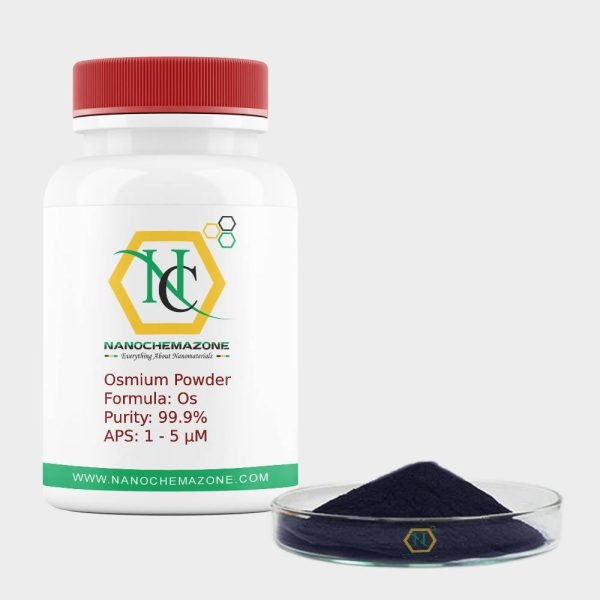
Osmium Powder
Product Name: Osmium Powder
| Product | Osmium Powder |
| CAS No. | 7440-04-2 |
| Appearance | Powder |
| Purity | 99.9% |
| APS | 1 – 5 microns (can be customized) |
| Ingredient | Os |
| Product Code | NCZ-AE-250 |

Oxidation Zinc Powder
Oxidation Zinc Powder
Product Name: Oxidation zinc Powder
| Product | Oxidation Zinc |
| CAS No. | 1314-13-2 |
| Appearance | Milky white |
| Purity | 99.9% |
| APS | 1 – 5 Microns (Can be customized) |
| Ingredient | ZnO-L |
| Product Code | NCZ-NSC-147/20 |
Oxidation Zinc Powder Description :
Another optional system: ester, liquid hydrocarbon, due to its non-polar systems, the production process is long, do not destroy, Can be used for pharmaceutical products except outside, Recommended industry, rubber, plastic, textile, high-grade coating, chemical synthesis, Used in cosmetics, sunscreen need special manufacturing.
The fine UV shielding materials, for fabric not produce shading effect. Can be used for light fabric. Medium strength antibacterial ability can be used for parts antibacterial occasions. The fine deodorant ability, and sulfur reaction, can deodorant, have in the uniform application prospect.
RELATED INFORMATION Storage Conditions: Airtight sealed, avoid light, and keep dry at room temperature. Please email us for the customization. Email: contact@nanochemazone.com Note: We supply different size ranges of nano and micron size powder as per the client’s requirements and also accept customization in various parameters.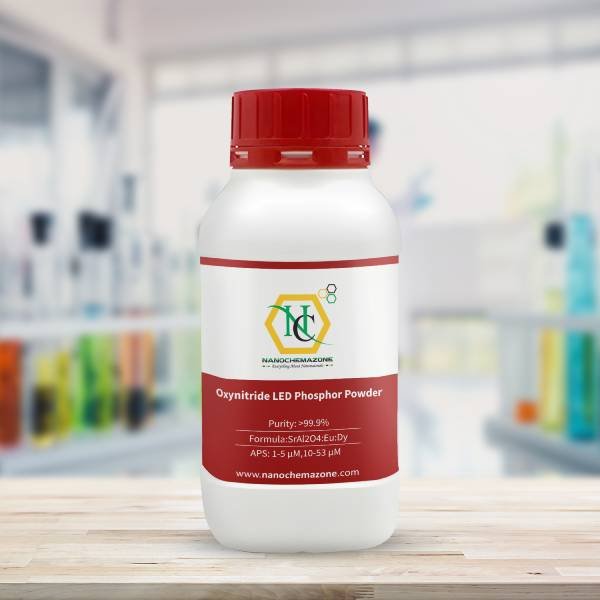
Oxynitride LED Phosphor Powder
Oxynitride LED Phosphor Powder
| Product | Oxynitride LED Phosphor Powder |
| CAS No. | N/A |
| Appearance | Green Powder |
| Purity | ≥99%, ≥99.9%, ≥95% (Other purities are also available) |
| APS | 1-5 µM, 10-53 µM (Can be customized), Ask for other available size range. |
| Ingredient | SrAl2O4:Eu:Dy |
| Density | 2.7g/cm3 |
| Molecular Weight | N/A |
| Product Codes | NCZ-MNO-148/25 |
Oxynitride LED Phosphor Description:
Oxynitride LED Phosphor Powder is one of the numerous advanced ceramic materials manufactured by Nanochemazone. Nanochemazone produces too many standard grades when applicable, including Mil Spec (military grade); ACS, Reagent and Technical Grade; Food, Agricultural and Pharmaceutical Grade; Optical Grade, USP and EP/BP (European Pharmacopoeia/British Pharmacopoeia) and follows applicable ASTM testing standards. Typical and custom packaging is available. Additional technical, research and safety (MSDS) information are available. Please request a quote above for more information on lead time and pricing.Oxynitride LED Phosphor Powder Related Information :
Storage Conditions: Airtight sealed, avoid light and keep dry at room temperature. Please contact us for customization and price inquiry Email: contact@nanochemazone.com Note: We supply different size ranges of Nano and micron as per the client’s requirements and also accept customization in various parameters. Oxynitride LED Phosphor Powder| Catalog No. | NCZ-MNO-148/25 |
| Appearance | Green Powder |
| Product Name | Oxynitride LED Phosphor Powder |
| Light Color | Blue |
| Relative Intensity | 100±2% |
| Peak Wavelength (nm) | 490±1 |
| CIE-X | 0.076±0.002 |
| CIE-Y | 0.462±0.002 |
| Density (g/) | 2.7 |
| Particle Size () | 15±2.0 |
| Chip Size (nm) | 445-470 |
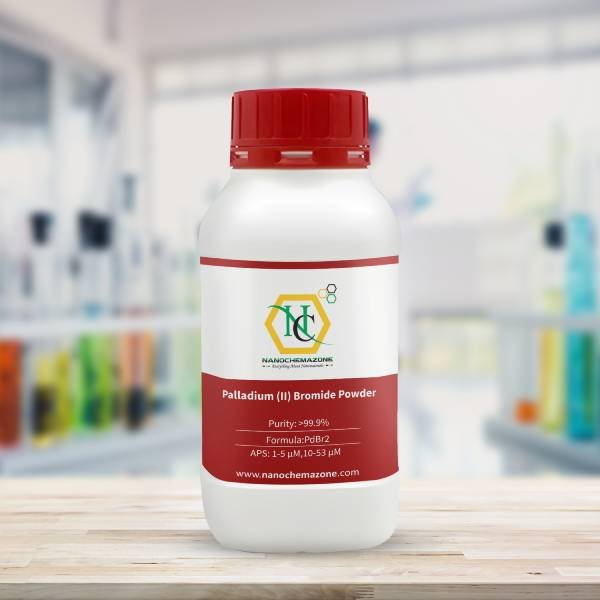
Palladium (II) Bromide Powder
Palladium (II) Bromide Powder
| Product | Palladium (II) Bromide Powder |
| CAS No. | 134444-94-5 |
| Appearance | Brown Powder |
| Purity | ≥99%, ≥99.9%, ≥95% (Other purities are also available) |
| APS | 1-5 µM, 10-53 µM (Can be customized), Ask for other available size range. |
| Ingredient | PdBr2 |
| Density | N/A |
| Molecular Weight | 266.23g/mol |
| Product Code | NCZ-MNO-350/25 |
Palladium (II) Bromide Description:
Palladium (II) Bromide Powder is one of the numerous advanced ceramic materials manufactured by Nanochemazone. Nanochemazone produces too many standard grades when applicable, including Mil Spec (military grade); ACS, Reagent and Technical Grade; Food, Agricultural and Pharmaceutical Grade; Optical Grade, USP and EP/BP (European Pharmacopoeia/British Pharmacopoeia) and follows applicable ASTM testing standards. Typical and custom packaging is available. Additional technical, research and safety (MSDS) information are available. Please request a quote above for more information on lead time and pricing.Palladium (II) Bromide Powder Related Information:
Storage Conditions: Airtight sealed, avoid light and keep dry at room temperature. Please contact us for customization and price inquiry Email: contact@nanochemazone.com Note: We supply different size ranges of Nano and micron as per the client’s requirements and also accept customization in various parameters. Palladium (II) Bromide Powder CAS 13444-94-5| Catalog No. | NCZ-MNO-350/25 |
| Purity | 99.0% |
| CAS Number | 13444-94-5 |
| Appearance | Brown powder |
| Molecular Formula | PdBr2 |
| Theoretical Metal Content | 39.95% |
| CAS Number | 13444-94-5 |
| Molecular Formula | PdBr2 |
| Molecular Weight | 266.23 g/mol |
| Appearance | Brown powder |
| Density | 5.173 g/mL |
| Storage | Store at RT |
| Personal Protective Equipment | Eye shields, Gloves, type N95 (US), type P1 (EN143) respirator filter |
| RIDADR | NONH for all modes of transport |
| WGK Germany | 3 |
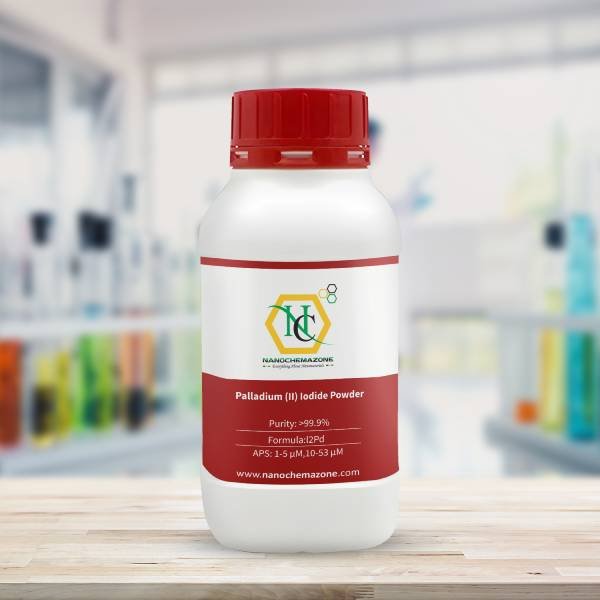
Palladium (II) Iodide Powder
Palladium (II) Iodide Powder
| Product | Palladium (II) Iodide Powder |
| CAS No. | 7790-38-7 |
| Appearance | Black Powder |
| Purity | ≥99%, ≥99.9%, ≥95% (Other purities are also available) |
| APS | 1-5 µM, 10-53 µM (Can be customized), Ask for other available size range. |
| Ingredient | l2Pd |
| Density | N/A |
| Molecular Weight | 360.23g/mol |
| Product Code | NCZ-MNO-339/25 |
Palladium (II) Iodide Description:
Palladium (II) Iodide Powder is one of the numerous advanced ceramic materials manufactured by Nanochemazone. Nanochemazone produces too many standard grades when applicable, including Mil Spec (military grade); ACS, Reagent and Technical Grade; Food, Agricultural and Pharmaceutical Grade; Optical Grade, USP and EP/BP (European Pharmacopoeia/British Pharmacopoeia) and follows applicable ASTM testing standards. Typical and custom packaging is available. Additional technical, research and safety (MSDS) information are available. Please request a quote above for more information on lead time and pricing.Palladium (II) Iodide Powder Related Information:
Storage Conditions: Airtight sealed, avoid light and keep dry at room temperature. Please contact us for customization and price inquiry Email: contact@nanochemazone.com Note: We supply different size ranges of Nano and micron as per the client’s requirements and also accept customization in various parameters. Palladium (II) Iodide Powder (PdI2) (CAS No.7790-38-7)| Catalog No. | NCZ-MNO-339/25 |
| Purity | 99.0 % |
| CAS Number | 7790-38-7 |
| Appearance | Black powder |
| Molecular Formula | I2Pd |
| Theoretical Metal Content | 29.54 % |
| CAS Number | 7790-38-7 |
| Molecular Formula | I2Pd |
| Molecular Weight | 360.23 g/mol |
| Appearance | Black powder |
| Density | 6.003 g/mL |
| Melting Point | 350 °C (dec.) (lit.) |
| Personal Protective Equipment | Eye shields, Gloves, type N95 (US), type P1 (EN143) respirator filter |
| RIDADR | NONH for all modes of transport |
| WGK Germany | 3 |
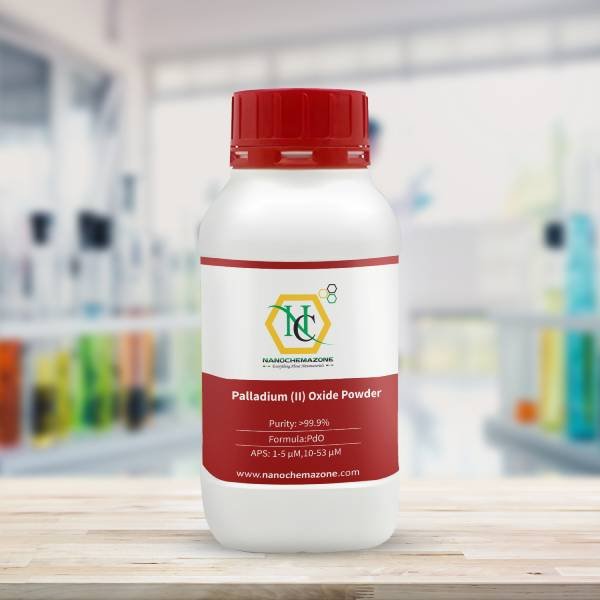
Palladium (II) Oxide Powder
Palladium (II) Oxide Powder
| Product | Palladium (II) Oxide Powder |
| CAS No. | 1314-08-5 |
| Appearance | Greenish-Black Powder |
| Purity | ≥99%, ≥99.9%, ≥95% (Other purities are also available) |
| APS | 1-5 µM, 10-53 µM (Can be customized), Ask for other available size range. |
| Ingredient | PdO |
| Density | 8.7g/cm |
| Molecular Weight | 317.09g/mol |
| Product Codes | NCZ-MNO-240/25 |
Palladium (II) Oxide Description:
Palladium (II) Oxide Powder is one of the numerous advanced ceramic materials manufactured by Nanochemazone. Nanochemazone produces too many standard grades when applicable, including Mil Spec (military grade); ACS, Reagent and Technical Grade; Food, Agricultural and Pharmaceutical Grade; Optical Grade, USP and EP/BP (European Pharmacopoeia/British Pharmacopoeia) and follows applicable ASTM testing standards. Typical and custom packaging is available. Additional technical, research and safety (MSDS) information are available. Please request a quote above for more information on lead time and pricing.Palladium (II) Oxide Powder Related Information:
Storage Conditions: Airtight sealed,avoid light and keep dry at room temperature. Please contact us for customization and price inquiry Email: contact@nanochemazone.com Note: We supply different size ranges of Nano and micron as per the client’s requirements and also accept customization in various parameters. Palladium (II) Oxide (PdO) Powder (CAS 1314-08-5)| Catalog No. | NCZ-MNO-240/25 |
| Material | Palladium Oxide |
| Purity | Pd≥86.2% |
| CAS Number | 1314-08-5 |
| Chemical Formula | PdO |
| Density | 8.7 g/mL at 25 °C (lit.) |
| Appearance | Greenish-black powder |
| Melting Point | 750 ℃ |
| Molecular Weight | 122.42 |
| Palladium | Impurity | |||
| ≥86.2% | Ag | ≤0.002% | Al | ≤0.005% |
| Au | ≤0.01% | Pb | ≤0.005% | |
| Pt | ≤0.01% | Cu | ≤0.001% | |
| Rh | ≤0.01% | Ni | ≤0.005% | |
| Ir | ≤0.01% | Si | ≤0.005% | |
| Fe | ≤0.005% | Sn | ≤0.005% | |

Palladium (II) Trifluoroacetate Powder
Palladium (II) Trifluoroacetate Powder
| Product | Palladium (II) Trifluoroacetate Powder |
| CAS No. | 42196-31-6 |
| Appearance | Brown Powder |
| Purity | ≥99%, ≥99.9%, ≥95% (Other purities are also available) |
| APS | 1-5 µM, 10-53 µM (Can be customized), Ask for other available size range. |
| Ingredient | (CF3COO)2Pd |
| Density | N/A |
| Molecular Weight | 332.45g/mol |
| Product Codes | NCZ-MNO-280/25 |
Palladium (II) Trifluoroacetate Powder Description:
Palladium (II) Trifluoroacetate Powder is one of the numerous advanced ceramic materials manufactured by Nanochemazone. Nanochemazone produces too many standard grades when applicable, including Mil Spec (military grade); ACS, Reagent and Technical Grade; Food, Agricultural and Pharmaceutical Grade; Optical Grade, USP and EP/BP (European Pharmacopoeia/British Pharmacopoeia) and follows applicable ASTM testing standards. Typical and custom packaging is available. Additional technical, research and safety (MSDS) information are available. Please request a quote above for more information on lead time and pricing.Palladium (II) Trifluoroacetate Powder Related Information:
Storage Conditions: Airtight sealed,avoid light and keep dry at room temperature. Please contact us for customization and price inquiry Email: contact@nanochemazone.com Note: We supply different size ranges of Nano and micron as per the client’s requirements and also accept customization in various parameters. Palladium (II) Trifluoroacetate Powder (CAS No.42196-31-6)| Catalog No. | NCZ-MNO-280/25 |
| Purity | 98.0 % |
| CAS Number | 42196-31-6 |
| Appearance | Brown powder |
| Molecular Formula | (CF3COO)2Pd |
| Theoretical Metal Content | 32.0 % |
| CAS Number | 42196-31-6 |
| Molecular Formula | (CF3COO)2Pd |
| Molecular Weight | 332.45 g/mol |
| Appearance | Brown powder |
| Synonyms | Pd(TFA)2, Trifluoroacetic acid palladium(II) salt |
| Melting Point | 220 °C |
| Solubility | Soluble in diethyl ether and acetone. Insoluble in benzene, chloroform and trifluoroacetic acid. |
| Symbol | GHS07 |
| Signal Word | Warning |
| Hazard Statements | H315-H319-H335 |
| Precautionary Statements | P261-P305 + P351 + P338 |
| Personal Protective Equipment | Dust mask type N95 (US), Eye shields, Gloves |
| RIDADR | NONH for all modes of transport |
| WGK Germany | 3 |
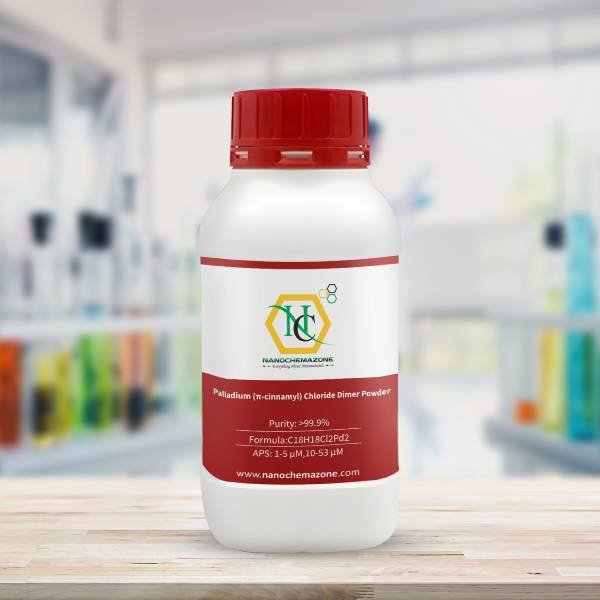
Palladium (π-cinnamyl) Chloride Dimer Powder
Palladium (π-cinnamyl) Chloride Dimer Powder
| Product | Palladium (π-cinnamyl) Chloride Dimer Powder |
| CAS No. | 12131-44-1 |
| Appearance | Yellow Powder |
| Purity | ≥99%, ≥99.9%, ≥95% (Other purities are also available) |
| APS | 1-5 µM, 10-53 µM (Can be customized), Ask for other available size range. |
| Ingredient | C18H18Cl2Pd2 |
| Density | N/A |
| Molecular Weight | 518.08g/mol |
| Product Code | NCZ-MNO-340/25 |
Palladium (π-cinnamyl) Chloride Dimer Description:
Palladium (π-cinnamyl) Chloride Dimer Powder is one of the numerous advanced ceramic materials manufactured by Nanochemazone. Nanochemazone produces too many standard grades when applicable, including Mil Spec (military grade); ACS, Reagent and Technical Grade; Food, Agricultural and Pharmaceutical Grade; Optical Grade, USP and EP/BP (European Pharmacopoeia/British Pharmacopoeia) and follows applicable ASTM testing standards. Typical and custom packaging is available. Additional technical, research and safety (MSDS) information are available. Please request a quote above for more information on lead time and pricing. Palladium (π-cinnamyl) Chloride Dimer Powder Related Information: Storage Conditions: Airtight sealed, avoid light and keep dry at room temperature. Please contact us for customization and price inquiry Email: contact@nanochemazone.com Note: We supply different size ranges of Nano and micron as per the client’s requirements and also accept customization in various parameters. Palladium (π-cinnamyl) Chloride Dimer Powder (CAS No.12131-44-1)| Catalog No. | NCZ-MNO-340/25 |
| Purity | 99.0 % |
| CAS Number | 12131-44-1 |
| Appearance | Yellow powder |
| Molecular Formula | C18H18Cl2Pd2 |
| Theoretical Metal Content | 41.07 % |
| CAS Number | 12131-44-1 |
| Molecular Formula | C18H18Cl2Pd2 |
| Molecular Weight | 518.08 g/mol |
| Appearance | Yellow powder |
| Melting Point | 218-220 °C |
| Symbol | GHS05, GHS06, GHS08 |
| Signal word | Danger |
| Hazard Statements | H315-H318-H331-H334 |
| Precautionary Statements | P261-P280-P284-P304 + P340 + P312-P305 + P351 + P338 + P310-P403 + P233 |
| RIDADR | UN 2811 6.1 / PGIII |
| WGK Germany | 3 |
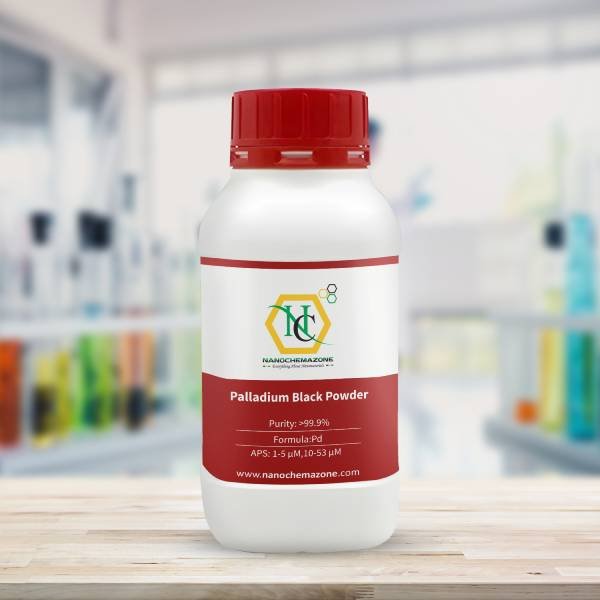
Palladium Black Powder
Palladium Black Powder
| Product | Palladium Black Powder |
| CAS No. | 7440-05-3 |
| Appearance | Black Powder |
| Purity | ≥99%, ≥99.9%, ≥95% (Other purities are also available) |
| APS | 1-5 µM, 10-53 µM (Can be customized), Ask for other available size range. |
| Ingredient | Pd |
| Density | 12.02 g/cm3 |
| Molecular Weight | N/A |
| Product Codes | NCZ-MNO-254/25 |
| Catalog No. | NCZ-MNO-254/25 |
| CAS Number | 7440-05-3 |
| Density | 12.02 g/cm3 |
| Appearance | Black Powder |
| Melting Point | 1554 °C |
| Molecular Formula | Pd |
| Boiling point | 2963 °C |
| Molecular Weight | 106.42 |
| Appearance | Black Powder |
| Melting Point | 1554 °C |
| Boiling Point | 2963 °C |
| Density | 12.02 g/cm3 |
| Electrical Resistivity | 105.4 nΩ ·m (20 °C) |
| Electronegativity | 2.2 Paulings |
| Heat of Vaporization | 362 kJ ·mol-1 |
| Specific Heat | 0.244 J ·g-1 ·mol-1(25 °C) |
| Thermal Conductivity | 71.8 W ·m-1 ·K-1 |
| Precautionary Statements | P210-P261-P305 + P351 + P338 |
| Flash Point | Not applicable |
| Transport Information | NONH |
| WGK Germany | NONH |


Palladium Metal Foil
| Materials | Palladium Metal Foil |
| Stock No. | NCZ-F-0016 |
| CAS | 7440-05-3 |
| Purity | ≥ 99.9% |
| Thickness | 12 μm, customization is possible |
| Width | 30~500 mm, customization is possible |
| Surface density | 12.023 g/cm3 |
| Melting Point | 1554 °C |
| Boiling Point | 2963 °C |
| Joint | 1pcs/roll |
| Polished | One / Both Side Polished |
| Polished | One Side Coarse |

Palladium Nanoparticle
Palladium Nanoparticle
Product Name: Palladium Nanoparticle
| Product | Palladium Nanoparticle |
| Colour | Black |
| Purity | ≥ 99.99% |
| Particle size | 1-10 µM (customizable) |
| Ingredient/MF | Pd |
| Product Code | NCZ-CE-162/20 |
| CAS Number | 7440-05-3 |
Application of Palladium Nanoparticle:
- Nano palladium powder can be used as a good hydrogen storage material. On the other hand, nano-palladium powder is an indispensable material for thick film conductor paste. The main use of palladium powder in thick film conductor paste is conductor paste. Resistance to drought resistance increases the number of welds. The quality of nano-palladium powder directly affects the quality of the conductor paste.
- The main use of palladium in the industry is as a catalyst and both are related to the hydrogenation or dehydrogenation process. In addition, palladium-containing fine chemical products play an important role in the production of electronic components. The palladium-containing compound is applied to the surface of the device by electroplating or slurring to impart specific electrical properties to the device.

Palladium Nanopowder
Palladium Powder
| Product | Palladium Powder |
| CAS | 7440-05-3 |
| Stock No. | NCZM104-19 |
| APS | ≥ 5-10 µm (Micro and Nano Size Range available) |
| Purity | ≥ 99.9% |
| Molecular Formula | Pd |
| Molecular Weight | 106.42 g/mol |
| Form | Powder |
| Colour | Black/Gary |
| Density | 12.02 g/cm3 |
| Melting Point | 1554 °C |
| Boiling Point | 2970 °C |
Palladium Powder Nano and Micro-Size Range
Note: We can supply different size products of micro and Nano Size range powder according to client’s requirements.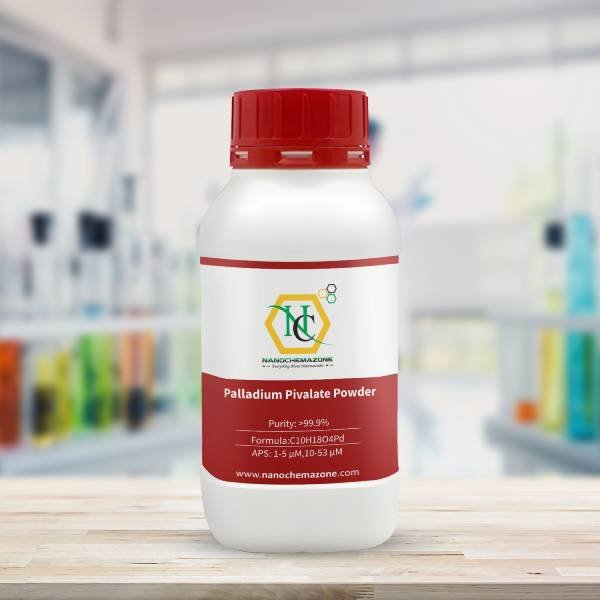
Palladium Pivalate Powder
Palladium Pivalate Powder
| Product | Palladium Pivalate Powder |
| CAS No. | 106224-36-3 |
| Appearance | Yellow-Brown Powder |
| Purity | ≥99%, ≥99.9%, ≥95% (Other purities are also available) |
| APS | 1-5 µM, 10-53 µM (Can be customized), Ask for other available size range. |
| Ingredient | C10H18O4Pd |
| Density | N/A |
| Molecular Weight | 308.67g/mol |
| Product Codes | NCZ-MNO-312/25 |
Palladium Pivalate Description:
Palladium Pivalate Powder is one of the numerous advanced ceramic materials manufactured by Nanochemazone. Nanochemazone produces too many standard grades when applicable, including Mil Spec (military grade); ACS, Reagent and Technical Grade; Food, Agricultural and Pharmaceutical Grade; Optical Grade, USP and EP/BP (European Pharmacopoeia/British Pharmacopoeia) and follows applicable ASTM testing standards. Typical and custom packaging is available. Additional technical, research and safety (MSDS) information are available. Please request a quote above for more information on lead time and pricing.Palladium Pivalate Powder Related Information:
Storage Conditions: Airtight sealed, avoid light and keep dry at room temperature. Please contact us for customization and price inquiry Email: contact@nanochemazone.com Note: We supply different size ranges of Nano and micron as per the client’s requirements and also accept customization in various parameters. Palladium Pivalate Powder (CAS No.106224-36-6)| Catalog No. | NCZ-MNO-312/25 |
| Purity | 99.0 % |
| CAS Number | 106224-36-6 |
| Appearance | Yellow-brown powder |
| Molecular Formula | C10H18O4Pd |
| Theoretical Metal Content | 34.2 % |
| CAS Number | 106224-36-6 |
| Molecular Formula | C10H18O4Pd |
| Molecular Weight | 308.67 g/mol |
| Synonym | 2,2-Dimethylpropanoic acid palladium(II) salt |
| Appearance | Yellow-brown powder |
| Melting Point | 230-232 °C |
| Symbol | GHS07 |
| Signal Word | Warning |
| Hazard Statements | H315-H319-H335 |
| Precautionary Statements | P261-P305 + P351 + P338 |
| RIDADR | NONH for all modes of transport |
| WGK Germany | 3 |

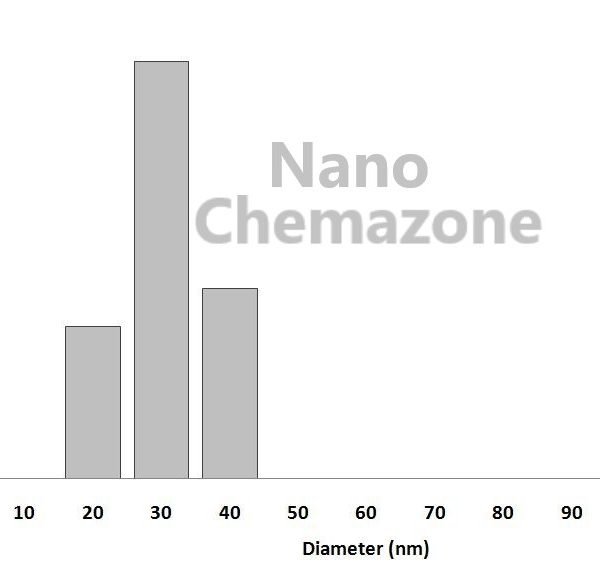
Palladium Silver Alloy Nanopowder
Palladium Silver Nanopowder Powder
Palladium Silver Nanopowder Powder
| Product | Palladium Silver Nanopowder Powder |
| CAS No. | N/A |
| Appearance | Gray Powder |
| Purity | ≥99%, ≥99.9%, ≥95% (Other purities are also available) |
| APS | 1-5 µM, 10-53 µM (Can be customized), Ask for other available size range. |
| Ingredient | PdAg |
| Density | N/A |
| Molecular Weight | N/A |
| Product Codes | NCZ-MNO-326/25 |
Palladium Silver Nanopowder Description:
Palladium Silver Nanopowder Powder is one of the numerous advanced ceramic materials manufactured by Nanochemazone. Nanochemazone produces too many standard grades when applicable, including Mil Spec (military grade); ACS, Reagent and Technical Grade; Food, Agricultural and Pharmaceutical Grade; Optical Grade, USP and EP/BP (European Pharmacopoeia/British Pharmacopoeia) and follows applicable ASTM testing standards. Typical and custom packaging is available. Additional technical, research and safety (MSDS) information are available. Please request a quote above for more information on lead time and pricing.Palladium Silver Nanopowder Powder Related Information:
Storage Conditions: Airtight sealed, avoid light and keep dry at room temperature. Please contact us for customization and price inquiry Email: contact@nanochemazone.com Note: We supply different size ranges of Nano and micron as per the client’s requirements and also accept customization in various parameters. Palladium Silver Nanopowder, PdAg| Catalog No. | NCZ-MNO-326/25 |
| Compositions | Pd, Ag |
| Appearance | gray powder |
| Average Particle Size | 20-40nm |
| Purity | 99.9% |
| Chemical Composition (%) | Pd : Ag = 2 : 98 |
| Appearance | gray powder |
| Average Particle Size (nm) | 20-40 |
| True Density (g/cm3) | 10.9 |
| Melting Point (℃) | 1155-1220 |
| Boiling Point (℃) | 1489 |
| Thermal Conductivity (w/m·k) | 60 |
| Tensile Strength (MPa) | 320 |
| Purity % | 99.9 |
Palladium(II) Acetate Powder
Palladium(II) Acetate Powder
| Product | Palladium(II) Acetate Powder |
| CAS No. | 3375-31-3 |
| Appearance | Yellowish-Brown to Reddish-Brown Crystals |
| Purity | ≥99%, ≥99.9%, ≥95%(Other purities are also available) |
| APS | 1-5 µM, 10-53 µM (Can be customized), Ask for other available size range. |
| Ingredient | Pd(CH3COO)2 |
| Density | 2.19 g/cm3 |
| Molecular Weight | 224.51g/mol |
| Product Code | NCZ-CAS-223/25 |
Palladium(II) Acetate Description:
Palladium(II) Acetate Powder is one of the numerous advanced ceramic materials manufactured by Nanochemazone. Nanochemazone produces too many standard grades when applicable, including Mil Spec (military grade); ACS, Reagent and Technical Grade; Food, Agricultural and Pharmaceutical Grade; Optical Grade, USP and EP/BP (European Pharmacopoeia/British Pharmacopoeia) and follows applicable ASTM testing standards. Typical and custom packaging is available. Additional technical, research and safety (MSDS) information are available. Please request a quote above for more information on lead time and pricing.Palladium(II) Acetate Powder Related Information:
Storage Conditions: Airtight sealed, avoid light and keep dry at room temperature. Please contact us for customization and price inquiry Email: contact@nanochemazone.com Note: We supply different size ranges of Nano and micron as per the client’s requirements and also accept customization in various parameters. Palladium(II) Acetate Pd(OAc)2 CAS #: 3375-31-3 Linear Formula: Pd(OCOCH3)2 MDL Number:MFCD00012453 EC No.:222-164-4 Palladium(II) Acetate Properties (Theoretical)| Compound Formula | C4H6O4Pd |
| Molecular Weight | 224.51 |
| Appearance | Yellowish-brown to reddish-brown crystals |
| Melting Point | 200-223.7 °C (dec.) |
| Boiling Point | N/A |
| Density | 2.19 g/cm3 |
| Solubility in H2O | Insoluble |
| Exact Mass | 224.51 |
| Monoisotopic Mass | 223.930092 Da |