

Shop
Potassium Thioacetate Powder
$0.00Potassium Thioacetate Powder
| Product | Potassium Thioacetate Powder |
| CAS No. | 10387-40-3 |
| Appearance | White to Off-White Crystalline Powder |
| Purity | ≥99%, ≥99.9%, ≥95%(Other purities are also available) |
| APS | 1-5 µM, 10-53 µM (Can be customized), Ask for other available size range. |
| Ingredient | CH3COSK |
| Density | N/A |
| Molecular Weight | 114.20792g/mol |
| Product Code | NCZ-CAS-232/25 |
Potassium Thioacetate Description:
Potassium Thioacetate Powder is one of the numerous advanced ceramic materials manufactured by Nanochemazone. Nanochemazone produces too many standard grades when applicable, including Mil Spec (military grade); ACS, Reagent and Technical Grade; Food, Agricultural and Pharmaceutical Grade; Optical Grade, USP and EP/BP (European Pharmacopoeia/British Pharmacopoeia) and follows applicable ASTM testing standards. Typical and custom packaging is available. Additional technical, research and safety (MSDS) information are available. Please request a quote above for more information on lead time and pricing.
Potassium Thioacetate Powder Related Information:
Storage Conditions:
Airtight sealed, avoid light and keep dry at room temperature.
Please contact us for customization and price inquiry
Email: contact@nanochemazone.com
Note: We supply different size ranges of Nano and micron as per the client’s requirements and also accept customization in various parameters.
CAS #: 10387-40-3
Linear Formula:CH3COSK
MDL Number:MFCD00137704
EC No.:233-848-7
Potassium Thioacetate Properties (Theoretical)
| Compound Formula | C2H3KOS |
| Molecular Weight | 114.20792 |
| Appearance | Beige solid |
| Melting Point | 173-176 °C |
| Boiling Point | N/A |
| Density | N/A |
| Solubility in H2O | Soluble |
| Exact Mass | 113.954167 |
| Monoisotopic Mass | 113.954167 |
| Charge | N/A |

Potassium Titanate Flake Powder
$0.00Potassium Titanate Flake Powder
| Product | Potassium Titanate Flake Powder |
| CAS No. | 12030-97-6 |
| Appearance | White Powder |
| Purity | ≥99%, ≥99.9%, ≥95%(Other purities are also available) |
| APS | 1-5 µM, 10-53 µM (Can be customized), Ask for other available size range. |
| Ingredient | K2Ti8017 |
| Density | 3.1-3.6 g/cm³ |
| Molecular Weight | 174.06 g/mol |
| Product Codes | NCZ-DCY-107/25 |
Potassium Titanate Flake Description:
Potassium Titanate Flake Powder is one of the numerous advanced ceramic materials manufactured by Nanochemazone. Nanochemazone produces too many standard grades when applicable, including Mil Spec (military grade); ACS, Reagent and Technical Grade; Food, Agricultural and Pharmaceutical Grade; Optical Grade, USP and EP/BP (European Pharmacopoeia/British Pharmacopoeia) and follows applicable ASTM testing standards. Typical and custom packaging is available. Additional technical, research and safety (MSDS) information are available. Please request a quote above for more information on lead time and pricing.
Potassium Titanate Flake Powder Related Information:
Storage Conditions:
Airtight sealed, avoid light and keep dry at room temperature.
Please contact us for customization and price inquiry
Email: contact@nanochemazone.com
Note: We supply different size ranges of Nano and micron as per the client’s requirements and also accept customization in various parameters.
Potassium Titanate Flake is widely applied in ceramic brake pads, brake lining, clutch, motorcycle brake pad and other friction materials, plastic modification materials, rubber modification, electric conduction and anti-static materials, paint of premium grade and anti-static purposes, Heat resistant paints, Diesel engine filter.
Chemical property:
| Item | Unit | Spec |
| Particle Size | μm | 1~10 |
| PH Level | – | 9.5~11.5 |
| Moisture Content | wt% | 0.7MAX |
| Moh’s Hardness | – | 4 |
| Tensile Strength | Gpa | 7 |
| Coefficient of Heat Conductivity | w/(m·k) | 0.05-0.06 |
| Spectral Reflectivity | % | 75-85 |
| Bulk Density(g/cm3 ) | g/cm3 | 0.4-0.8 |
| Appearance | – | White Powder |
Potassium titanate Flake is widely applied in ceramic brake pads, brake lining, clutch, motorcycle brake pad and other friction materials, plastic modification materials, rubber modification, electric conduction and anti-static materials, paint of premium grade and anti-static purposes, Heat resistant paints, Diesel engine filter.

Potassium Titanate Powder
$0.00Potassium Titanate Powder
| Product | Potassium Titanate Powder |
| CAS No. | 12030-97-6 |
| Appearance | White or Beige Powder |
| Purity | ≥99%, ≥99.9%, ≥95%(Other purities are also available) |
| APS | 1-5 µM, 10-53 µM (Can be customized), Ask for other available size range. |
| Ingredient | K2TiO3 |
| Density | 3.1g/cm |
| Molecular Weight | 253.79g/mol |
| Product Codes | NCZ-DCY-104/25 |
Potassium Titanate Powder Description:
Potassium Titanate Powder is one of the numerous advanced ceramic materials manufactured by Nanochemazone. Nanochemazone produces too many standard grades when applicable, including Mil Spec (military grade); ACS, Reagent and Technical Grade; Food, Agricultural and Pharmaceutical Grade; Optical Grade, USP and EP/BP (European Pharmacopoeia/British Pharmacopoeia) and follows applicable ASTM testing standards. Typical and custom packaging is available. Additional technical, research and safety (MSDS) information are available. Please request a quote above for more information on lead time and pricing.
Potassium Titanate Powder Related Information :
Storage Conditions:
Airtight sealed, avoid light and keep dry at room temperature.
Please contact us for customization and price inquiry
Email: contact@nanochemazone.com
Note: We supply different size ranges of Nano and micron as per the client’s requirements and also accept customization in various parameters.
Potassium Titanate is a new type of additive for electrode which lowers Arc voltage, stabilizes Arc, reduces spatter and generates find welding seam. With special technology, Shanghai Dianyang has resolved moisture absorption which has superior specification to other local producers.
Other names: Potassium titanium Oxide and Dipotassium titanium Trioxide
Chemical formula: K2TiO3
CAS No.: 12030-97-6
Molar mass: 174.06
Melting point: 1615°C
EINECS: 234-748-6
Potassium Titanate Technology parameters
| Item | Specification |
| Appearance | White or beige (Particle or Powder) |
| TiO2 (wt%) | ≥60-65 (Adjustable) |
| K2O (wt%) | ≥19-32 (Adjustable) |
| S (wt%) | <0.03 |
| P (wt%) | <0.03 |
| Mesh size | Tailor-Made Acceptable |
| Packing | 25KG PE King Kraft Paper Bag |
Applications:
Potassium titanium Oxide is widely used in flux-cored wire, stainless steel electrode and low hydrogen electrode, AC&DC welding electrode. K2TiO3 is also one kind of excellent friction material and widely used in brake disc & plastic modification. Shanghai Dian Yang use special technology to solve the problem of easy to absorb moisture thoroughly and the main properties of that our products are better than similar products at home and abroad.

Potassium Titanate Whisker Powder
$0.00Potassium Titanate Whisker Powder
| Product | Potassium Titanate Whisker Powder |
| CAS No. | 12030-97-6 |
| Appearance | White or yellowish |
| Purity | ≥99%, ≥99.9%, ≥95%(Other purities are also available) |
| APS | 1-5 µM, 10-53 µM (Can be customized), Ask for other available size range. |
| Ingredient | N2TiO3 |
| Density | 3.33 g/cm3 |
| Molecular Weight | N/A |
| Product Codes | NCZ-DCY-106/25 |
Potassium Titanate Whisker Description:
Potassium Titanate Whisker Powder is one of the numerous advanced ceramic materials manufactured by Nanochemazone. Nanochemazone produces too many standard grades when applicable, including Mil Spec (military grade); ACS, Reagent and Technical Grade; Food, Agricultural and Pharmaceutical Grade; Optical Grade, USP and EP/BP (European Pharmacopoeia/British Pharmacopoeia) and follows applicable ASTM testing standards. Typical and custom packaging is available. Additional technical, research and safety (MSDS) information are available. Please request a quote above for more information on lead time and pricing.
Potassium Titanate Whisker Powder Related Information :
Storage Conditions:
Airtight sealed, avoid light and keep dry at room temperature.
Please contact us for customization and price inquiry
Email: contact@nanochemazone.com
Note: We supply different size ranges of Nano and micron as per the client’s requirements and also accept customization in various parameters.
Potassium titanate whisker (K2Ti6O13), PTW, adopts special production process which can be tailor-made to have a uniform staple in terms of diameter and length. Potassium titanate whisker is a high-performance reinforcing fibers. Shanghai Dian Yang can provide K2Ti6O13 with Diameter 0.2-10um, a length of 4-50um and the other grades per customers’ request. Our products are higher in mechanical strength, better heat insulation, corrosion resistance, high reflectivity, low thermal conductivity at high temperature.
Potassium Titanate Whisker Technology Parameters.
| Item | Unit | Spec |
| Purity | wt% | ≥95 |
| Diameter | μm | 0.2~0.6 |
| Length | μm | 2-40 |
| Melting | °C | 1300~1370 |
| PH | —- | 8.0~11.0 |
| Bulk Density | g/cm3 | 0.2~0.8 |
| Moisture Content | wt% | <0.8 |
| Appearance | —– | White or yellowish |
| Other Content | Adjustable | |
| Size | Adjustable | |
| Packing | 25 kg PE liner Kraft paper |
Potassium titanate whisker is widely applied in ceramic brake pads, brake lining, clutch, motorcycle brake pad and other friction materials, plastic modification materials, rubber modification, electric conduction and anti-static materials, paint of premium grade and anti-static purposes, Heat resistant paints, Diesel engine filter.

Potassium Trimolybdate Nanowire
$0.00| Product | Potassium Trimolybdate |
| Formula | K2Mo3O10.3H2O |
| Stock No. | NCZNW114-19 |
| Diameter | 120 nm (customization available) |
| Length | 50 µm (customization available) |
Please contact us for customization and price inquiry.
Note: We supply different size ranges of Potassium Trimolybdate Nanowires as per the client’s requirements and also accept customization in various parameters.
Povidone Iodine Raw Material Powder
$0.00Product Name: Povidone Iodine Raw Material Powder
| Product | Povidone Iodine Raw Material Powder |
| CAS No. | 25655-41-8 |
| Appearance | Powder |
| Purity | 99.9% |
| APS | 1 – 5 microns (can be customized) |
| Ingredient | PVP |
| Product Code | NCZ-AE-209 |
FUNCTION
- Bactericide, virucide, fungicide or local antiseptic in surgical scrubs or for other rapcutical purposes and protect patient from infection.
2. Microbicide for kitchen utensils in family.
3. Microbicide for food and feed industry.
4. Microbicide and disease-protector for animal.
APPLICATION
1). Broad-spectrum germicidal action.
2). Skin and equipment disinfectant before injection or surgery.
3). Anti-infection treatment for oral, gynaecological, surgical, skin, etc.
4). Disinfects family tableware and apparatus.
5). Sterilizes, disinfects in the foodstuff industry, breeding aquatics, animal diseases.
RELATED INFORMATION
Storage Conditions:
Airtight sealed, avoid light, and keep dry at room temperature.
Please email us for the customization.
Email: contact@nanochemazone.com

Praseodymium (Pr) Micron Powder
$0.00Praseodymium (Pr) Micron Powder, Purity: 99.5 %, Size: 325 mesh
Praseodymium (Pr) Micron Powder
Purity: 99.5 %, Size: 325 mesh
Technical Properties:
| Product Number | NCZ-RE-109-19 |
| PURITY | 99.5 % |
| PARTICLE SIZE | 325 mesh |
| MELTING POINT | 931 °C |
| BOILING POINT | 3512 °C |
| DENSITY | 6.773 g/cc |
| FORM | Powder |
| ELECTRIC RESISTIVITY | 68 micro ohm-cm @ 25 °C |
Note: We can manufacture and supply different particle sizes (Nano size range, Micron, Submicron, and different Mesh size) products of Alloy powders (Multi-Element, Multi-Element Oxide and Mixture of Rare Earth Elements) according to client’s requirements. Kindly ask for the customization in size and Element ratio composition.
Praseodymium Acetate Powder
$0.00Praseodymium Acetate Powder
| Product | Praseodymium Acetate Powder |
| CAS No. | 6192-12-7 |
| Appearance | Green Powder |
| Purity | ≥99%, ≥99.9%, ≥95%(Other purities are also available) |
| APS | 1-5 µM, 10-53 µM (Can be customized), Ask for other available size range. |
| Ingredient | Pr(O2C2H3)3 |
| Density | N/A |
| Molecular Weight | 318.03g/mol |
| Product Code | NCZ-CAS-233/25 |
Praseodymium Acetate Description:
Praseodymium Acetate Powder is one of the numerous advanced ceramic materials manufactured by Nanochemazone. Nanochemazone produces too many standard grades when applicable, including Mil Spec (military grade); ACS, Reagent and Technical Grade; Food, Agricultural and Pharmaceutical Grade; Optical Grade, USP and EP/BP (European Pharmacopoeia/British Pharmacopoeia) and follows applicable ASTM testing standards. Typical and custom packaging is available. Additional technical, research and safety (MSDS) information are available. Please request a quote above for more information on lead time and pricing.
Praseodymium Acetate Powder Related Information:
Storage Conditions:
Airtight sealed, avoid light and keep dry at room temperature.
Please contact us for customization and price inquiry
Email: contact@nanochemazone.com
Note: We supply different size ranges of Nano and micron as per the client’s requirements and also accept customization in various parameters.
CAS #: 6192-12-7
Linear Formula: Pr(O2C2H3)3•xH2O
MDL Number:MFCD00150121
EC No.:228-242-4
Praseodymium Acetate Properties (Theoretical)
| Compound Formula | C6H9O6Pr |
| Molecular Weight | 318.03 |
| Appearance | Green |
| Melting Point | N/A |
| Boiling Point | N/A |
| Density | N/A |
| Solubility in H2O | N/A |
| Exact Mass | 317.948 g/mol |
| Monoisotopic Mass | 317.947513 Da |
Praseodymium Acetate Solution Powder
$0.00Praseodymium Acetate Solution Powder
| Product | Praseodymium Acetate Solution Powder |
| CAS No. | 6192-12-7 |
| Appearance | Green Powder |
| Purity | ≥99%, ≥99.9%, ≥95%(Other purities are also available) |
| APS | 1-5 µM, 10-53 µM (Can be customized), Ask for other available size range. |
| Ingredient | Pr(OOCCH3)3 |
| Density | N/A |
| Molecular Weight | 318.03g/mol |
| Product Code | NCZ-CAS-234/25 |
Praseodymium Acetate Solution Description:
Praseodymium Acetate Solution Powder is one of the numerous advanced ceramic materials manufactured by Nanochemazone. Nanochemazone produces too many standard grades when applicable, including Mil Spec (military grade); ACS, Reagent and Technical Grade; Food, Agricultural and Pharmaceutical Grade; Optical Grade, USP and EP/BP (European Pharmacopoeia/British Pharmacopoeia) and follows applicable ASTM testing standards. Typical and custom packaging is available. Additional technical, research and safety (MSDS) information are available. Please request a quote above for more information on lead time and pricing.
Praseodymium Acetate Solution Powder Related Information:
Storage Conditions:
Airtight sealed, avoid light and keep dry at room temperature.
Please contact us for customization and price inquiry
Email: contact@nanochemazone.com
Note: We supply different size ranges of Nano and micron as per the client’s requirements and also accept customization in various parameters.
CAS #: 6192-12-7
Linear Formula: Pr(O2C2H3)3.xH2O
MDL Number:MFCD00150121
EC No.:228-242-4
Praseodymium Acetate Solution Properties (Theoretical)
| Compound Formula | C6H9O6Pr |
| Molecular Weight | 318.03 |
| Appearance | liquid |
| Melting Point | N/A |
| Boiling Point | N/A |
| Density | N/A |
| Solubility in H2O | N/A |
| Exact Mass | 317.948 g/mol |
| Monoisotopic Mass | 317.947513 Da |

Praseodymium Metal Powder
$0.00Product Name: Praseodymium Metal Powder
| Product | Praseodymium Metal |
| CAS No. | 7440-10-0 |
| Appearance | White Powder |
| Purity | 99.9% |
| APS | 1 – 5 Microns (Can be customized) |
| Ingredient | Pr |
| Product Code | NCZ-NSC-303/20 |
Description of Praseodymium Metal Powder:
As the lanthanides are so similar, praseodymium can substitute for most other lanthanides without significant loss of function, and indeed many applications such as mischmetal and ferrocerium alloys involve variable mixes of several lanthanides, including small quantities of praseodymium. Due to its role in permanent magnets used for wind turbines, it has been argued that praseodymium will be one of the main objects of geopolitical competition in a world running on renewable energy.
Related Information of Praseodymium Metal Powder
Storage Conditions:
Airtight sealed, avoid light and keep dry at room temperature.
Please contact us for customization and price inquiry
Email: contact@nanochemazone.com
Note: We supply different size ranges of Nano and micron as per the client’s requirements and also accept customization in various parameters.

Praseodymium Oxide (Pr6O11) Micron Powder
$0.00Praseodymium Oxide (Pr6O11) Micron Powder, Purity: 99.99%, Size: 325 mesh
Praseodymium Oxide (Pr6O11) Micron Powder
Purity: 99.99 %, Size: 325 mesh
Technical Properties:
| Product Number | NCZ-RE-124-19 |
| PURITY | 99.99 % |
| COLOR | Black |
| SIZE | 325 Mesh |
Note: We can manufacture and supply different particle sizes (Nano size range, Micron, Submicron, and different Mesh size) products of Alloy powders (Multi-Element, Multi-Element Oxide and Mixture of Rare Earth Elements) according to client’s requirements. Kindly ask for the customization in size and Element ratio composition.

Praseodymium Oxide (Pr6O11) Nanopowder/Nanoparticles
$0.00Praseodymium Oxide (Pr6O11) Nanopowder/Nanoparticles, Purity: 99.99%, Size: 13-57 nm
Praseodymium Oxide (Pr6O11) Nanopowder/Nanoparticles
Purity: 99.99 %, Size: 40 nm
Technical Properties:
| Product Number | NCZ-RE-124B-19 |
| PURITY | 99.95 % |
| AVERAGE PARTICLE SIZE | 40 nm |
| SPECIFIC SURFACE AREA (m2/g) | >45 |
| BULK DENSITY (g/cm3) | 0,2 |
| TRUE DENSITY (g/cm3) | 6,8 |
| ELEMENT ANALYSIS (%) | |
| Fe2O3 | 0.003 |
| CaO | 0.005 |
| SiO2 | 0.01 |
Note: We can manufacture and supply different particle sizes (Nano size range, Micron, Submicron, and different Mesh size) products of Alloy powders (Multi-Element, Multi-Element Oxide and Mixture of Rare Earth Elements) according to client’s requirements. Kindly ask for the customization in size and Element ratio composition.
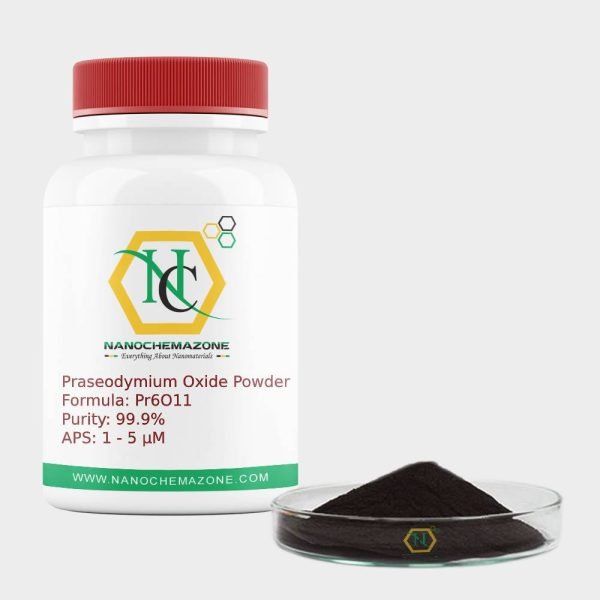
Praseodymium Oxide Powder
$0.00Product Name: Praseodymium Oxide Powder
| Product | Praseodymium Oxide Powder |
| CAS No. | 12037-29-5 |
| Appearance | Powder |
| Purity | 99.9% |
| APS | 1 – 5 microns (can be customized) |
| Ingredient | Pr6O11 |
| Product Code | NCZ-AE-228 |
RELATED INFORMATION
Storage Conditions:
Airtight sealed, avoid light, and keep dry at room temperature.
Please email us for the customization.
Email: contact@nanochemazone.com
Precious Metal Compound Powder
$0.00Precious Metal Compound Powder
| Product | Precious Metal Compound Powder |
| CAS No. | N/A |
| Appearance | White Powder |
| Purity | ≥99%, ≥99.9%, ≥95%
(Other purities are also available) |
| APS | 1-5 µM, 10-53 µM (Can be customized), Ask for other available size range. |
| Ingredient | AgNO3 |
| Density | N/A |
| Molecular Weight | N/A |
| Product Codes | NCZ-MNO-251/25 |
Precious Metal Compound Description:
Precious Metal Compound Powder is one of the numerous advanced ceramic materials manufactured by Nanochemazone. Nanochemazone produces too many standard grades when applicable, including Mil Spec (military grade); ACS, Reagent and Technical Grade; Food, Agricultural and Pharmaceutical Grade; Optical Grade, USP and EP/BP (European Pharmacopoeia/British Pharmacopoeia) and follows applicable ASTM testing standards. Typical and custom packaging is available. Additional technical, research and safety (MSDS) information are available. Please request a quote above for more information on lead time and pricing.
Precious Metal Compound Powder Related Information:
Storage Conditions:
Airtight sealed, avoid light and keep dry at room temperature.
Please contact us for customization and price inquiry
Email: contact@nanochemazone.com
Note: We supply different size ranges of Nano and micron as per the client’s requirements and also accept customization in various parameters.
Precious Metal Compound Powder
| Catalog No. | NCZ-MNO-251/25 |
| MSDS/SDS | Download MSDS/SDS |
Precious Metal Compound Powder Description
Precious metal compounds are used as plating chemicals and catalysts in various industrial fields.
Precious Metal Compound Features
Stable supply of precious metal compounds for plating etc.
Various organic precious metal compounds are available for use as homogeneous catalysts.
Precious Metal Compound Specification
| Catalog Number | Product Name | Formula | MW | Grade | Package(g) | Purity |
| PT3001 | Silver nitrate | AgNO3 | 169.87 | GR | 10 | 99.8 |
| PT3002 | AR | 100 | 99.8 | |||
| PT3003 | CP | 500~1000 | 99.5 | |||
| PT3004 | Silver sulfate | AgSO4 | 311.79 | AR | 100~500 | 99.7 |
| PT3005 | CP | 500~1000 | 99 | |||
| PT3006 | Silver oxide | Ag2O | 231.74 | AR | 100~500 | 99.7 |
| PT3007 | CP | 500~1000 | 99 | |||
| PT3008 | Silver chloride | AgCl | 143.32 | AR | 100~500 | 99.5 |
| PT3009 | CP | 500~1000 | 99 | |||
| PT3010 | Chloroplatinic acid | H2PtCl6.6H2O | 517.92 | AR | 1~2~3~10 | Pt>37% |
| PT3011 | Potassium chloride platinum | K2PtCl6 | 486.13 | AR | 100~500 | Pt40-40.3% |
| PT3012 | CP | 500~1000 | Pt39.7-40% | |||
| PT3013 | Potassium chloride Asia Platinum | K2PtCl4 | 415.26 | CP | 500~1000 | Pt>45% |
| PT3014 | Potassium chloride Asian palladium | K2PdCl4 | 326.43 | CP | 500~1000 | Pd>32% |
| PT3015 | Potassium palladium chloride | K2PdCl6 | 397.31 | CP | 500~1000 | Pd>26% |
| PT3016 | Ruthenium trichloride hydrate | RuCl3.7H2O | 333.67 | CP | 500~1000 | Ru>37% |
| PT3017 | Dichlorodiamine palladium | Pd(NH3)2Cl2 | 210.42 | CP | 500~1000 | Pd>49.5% |
| PT3018 | Tetraamine palladium dichloride | Pd(NH3)4Cl2 | 244.42 | CP | 500~1000 | Pd>41% |
| PT3019 | Gold trichloride | AuCl3 | 411.85 | CP | 500~1000 | Au>47.5% |
| PT3020 | Gold potassium cyanide | K[Au(Cu)4] | 340 | CP | 500~1000 | Au>57% |
| PT3021 | Gold potassium cyanide Asia | KAu(CN)2.2H2O | 324.13 | CP | 50~100 | Au>98% |
| PT3022 | Iridium acid chloride | H2IrCl6.8H2O | 551 | CP | 500~1000 | Ir>35% |
| PT3023 | Lithium metaborate | Li2Bo2.8H2O | 193.87 | CP | 500~1000 | 99% |
| PT3024 | Platinum on carbon | Customize | 500~1000 | |||
| PT3025 | Palladium on carbon | Customize | 500~1000 | |||
| PT3026 | Ruthenium carbon | Customize | 500~1000 | |||
| PT3027 | Palladium chloride | PdCl2 | 177.31 | CP | 500~1000 | ≥58% |
| PT3028 | AR | 500~1000 | ≥59.5% | |||
| PT3029 | Silver bromate | AgBrO3 | 235.78 | AR | ||
| PT3030 | Rhodium trichloride | RbCl3.nH2O | 209.26 | AR | ||
| PT3031 | Silver acetate | CH3COOAg | 166.91 | AR |
PREF Refractory Titanium Alloy Powder
$0.00PREF Refractory Titanium Alloy Powder
| Product | PREF Refractory Titanium Alloy Powder |
| CAS No. | 7440-32-6 |
| Appearance | Grey Powder |
| Purity | ≥99%, ≥99.9%, ≥95%(Other purities are also available) |
| APS | 1-5 µM, 10-53 µM (Can be customized), Ask for other available size range. |
| Ingredient | TiTaNbZr |
| Density | 2.53g/cm3 |
| Molecular Weight | N/A |
| Product Codes | NCZ-DCY-313/25 |
PREF Refractory Titanium Alloy Description:
PREF Refractory Powder is one of the numerous advanced ceramic materials manufactured by Nanochemazone. Nanochemazone produces too many standard grades when applicable, including Mil Spec (military grade); ACS, Reagent and Technical Grade; Food, Agricultural and Pharmaceutical Grade; Optical Grade, USP and EP/BP (European Pharmacopoeia/British Pharmacopoeia) and follows applicable ASTM testing standards. Typical and custom packaging is available. Additional technical, research and safety (MSDS) information are available. Please request a quote above for more information on lead time and pricing.
PREF Refractory Powder Related Information :
Storage Conditions:
Airtight sealed, avoid light and keep dry at room temperature.
Please contact us for customization and price inquiry
Email: contact@nanochemazone.com
Note: We supply different size ranges of Nano and micron as per the client’s requirements and also accept customization in various parameters.
PREP Refractory Titanium Alloy Powder
TiAl is a new class of aerospace alloys that offers an excellent strength-to-weight ratio as well as high chemical and thermal stability. Gamma titanium aluminide alloy has excellent mechanical properties as well as oxidation and corrosion resistance at elevated temperatures (over 600 degrees Celsius). TiAl is the latest class of materials competing with Nickel superalloys for the fabrication of aircraft engine parts such as low-pressure turbine.
Overview of PREP Refractory Titanium Alloy Powder
PREP (Plasma Rotating Electrode Process) alloy is a high-performance refractory titanium alloy powder designed for additive manufacturing of components needing excellent mechanical properties at extreme temperatures.
This article provides a comprehensive guide to PREP titanium alloy powder covering composition, properties, print parameters, applications, specifications, suppliers, handling, inspection, comparisons, pros and cons, and FAQs. Quantitative information is presented in easy-to-reference tables.
Composition of PREP Titanium Alloy Powder
PREP alloy has a complex composition containing various solute elements:
| Element | Weight % | Purpose |
| Titanium | Balance | Principal matrix element |
| Aluminum | 5 – 7 | Solid solution strengthener |
| Tin | 1 – 3 | Solid solution strengthener |
| Zirconium | 0.5 – 2 | Grain structure control |
| Molybdenum | 1 – 3 | Solid solution strengthener |
| Silicon | 0.5 – 1.5 | Oxidation resistance |
| Niobium | 1 – 3 | Carbide former |
| Tantalum | 1 – 3 | Carbide former |
Trace amounts of boron and carbon are also added for grain boundary strengthening.
Properties of PREP Titanium Alloy Powder
PREP alloy exhibits an exceptional combination of properties:
| Property | Description |
| High strength | Excellent tensile and creep strength up to 700°C |
| Fatigue resistance | High fatigue life at elevated temperatures |
| Fracture toughness | Up to 100 MPa-√m |
| Oxidation resistance | Forms protective oxide scale |
| Thermal stability | Microstructural stability after prolonged exposures |
| Damage tolerance | Resistant to crack growth |
| Biocompatibility | Non-toxic and non-allergenic |
The properties enable lightweight components for demanding applications.
Typical AM process parameters include:
| Parameter | Typical Value | Purpose |
| Layer height | 30-50 μm | Resolution versus build speed |
| Laser power | 150-500 W | Sufficient melting without evaporation |
| Scan speed | 750-1500 mm/s | Density versus production rate |
| Hatch spacing | 80-120 μm | Mechanical properties |
| Hot isostatic pressing | 900°C, 100 MPa, 3 hrs | Eliminate internal voids |
Applications of 3D Printed PREP Titanium Parts
| Industry | Components |
| Aerospace | Turbine blades, compressor parts, mounts |
| Automotive | Connecting rods, valves, turbocharger wheels |
| Medical | Orthopedic implants, surgical tools |
| Chemical | Pumps, valves, reaction vessels |
| Power generation | Hot gas path components |
Benefits over wrought equivalents include complex geometries and accelerated development.
Specifications of PREP Titanium Powder for AM
PREP alloy powder must meet strict specifications:
| Parameter | Specification |
| Particle size range | 15-45 μm typical |
| Particle shape | Spherical morphology |
| Apparent density | >2.5 g/cc |
| Tap density | >4.5 g/cc |
| Hall flow rate | >35 sec for 50 g |
| Purity | >99.95% |
| Oxygen content | <1000 ppm |
Custom size distributions and controlled oxygen levels available.
Handling and Storage of PREP Titanium Powder
As a reactive material, careful handling of PREP alloy powder is essential:
Store sealed containers under inert gas like argon
Prevent exposure to air and moisture during handling
Use properly grounded equipment
Avoid dust accumulation to minimize explosion risk
Local exhaust ventilation recommended
Wear appropriate PPE and avoid inhalation
Proper techniques and controls prevent powder oxidation.
Inspection and Testing of PREP Titanium Powder
PREP alloy powder batches are validated using:
| Method | Parameters Tested |
| Sieve analysis | Particle size distribution |
| SEM imaging | Particle morphology |
| EDX | Chemistry/composition |
| XRD | Phases present |
| Pycnometry | Density |
| Hall flow rate | Powder flowability |
Testing per ASTM standards ensures batch-to-batch consistency.
Comparing PREP Alloy to Alternative Titanium Powders
PREP alloy compares to other titanium materials as:
| Alloy | Strength | Oxidation Resistance | Cost | Printability |
| PREP | Excellent | Excellent | High | Good |
| Ti64 | Good | Good | Medium | Fair |
| Ti6242 | Excellent | Good | High | Fair |
| CP-Ti | Low | Excellent | Low | Excellent |
PREP provides the best all-round properties but at higher cost than workhorse alloys like Ti64.
Pros and Cons of PREP Titanium Powder for AM
| Pros | Cons |
| Outstanding high temperature strength | Expensive compared to Ti64 and CP-Ti |
| Excellent thermomechanical fatigue resistance | Higher density than other titanium alloys |
| Complex geometries feasible | Controlled atmosphere handling mandatory |
| Lower anisotropy than Ti64 and CP-Ti | Processing very technique sensitive |
| Matching properties to PREP wrought forms | Limited suppliers and alloy variants |
PREP enables exceptional performance additive manufacturing but requires very rigorous control of process conditions.
Frequently Asked Questions about PREP Titanium Alloy Powder
Q: What is PREP titanium alloy used for in AM?
A: PREP alloy is used to 3D print lightweight aerospace and automotive components needing extremely high mechanical properties at temperatures up to 700°C.
Q: What particle size is recommended for printing PREP titanium alloy?
A: A powder size range of 15-45 microns provides a good balance of flowability, high resolution, and dense printed parts.
Q: Does PREP titanium require hot isostatic pressing after AM?
A: HIP is recommended to eliminate internal voids, maximize fatigue resistance and achieve full density. It may not be mandatory for non-critical applications.
Q: What material has properties closest to PREP titanium alloy?
A: Ti-6Al-4V has comparable density and good high temperature strength, but lower oxidation resistance compared to PREP alloys.
Q: What benefits does PREP alloy offer over Ti-6Al-4V in AM?
A: Key advantages are higher tensile and fatigue strength up to 700°C along with significantly better creep and thermo-mechanical fatigue resistance.
Q: What precision can be obtained with PREP titanium printed parts?
A: After post-processing, printed PREP components can achieve dimensional tolerances and surface finish comparable to CNC machined titanium parts.
Q: What defects can occur when printing PREP titanium alloy?
A: Potential defects are cracking, distortion, porosity, incomplete fusion, and surface roughness. Most can be minimized through optimized parameters.
Q: Can support structures be easily removed from PREP titanium AM parts?
A: Properly designed minimal supports are readily detachable after printing due to excellent mechanical properties of PREP alloys.
Q: What type of post-processing is typically done on PREP titanium components?
A: Hot isostatic pressing, heat treatment, abrasive flow machining, CNC machining, and electropolishing are commonly used post-processes.
Q: What is the key difference between Ti-6Al-4V Grade 5 and Grade 23?
A: Grade 5 has higher oxygen content for better powder flowability while Grade 23 has lower oxygen for superior fracture toughness and fatigue resistance.


Premium Grade Copper Metal Foams
$0.00Product: Copper Foam (Cu Foam, Purity: 99.9%, 50PPI/1mm)
Copper Metal Foams
| Stock No. | NCZFF102 |
| PPI | 10 to 110, customization is also possible |
| Bulk Density | 0.80-0.85 g/cc |
| Purity | ≥99.9% |
| Porosity | ≥70% , customization is also possible |
| Dimension | 500 mm X 500 mm, customization is also possible |
| Thickness | 1mm to 25mm, customization is also possible |
Physical Characteristics of Cu Foam
| Compression Strength | 131 psi |
| Tensile Strength | 1000 psi |
| Shear Strength | 190 psi |
| Modulus of Elasticity (Compression) | 107 kpsi |
| Modulus of Elasticity (Tension) | 14.6 × 10³ psi |
| Shear Modulus | 40.9 kpsi |
| Vickers Hardness | 35 |
| Specific Heat | 0.385 J/g-°C |
| Bulk Thermal Conductivity | 10.1 W/m-°C |
| Coefficient of Thermal Expansion | 1.7 × 10⁻⁵ m/m–°C (0-100°C) |
| Bulk Resistivity | 2.56× 10⁻⁵ ohm – in |
| Melting Point | 1080 °C |
Copper foam available as open cell and closed cell. Please ask for customization while ordering.
PREP Refractory Titanium Alloy Powder
$0.00PREP Refractory Titanium Alloy Powder
| Product | PREP Refractory Titanium Alloy Powder |
| CAS No. | 7440-32-6 |
| Appearance | Gray Powder |
| Purity | ≥99%, ≥99.9%, ≥95%(Other purities are also available) |
| APS | 1-5 µM, 10-53 µM (Can be customized), Ask for other available size range. |
| Ingredient | TiTaNbZr |
| Density | 2.5-4.5g/cm3 |
| Molecular Weight | N/A |
| Product Codes | NCZ-DCY-247/25 |
PREP Refractory Titanium Alloy Description:
PREP Refractory Titanium Alloy Powder is one of the numerous advanced ceramic materials manufactured by Nanochemazone. Nanochemazone produces too many standard grades when applicable, including Mil Spec (military grade); ACS, Reagent and Technical Grade; Food, Agricultural and Pharmaceutical Grade; Optical Grade, USP and EP/BP (European Pharmacopoeia/British Pharmacopoeia) and follows applicable ASTM testing standards. Typical and custom packaging is available. Additional technical, research and safety (MSDS) information are available. Please request a quote above for more information on lead time and pricing
Niobium Powder Related Information :
Storage Conditions:
Airtight sealed, avoid light and keep dry at room temperature.
Please contact us for customization and price inquiry
Email: contact@nanochemazone.com
Note: We supply different size ranges of Nano and micron as per the client’s requirements and also accept customization in various parameters.
PREP Refractory Titanium Alloy Powder
TiAl is a new class of aerospace alloys that offers an excellent strength-to-weight ratio as well as high chemical and thermal stability. Gamma titanium aluminide alloy has excellent mechanical properties as well as oxidation and corrosion resistance at elevated temperatures (over 600 degrees Celsius). TiAl is the latest class of materials competing with Nickel superalloys for the fabrication of aircraft engine parts such as low-pressure turbine.
Overview of PREP Refractory Titanium Alloy Powder
PREP (Plasma Rotating Electrode Process) alloy is a high-performance refractory titanium alloy powder designed for additive manufacturing of components needing excellent mechanical properties at extreme temperatures.
This article provides a comprehensive guide to PREP titanium alloy powder covering composition, properties, print parameters, applications, specifications, suppliers, handling, inspection, comparisons, pros and cons, and FAQs. Quantitative information is presented in easy-to-reference tables.
Composition of PREP Titanium Alloy Powder
PREP alloy has a complex composition containing various solute elements:
| Element | Weight % | Purpose |
| Titanium | Balance | Principal matrix element |
| Aluminum | 5 – 7 | Solid solution strengthener |
| Tin | 1 – 3 | Solid solution strengthener |
| Zirconium | 0.5 – 2 | Grain structure control |
| Molybdenum | 1 – 3 | Solid solution strengthener |
| Silicon | 0.5 – 1.5 | Oxidation resistance |
| Niobium | 1 – 3 | Carbide former |
| Tantalum | 1 – 3 | Carbide former |
Trace amounts of boron and carbon are also added for grain boundary strengthening.
Properties of PREP Titanium Alloy Powder
| Property | Description |
| High strength | Excellent tensile and creep strength up to 700°C |
| Fatigue resistance | High fatigue life at elevated temperatures |
| Fracture toughness | Up to 100 MPa-√m |
| Oxidation resistance | Forms protective oxide scale |
| Thermal stability | Microstructural stability after prolonged exposures |
| Damage tolerance | Resistant to crack growth |
| Biocompatibility | Non-toxic and non-allergenic |
The properties enable lightweight components for demanding applications.
AM Print Parameters for PREP Titanium Alloy Powder
| Parameter | Typical Value | Purpose |
| Layer height | 30-50 μm | Resolution versus build speed |
| Laser power | 150-500 W | Sufficient melting without evaporation |
| Scan speed | 750-1500 mm/s | Density versus production rate |
| Hatch spacing | 80-120 μm | Mechanical properties |
| Hot isostatic pressing | 900°C, 100 MPa, 3 hrs | Eliminate internal voids |
Applications of 3D Printed PREP Titanium Parts
PREP alloy components serve critical applications including:
| Industry | Components |
| Aerospace | Turbine blades, compressor parts, mounts |
| Automotive | Connecting rods, valves, turbocharger wheels |
| Medical | Orthopedic implants, surgical tools |
| Chemical | Pumps, valves, reaction vessels |
| Power generation | Hot gas path components |
Benefits over wrought equivalents include complex geometries and accelerated development.
Specifications of PREP Titanium Powder for AM
| Parameter | Specification |
| Particle size range | 15-45 μm typical |
| Particle shape | Spherical morphology |
| Apparent density | >2.5 g/cc |
| Tap density | >4.5 g/cc |
| Hall flow rate | >35 sec for 50 g |
| Purity | >99.95% |
| Oxygen content | <1000 ppm |
Custom size distributions and controlled oxygen levels available.
Handling and Storage of PREP Titanium Powder
As a reactive material, careful handling of PREP alloy powder is essential:
Store sealed containers under inert gas like argon
Prevent exposure to air and moisture during handling
Use properly grounded equipment
Avoid dust accumulation to minimize explosion risk
Local exhaust ventilation recommended
Wear appropriate PPE and avoid inhalation
Proper techniques and controls prevent powder oxidation.
Inspection and Testing of PREP Titanium Powder
PREP alloy powder batches are validated using:
| Method | Parameters Tested |
| Sieve analysis | Particle size distribution |
| SEM imaging | Particle morphology |
| EDX | Chemistry/composition |
| XRD | Phases present |
| Pycnometry | Density |
| Hall flow rate | Powder flowability |
PREP alloy compares to other titanium materials as:
| Alloy | Strength | Oxidation Resistance | Cost | Printability |
| PREP | Excellent | Excellent | High | Good |
| Ti64 | Good | Good | Medium | Fair |
| Ti6242 | Excellent | Good | High | Fair |
| CP-Ti | Low | Excellent | Low | Excellent |
PREP provides the best all-round properties but at higher cost than workhorse alloys like Ti64.
Pros and Cons of PREP Titanium Powder for AM
| Pros | Cons |
| Outstanding high temperature strength | Expensive compared to Ti64 and CP-Ti |
| Excellent thermomechanical fatigue resistance | Higher density than other titanium alloys |
| Complex geometries feasible | Controlled atmosphere handling mandatory |
| Lower anisotropy than Ti64 and CP-Ti | Processing very technique sensitive |
| Matching properties to PREP wrought forms | Limited suppliers and alloy variants |
PREP enables exceptional performance additive manufacturing but requires very rigorous control of process conditions.
Frequently Asked Questions about PREP Titanium Alloy Powder
Q: What is PREP titanium alloy used for in AM?
A: PREP alloy is used to 3D print lightweight aerospace and automotive components needing extremely high mechanical properties at temperatures up to 700°C.
Q: What particle size is recommended for printing PREP titanium alloy?
A: A powder size range of 15-45 microns provides a good balance of flowability, high resolution, and dense printed parts.
Q: Does PREP titanium require hot isostatic pressing after AM?
A: HIP is recommended to eliminate internal voids, maximize fatigue resistance and achieve full density. It may not be mandatory for non-critical applications.
Q: What material has properties closest to PREP titanium alloy?
A: Ti-6Al-4V has comparable density and good high temperature strength, but lower oxidation resistance compared to PREP alloys.
Q: What benefits does PREP alloy offer over Ti-6Al-4V in AM?
A: Key advantages are higher tensile and fatigue strength up to 700°C along with significantly better creep and thermo-mechanical fatigue resistance.
Q: What precision can be obtained with PREP titanium printed parts?
A: After post-processing, printed PREP components can achieve dimensional tolerances and surface finish comparable to CNC machined titanium parts.
Q: What defects can occur when printing PREP titanium alloy?
A: Potential defects are cracking, distortion, porosity, incomplete fusion, and surface roughness. Most can be minimized through optimized parameters.
Q: Can support structures be easily removed from PREP titanium AM parts?
A: Properly designed minimal supports are readily detachable after printing due to excellent mechanical properties of PREP alloys.
Q: What type of post-processing is typically done on PREP titanium components?
A: Hot isostatic pressing, heat treatment, abrasive flow machining, CNC machining, and electropolishing are commonly used post-processes.
Q: What is the key difference between Ti-6Al-4V Grade 5 and Grade 23?
A: Grade 5 has higher oxygen content for better powder flowability while Grade 23 has lower oxygen for superior fracture toughness and fatigue resistance.

Pretreated Graphene on PET/PMMA Substrate
$0.00| Product Name |
Graphene-coated PMMA and PET |
| Stock No. | NCZ-GSW-0021 |
| Purity | > 99.9% |
| Graphene Film | |
| FET Electron Mobility on Al2O3 | 2000 cm2/Vs |
| Hall Electron Mobility on SiO2/Si | 4000 cm2/Vs |
CAS No.: 7782-42-5 (graphene)
| Sheet Resistance | <600Ω/sq |
| Custom Order | <300Ω/sq |
| Transparency | >95% |

Pt Doped Monoatomic Nb2C MXene
$0.00Product Name: Pt Doped Monoatomic Nb2C MXene
| Product | Pt Doped Monoatomic Nb2C MXene |
| CAS No. | 12316-56-2 |
| Appearance | Powder |
| Purity | 99% |
| APS | 1 – 5 microns (can be customized) |
| Ingredient | HCl + LiF treatment process, stripped into a single layer at ultra-low temperature, and then doped with Pt atoms in the reduction method |
| Product Code | NCZ-MX-301 |
APPLICATION
Energy storage, Catalysis, Analytical Chemistry, Mechanics, Adsorption, Biology, Microelectronics, Sensors, and other sizes can be customized
RELATED INFORMATION
Storage Conditions:
Airtight sealed, avoid light and keep dry at room temperature.
Please email us for the customization.
Email: contact@nanochemazone.com
PTC Formulated Powder
$0.00PTC Formulated Powder
| Product | PTC Formulated Powder |
| CAS No. | 12049-16-2 |
| Appearance | White Powder |
| Purity | ≥99%, ≥99.9%, ≥95%(Other purities are also available) |
| APS | 1-5 µM, 10-53 µM (Can be customized), Ask for other available size range. |
| Ingredient | R(T) = R0(1 + α(T – T0) + β(T – T0)2 ) |
| Density | N/A |
| Molecular Weight | N/A |
| Product Codes | NCZ-DCY-145/25 |
PTC Formulated Description:
PTC Formulated Powder is one of the numerous advanced ceramic materials manufactured by Nanochemazone. Nanochemazone produces too many standard grades when applicable, including Mil Spec (military grade); ACS, Reagent and Technical Grade; Food, Agricultural and Pharmaceutical Grade; Optical Grade, USP and EP/BP (European Pharmacopoeia/British Pharmacopoeia) and follows applicable ASTM testing standards. Typical and custom packaging is available. Additional technical, research and safety (MSDS) information are available. Please request a quote above for more information on lead time and pricing
PTC Formulated Powder Related Information :
Storage Conditions:
Airtight sealed, avoid light and keep dry at room temperature.
Please contact us for customization and price inquiry
Email: contact@nanochemazone.com
Note: We supply different size ranges of Nano and micron as per the client’s requirements and also accept customization in various parameters.
PTC (Positive Temperature Coefficient) Thermistor is a semiconducting ceramic element which is made from Barium Titanate as the main materials. It has the feature that resistance value will make a sudden change accompanying with the rising of the temperature after arriving the Currie point. PTC Thermistor ceramics. And Curie temperature is -50°C-320°C Electrical Resistivity is in the range from 5Ω.cm to 50kΩ.cm. Ceramic matched with PTC thermistor ceramic contains degausser of CRT, motor stater of fridge and air-conditioner, over current
protection, temperature compensation, constant temperature heater and PTC in SMD style.
PTC Formulated Powder Specification
| Type | Curie Temperature (°C) | Resistivity at 25°C(Ω.cm) | Broken Voltage (V/mm) |
| N5*B | -50±5 | 100-5,000 | >25 |
| P0*E | 0±5 | 100-5,000 | >25 |
| P2*E | 20±5 | 20-1,000 | >25 |
| P4*E | 40±5 | 20-100 | >220 |
| P5*E | 50±5 | 20-100 | >220 |
| P6*E | 60± | 20-100 | >220 |
| P7*E | 70±5 | 20-300 | >220 |
| P7*E | 80±5 | 20-300 | >220 |
| P9*E | 90±5 | 20-300 | >220 |
PTFE Molding Powder
$0.00Product Name: PTFE Molding Powder
| Product | PTFE Molding Powder |
| CAS No. | 9002-84-0 |
| Appearance | Powder |
| Purity | 99.9% |
| APS | 1 – 5 Microns (Can be customized) |
| Ingredient | PTFE |
| Product Code | NCZ-AE-134 |
DESCRIPTION
PTFE Teflon powder is used as a non-stick coating for pans and other cookware. It is very non-reactive, partly because of the strength of carbon–fluorine bonds, and so it is often used in containers and pipework for reactive and corrosive chemicals. Where used as a lubricant, PTFE reduces friction, wear and energy consumption of machinery.
The Teflon powder is commonly used as a graft material in surgical interventions. Also, it is frequently employed as coating on catheters; this interferes with the ability of bacteria and other infectious agents to adhere to catheters and cause hospital-acquired infections.
RELATED INFORMATION
Storage Conditions:
Airtight sealed, avoid light, and keep dry at room temperature.
Please email us for the customization.
Email: contact@nanochemazone.com
PU Plastic Powder
$0.00Product Name: PU Plastic Powder
| Product | PU Plastic Powder |
| CAS No. | 9009-54-5 |
| Appearance | Powder |
| Purity | 99.9% |
| APS | 1 – 5 microns (can be customized) |
| Ingredient | PU |
| Product Code | NCZ-AE-212 |
POLYURETHANE
Products made of polyurethane resin include foam, elastomers, coatings, adhesives, fibers, synthetic leather, and paving materials. Widely used in mechanical and electrical, marine, aviation, vehicles, civil construction, light industry and textile fields.
(1) Basic composition of PU products:
The raw materials used in the production of polyurethane (PU) products are divided into the following components according to their properties and functions: Component 1: Isocyanates (salts) —This kind of raw material is one of the main raw materials of PU resin. Its functional group is: -NCO (that is, isocyanate group),
White to slightly yellow crystals (or powder). Soluble in acetone, benzene, toluene, chlorobenzene, nitrobenzene, kerosene, ethyl acetate, etc., with a specific gravity of 1.197 (70 ° C), a freezing point of 38-39 ° C, and a boiling point of 190 ° C (5mmHg).
MDI is only used in the polyurethane industry, and its applications are: elastomers, fibers, leather resins, sole fluids, adhesives and paints.
USE
Polyurethane has a wide range of applications. The products involved are: foam, elastomers, coatings, adhesives, fibers, synthetic leather and paving materials. These products are widely used in industries such as industry, agriculture, transportation, construction and daily necessities.
RELATED INFORMATION
Storage Conditions:
Airtight sealed, avoid light, and keep dry at room temperature.
Please email us for the customization.
Email: contact@nanochemazone.com
Pure Aluminum Powder
$0.00Pure Aluminum Powder
| Product | Pure Aluminum Powder |
| CAS No. | 7429-90-5 |
| Appearance | Slivery Gray Powder |
| Purity | ≥99%, ≥99.9%, ≥95%(Other purities are also available) |
| APS | 1-5 µM, 10-53 µM (Can be customized), Ask for other available size range. |
| Ingredient | Al |
| Density | 2.7g/cm3 |
| Molecular Weight | 26.98g/mol |
| Product Codes | NCZ-DCY-249/25 |
Pure Aluminum Description:
Pure Aluminum Powder is one of the numerous advanced ceramic materials manufactured by Nanochemazone. Nanochemazone produces too many standard grades when applicable, including Mil Spec (military grade); ACS, Reagent and Technical Grade; Food, Agricultural and Pharmaceutical Grade; Optical Grade, USP and EP/BP (European Pharmacopoeia/British Pharmacopoeia) and follows applicable ASTM testing standards. Typical and custom packaging is available. Additional technical, research and safety (MSDS) information are available. Please request a quote above for more information on lead time and pricing
Pure Aluminum Powder Related Information:
Storage Conditions:
Airtight sealed, avoid light and keep dry at room temperature.
Please contact us for customization and price inquiry
Email: contact@nanochemazone.com
Note: We supply different size ranges of Nano and micron as per the client’s requirements and also accept customization in various parameters.
Pure aluminum powder
Pure aluminum powder contains 99% or higher aluminum content. It provides low density combined with good ductility, conductivity, and corrosion resistance.
Overview of Pure Aluminum Powder
Pure aluminum powder contains 99% or higher aluminum content. It provides low density combined with good ductility, conductivity, and corrosion resistance.
Key properties and advantages of pure aluminum powder include:
Pure Aluminum Powder Properties and Characteristics
| Properties | Details |
| Composition | 99% or higher Al content |
| Density | 2.7 g/cc |
| Particle shape | Spherical, irregular |
| Size range | 1-150 microns |
| Apparent density | Up to 50% of true density |
| Conductivity | Excellent electrical and thermal conductivity |
| Corrosion resistance | Good due to protective oxide layer |
Pure aluminum powder is suitable for applications like thermite welding, diamond tools, conductive coatings, pyrotechnics, and metal injection molding.
Pure Aluminum Powder Composition
| Element | Weight % |
| Aluminum (Al) | 99% min |
| Silicon (Si) | 0.5% max |
| Iron (Fe) | 0.5% max |
| Copper (Cu) | 0.05% max |
| Manganese (Mn) | 0.05% max |
| Magnesium (Mg) | 0.05% max |
| Other impurities | 0.05% max |
Aluminum provides low density, ductility and conductivity
Impurity levels of other elements are carefully controlled
High aluminum purity provides optimal electrical and thermal conductivity
Pure Aluminum Powder Physical Properties
| Property | Values |
| Density | 2.7 g/cc |
| Melting point | 660°C |
| Thermal conductivity | 237 W/mK |
| Electrical resistivity | 2.65 μΩ-cm |
| CTE | 23.1 x 10^-6 /K |
| Reflectivity | 87% at 400 nm wavelength |
Very low density compared to most metals
High reflectivity and thermal conductivity
Low electrical resistivity provides high conductivity
Relatively high CTE necessitates design considerations
Maintains strength up to moderately high temperatures
The properties make pure aluminum suitable for lightweight applications needing electrical/thermal conductivity.
Pure Aluminum Powder Mechanical Properties
| Property | Values |
| Tensile strength | 90-100 MPa |
| Yield strength | 35-45 MPa |
| Elongation | 35-40% |
| Hardness | 25-35 HB |
| Fatigue strength | 50-90 MPa |
| Shear strength | 60-65 MPa |
Relatively low tensile and yield strength
Very high elongation provides excellent ductility
Low hardness compared to most metals
High fatigue strength suited for cyclic loading
Properties can be enhanced through alloying additions
The properties make pure aluminum suitable for soft, ductile applications requiring conductivity and formability.
Pure Aluminum Powder Applications
Typical applications of pure aluminum powder include:
Pure Aluminum Powder Applications
| Industry | Uses |
| Thermite welding | Rail welding, metal joining |
| Additive manufacturing | Low strength components |
| Explosives and pyrotechnics | Thermite compositions |
| Powder coatings | Conductive and resistant coatings |
| Diamond tools | Metal matrix with diamond particles |
| Fireworks | Fuel and pyrotechnic compositions |
Some specific product uses:
Thermite mixtures for in-situ metal joining and welding
Low melting point casting alloys
Electrically conductive coatings and RF shielding
Aluminum-diamond tools for stone cutting
Flash powder and pyrotechnic compositions
Metal injection molding of non-structural parts
The ductility, conductivity and reactivity make pure aluminum suitable for these niche applications.
Pure Aluminum Powder Specifications
| Standard | Description |
| ASTM B787 | Standard for pure aluminum powders |
| ASTM B859 | Specs for aluminum and aluminum alloy powders |
| DIN 1718-1 | Designation system for aluminum and aluminum alloys |
| GJB320B | Chinese military standard for aluminum and aluminum alloy powders |
These define:
Minimum 99% aluminum content
Limits on impurities like Fe, Si
Powder characteristics like apparent density and particle size distribution
Approved production methods like atomization
Sampling and testing protocols
Meeting the standards ensures suitability for applications needing high purity aluminum powder.
Pure Aluminum Powder Particle Size Distribution
| Size | Characteristics |
| 1-10 microns | Ultrafine grade used in printing pastes |
| 10-45 microns | Fine grade suitable for coatings, pressing |
| 45-150 microns | Coarse grade offers better flowability |
Finer sizes provide a smooth finish and high reactivity
Coarser powder has improved flow for automated processing
Both spherical and irregular particle shapes are available
Size distribution depends on targeted use
Controlling particle size distribution optimizes processing behavior, density, reactivity, and finish.
Pure Aluminum Powder Apparent Density
| Apparent Density | Details |
| Up to 50% of true density | For irregular morphology powder |
| 1.3-1.7 g/cc | Higher for spherical powder |
Spherical powder shape provides higher apparent density
Irregular particles have lower density around 30-40%
Higher density improves powder flow and compactibility
Values up to 60% are possible with optimized spherical powder
Higher apparent density leads to better manufacturing productivity and part quality.
Pure Aluminum Powder Production
| Method | Details |
| Atomization | Molten aluminum stream broken into fine droplets that solidify into powder |
| Ball milling | Mechanical milling classifies coarse powder into fine powder |
| Annealing | Removes internal stresses and improves powder compressibility |
| Sieving | Classifies powder into different size fractions |
Atomization allows large volume production with controlled particle sizes
Milling provides lower cost size reduction of coarse powder
Annealing and sieving provide customized powder sizes and shapes
Combination of methods produces high purity aluminum powder with application-specific characteristics.
Pure Aluminum Powder Handling and Storage
| Recommendation | Reason |
| Use proper ventilation | Avoid concentrated dust environment |
| Employ grounding systems | Prevent static discharge during handling |
| Limit moisture exposure | Prevents oxidation of particles |
| Follow safe protocols | Reduce health and fire hazards |
| Avoid ignition sources | Flammable powder risk |
| Use non-sparking tools | Prevent possibility of ignition |
Storage Recommendations
Store in dry, inert sealed containers
Maintain storage temperatures below 27°C
Limit exposure to oxidizers like nitric acid
Proper precautions during handling and storage help preserve purity and prevent oxidation or ignition risks.
Pure Aluminum Powder Inspection and Testing
| Test | Details |
| Chemical analysis | XRF or ICP testing verifies composition |
| Particle size distribution | Laser diffraction analysis |
| Apparent density | Hall flowmeter test per ASTM B212 standard |
| Powder morphology | SEM imaging of particle shape |
| Flow rate analysis | Gravity flow rate through specified funnel |
| Moisture measurement | Loss on drying test |
Testing ensures the powder meets the required purity levels, particle characteristics, density specifications, morphology and flowability per applicable standards.
Pure Aluminum Powder Pros and Cons
Advantages of Pure Aluminum Powder
Low density provides lightweight properties
Excellent electrical and thermal conductivity
Good corrosion resistance
High ductility and excellent formability
Recyclable and environmentally friendly
Cost-effective compared to other conductive powders
Limitations of Pure Aluminum Powder
Low strength limits load bearing structural applications
Moderate high temperature mechanical strength
Requires protective coatings in corrosive environments
Sensitive to contamination from moisture and other powders
Pyrophoric nature requires careful handling
Gradually oxidizes over time if uncoated
Comparison With Al-Mg Alloy Powder
Pure Al vs Al-Mg Alloy Powder
| Parameter | Pure Al | Al-Mg |
| Density | 2.7 g/cc | 2.7 g/cc |
| Strength | 90-100 MPa | 150-220 MPa |
| Conductivity | Excellent | Good |
| Corrosion resistance | Good | Excellent |
| Cost | Low | High |
| Uses | Thermite welding, pyrotechnics | Structural components |
Pure Al offers better conductivity and lower cost
Al-Mg alloy provides higher strength
Pure Al suited for electrical applications and pyrotechnics
Al-Mg preferred for structural lightweight components
Pure Aluminum Powder FAQs
Q: What are the main applications of pure aluminum powder?
A: Main applications include thermite welding, conductive coatings, pyrotechnic compositions, diamond tools, metal injection molding of non-structural parts, and low-melting casting alloys.
Q: What precautions should be taken when working with pure aluminum powder?
A: Recommended precautions include proper ventilation, avoiding ignition sources, explosion-proof equipment, grounding systems, non-sparking tools, protective gear, safe protocols, and inert storage sealed away from contaminants.
Q: How does pure aluminum powder differ from aluminum alloy powders?
A: Pure aluminum has 99% or higher Al content while alloy powders contain other elements like magnesium, silicon, zinc. Pure Al offers high conductivity but lower strength than alloys.
Q: What affects the properties of pure aluminum powder components?
A: Key factors are apparent density, particle size distribution, compaction pressure, sintering parameters, impurities, and final part porosity.
Pure Aluminum Powder
$0.00Pure Aluminum Powder
| Product | Pure Aluminum Powder |
| CAS No. | 7429-90-5 |
| Appearance | Slivery Gray Powder |
| Purity | ≥99%, ≥99.9%, ≥95%(Other purities are also available) |
| APS | 1-5 µM, 10-53 µM (Can be customized), Ask for other available size range. |
| Ingredient | Al |
| Density | 2.7g/cm3 |
| Molecular Weight | 26.98g/mol |
| Product Codes | NCZ-DCY-250/25 |
Pure Aluminum Description:
Pure Aluminum Powder is one of the numerous advanced ceramic materials manufactured by Nanochemazone. Nanochemazone produces too many standard grades when applicable, including Mil Spec (military grade); ACS, Reagent and Technical Grade; Food, Agricultural and Pharmaceutical Grade; Optical Grade, USP and EP/BP (European Pharmacopoeia/British Pharmacopoeia) and follows applicable ASTM testing standards. Typical and custom packaging is available. Additional technical, research and safety (MSDS) information are available. Please request a quote above for more information on lead time and pricing
Pure Aluminum Powder Related Information:
Storage Conditions:
Airtight sealed, avoid light and keep dry at room temperature.
Please contact us for customization and price inquiry
Email: contact@nanochemazone.com
Note: We supply different size ranges of Nano and micron as per the client’s requirements and also accept customization in various parameters.
Pure Aluminum Powder
Pure aluminum powder refers to aluminum powder produced from just aluminum without the addition of other alloying elements. It exhibits low density, high thermal and electrical conductivity, ductility, excellent corrosion resistance, and reflectivity.
Overview of Pure Aluminum Powder
Pure aluminum powder refers to aluminum powder produced from just aluminum without the addition of other alloying elements. It exhibits low density, high thermal and electrical conductivity, ductility, excellent corrosion resistance, and reflectivity.
Key features of pure aluminum powder include:
Unalloyed aluminum with 99%+ purity
Highly reactive with high affinity to oxygen
Low melting point and excellent thermal conductivity
Lightweight with density around 2.7 g/cc
Soft and ductile for deformation processing
Available in various particle sizes and morphologies
Pure aluminum powder is used for protective coatings, pyrotechnic compositions, fuel additives, 3D printing, and other applications requiring pure aluminum properties.
This article provides a comprehensive overview of properties, production methods, applications, specifications, and other details of pure aluminum powder.
Composition of Pure Aluminum Powder
| Element | Weight % |
| Aluminum (Al) | 99%+ |
| Iron (Fe) | 0.35% max |
| Silicon (Si) | 0.10% max |
| Copper (Cu) | 0.05% max |
| Zinc (Zn) | 0.07% max |
| Manganese (Mn) | 0.03% max |
| Magnesium (Mg) | 0.03% max |
| Chromium (Cr) | 0.03% max |
| Others (each) | 0.03% max |
| Others (total) | 0.10% max |
Properties of Pure Aluminum Powder
| Property | Value |
| Density | 2.70 g/cm3 |
| Melting Point | 660°C |
| Thermal Conductivity | 237 W/m.K |
| Electrical Resistivity | 2.65 microhm-cm |
| Young’s Modulus | 70 GPa |
| Poisson’s Ratio | 0.33 |
| Tensile Strength | 90-115 MPa |
| Elongation | 8-25% |
| Mohs Hardness | 2.75 |
| Oxidation Resistance | Poor |
The low density and softness of aluminum powder make it easy to handle and process for various applications. It has excellent thermal and electrical conductivity. Oxidation resistance is poor and powders require protection from oxidation during storage and use.
Production Methods for Pure Aluminum Powder
There are different production processes used to make pure aluminum powder:
Atomization – Molten aluminum is broken into droplets using gas or water jets which solidify into powder. Gas atomized powder has spherical morphology.
Electrolysis – Aluminum is deposited in powder form from alumina electrolyte. Powder is spongy and irregular shaped.
Milling – Ball milling of aluminum flakes produces flake powders of various sizes and morphologies.
Chemical Methods – Reactions of aluminum compounds produce fine aluminum powders of high purity.
Atomization is the most common method while special techniques are used for ultrafine or nanoscale aluminum powders. Powder characteristics can be controlled by process parameters.
Applications of Pure Aluminum Powder
Pure aluminum powder is used in the following applications:
Protective Coatings – Thermal spray coatings to provide corrosion protection for steel surfaces.
Pyrotechnics – Powder fuel for pyrotechnic compositions due to high flammability.
Fuel Additive – Added to solid rocket propellants and explosives to improve energetic characteristics.
3D Printing – Used in selective laser sintering, direct metal laser sintering (DMLS) additive manufacturing processes.
Printing Inks – Used in conductive inks for printing of circuits, RFID tags, other electronics.
Pigments – Flake and atomized powders for paints, plastics, rubber and other coatings.
Electronics – Pure aluminum bonding wires, contacts, circuits requiring conductivity.
Welding – Used as aluminum powder filler material for welding components and repair.
Specifications of Pure Aluminum Powder
Pure aluminum powder is available under various specifications:
Particle Size: Ranging from 5-150 microns depending on application. Finer atomized powder for AM, coarser grade for coatings.
Purity: From 99% to 99.9% purity based on impurity limits for iron, silicon and other elements.
Morphology: Spherical, irregular and flake type particle shapes. Spherical powder has better flowability.
Coating: Partially oxygen passivated, uncoated and oil coated pure aluminum powders offered.
Grades: Commercial pure, very high purity and technical grades conforming to standards like ASTM B209.
Surface Area: Powder can be tailored as ultrafine nanoscale (up to 20 m2/g) to coarse grades.
Health and Safety When Handling Aluminum Powder
Pure aluminum powder poses some health and safety hazards:
Fine aluminum powder is highly flammable and explosive when suspended in air. Dust explosion risks must be mitigated.
Oxidation is a risk leading to loss of material. Storage in inert atmosphere is recommended.
Aluminum powder should not be heated or used near sparks or ignition sources.
Contact with skin or eyes may cause irritation. Use personal protective equipment.
Inhalation of fine aluminum powders may cause respiratory issues. Use appropriate ventilation and breathing protection.
Aluminum powder wastage and disposal must be handled carefully to avoid contamination.
Inspection and Testing of Aluminum Powder
To ensure quality standards, pure aluminum powder is tested for:
Chemical Composition – Inductively coupled plasma mass spectrometry and optical emission spectroscopy used to verify composition and purity.
Particle Size – Laser diffraction analysis, sieve testing as per ASTM B214 standard used for measurement of particle size distribution.
Morphology – Scanning electron microscopy used to examine shape and surface structure of powder particles.
Flow Rate – Determined as per ASTM B213 using Hall flowmeter funnel. Spherical powder has excellent flowability.
Apparent Density – Measured using gravimetric analysis or Scott volumeter as per ASTM B212.
Specific Surface Area – BET gas absorption method used for measurement of surface area per unit mass, especially for nanoscale powders.
Routine testing ensures consistency in aluminum powder quality and performance.
Comparison of Atomized and Sintered Aluminum Powder:
| Parameter | Atomized Al Powder | Sintered Al Powder |
| Production Method | Gas or water atomization of molten aluminum | Compacting and sintering of aluminum powder |
| Particle Morphology | Spherical | Irregular, porous |
| Particle Size | 5 to 150 microns | Under 5 microns |
| Flowability | Excellent | Poor |
| Purity | 99 to 99.9% | Lower |
| Cost | Higher | Lower |
| Applications | Thermal spray, AM | Flash powder, explosives |
Atomized aluminum powder has more controlled characteristics preferred for coatings, AM, electronics. Sintered aluminum is used where ultrafine particle size is required despite lower purity.
FAQs
Q: What is pure aluminum powder used for?
A: Pure aluminum powder is used in protective coatings, pyrotechnics, fuel additives, 3D printing, conductive inks, pigments, welding filler, and other applications requiring unalloyed aluminum properties.
Q: What is the difference between atomized and milled aluminum powder?
A: Atomized aluminum powder has spherical morphology and controlled particle size distribution while milled flake powder has irregular shapes and broader distribution. Atomized powder has better flow and packing density.
Q: How is ultrafine aluminum powder produced?
A: Special production methods like exploding wire process, evaporation-condensation, and high-energy ball milling allow production of aluminum powder with particle sizes below 10 microns.
Q: What safety precautions are needed when handling aluminum powder?
A: Fine aluminum powder is highly flammable. Dust explosion risks must be controlled. Storage in inert gas is recommended. Use proper grounding, ventilation, and PPE when handling aluminum powder.
Q: How is the purity of aluminum powder determined?
A: Spectroscopic analysis like ICP-MS and OES is used to accurately quantify the elemental composition. Purity levels from 99% to 99.9% based on impurity elements like iron, silicon are specified.
Q: Where can I buy pure aluminum powder for electronics applications?
A: High purity aluminum powder with controlled particle size and low impurities suitable for electronics can be purchased from suppliers Like Nanochemazone.
Pure Aluminum Powder
$0.00Pure Aluminum Powder
| Product | Pure Aluminum Powder |
| CAS No. | 7429-90-5 |
| Appearance | Silvery White to Grayish Powder |
| Purity | ≥99%, ≥99.9%, ≥95%(Other purities are also available) |
| APS | 1-5 µM, 10-53 µM (Can be customized), Ask for other available size range. |
| Ingredient | Al |
| Density | 2.7g/cm3 |
| Molecular Weight | 26.98g/mol |
| Product Codes | NCZ-DCY-311/25 |
Pure Aluminum Description:
Pure Aluminum Powder is one of the numerous advanced ceramic materials manufactured by Nanochemazone. Nanochemazone produces too many standard grades when applicable, including Mil Spec (military grade); ACS, Reagent and Technical Grade; Food, Agricultural and Pharmaceutical Grade; Optical Grade, USP and EP/BP (European Pharmacopoeia/British Pharmacopoeia) and follows applicable ASTM testing standards. Typical and custom packaging is available. Additional technical, research and safety (MSDS) information are available. Please request a quote above for more information on lead time and pricing
Aluminum Powder Related Information :
Storage Conditions:
Airtight sealed, avoid light and keep dry at room temperature.
Please contact us for customization and price inquiry
Email: contact@nanochemazone.com
Note: We supply different size ranges of Nano and micron as per the client’s requirements and also accept customization in various parameters.
Pure Aluminum Powder
Pure aluminum powder refers to aluminum powder produced from just aluminum without the addition of other alloying elements. It exhibits low density, high thermal and electrical conductivity, ductility, excellent cOverview of Pure Aluminum Powder
Pure aluminum powder refers to aluminum powder produced from just aluminum without the addition of other alloying elements. It exhibits low density, high thermal and electrical conductivity, ductility, excellent corrosion resistance, and reflectivity.
Key features of pure aluminum powder include:
Unalloyed aluminum with 99%+ purity
Highly reactive with high affinity to oxygen
Low melting point and excellent thermal conductivity
Lightweight with density around 2.7 g/cc
Soft and ductile for deformation processing
Available in various particle sizes and morphologies
Pure aluminum powder is used for protective coatings, pyrotechnic compositions, fuel additives, 3D printing, and other applications requiring pure aluminum properties.
This article provides a comprehensive overview of properties, production methods, applications, specifications, and other details of pure aluminum powder.
Composition of Pure Aluminum Powder
Pure aluminum powder has the following typical composition:
| Element | Weight % |
| Aluminum (Al) | 99%+ |
| Iron (Fe) | 0.35% max |
| Silicon (Si) | 0.10% max |
| Copper (Cu) | 0.05% max |
| Zinc (Zn) | 0.07% max |
| Manganese (Mn) | 0.03% max |
| Magnesium (Mg) | 0.03% max |
| Chromium (Cr) | 0.03% max |
| Others (each) | 0.03% max |
| Others (total) | 0.10% max |
Properties of Pure Aluminum Powder
Pure aluminum powder exhibits the following properties:
| Property | Value |
| Density | 2.70 g/cm3 |
| Melting Point | 660°C |
| Thermal Conductivity | 237 W/m.K |
| Electrical Resistivity | 2.65 microhm-cm |
| Young’s Modulus | 70 GPa |
| Poisson’s Ratio | 0.33 |
| Tensile Strength | 90-115 MPa |
| Elongation | 8-25% |
| Mohs Hardness | 2.75 |
| Oxidation Resistance | Poor |
The low density and softness of aluminum powder make it easy to handle and process for various applications. It has excellent thermal and electrical conductivity. Oxidation resistance is poor and powders require protection from oxidation during storage and use.
Production Methods for Pure Aluminum Powder
There are different production processes used to make pure aluminum powder:
Atomization – Molten aluminum is broken into droplets using gas or water jets which solidify into powder. Gas atomized powder has spherical morphology.
Electrolysis – Aluminum is deposited in powder form from alumina electrolyte. Powder is spongy and irregular shaped.
Milling – Ball milling of aluminum flakes produces flake powders of various sizes and morphologies.
Chemical Methods – Reactions of aluminum compounds produce fine aluminum powders of high purity.
Atomization is the most common method while special techniques are used for ultrafine or nanoscale aluminum powders. Powder characteristics can be controlled by process parameters.
Applications of Pure Aluminum Powder
Pure aluminum powder is used in the following applications:
Protective Coatings – Thermal spray coatings to provide corrosion protection for steel surfaces.
Pyrotechnics – Powder fuel for pyrotechnic compositions due to high flammability.
Fuel Additive – Added to solid rocket propellants and explosives to improve energetic characteristics.
3D Printing – Used in selective laser sintering, direct metal laser sintering (DMLS) additive manufacturing processes.
Printing Inks – Used in conductive inks for printing of circuits, RFID tags, other electronics.
Pigments – Flake and atomized powders for paints, plastics, rubber and other coatings.
Electronics – Pure aluminum bonding wires, contacts, circuits requiring conductivity.
Welding – Used as aluminum powder filler material for welding components and repair.
Specifications of Pure Aluminum Powder
Pure aluminum powder is available under various specifications:
Particle Size: Ranging from 5-150 microns depending on application. Finer atomized powder for AM, coarser grade for coatings.
Purity: From 99% to 99.9% purity based on impurity limits for iron, silicon and other elements.
Morphology: Spherical, irregular and flake type particle shapes. Spherical powder has better flowability.
Coating: Partially oxygen passivated, uncoated and oil coated pure aluminum powders offered.
Grades: Commercial pure, very high purity and technical grades conforming to standards like ASTM B209.
Surface Area: Powder can be tailored as ultrafine nanoscale (up to 20 m2/g) to coarse grades.
Health and Safety When Handling Aluminum Powder
Pure aluminum powder poses some health and safety hazards:
Fine aluminum powder is highly flammable and explosive when suspended in air. Dust explosion risks must be mitigated.
Oxidation is a risk leading to loss of material. Storage in inert atmosphere is recommended.
Aluminum powder should not be heated or used near sparks or ignition sources.
Contact with skin or eyes may cause irritation. Use personal protective equipment.
Inhalation of fine aluminum powders may cause respiratory issues. Use appropriate ventilation and breathing protection.
Aluminum powder wastage and disposal must be handled carefully to avoid contamination.
Inspection and Testing of Aluminum Powder
To ensure quality standards, pure aluminum powder is tested for:
Chemical Composition – Inductively coupled plasma mass spectrometry and optical emission spectroscopy used to verify composition and purity.
Particle Size – Laser diffraction analysis, sieve testing as per ASTM B214 standard used for measurement of particle size distribution.
Morphology – Scanning electron microscopy used to examine shape and surface structure of powder particles.
Flow Rate – Determined as per ASTM B213 using Hall flowmeter funnel. Spherical powder has excellent flowability.
Apparent Density – Measured using gravimetric analysis or Scott volumeter as per ASTM B212.
Specific Surface Area – BET gas absorption method used for measurement of surface area per unit mass, especially for nanoscale powders.
Routine testing ensures consistency in aluminum powder quality and performance.
Comparison of Atomized and Sintered Aluminum Powder
Atomized and sintered aluminum powders differ in production method and properties:
| Parameter | Atomized Al Powder | Sintered Al Powder |
| Production Method | Gas or water atomization of molten aluminum | Compacting and sintering of aluminum powder |
| Particle Morphology | Spherical | Irregular, porous |
| Particle Size | 5 to 150 microns | Under 5 microns |
| Flowability | Excellent | Poor |
| Purity | 99 to 99.9% | Lower |
| Cost | Higher | Lower |
| Applications | Thermal spray, AM | Flash powder, explosives |
Atomized aluminum powder has more controlled characteristics preferred for coatings, AM, electronics. Sintered aluminum is used where ultrafine particle size is required despite lower purity.
FAQs
Q: What is pure aluminum powder used for?
A: Pure aluminum powder is used in protective coatings, pyrotechnics, fuel additives, 3D printing, conductive inks, pigments, welding filler, and other applications requiring unalloyed aluminum properties.
Q: What is the difference between atomized and milled aluminum powder?
A: Atomized aluminum powder has spherical morphology and controlled particle size distribution while milled flake powder has irregular shapes and broader distribution. Atomized powder has better flow and packing density.
Q: How is ultrafine aluminum powder produced?
A: Special production methods like exploding wire process, evaporation-condensation, and high-energy ball milling allow production of aluminum powder with particle sizes below 10 microns.
Q: What safety precautions are needed when handling aluminum powder?
A: Fine aluminum powder is highly flammable. Dust explosion risks must be controlled. Storage in inert gas is recommended. Use proper grounding, ventilation, and PPE when handling aluminum powder.
Q: How is the purity of aluminum powder determined?
A: Spectroscopic analysis like ICP-MS and OES is used to accurately quantify the elemental composition. Purity levels from 99% to 99.9% based on impurity elements like iron, silicon are specified.
Q: Where can I buy pure aluminum powder for electronics applications?
A: High purity aluminum powder with controlled particle size and low impurities suitable for electronics can be purchased from supplier.
Pure Aluminum Powder
$0.00Pure Aluminum Powder
| Product | Pure Aluminum Powder |
| CAS No. | 7429-90-5 |
| Appearance | Silvery White to Grayish Powder |
| Purity | ≥99%, ≥99.9%, ≥95%(Other purities are also available) |
| APS | 1-5 µM, 10-53 µM (Can be customized), Ask for other available size range. |
| Ingredient | Al |
| Density | 2.7g/cm3 |
| Molecular Weight | 26.98g/mol |
| Product Codes | NCZ-DCY-313/25 |
Pure Aluminum Description:
Pure Aluminum Powder is one of the numerous advanced ceramic materials manufactured by Nanochemazone. Nanochemazone produces too many standard grades when applicable, including Mil Spec (military grade); ACS, Reagent and Technical Grade; Food, Agricultural and Pharmaceutical Grade; Optical Grade, USP and EP/BP (European Pharmacopoeia/British Pharmacopoeia) and follows applicable ASTM testing standards. Typical and custom packaging is available. Additional technical, research and safety (MSDS) information are available. Please request a quote above for more information on lead time and pricing
Aluminum Powder Related Information :
Storage Conditions:
Airtight sealed, avoid light and keep dry at room temperature.
Please contact us for customization and price inquiry
Email: contact@nanochemazone.com
Note: We supply different size ranges of Nano and micron as per the client’s requirements and also accept customization in various parameters.
Pure aluminum powder
Pure aluminum powder contains 99% or higher aluminum content. It provides low density combined with good ductility, conductivity, and corrosion resistance.
Overview of Pure Aluminum Powder
Pure aluminum powder contains 99% or higher aluminum content. It provides low density combined with good ductility, conductivity, and corrosion resistance.
Key properties and advantages of pure aluminum powder include:
Pure Aluminum Powder Properties and Characteristics
| Properties | Details |
| Composition | 99% or higher Al content |
| Density | 2.7 g/cc |
| Particle shape | Spherical, irregular |
| Size range | 1-150 microns |
| Apparent density | Up to 50% of true density |
| Conductivity | Excellent electrical and thermal conductivity |
| Corrosion resistance | Good due to protective oxide layer |
Pure aluminum powder is suitable for applications like thermite welding, diamond tools, conductive coatings, pyrotechnics, and metal injection molding.
Pure Aluminum Powder Composition
Typical composition of pure aluminum powder:
Pure Aluminum Powder Composition
| Element | Weight % |
| Aluminum (Al) | 99% min |
| Silicon (Si) | 0.5% max |
| Iron (Fe) | 0.5% max |
| Copper (Cu) | 0.05% max |
| Manganese (Mn) | 0.05% max |
| Magnesium (Mg) | 0.05% max |
| Other impurities | 0.05% max |
Aluminum provides low density, ductility and conductivity
Impurity levels of other elements are carefully controlled
High aluminum purity provides optimal electrical and thermal conductivity
Pure Aluminum Powder Physical Properties
| Property | Values |
| Density | 2.7 g/cc |
| Melting point | 660°C |
| Thermal conductivity | 237 W/mK |
| Electrical resistivity | 2.65 μΩ-cm |
| CTE | 23.1 x 10^-6 /K |
| Reflectivity | 87% at 400 nm wavelength |
Very low density compared to most metals
High reflectivity and thermal conductivity
Low electrical resistivity provides high conductivity
Relatively high CTE necessitates design considerations
Maintains strength up to moderately high temperatures
The properties make pure aluminum suitable for lightweight applications needing electrical/thermal conductivity.
Pure Aluminum Powder Mechanical Properties
| Property | Values |
| Tensile strength | 90-100 MPa |
| Yield strength | 35-45 MPa |
| Elongation | 35-40% |
| Hardness | 25-35 HB |
| Fatigue strength | 50-90 MPa |
| Shear strength | 60-65 MPa |
Relatively low tensile and yield strength
Very high elongation provides excellent ductility
Low hardness compared to most metals
High fatigue strength suited for cyclic loading
Properties can be enhanced through alloying additions
The properties make pure aluminum suitable for soft, ductile applications requiring conductivity and formability.
Pure Aluminum Powder Applications
| Industry | Uses |
| Thermite welding | Rail welding, metal joining |
| Additive manufacturing | Low strength components |
| Explosives and pyrotechnics | Thermite compositions |
| Powder coatings | Conductive and resistant coatings |
| Diamond tools | Metal matrix with diamond particles |
| Fireworks | Fuel and pyrotechnic compositions |
Some specific product uses:
Thermite mixtures for in-situ metal joining and welding
Low melting point casting alloys
Electrically conductive coatings and RF shielding
Aluminum-diamond tools for stone cutting
Flash powder and pyrotechnic compositions
Metal injection molding of non-structural parts
The ductility, conductivity and reactivity make pure aluminum suitable for these niche applications.
Pure Aluminum Powder Specifications
| Standard | Description |
| ASTM B787 | Standard for pure aluminum powders |
| ASTM B859 | Specs for aluminum and aluminum alloy powders |
| DIN 1718-1 | Designation system for aluminum and aluminum alloys |
| GJB320B | Chinese military standard for aluminum and aluminum alloy powders |
These define:
Minimum 99% aluminum content
Limits on impurities like Fe, Si
Powder characteristics like apparent density and particle size distribution
Approved production methods like atomization
Sampling and testing protocols
Meeting the standards ensures suitability for applications needing high purity aluminum powder.
Pure Aluminum Powder Particle Size Distribution
| Size | Characteristics |
| 1-10 microns | Ultrafine grade used in printing pastes |
| 10-45 microns | Fine grade suitable for coatings, pressing |
| 45-150 microns | Coarse grade offers better flowability |
Finer sizes provide a smooth finish and high reactivity
Coarser powder has improved flow for automated processing
Both spherical and irregular particle shapes are available
Size distribution depends on targeted use
Controlling particle size distribution optimizes processing behavior, density, reactivity, and finish.
Pure Aluminum Powder Apparent Density
| Apparent Density | Details |
| Up to 50% of true density | For irregular morphology powder |
| 1.3-1.7 g/cc | Higher for spherical powder |
Spherical powder shape provides higher apparent density
Irregular particles have lower density around 30-40%
Higher density improves powder flow and compactibility
Values up to 60% are possible with optimized spherical powder
Higher apparent density leads to better manufacturing productivity and part quality.
Pure Aluminum Powder Production
| Method | Details |
| Atomization | Molten aluminum stream broken into fine droplets that solidify into powder |
| Ball milling | Mechanical milling classifies coarse powder into fine powder |
| Annealing | Removes internal stresses and improves powder compressibility |
| Sieving | Classifies powder into different size fractions |
Atomization allows large volume production with controlled particle sizes
Milling provides lower cost size reduction of coarse powder
Annealing and sieving provide customized powder sizes and shapes
Pure Aluminum Powder Handling and Storage
| Recommendation | Reason |
| Use proper ventilation | Avoid concentrated dust environment |
| Employ grounding systems | Prevent static discharge during handling |
| Limit moisture exposure | Prevents oxidation of particles |
| Follow safe protocols | Reduce health and fire hazards |
| Avoid ignition sources | Flammable powder risk |
| Use non-sparking tools | Prevent possibility of ignition |
Storage Recommendations
Store in dry, inert sealed containers
Maintain storage temperatures below 27°C
Limit exposure to oxidizers like nitric acid
Proper precautions during handling and storage help preserve purity and prevent oxidation or ignition risks.
Pure Aluminum Powder Inspection and Testing
| Test | Details |
| Chemical analysis | XRF or ICP testing verifies composition |
| Particle size distribution | Laser diffraction analysis |
| Apparent density | Hall flowmeter test per ASTM B212 standard |
| Powder morphology | SEM imaging of particle shape |
| Flow rate analysis | Gravity flow rate through specified funnel |
| Moisture measurement | Loss on drying test |
Testing ensures the powder meets the required purity levels, particle characteristics, density specifications, morphology and flowability per applicable standards.
Pure Aluminum Powder Pros and Cons
Advantages of Pure Aluminum Powder
Low density provides lightweight properties
Excellent electrical and thermal conductivity
Good corrosion resistance
High ductility and excellent formability
Recyclable and environmentally friendly
Cost-effective compared to other conductive powders
Limitations of Pure Aluminum Powder
Low strength limits load bearing structural applications
Moderate high temperature mechanical strength
Requires protective coatings in corrosive environments
Sensitive to contamination from moisture and other powders
Pyrophoric nature requires careful handling
Gradually oxidizes over time if uncoated
Comparison With Al-Mg Alloy Powder
| Parameter | Pure Al | Al-Mg |
| Density | 2.7 g/cc | 2.7 g/cc |
| Strength | 90-100 MPa | 150-220 MPa |
| Conductivity | Excellent | Good |
| Corrosion resistance | Good | Excellent |
| Cost | Low | High |
| Uses | Thermite welding, pyrotechnics | Structural components |
Pure Al offers better conductivity and lower cost
Al-Mg alloy provides higher strength
Pure Al suited for electrical applications and pyrotechnics
Al-Mg preferred for structural lightweight components
Pure Aluminum Powder FAQs
Q: What are the main applications of pure aluminum powder?
A: Main applications include thermite welding, conductive coatings, pyrotechnic compositions, diamond tools, metal injection molding of non-structural parts, and low-melting casting alloys.
Q: What precautions should be taken when working with pure aluminum powder?
A: Recommended precautions include proper ventilation, avoiding ignition sources, explosion-proof equipment, grounding systems, non-sparking tools, protective gear, safe protocols, and inert storage sealed away from contaminants.
Q: How does pure aluminum powder differ from aluminum alloy powders?
A: Pure aluminum has 99% or higher Al content while alloy powders contain other elements like magnesium, silicon, zinc. Pure Al offers high conductivity but lower strength than alloys.
Q: What affects the properties of pure aluminum powder components?
A: Key factors are apparent density, particle size distribution, compaction pressure, sintering parameters, impurities, and final part porosity.
Pure Copper Powder
$0.00Pure Copper Powder
| Product | Pure Copper Powder |
| CAS No. | 7429-50-8 |
| Appearance | Red-Brown Powder |
| Purity | ≥99%, ≥99.9%, ≥95%(Other purities are also available) |
| APS | 1-5 µM, 10-53 µM (Can be customized), Ask for other available size range. |
| Ingredient | Cu |
| Density | 63.55g/cm3 |
| Molecular Weight | 8.94g/mol |
| Product Codes | NCZ-DCY-251/25 |
Pure Copper Description:
Pure Copper Powder is one of the numerous advanced ceramic materials manufactured by Nanochemazone. Nanochemazone produces too many standard grades when applicable, including Mil Spec (military grade); ACS, Reagent and Technical Grade; Food, Agricultural and Pharmaceutical Grade; Optical Grade, USP and EP/BP (European Pharmacopoeia/British Pharmacopoeia) and follows applicable ASTM testing standards. Typical and custom packaging is available. Additional technical, research and safety (MSDS) information are available. Please request a quote above for more information on lead time and pricing
Pure Copper Powder Related Information :
Storage Conditions:
Airtight sealed, avoid light and keep dry at room temperature.
Please contact us for customization and price inquiry
Email: contact@nanochemazone.com
Note: We supply different size ranges of Nano and micron as per the client’s requirements and also accept customization in various parameters.
Pure Copper Powder
Pure copper powder contains 99.5% or higher copper content. It provides excellent thermal and electrical conductivity combined with good corrosion resistance, solderability, and bio-compatibility.
Overview of Pure Copper Powder
Pure copper powder contains 99.5% or higher copper content. It provides excellent thermal and electrical conductivity combined with good corrosion resistance, solderability, and bio-compatibility.
Key properties and advantages of pure copper powder:
Pure Copper Powder Properties and Characteristics
| Properties | Details |
| Composition | 99.5% or higher copper content |
| Density | 8.94 g/cc |
| Particle shape | Spherical, irregular |
| Size range | 1-150 microns |
| Apparent density | Up to 50% of true density |
| Conductivity | Excellent, second only to silver |
| Solderability | Excellent due to oxidation resistance |
| Bio-compatibility | High, safe for food contact |
Pure copper powder is ideal for applications like welding products, brazing alloys, friction materials, diamond tools, electrical contacts, and metal injection molding.
Pure Copper Powder Composition
Typical composition of pure copper powder:
Pure Copper Powder Composition
| Element | Weight % |
| Copper (Cu) | 99.5% min |
| Oxygen (O) | 0.05% max |
| Lead (Pb) | 0.005% max |
| Other impurities | 0.005% max |
Copper provides excellent conductivity and corrosion resistance
Oxygen present as impurity affects conductivity and sintering
Lead and other impurities carefully controlled
Pure Copper Powder Physical Properties
| Property | Values |
| Density | 8.94 g/cc |
| Melting point | 1083°C |
| Thermal conductivity | 400 W/mK |
| Electrical resistivity | 1.72 μΩ-cm |
| Recrystallization temperature | 200-300°C |
| Curie temperature | -269°C |
High density compared to magnesium or aluminum
Excellent thermal conductivity for heat dissipation
Low electrical resistivity provides high conductivity
Recrystallization enables sintering and improves ductility
Resistivity increases above Curie point
These properties make pure copper suitable for highly conductive components like electrical contacts and brushes.
Pure Copper Powder Mechanical Properties
| Property | Values |
| Tensile strength | 220-340 MPa |
| Yield strength | 69-172 MPa |
| Elongation | 35-60% |
| Hardness | 45-90 HB |
| Modulus of elasticity | 110-130 GPa |
| Compressive strength | 500-700 MPa |
Good combination of strength and very high ductility
Relatively low hardness and high malleability
Moderate strength compared to high strength alloys
Properties depend on factors like porosity and grain size
The properties make pure copper suitable for soft, highly conductive components requiring good deformation and compressive strength.
Pure Copper Powder Applications
| Industry | Uses |
| Electricals | Contacts, brushes, welding electrodes |
| Electronics | Conductive adhesives, RF shielding |
| Automotive | Brushes, bushings, bearings |
| Industrial | Diamond tools, casting molds |
| Manufacturing | Brazing alloys, powder metallurgy |
| Friction products | Brake pads, clutch discs |
Some specific product uses:
Sliding electrical contacts and brushes
Heat sinks and thermal management components
Welding rods, brazing pastes, and solder filler metal
Metal matrix composites like diamond tools
Net shape components made via metal injection molding
Pump bushings, impellers, and other wear parts
The high conductivity, corrosion resistance, bio-compatibility and moderate strength make pure copper suitable for this diverse range of electrical, thermal, and moderate wear applications across all industries.
Pure Copper Powder Specifications
| Standard | Description |
| ASTM B602 | Specification for high purity electrolytic copper powder |
| JIS H2111 | Specs for electrolytic copper and copper alloy powders |
| ISO 3497 | Specification for general purpose copper powders |
| ASTM B243 | Guidance on apparent density and flow rate |
These define:
Minimum 99.5% copper content
Limits on impurities like oxygen and lead
Required powder characteristics
Apparent density and flow rate
Approved production method – electrolytic
Sampling and testing protocols
Meeting these specifications ensures suitability for applications needing high thermal and electrical conductivity combined with good mechanical properties.
Pure Copper Powder Particle Sizes
| Size | Characteristics |
| 1-10 microns | Ultrafine grade used in microelectronics |
| 10-30 microns | Fine grade suitable for sintering |
| 30-150 microns | Coarse grade has good flow for pressing |
Finer sizes provide higher sintered density
Coarser powder has improved flowability
Size range tailored based on targeted application
Both spherical and irregular shapes available
Controlling particle size distribution optimizes pressing behavior, sintered density and final part properties.
Pure Copper Powder Apparent Density
| Apparent Density | Details |
| Up to 50% of true density | For irregular powder morphology |
| 3.5-5.0 g/cc typical | Improves with greater packing density |
Higher apparent density improves powder flow and compressibility
Irregular morphology limits maximum packing density
Values up to 60% achievable with spherical powder
High apparent density enables easier compaction
Higher apparent density leads to more efficient powder pressing and sintering to full density.
| Method | Details |
| Electrolysis | Copper cathodes dissolved anodically into Cu+ ions and deposited on stainless steel cathodes |
| Ball milling | Coarse powder broken down and classified into specific sizes |
| Annealing | Softens the powder particles and improves compressibility |
| Reducing atmosphere | Prevents oxidation of particles during production |
Automated electrolytic process allows large scale production
Milling and sieving provides controlled particle size distribution
Annealing facilitates pressing and handling
Strict process control ensures high purity and repeatable quality
Pure Copper Powder Handling and Storage
| Recommendation | Reason |
| Ensure proper ventilation | Prevent exposure to fine particles |
| Use appropriate PPE | Avoid accidental ingestion |
| Follow safe protocols | Reduce health hazards |
| Avoid ignition sources | Flammable dust hazard |
| Ground equipment | Prevent static discharge |
| Use non-sparking tools | Prevent possibility of ignition |
Storage Recommendations
Store in stable containers in a cool, dry area
Limit exposure to acids, ammonia, acetylene
Maintain temperatures below 30°C
Proper precautions during handling and storage help preserve purity and prevent safety issues.
Pure Copper Powder Inspection and Testing
Pure Copper Powder Testing
| Test | Details |
| Chemical analysis | ICP or XRF verifies composition |
| Particle size distribution | Laser diffraction analysis |
| Apparent density | Hall flowmeter test per ASTM B212 |
| Powder morphology | SEM imaging of particle shape |
| Tap density test | Density measured after mechanical tapping |
| Flow rate analysis | Gravity flow through a specified funnel |
Testing ensures the powder meets the required purity levels, particle characteristics, density specifications, morphology and flowability as per applicable standards.
Pure Copper Powder Pros and Cons
Advantages of Pure Copper Powder
Excellent thermal and electrical conductivity
Good corrosion resistance and bio-compatibility
High purity provides optimal performance
Easy to sinter and compress into high density components
Ductile and malleable
Recyclable and environmentally sustainable
Limitations of Pure Copper Powder
Lower strength than many alloy powders
Moderate high temperature oxidation resistance
Heavy compared to magnesium or aluminum
Not suitable for high wear or load bearing applications
Sensitive to contamination from zinc and sulfur
Gradually tarnishes over time if uncoated
Comparison With Brass and Bronze Powders
Pure Copper vs. Brass and Bronze Powders
| Parameter | Pure Copper | Brass/Bronze |
| Density | 8.94 g/cc | 8.7-8.8 g/cc |
| Strength | 220-340 MPa | 350-550 MPa |
| Conductivity | Excellent | Good |
| Corrosion resistance | Excellent | Good |
| Cost | Low | Moderate |
| Uses | Electrical, thermal | Hardware, decorative |
Pure copper has higher conductivity and ductility
Brass/bronze offer higher strength
Pure copper better suited for thermal management
Brass/bronze used for hardware and decorative items
Pure Copper Powder FAQs
Q: What are the main applications of pure copper powder?
A: Main applications include electrical contacts and brushes, welding rods, brazing alloys, diamond tools, heat sinks, net shape components made via powder metallurgy, friction materials, and conductive adhesives.
Q: What precautions should be taken when working with pure copper powder?
A: Recommended precautions include proper ventilation, appropriate PPE, safe handling protocols, grounding equipment, avoiding ignition sources, using non-sparking tools, and storing in stable inert containers away from contaminants.
Q: How does pure copper powder differ from electrolytic tough pitch (ETP) copper?
A: Pure copper powder has 99.5% or higher copper content, while ETP copper powder has minimum 99.5% copper. Pure copper provides slightly higher conductivity but the two are mostly interchangeable for common applications.
Q: What affects the properties of parts made from pure copper powder?
A: Key factors are apparent density, powder composition, particle size distribution, compaction pressure, sintering parameters, presence of impurities, and final part porosity.


Pure Gold Metal Sheet/Foil
$0.00Gold Foil Sheets (Au foil, thickness 0.025 mm, ≥99.9% trace metals basis)
Gold Foil Sheets
Product: Gold Foil Sheets (Au foil, thickness 0.025 mm, ≥99.9% trace metals basis)
| Materials | Gold Foil Sheets |
| Chemical Formula | Au |
| Stock No. | NCZ-F-00118-R1 |
| CAS | 7440-57-5 |
| Purity | ≥99.9% |
| Thickness | 0.025 mm, 0.05 mm, 0.1 mm, 0.25 mm, 0.5 mm, 1 mm etc. (Customization is available on request) |
| Molecular Weight | 196.97 |
| EC Number | 231-165-9 |
| PubChem Substance ID | 24856107 |
| Resistivity | 2.05 μΩ-cm, 0°C |
| Boiling Point | 2808 °C(lit.) |
| Melting Point | 1063 °C(lit.) |
| Polished | Both Side Polished, one side polished, without Polish, etc.
(Customizable) |
| Appearance Quality | Foil/Sheet |
| Size | 25 × 25 mm; 50 × 50 mm, 100 x 100 mm (Customization is available on request) |
Please send an email at sales@nanochemazone.com for the Size and Thickness customization.

Pure Platinum Metal Sheet/Foil
$0.00Platinum Foil Sheets (Pt foil, thickness 0.1 mm, ≥99.99% trace metals basis)
Platinum Foil Sheets
Pure Platinum Metal Foil Sheets
| Molecular Formula | Pt |
| Appearance | Solid Foil Sheet |
| CAS No. | 7440-06-4 |
| Stock No. | NCZ-F-00122-R1 |
| Molecular Weight | 195.08 |
| Assay | ≥99.99% trace metals basis |
| Density | 21.45 g/cm3 |
| Melting Point | 1772 °C |
| Boiling Point | 3827 °C |
| Storage & Sensitivity | Ambient temperatures |
| Resistivity | 10.6 μΩ-cm, 20°C |
| Young’s Modulus | 168 GPa |
| Size | 25 × 25 mm; 50 × 50 mm, 100 x 100 mm (Customization is available on request) |
| Thickness | 0.025 mm, 0.05 mm, 0.1 mm, 0.25 mm, 0.5 mm, 1 mm etc. (Customization is available on request) |
Please send an email at sales@nanochemazone.com for the Platinum Sheet Size and Thickness customization.


Pure Silver Metal Sheet/Foil
$0.00Silver Foil Sheets (Ag foil, thickness 0.025 mm, ≥ 99.9% trace metals basis)
Silver Foil Sheets
Product: Silver Foil Sheets (Ag foil, thickness 0.025 mm, ≥ 99.9% trace metals basis)
| Materials | Silver Foil Sheets |
| Chemical Formula | Ag |
| Stock No. | NCZ-F-00117-R1 |
| CAS | 7440-22-4 |
| Purity | ≥ 99.9% |
| Thickness | 0.025 mm, 0.05 mm, 0.1 mm, 0.25 mm, 0.5 mm, 1 mm etc. (Customization is available on request) |
| Molecular Weight | 107.87 |
| EC Number | 231-131-3 |
| PubChem Substance ID | 24856080 |
| Density | 10.49 g/cm3(lit.) |
| Resistivity | 1.59 μΩ-cm, 20°C |
| Boiling Point | 2212 °C(lit.) |
| Melting Point | 960 °C(lit.) |
| Polished | Both Side Polished, one side polished, without Polish
(Customization possible) |
| Appearance Quality | Foil/Sheet appearance |
| Size | 25 × 25 mm; 50 × 50 mm, 100 x 100 mm (Customization is available on request) |
Please send an email at sales@nanochemazone.com for the Size and Thickness customization.

Pure Silver Powder
$0.00Product Name: Silver Powder
| Product | Silver Powder |
| CAS No. | 7440-22-4 |
| Appearance | Powder |
| Purity | 99.9% |
| APS | 1 – 5 Microns (Can be customized) |
| Ingredient | Ag |
| Product Code | NCZ-AE-121 |
RELATED INFORMATION
Storage Conditions:
Airtight sealed, avoid light, and keep dry at room temperature.
Please email us for the customization.
Email: contact@nanochemazone.com
Pure Titanium Powder
$0.00Pure Titanium Powder
| Product | Pure Titanium Powder |
| CAS No. | 7429-32-6 |
| Appearance | Silvery-White Powder |
| Purity | ≥99%, ≥99.9%, ≥95%(Other purities are also available) |
| APS | 1-5 µM, 10-53 µM (Can be customized), Ask for other available size range. |
| Ingredient | Ti |
| Density | 4.54g/cm3 |
| Molecular Weight | 47.86g/mol |
| Product Codes | NCZ-DCY-251/25 |
Pure Titanium Description:
Pure Titanium Powder is one of the numerous advanced ceramic materials manufactured by Nanochemazone. Nanochemazone produces too many standard grades when applicable, including Mil Spec (military grade); ACS, Reagent and Technical Grade; Food, Agricultural and Pharmaceutical Grade; Optical Grade, USP and EP/BP (European Pharmacopoeia/British Pharmacopoeia) and follows applicable ASTM testing standards. Typical and custom packaging is available. Additional technical, research and safety (MSDS) information are available. Please request a quote above for more information on lead time and pricing
Pure Titanium Powder Related Information :
Storage Conditions:
Airtight sealed, avoid light and keep dry at room temperature.
Please contact us for customization and price inquiry
Email: contact@nanochemazone.com
Note: We supply different size ranges of Nano and micron as per the client’s requirements and also accept customization in various parameters.
Pure Titanium Powder
Titanium powder is a metal powder made from titanium metal. It is characterized by its high strength-to-weight ratio, corrosion resistance, and biocompatibility. Titanium powder has diverse applications across industries Overview of Pure Titanium Powder
Titanium powder is a metal powder made from titanium metal. It is characterized by its high strength-to-weight ratio, corrosion resistance, and biocompatibility. Titanium powder has diverse applications across industries such as aerospace, medical, automotive, and consumer products.
This article provides a comprehensive guide to titanium powder. It covers the composition, properties, applications, specifications, suppliers, handling, inspection, comparisons, pros and cons, and frequently asked questions about titanium powder. Quantitative data is presented in easy-to-read tables for quick reference.
Composition of Titanium Powder
Titanium powder can be pure titanium or an alloy containing titanium as the main element. The composition determines the properties and applications.
| Composition | Details |
| Pure Titanium | Contains >99% titanium. Lowest strength but excellent corrosion resistance. |
| Ti-6Al-4V | 6% aluminum, 4% vanadium. Most common titanium alloy with high strength. |
| Ti-3Al-2.5V | 3% aluminum, 2.5% vanadium. Higher ductility than Ti-6Al-4V. |
| Ti-6Al-7Nb | 6% aluminum, 7% niobium. Higher strength for aerospace applications. |
| Ti-15Mo-3Nb-3Al-0.2Si | 15% molybdenum, 3% niobium, 3% aluminum, 0.2% silicon. Beta titanium alloy. |
Titanium powder can also be blended with other elemental powders like iron, aluminum, or boron to create customized alloys.
Properties of Titanium Powder
The unique properties of titanium make it suitable for demanding applications across industries.
| Property | Description |
| High strength | Has excellent strength-to-density ratio, close to high strength steels. |
| Low density | Weighs 60% less than steel or nickel alloys. |
| Corrosion resistance | Forms stable TiO2 oxide film for corrosion protection. |
| Biocompatibility | Non-toxic and compatible with human body tissues. |
| Heat resistance | Maintains mechanical properties up to 600°C. |
| Non-magnetic | Useful for non-magnetic applications. |
| Non-sparking | Safer for flammable environments compared to steel. |
The properties can be tuned by changing the composition, grain size, porosity, and processing method.
such as aerospace, medical, automotive, and consumer products.
Applications of Titanium Powder
The versatile properties of titanium powder enable unique applications in the following industries:
| Industry | Applications |
| Aerospace | Engine components, aircraft structures, space vehicles |
| Medical | Implants, surgical instruments, medical devices |
| Automotive | Connecting rods, valves, springs, fasteners |
| Chemical | Corrosion resistant vessels, heat exchangers, pipes |
| Sporting goods | Golf clubs, tennis rackets, bicycles, helmets |
| Additive manufacturing | Aerospace, automotive, and medical 3D printed parts |
Titanium’s biocompatibility makes it ideal for implants and medical devices. Its corrosion resistance suits it for seawater applications. The high strength is useful for critical components in aerospace.
Specifications of Titanium Powder
Titanium powder is available in different size ranges, shapes, purity levels, and composition to suit specific applications.
| Parameter | Specifications |
| Particle sizes | 15-45 microns, 45-105 microns, 105-250 microns |
| Particle shape | Spherical, angular, mixed morphology |
| Purity | Grade 1 (99.2% Ti), Grade 2 (99.5% Ti), Grade 4 (99.9% Ti) |
| Alloy grades | Ti-6Al-4V, Ti-6Al-7Nb, Ti-64, Ti-1023 |
| Production method | Gas atomization, plasma atomization, hydride-dehydride |
The particle size distribution, morphology, oxygen/nitrogen content, and microstructure are controlled as per application requirements.
Handling and Storage of Titanium Powder
Special precautions are needed when handling titanium powder to prevent fires, explosions, and property damage:
Store in cool, dry, inert environments away from moisture, sparks, and flames
Use conductive containers grounded to prevent static charge buildup
Local exhaust ventilation is recommended to control dust
Avoid dust accumulation to minimize explosion hazard
Wear dust masks, safety goggles, gloves to prevent inhalation and skin contact
Follow material safety data sheet (MSDS) instructions for safe handling
Inspection and Testing of Titanium Powder
Titanium powder batches are tested to ensure they meet the required material specifications:
| Test Method | Parameter Measured |
| Sieve analysis | Particle size distribution |
| Laser diffraction | Particle size distribution, mean size |
| Scanning electron microscopy | Particle morphology, microstructure |
| Energy dispersive X-ray spectroscopy | Chemical composition |
| X-ray diffraction | Phase composition |
| Spectrophotometry | Oxygen, nitrogen, hydrogen content |
| Tap density | Apparent density, flowability |
| Pycnometer | Skeletal density |
Sampling and testing as per ASTM standards ensures titanium powder quality for critical applications.
Comparing Titanium Powder to Alternatives
Titanium has advantages and disadvantages compared to substitute materials:
| Titanium | Aluminum | Stainless Steel | |
| Density | Low | Lower | Higher |
| Strength | High | Medium | High |
| Corrosion resistance | Excellent | Good | Good |
| Temperature resistance | Good | Medium | Better |
| Cost | High | Low | Medium |
| Magnetic permeability | Low | Low | High |
| Biocompatibility | Excellent | Poor | Good |
Titanium stands out for its corrosion resistance and biocompatibility despite its higher cost. Aluminum and stainless steel may be cheaper alternatives depending on application requirements.
Pros and Cons of Titanium Powder
| Pros | Cons |
| High strength-to-weight ratio | Expensive compared to steels |
| Corrosion resistant | Reactivity with oxygen at high temperatures |
| Non-toxic and non-allergenic | Low elastic modulus can mean springback in machining |
| Excellent biocompatibility | Low thermal conductivity |
| Retains properties at high temperatures | Requires inert atmosphere processing |
| Wide range of alloying possibilities | Limited high temperature strength |
Titanium powder enables lightweight, strong parts but requires controlled handling and processing. Cost is higher than conventional alloys.
Frequently Asked Questions about Titanium Powder
Here are answers to some common questions about titanium powder:
Q: What is titanium powder used for?
A: Titanium powder has uses across aerospace, medical, automotive, chemical, and sporting goods due to its high strength, low weight, corrosion resistance, heat resistance, and biocompatibility. It is commonly used for critical rotating parts in aircraft engines, orthopedic implants, automotive components, heat exchangers, and additively manufactured parts.
Q: Is titanium powder safe to handle?
A: Titanium powder can ignite and explode when very finely divided and exposed to air. Proper grounding, inert atmosphere, ventilation, and protective equipment are essential when handling titanium powder. It is also non-toxic and hypoallergenic on skin contact.
Q: What is the difference between Grade 1 and Grade 5 titanium powder?
A: Grade 1 titanium powder has higher purity with lower oxygen and iron content compared to Grade 5. Grade 1 provides better corrosion resistance while Grade 5 offers higher strength. Grade 5 powder would be used where strength is critical while Grade 1 suits chemical resistance needs.
Q: Does titanium powder rust?
A: Titanium forms an impervious and self-repairing oxide layer that protects it from rusting and corrosion. It exhibits excellent corrosion resistance in most environments including saltwater. This property makes it suitable for marine applications.
Q: Is titanium powder magnetic?
A: No, titanium powder is non-magnetic. Its relative magnetic permeability is very close to 1 which makes it useful for non-magnetic applications instead of ferritic steels.
Q: What is the cost of titanium powder?
A: Titanium powder can range from $50/kg to $500/kg depending on purity, particle size, production method, morphology, and order volume. High purity grades suitable for medical use are more expensive. Custom alloys and special particle shapes also cost more.
Q: What is the difference between gas atomized and hydride-dehydride titanium powder?
A: Gas atomized titanium powder has a spherical morphology ideal for additive manufacturing while hydride-dehydride powder has an angular, irregular shape suited for pressing-and-sintering. The powder properties, surface chemistry, microstructure and cost differ for the two production methods.
Q: How is titanium powder produced?
A: The main production methods are gas atomization, plasma atomization, and hydride-dehydride process. Gas atomization using argon or nitrogen gas is a common method to produce fine spherical powder for AM. The hydride process generates angular powder for pressing into shapes before sintering. Plasma atomization can produce very fine spherical powders.
Q: What are the contents of a titanium powder material safety data sheet (MSDS)?
A: The MSDS will have health hazard information, reactivity data, toxicological data, handling precautions, storage information, spill procedures, firefighting instructions, first aid measures, and disposal guidelines. It is critical to review the MSDS before working with any amount of titanium powder.
Q: What standards apply to titanium powder?
A: Key standards include ASTM B833 for spherical titanium powder, ASTM B981 for titanium alloys for powder metallurgy, ASTM B988 for gas atomized titanium alloy powder, and ISO 22068 for additive manufacturing with titanium alloys. The specifications cover sampling, testing, size analysis, chemical analysis, and quality assurance.
Pure Titanium Powder
$0.00Pure Titanium Powder
| Product | Pure Titanium Powder |
| CAS No. | 7440-32-6 |
| Appearance | Silvery Powder |
| Purity | ≥99%, ≥99.9%, ≥95%(Other purities are also available) |
| APS | 1-5 µM, 10-53 µM (Can be customized), Ask for other available size range. |
| Ingredient | Ti |
| Density | 4.54g/cm3 |
| Molecular Weight | 47.86g/mol |
| Product Codes | NCZ-DCY-314/25 |
Pure Titanium Description:
Pure Titanium Powder is one of the numerous advanced ceramic materials manufactured by Nanochemazone. Nanochemazone produces too many standard grades when applicable, including Mil Spec (military grade); ACS, Reagent and Technical Grade; Food, Agricultural and Pharmaceutical Grade; Optical Grade, USP and EP/BP (European Pharmacopoeia/British Pharmacopoeia) and follows applicable ASTM testing standards. Typical and custom packaging is available. Additional technical, research and safety (MSDS) information are available. Please request a quote above for more information on lead time and pricing.
Pure Titanium Powder Related Information :
Storage Conditions:
Airtight sealed, avoid light and keep dry at room temperature.
Please contact us for customization and price inquiry
Email: contact@nanochemazone.com
Note: We supply different size ranges of Nano and micron as per the client’s requirements and also accept customization in various parameters.
Pure Titanium Powder
Titanium powder is a metal powder made from titanium metal. It is characterized by its high strength-to-weight ratio, corrosion resistance, and biocompatibility. Titanium powder has diverse applications across industries such as aerospace, medical, automotive, and consumer products.
Overview of Pure Titanium Powder
Titanium powder is a metal powder made from titanium metal. It is characterized by its high strength-to-weight ratio, corrosion resistance, and biocompatibility. Titanium powder has diverse applications across industries such as aerospace, medical, automotive, and consumer products.
This article provides a comprehensive guide to titanium powder. It covers the composition, properties, applications, specifications, suppliers, handling, inspection, comparisons, pros and cons, and frequently asked questions about titanium powder. Quantitative data is presented in easy-to-read tables for quick reference.
Composition of Titanium Powder
Titanium powder can be pure titanium or an alloy containing titanium as the main element. The composition determines the properties and applications.
| Composition | Details |
| Pure Titanium | Contains >99% titanium. Lowest strength but excellent corrosion resistance. |
| Ti-6Al-4V | 6% aluminum, 4% vanadium. Most common titanium alloy with high strength. |
| Ti-3Al-2.5V | 3% aluminum, 2.5% vanadium. Higher ductility than Ti-6Al-4V. |
| Ti-6Al-7Nb | 6% aluminum, 7% niobium. Higher strength for aerospace applications. |
| Ti-15Mo-3Nb-3Al-0.2Si | 15% molybdenum, 3% niobium, 3% aluminum, 0.2% silicon. Beta titanium alloy. |
Titanium powder can also be blended with other elemental powders like iron, aluminum, or boron to create customized alloys.Properties of Titanium Powder
The unique properties of titanium make it suitable for demanding applications across industries.
| Property | Description |
| High strength | Has excellent strength-to-density ratio, close to high strength steels. |
| Low density | Weighs 60% less than steel or nickel alloys. |
| Corrosion resistance | Forms stable TiO2 oxide film for corrosion protection. |
| Biocompatibility | Non-toxic and compatible with human body tissues. |
| Heat resistance | Maintains mechanical properties up to 600°C. |
| Non-magnetic | Useful for non-magnetic applications. |
| Non-sparking | Safer for flammable environments compared to steel. |
The properties can be tuned by changing the composition, grain size, porosity, and processing method.
Applications of Titanium Powder
The versatile properties of titanium powder enable unique applications in the following industries:
| Industry | Applications |
| Aerospace | Engine components, aircraft structures, space vehicles |
| Medical | Implants, surgical instruments, medical devices |
| Automotive | Connecting rods, valves, springs, fasteners |
| Chemical | Corrosion resistant vessels, heat exchangers, pipes |
| Sporting goods | Golf clubs, tennis rackets, bicycles, helmets |
| Additive manufacturing | Aerospace, automotive, and medical 3D printed parts |
Titanium’s biocompatibility makes it ideal for implants and medical devices. Its corrosion resistance suits it for seawater applications. The high strength is useful for critical components in aerospace.
Specifications of Titanium Powder
Titanium powder is available in different size ranges, shapes, purity levels, and composition to suit specific applications.
| Parameter | Specifications |
| Particle sizes | 15-45 microns, 45-105 microns, 105-250 microns |
| Particle shape | Spherical, angular, mixed morphology |
| Purity | Grade 1 (99.2% Ti), Grade 2 (99.5% Ti), Grade 4 (99.9% Ti) |
| Alloy grades | Ti-6Al-4V, Ti-6Al-7Nb, Ti-64, Ti-1023 |
| Production method | Gas atomization, plasma atomization, hydride-dehydride |
The particle size distribution, morphology, oxygen/nitrogen content, and microstructure are controlled as per application requirements.
Handling and Storage of Titanium Powder
Special precautions are needed when handling titanium powder to prevent fires, explosions, and property damage:
Store in cool, dry, inert environments away from moisture, sparks, and flames
Use conductive containers grounded to prevent static charge buildup
Local exhaust ventilation is recommended to control dust
Avoid dust accumulation to minimize explosion hazard
Wear dust masks, safety goggles, gloves to prevent inhalation and skin contact
Follow material safety data sheet (MSDS) instructions for safe handling
Inspection and Testing of Titanium Powder
Titanium powder batches are tested to ensure they meet the required material specifications:
| Test Method | Parameter Measured |
| Sieve analysis | Particle size distribution |
| Laser diffraction | Particle size distribution, mean size |
| Scanning electron microscopy | Particle morphology, microstructure |
| Energy dispersive X-ray spectroscopy | Chemical composition |
| X-ray diffraction | Phase composition |
| Spectrophotometry | Oxygen, nitrogen, hydrogen content |
| Tap density | Apparent density, flowability |
| Pycnometer | Skeletal density |
Sampling and testing as per ASTM standards ensures titanium powder quality for critical applications.
Comparing Titanium Powder to Alternatives
Titanium has advantages and disadvantages compared to substitute materials:
| Titanium | Aluminum | Stainless Steel | |
| Density | Low | Lower | Higher |
| Strength | High | Medium | High |
| Corrosion resistance | Excellent | Good | Good |
| Temperature resistance | Good | Medium | Better |
| Cost | High | Low | Medium |
| Magnetic permeability | Low | Low | High |
| Biocompatibility | Excellent | Poor | Good |
Titanium stands out for its corrosion resistance and biocompatibility despite its higher cost. Aluminum and stainless steel may be cheaper alternatives depending on application requirements.
Pros and Cons of Titanium Powder
| Pros | Cons |
| High strength-to-weight ratio | Expensive compared to steels |
| Corrosion resistant | Reactivity with oxygen at high temperatures |
| Non-toxic and non-allergenic | Low elastic modulus can mean springback in machining |
| Excellent biocompatibility | Low thermal conductivity |
| Retains properties at high temperatures | Requires inert atmosphere processing |
| Wide range of alloying possibilities | Limited high temperature strength |
Titanium powder enables lightweight, strong parts but requires controlled handling and processing. Cost is higher than conventional alloys.
Frequently Asked Questions about Titanium Powder
Here are answers to some common questions about titanium powder:
Q: What is titanium powder used for?
A: Titanium powder has uses across aerospace, medical, automotive, chemical, and sporting goods due to its high strength, low weight, corrosion resistance, heat resistance, and biocompatibility. It is commonly used for critical rotating parts in aircraft engines, orthopedic implants, automotive components, heat exchangers, and additively manufactured parts.
Q: Is titanium powder safe to handle?
A: Titanium powder can ignite and explode when very finely divided and exposed to air. Proper grounding, inert atmosphere, ventilation, and protective equipment are essential when handling titanium powder. It is also non-toxic and hypoallergenic on skin contact.
Q: What is the difference between Grade 1 and Grade 5 titanium powder?
A: Grade 1 titanium powder has higher purity with lower oxygen and iron content compared to Grade 5. Grade 1 provides better corrosion resistance while Grade 5 offers higher strength. Grade 5 powder would be used where strength is critical while Grade 1 suits chemical resistance needs.
Q: Does titanium powder rust?
A: Titanium forms an impervious and self-repairing oxide layer that protects it from rusting and corrosion. It exhibits excellent corrosion resistance in most environments including saltwater. This property makes it suitable for marine applications.
Q: Is titanium powder magnetic?
A: No, titanium powder is non-magnetic. Its relative magnetic permeability is very close to 1 which makes it useful for non-magnetic applications instead of ferritic steels.
Q: What is the cost of titanium powder?
A: Titanium powder can range from $50/kg to $500/kg depending on purity, particle size, production method, morphology, and order volume. High purity grades suitable for medical use are more expensive. Custom alloys and special particle shapes also cost more.
Q: What is the difference between gas atomized and hydride-dehydride titanium powder?
A: Gas atomized titanium powder has a spherical morphology ideal for additive manufacturing while hydride-dehydride powder has an angular, irregular shape suited for pressing-and-sintering. The powder properties, surface chemistry, microstructure and cost differ for the two production methods.
Q: How is titanium powder produced?
A: The main production methods are gas atomization, plasma atomization, and hydride-dehydride process. Gas atomization using argon or nitrogen gas is a common method to produce fine spherical powder for AM. The hydride process generates angular powder for pressing into shapes before sintering. Plasma atomization can produce very fine spherical powders.
Q: What are the contents of a titanium powder material safety data sheet (MSDS)?
A: The MSDS will have health hazard information, reactivity data, toxicological data, handling precautions, storage information, spill procedures, firefighting instructions, first aid measures, and disposal guidelines. It is critical to review the MSDS before working with any amount of titanium powder.
Q: What standards apply to titanium powder?
A: Key standards include ASTM B833 for spherical titanium powder, ASTM B981 for titanium alloys for powder metallurgy, ASTM B988 for gas atomized titanium alloy powder, and ISO 22068 for additive manufacturing with titanium alloys. The specifications cover sampling, testing, size analysis, chemical analysis, and quality assurance.

Purple Photoluminescent Pigment Powder
$0.00Purple Photoluminescent Pigment Powder
| Product | Purple Photoluminescent Pigment Powder |
| CAS No. | 215247-95-3 |
| Appearance | Light Gray and Purple Powder |
| Purity | ≥99%, ≥99.9%, ≥95%
(Other purities are also available) |
| APS | 1-5 µM, 10-53 µM (Can be customized), Ask for other available size range. |
| Ingredient | CaAl2O4:Eu,Nd |
| Density | N/A |
| Molecular Weight | N/A |
| Product Codes | NCZ-MNO-141/25 |
Purple Photoluminescent Pigment Description:
Purple Photoluminescent Pigment Powder is one of the numerous advanced ceramic materials manufactured by Nanochemazone. Nanochemazone produces too many standard grades when applicable, including Mil Spec (military grade); ACS, Reagent and Technical Grade; Food, Agricultural and Pharmaceutical Grade; Optical Grade, USP and EP/BP (European Pharmacopoeia/British Pharmacopoeia) and follows applicable ASTM testing standards. Typical and custom packaging is available. Additional technical, research and safety (MSDS) information are available. Please request a quote above for more information on lead time and pricing.
Purple Photoluminescent Pigment Powder Related Information :
Storage Conditions:
Airtight sealed, avoid light and keep dry at room temperature.
Please contact us for customization and price inquiry
Email: contact@nanochemazone.com
Note: We supply different size ranges of Nano and micron as per the client’s requirements and also accept customization in various parameters.
Purple Photoluminescent Pigment
| Catalog No. | NCZ-MNO-141/25 |
| Molecular Formula | CaAl2O4:Eu,Nd |
| Day Color | Light grey |
| Glowing Color | Purple |
| Compositions | Alkaline earth aluminate |
Purple Photoluminescent Pigment Description
Purple Photoluminescent Pigment can glow for more than 8 hours. It is light grey in the day and pure blue at night. It is non-toxic, non-radioactive, and non soluble in water.
Purple Photoluminescent Pigment Specification
| Formula | CaAl2O4:Eu,Nd | |
| Composition | Alkaline earth aluminate | |
| Day Color | Light grey | |
| Night Color | purple | |
| Specific Gravity | 3.2g/cm3 | |
| Excitation wave length | 240~440nm | |
| Particle size (D50) μm | 35-45 | 65-75 |
| Glowing time (DIN 67510) | ≥8 hours | |
Purple Photoluminescent Pigment Applications
Purple Photoluminescent Pigment Powder is mainly used for producing photoluminescent gravel.
Purple Photoluminescent Pigment Packaging
Our Purple Photoluminescent Pigment is carefully handled during storage and transportation to preserve the quality of our product in its original condition.

PVDF nanoparticles polymer powder
$0.00Poly(vinylidene fluoride) PVDF Nanoparticles
PVDF Nanopowder
PVDF Nanoparticles
| Product | PVDF Powder |
| CAS | 24937-79-9 |
| APS | 100 to 500 nm, 1 micron, 5 Micron, 10 Micron, 20 Micron, 200 Mesh, 325 Mesh, PVDF Powder & Crystals, also available in nano and micro size range (Customization available) |
| Product Number | NCZ-A-152-20 |
| Mol. weight | average Mw ~534,000 by GPC, also available in other Mol. weight range
Ask for the customization |
| Form | Powder/Crystals |
| Purity | ≥ 99.9% |
| Density | 1.74 g/mL at 25 °C |
Applications: Supercapacitor and Battery Applications
PVDF Powder Storage Conditions:
Airtight sealed and keep dry at room temperature.
Please email us for the customization.
Email: contact@nanochemazone.com

PVDF Powder Poly(vinylidene fluoride)
$0.00Poly(vinylidene fluoride) PVDF Powder
PVDF Nanopowder
| Product | PVDF Powder |
| CAS | 24937-79-9 |
| APS | 1 to 3 Microns, 200 Mesh, 325 Mesh, PVDF Crystals, also available in nano and micro size range |
| Product Number | NCZ-A-152-19 |
| Mol. weight | average Mw ~534,000 by GPC, also available in other Mol. weight range
Ask for the customization |
| Form | Powder/Crystals |
| Purity | ≥ 99.9% |
| Density | 1.74 g/mL at 25 °C |
PVDF Powder Applications: Supercapacitor and Battery Applications
PVDF Powder Storage Conditions:
Airtight sealed and keep dry at room temperature.
Please email us for the customization.
Email: contact@nanochemazone.com
Pyridine-2,4-dicarboxylic acid Powder
$0.00Pyridine-2,4-dicarboxylic acid Powder
| Product | Pyridine-2,4-dicarboxylic acid Powder |
| CAS No. | 499-80-9 |
| Appearance | White to Off White Powder |
| Purity | ≥99%, ≥99.9%, ≥95%
(Other purities are also available) |
| APS | 1-5 µM, 10-53 µM (Can be customized), Ask for other available size range. |
| Ingredient | C6H2Br2N2S |
| Density | 1.5216g/cm3 |
| Molecular Weight | 167.12g/mol |
| Product Code | NCZ-MNO-341/25 |
Pyridine-2,4-dicarboxylic acid Description:
Pyridine-2,4-dicarboxylic acid Powder is one of the numerous advanced ceramic materials manufactured by Nanochemazone. Nanochemazone produces too many standard grades when applicable, including Mil Spec (military grade); ACS, Reagent and Technical Grade; Food, Agricultural and Pharmaceutical Grade; Optical Grade, USP and EP/BP (European Pharmacopoeia/British Pharmacopoeia) and follows applicable ASTM testing standards. Typical and custom packaging is available. Additional technical, research and safety (MSDS) information are available. Please request a quote above for more information on lead time and pricing.
Pyridine-2,4-dicarboxylic acid Powder Related Information:
Storage Conditions:
Airtight sealed, avoid light and keep dry at room temperature.
Please contact us for customization and price inquiry
Email: contact@nanochemazone.com
Note: We supply different size ranges of Nano and micron as per the client’s requirements and also accept customization in various parameters.
Pyridine-2,4-dicarboxylic acid (CAS No. 499-80-9)
| Catalog No. | NCZ-MNO-341/25 |
| CAS Number | 499-80-9 |
| Chemical Formula | C6H2Br2N2S |
| Molecular Weight | 167.12 |
| Purity | 98% |
Pyridine-2,4-dicarboxylic acid Description
Pyridine-2,4-dicarboxylic acid (CAS: 499-80-9) is a kind of medical intermediate. It can be used as an organic synthesis intermediate and pharmaceutical intermediate, mainly used in laboratory research and development processes and chemical production processes.
Pyridine-2,4-dicarboxylic acid Specification
| CAS Number | 499-80-9 |
| Chemical Formula | C6H2Br2N2S |
| Molecular Weight | 167.12 |
| Form | White crystalline powder |
| Density (g/cm3) | 1.5216 |
| Melting Point | 243-246℃ |
| Boiling Point | 295.67℃ |
Pyridine-2,4-dicarboxylic acid Applications
It can be used as an organic synthesis intermediate and pharmaceutical intermediate, mainly used in laboratory research and development processes and chemical production processes.
Pyridine-2,4-dicarboxylic acid Safety Information
| Signal Word | Warning |
| Hazard Statements | H315-H319-H335 |
| Precautionary Statements | P261-P305+P351+P338 |
| WGK Germany | 3 |
| GHS Pictograms |
Pyridine-2,4-dicarboxylic acid Packaging
Our Pyridine-2,4-dicarboxylic acid is carefully handled during storage and transportation to preserve the quality of our product in its original condition.

Quartz Substrate
$0.00| Product Name |
Quartz Substrate |
| Stock No. | NCZ-GSW-0025 |
CAS No.: 7631-86-9 (silicon dioxide), 7440-21-3 (silicon)
Thickness = 1 mm
| Product No. | Type | Size | Thickness | Package |
| NCZ-GSW-0025-01 | Circular | 1 in | 1mm | 1 piece/pack |
| NCZ-GSW-0025-02 | Square | 1.5cm x 1.5cm | 1mm | 1 piece/pack |
| NCZ-GSW-0025-03 | Square | 3.5cm x 3.5cm | 1mm | 1 piece/pack |
| NCZ-GSW-0025-04 | Square | 7cm x 7cm | 1mm | 1 piece/pack |
| NCZ-GSW-0025-05 | Square | 1.5cm x 1.5cm | 1mm | 4 pieces/pack |
| NCZ-GSW-0025-06 | Square | 3.5cm x 3.5cm | 1mm | 4 pieces/pack |
| NCZ-GSW-0025-07 | Square | 7cm x 7cm | 1mm | 4 pieces/pack |

Red Nitride Phosphor Powder
$0.00Red Nitride Phosphor Powder
| Product | Red Nitride Phosphor Powder |
| CAS No. | N/A |
| Appearance | Orange Powder |
| Purity | ≥99%, ≥99.9%, ≥95%
(Other purities are also available) |
| APS | 1-5 µM, 10-53 µM (Can be customized), Ask for other available size range. |
| Ingredient | Ca,SrAlSiN3:Eu2 |
| Density | 3.1g/cm3 |
| Molecular Weight | N/A |
| Product Codes | NCZ-MNO-151/25 |
Red Nitride Phosphor Description:
Red Nitride Phosphor Powder is one of the numerous advanced ceramic materials manufactured by Nanochemazone. Nanochemazone produces too many standard grades when applicable, including Mil Spec (military grade); ACS, Reagent and Technical Grade; Food, Agricultural and Pharmaceutical Grade; Optical Grade, USP and EP/BP (European Pharmacopoeia/British Pharmacopoeia) and follows applicable ASTM testing standards. Typical and custom packaging is available. Additional technical, research and safety (MSDS) information are available. Please request a quote above for more information on lead time and pricing.
Red Nitride Phosphor Powder Related Information :
Storage Conditions:
Airtight sealed, avoid light and keep dry at room temperature.
Please contact us for customization and price inquiry
Email: contact@nanochemazone.com
Note: We supply different size ranges of Nano and micron as per the client’s requirements and also accept customization in various parameters.
Red Nitride Phosphor Powder (YG610)
| Catalog No. | NCZ-MNO-151/25 |
| Appearance | Orange Powder |
| Density | 3.1 g/cm3 |
| Particle Size | 10±2.0 μm |
Red Nitride Phosphor Powder (YG610) Description
A phosphor, most generally, is a substance that exhibits the phenomenon of luminescence; it emits light when exposed to some type of radiant energy. Red Nitride Phosphor Powder (YG610) is characterized by chemical stability, thermostability, and high durability. It is non-poisonous, non-radioactive, and non-corrosive.
Red Nitride Phosphor Powder (YG610) Specifications
| Product Name | Red Nitride Phosphor Powder |
| Emission Color | Red |
| Relative Intensity | 100±2% |
| Peak Wavelength (nm) | 610±1 |
| CIE-X | 0.610±0.002 |
| CIE-Y | 0.390±0.002 |
| Density (g/cm3) | 3.1 |
| Particle Size (μm) | 10±2.0 |
| Chip Size (nm) | 445-470 |
Red Nitride Phosphor Powder (YG610) Applications
Phosphor layers provide most of the light produced by fluorescent lamps and are also used to improve the balance of light produced by metal halide lamps. Various neon signs use phosphor layers to produce different colors of light. Electroluminescent displays found, for example, in aircraft instrument panels, use a phosphor layer to produce glare-free illumination or as numeric and graphic display devices. White LED lamps consist of a blue or ultra-violet emitter with a phosphor coating that emits at longer wavelengths, giving a full spectrum of visible light.
Paired with yellow phosphor powder, Red Nitride Phosphor Powder (YG610) can be used to produce LED light with a color temperature of 3000K. In general, Red Nitride Phosphor Powder (YG610) is applied to produce warm white LED light or replace orange silicate phosphor powder to achieve greater stability.

Red Nitride Phosphor Powder
$0.00Red Nitride Phosphor Powder
| Product | Red Nitride Phosphor Powder |
| CAS No. | 7723-14-0 |
| Appearance | Red-Orange Powder |
| Purity | ≥99%, ≥99.9%, ≥95%
(Other purities are also available) |
| APS | 1-5 µM, 10-53 µM (Can be customized), Ask for other available size range. |
| Ingredient | (Ca,Sr)AlSiN3:Eu2 |
| Density | 3.6g/cm3 |
| Molecular Weight | N/A |
| Product Codes | NCZ-MNO-152/25 |
Red Nitride Phosphor Description:
Red Nitride Phosphor Powder is one of the numerous advanced ceramic materials manufactured by Nanochemazone. Nanochemazone produces too many standard grades when applicable, including Mil Spec (military grade); ACS, Reagent and Technical Grade; Food, Agricultural and Pharmaceutical Grade; Optical Grade, USP and EP/BP (European Pharmacopoeia/British Pharmacopoeia) and follows applicable ASTM testing standards. Typical and custom packaging is available. Additional technical, research and safety (MSDS) information are available. Please request a quote above for more information on lead time and pricing.
Red Nitride Phosphor Powder Related Information :
Storage Conditions:
Airtight sealed, avoid light and keep dry at room temperature.
Please contact us for customization and price inquiry
Email: contact@nanochemazone.com
Note: We supply different size ranges of Nano and micron as per the client’s requirements and also accept customization in various parameters.
Red Nitride Phosphor Powder (YG612)
| Catalog No. | PNCZ-MNO-152/25 |
| Appearance | Red Orange Powder |
| Density | 3.6 g/cm3 |
| Particle Size | 10±1.0, 5±1.0 μm |
Red Nitride Phosphor Powder (YG612) Description
A phosphor, most generally, is a substance that exhibits the phenomenon of luminescence; it emits light when exposed to some type of radiant energy. Red Nitride Phosphor Powder (YG612) is characterized by chemical stability, thermostability and high durability. It is non-poisonous, non-radioactive and non-corrosive.
Red Nitride Phosphor Powder (YG612) Specifications
| Product Name | Red Nitride Phosphor Powder |
| Emission Color | Red |
| Relative Intensity | 100±2% |
| Peak Wavelength (nm) | 612±1 |
| CIE-X | 0.634±0.002 |
| CIE-Y | 0.366±0.002 |
| Density (g/cm3) | 3.6 |
| Particle Size (μm) | 10±1.0, 5±1.0 |
| Excitation range (nm) | 350-550 |
Red Nitride Phosphor Powder (YG612) Applications
Phosphor layers provide most of the light produced by fluorescent lamps, and are also used to improve the balance of light produced by metal halide lamps. Various neon signs use phosphor layers to produce different colors of light. Electroluminescent displays found, for example, in aircraft instrument panels, use a phosphor layer to produce glare-free illumination or as numeric and graphic display devices. White LED lamps consist of a blue or ultra-violet emitter with a phosphor coating that emits at longer wavelengths, giving a full spectrum of visible light.
Paired with other phosphor powder such as yellow silicate phosphor powder, Red Nitride Phosphor Powder (YG612) can be used to fabricate LED light with high CRI and low color temperature.
Red Nitride Phosphor Powder
$0.00Red Nitride Phosphor Powder
| Product | Red Nitride Phosphor Powder |
| CAS No. | 7723-14-0 |
| Appearance | Red-Orange Powder |
| Purity | ≥99%, ≥99.9%, ≥95%
(Other purities are also available) |
| APS | 1-5 µM, 10-53 µM (Can be customized), Ask for other available size range. |
| Ingredient | Sr,CaAlSiN3:Eu |
| Density | 3.1g/cm3 |
| Molecular Weight | N/A |
| Product Codes | NCZ-MNO-153/25 |
Red Nitride Phosphor Description:
Red Nitride Phosphor Powder is one of the numerous advanced ceramic materials manufactured by Nanochemazone. Nanochemazone produces too many standard grades when applicable, including Mil Spec (military grade); ACS, Reagent and Technical Grade; Food, Agricultural and Pharmaceutical Grade; Optical Grade, USP and EP/BP (European Pharmacopoeia/British Pharmacopoeia) and follows applicable ASTM testing standards. Typical and custom packaging is available. Additional technical, research and safety (MSDS) information are available. Please request a quote above for more information on lead time and pricing.
Red Nitride Phosphor Powder Related Information :
Storage Conditions:
Airtight sealed, avoid light and keep dry at room temperature.
Please contact us for customization and price inquiry
Email: contact@nanochemazone.com
Note: We supply different size ranges of Nano and micron as per the client’s requirements and also accept customization in various parameters.
Red Nitride Phosphor Powder (YG615)
| Catalog No. | NCZ-MNO-153/25 |
| Appearance | Red Orange Powder |
| Density | 3.1 g/cm3 |
| Particle Size | 13±2.0 μm |
Red Nitride Phosphor Powder (YG615) Description
A phosphor, most generally, is a substance that exhibits the phenomenon of luminescence; it emits light when exposed to some type of radiant energy. Red Nitride Phosphor Powder (YG615) is characterized by chemical stability, thermostability, and high durability. It is non-poisonous, non-radioactive, and non-corrosive.
Red Nitride Phosphor Powder (YG615) Specifications
| Product Name | Red Nitride Phosphor Powder (YG615) |
| Emission Color | Red |
| Relative Intensity | 100±2% |
| Peak Wavelength (nm) | 615±1 |
| CIE-X | 0.629±0.002 |
| CIE-Y | 0.371±0.002 |
| Density (g/cm3) | 3.1 |
| Particle Size (μm) | 13±2.0 |
| Chip Size (nm) | 445-470 |
Red Nitride Phosphor Powder (YG615) Application
Phosphor layers provide most of the light produced by fluorescent lamps, and are also used to improve the balance of light produced by metal halide lamps. Various neon signs use phosphor layers to produce different colors of light. Electroluminescent displays found, for example, in aircraft instrument panels, use a phosphor layer to produce glare-free illumination or as numeric and graphic display devices. White LED lamps consist of a blue or ultra-violet emitter with a phosphor coating that emits at longer wavelengths, giving a full spectrum of visible light.
Paired with yellow phosphor powder, Red Nitride Phosphor Powder (YG615) can be used to produce LED light of high CRI. In general, Red Nitride Phosphor Powder (YG615) is applied to provide warm white LED light.
Red Nitride Phosphor Powder
$0.00Red Nitride Phosphor Powder
| Product | Red Nitride Phosphor Powder |
| CAS No. | 7723-14-0 |
| Appearance | Red-Orange Powder |
| Purity | ≥99%, ≥99.9%, ≥95%
(Other purities are also available) |
| APS | 1-5 µM, 10-53 µM (Can be customized), Ask for other available size range. |
| Ingredient | Sr,CaAlSiN3:Eu2 |
| Density | 3.1g/cm3 |
| Molecular Weight | N/A |
| Product Codes | NCZ-MNO-156/25 |
Red Nitride Phosphor Description:
Red Nitride Phosphor Powder is one of the numerous advanced ceramic materials manufactured by Nanochemazone. Nanochemazone produces too many standard grades when applicable, including Mil Spec (military grade); ACS, Reagent and Technical Grade; Food, Agricultural and Pharmaceutical Grade; Optical Grade, USP and EP/BP (European Pharmacopoeia/British Pharmacopoeia) and follows applicable ASTM testing standards. Typical and custom packaging is available. Additional technical, research and safety (MSDS) information are available. Please request a quote above for more information on lead time and pricing.
Red Nitride Phosphor Powder Related Information :
Storage Conditions:
Airtight sealed, avoid light and keep dry at room temperature.
Please contact us for customization and price inquiry
Email: contact@nanochemazone.com
Note: We supply different size ranges of Nano and micron as per the client’s requirements and also accept customization in various parameters.
Red Nitride Phosphor Powder (YG625)
| Catalog No. | NCZ-MNO-156/25 |
| Appearance | Red Orange Powder |
Red Nitride Phosphor Powder (YG625) Description
A phosphor, most generally, is a substance that exhibits the phenomenon of luminescence; it emits light when exposed to some type of radiant energy. Red Nitride Phosphor Powder (YG625) is characterized by chemical stability, thermostability and high durability. It is non-poisonous, non-radioactive and non-corrosive.
Red Nitride Phosphor Powder (YG625) Specifications
| Product Name | Red Nitride Phosphor Powder |
| Emission Color | Red |
| Relative Intensity | 100±2% |
| Peak Wavelength (nm) | 625±1 |
| CIE-X | 0.653±0.002 |
| CIE-Y | 0.340±0.002 |
| Density (g/cm3) | 3.6 |
| Particle Size (μm) | 10±1.0, 5±1.0 |
| Excitation range (nm) | 350-550 |
Red Nitride Phosphor Powder (YG625) Applications
Phosphor layers provide most of the light produced by fluorescent lamps, and are also used to improve the balance of light produced by metal halide lamps. Various neon signs use phosphor layers to produce different colors of light. Electroluminescent displays found, for example, in aircraft instrument panels, use a phosphor layer to produce glare-free illumination or as numeric and graphic display devices. White LED lamps consist of a blue or ultra-violet emitter with a phosphor coating that emits at longer wavelengths, giving a full spectrum of visible light.
Paired with other phosphor powder such as yellow silicate phosphor powder, Red Nitride Phosphor Powder (YG625) can be used to fabricate LED light with high color rendering and low color temperature.
Red Nitride Phosphor Powder
$0.00Red Nitride Phosphor Powder
| Product | Red Nitride Phosphor Powder |
| CAS No. | 7723-14-0 |
| Appearance | Red-Orange Powder |
| Purity | ≥99%, ≥99.9%, ≥95%
(Other purities are also available) |
| APS | 1-5 µM, 10-53 µM (Can be customized), Ask for other available size range. |
| Ingredient | Sr,CaAlSiN3:Eu2 |
| Density | 3.6g/cm3 |
| Molecular Weight | N/A |
| Product Codes | NCZ-MNO-158/25 |
Red Nitride Phosphor Description:
Red Nitride Phosphor Powder is one of the numerous advanced ceramic materials manufactured by Nanochemazone. Nanochemazone produces too many standard grades when applicable, including Mil Spec (military grade); ACS, Reagent and Technical Grade; Food, Agricultural and Pharmaceutical Grade; Optical Grade, USP and EP/BP (European Pharmacopoeia/British Pharmacopoeia) and follows applicable ASTM testing standards. Typical and custom packaging is available. Additional technical, research and safety (MSDS) information are available. Please request a quote above for more information on lead time and pricing.
Red Nitride Phosphor Powder Related Information :
Storage Conditions:
Airtight sealed, avoid light and keep dry at room temperature.
Please contact us for customization and price inquiry
Email: contact@nanochemazone.com
Note: We supply different size ranges of Nano and micron as per the client’s requirements and also accept customization in various parameters.
Red Nitride Phosphor Powder (YG630)
| Catalog No. | NCZ-MNO-158/25 |
| Appearance | Red Orange Powder |
Red Nitride Phosphor Powder (YG630) Description
A phosphor, most generally, is a substance that exhibits the phenomenon of luminescence; it emits light when exposed to some type of radiant energy. Red Nitride Phosphor Powder (YG630) is characterized by chemical stability, thermostability and high durability. It is non-poisonous, non-radioactive and non-corrosive.
Red Nitride Phosphor Powder (YG630) Specifications
| Product Name | Red Nitride Phosphor Powder (YG630) |
| Emission Color | Pink Red |
| Relative Intensity | 100±2% |
| Peak Wavelength (nm) | 630±1 |
| CIE-X | 0.663±0.002 |
| CIE-Y | 0.335±0.002 |
| Density (g/cm3) | 3.6 |
| Particle Size (μm) | 10±1.0, 5±1.0 |
| Excitation range (nm) | 350-550 |
Red Nitride Phosphor Powder (YG630) Application
Phosphor layers provide most of the light produced by fluorescent lamps, and are also used to improve the balance of light produced by metal halide lamps. Various neon signs use phosphor layers to produce different colors of light. Electroluminescent displays found, for example, in aircraft instrument panels, use a phosphor layer to produce glare-free illumination or as numeric and graphic display devices. White LED lamps consist of a blue or ultra-violet emitter with a phosphor coating that emits at longer wavelengths, giving a full spectrum of visible light.
Paired with other phosphor powder such as yellow silicate phosphor powder, Red Nitride Phosphor Powder (YG630) can be used to fabricate LED light with high color rendering and low color temperature.
Red Nitride Phosphor Powder
$0.00Red Nitride Phosphor Powder
| Product | Red Nitride Phosphor Powder |
| CAS No. | N/A |
| Appearance | Red-Orange Powder |
| Purity  | ≥99%, ≥99.9%, ≥95%
(Other purities are also available) |
| APS   | 1-5 µM, 10-53 µM (Can be customized), Ask for other available size range. |
| Ingredient | Sr,CaAlSiN3:Eu2 |
| Density | 3.6g/cm3 |
| Molecular Weight | N/A |
| Product Codes | NCZ-DCY-159/25 |
Red Nitride Phosphor Powder Description:
Red Nitride Phosphor Powder is one of the numerous advanced ceramic materials manufactured by Nanochemazone. Nanochemazone produces too many standard grades when applicable, including Mil Spec (military grade); ACS, Reagent and Technical Grade; Food, Agricultural and Pharmaceutical Grade; Optical Grade, USP and EP/BP (European Pharmacopoeia/British Pharmacopoeia) and follows applicable ASTM testing standards. Typical and custom packaging is available. Additional technical, research and safety (MSDS) information are available. Please request a quote above for more information on lead time and pricing
Red Nitride Phosphor Powder Related Information :
Storage Conditions:
Airtight sealed, avoid light and keep dry at room temperature.
Please contact us for customization and price inquiry
Email: contact@nanochemazone.com
Note: We supply different size ranges of Nano and micron as per the client’s requirements and also accept customization in various parameters.
Red Nitride Phosphor Powder (YG645)
| Catalog No. | NCZ-DCY-159/25 |
| Appearance | Red Orange Powder |
Red Nitride Phosphor Powder (YG645) Description
A phosphor, most generally, is a substance that exhibits the phenomenon of luminescence; it emits light when exposed to some type of radiant energy. Red Nitride Phosphor Powder (YG645) is characterized by chemical stability, thermostability and high durability. It is non-poisonous, non-radioactive and non-corrosive.
As a one-stop platform for those who are looking for LED phosphor for sale, It enjoys over two decades of experience in the manufacture and sale of high-quality Red Nitride Phosphor Powder (YG645).
Red Nitride Phosphor Powder (YG645) Specifications
| Product Name | Red Nitride Phosphor Powder (YG645) |
| Emission Color | Pink Red |
| Relative Intensity | 100±2% |
| Peak Wavelength (nm) | 645±1 |
| CIE-X | 0.680±0.002 |
| CIE-Y | 0.319±0.002 |
| Density (g/cm3) | 3.6 |
| Particle Size (μm) | 10±1.0, 5±1.0 |
| Excitation range (nm) | 350-550 |
Red Nitride Phosphor Powder (YG645) Applications
Phosphor layers provide most of the light produced by fluorescent lamps, and are also used to improve the balance of light produced by metal halide lamps. Various neon signs use phosphor layers to produce different colors of light. Electroluminescent displays found, for example, in aircraft instrument panels, use a phosphor layer to produce glare-free illumination or as numeric and graphic display devices. White LED lamps consist of a blue or ultra-violet emitter with a phosphor coating that emits at longer wavelengths, giving a full spectrum of visible light.
Paired with other phosphor powder such as yellow silicate phosphor powder, Red Nitride Phosphor Powder (YG645) can be used to fabricate LED light with high color rendering and low color temperature.
Red Nitride Phosphor Powder
$0.00Red Nitride Phosphor Powder
| Product | Red Nitride Phosphor Powder |
| CAS No. | 7723-14-0 |
| Appearance | Red-Orange Powder |
| Purity | ≥99%, ≥99.9%, ≥95%
(Other purities are also available) |
| APS& | 1-5 µM, 10-53 µM (Can be customized), Ask for other available size range. |
| Ingredient | Ca,SrAlSiN3:Eu2 |
| Density | 3.1g/cm3 |
| Molecular Weight | N/A |
| Product Codes | NCZ-MNO-160/25 |
Red Nitride Phosphor Description:
Red Nitride Phosphor Powder is one of the numerous advanced ceramic materials manufactured by Nanochemazone. Nanochemazone produces too many standard grades when applicable, including Mil Spec (military grade); ACS, Reagent and Technical Grade; Food, Agricultural and Pharmaceutical Grade; Optical Grade, USP and EP/BP (European Pharmacopoeia/British Pharmacopoeia) and follows applicable ASTM testing standards. Typical and custom packaging is available. Additional technical, research and safety (MSDS) information are available. Please request a quote above for more information on lead time and pricing.
Red Nitride Phosphor Powder Related Information :
Storage Conditions:
Airtight sealed, avoid light and keep dry at room temperature.
Please contact us for customization and price inquiry
Email: contact@nanochemazone.com
Note: We supply different size ranges of Nano and micron as per the client’s requirements and also accept customization in various parameters.
Red Nitride Phosphor Powder (YG650)
| Catalog No. | NCZ-MNO-160/25 |
| Appearance | Red Orange Powder |
Red Nitride Phosphor Powder (YG650) Description
A phosphor, most generally, is a substance that exhibits the phenomenon of luminescence; it emits light when exposed to some type of radiant energy. Red Nitride Phosphor Powder (YG650) is characterized by chemical stability, thermostability and high durability. It is non-poisonous, non-radioactive and non-corrosive.
Red Nitride Phosphor Powder (YG650) Specifications
| Product Name | Red Nitride Phosphor Powder (YG650) |
| Emission Color | Red |
| Relative Intensity | 100±2% |
| Peak Wavelength (nm) | 650±1 |
| CIE-X | 0.675±0.002 |
| CIE-Y | 0.325±0.002 |
| Density (g/cm3) | 3.1 |
| Particle Size (μm) | 13±2.0 |
| Chip Size (nm) | 445-470 |
Red Nitride Phosphor Powder (YG650) Application
Phosphor layers provide most of the light produced by fluorescent lamps, and are also used to improve the balance of light produced by metal halide lamps. Various neon signs use phosphor layers to produce different colors of light. Electroluminescent displays found, for example, in aircraft instrument panels, use a phosphor layer to produce glare-free illumination or as numeric and graphic display devices. White LED lamps consist of a blue or ultra-violet emitter with a phosphor coating that emits at longer wavelengths, giving a full spectrum of visible light.
Paired with yellow phosphor powder, Red Nitride Phosphor Powder (YG650) can be used to produce LED light with CRI above 90. In general, Red Nitride Phosphor Powder (YG650) is applied to produce warm white LED light.
Red Nitride Phosphor Powder
$0.00Red Nitride Phosphor Powder
| Product | Red Nitride Phosphor Powder |
| CAS No. | 7723-14-0 |
| Appearance | Red-Orange Powder |
| Purity | ≥99%, ≥99.9%, ≥95%
(Other purities are also available) |
| APS | 1-5 µM, 10-53 µM (Can be customized), Ask for other available size range. |
| Ingredient | Sr,CaAlSiN3:Eu2 |
| Density | 3.1g/cm3 |
| Molecular Weight | N/A |
| Product Codes | NCZ-MNO-161/25 |
Red Nitride Phosphor Description:
Red Nitride Phosphor Powder is one of the numerous advanced ceramic materials manufactured by Nanochemazone. Nanochemazone produces too many standard grades when applicable, including Mil Spec (military grade); ACS, Reagent and Technical Grade; Food, Agricultural and Pharmaceutical Grade; Optical Grade, USP and EP/BP (European Pharmacopoeia/British Pharmacopoeia) and follows applicable ASTM testing standards. Typical and custom packaging is available. Additional technical, research and safety (MSDS) information are available. Please request a quote above for more information on lead time and pricing.
Red Nitride Phosphor Powder Related Information :
Storage Conditions:
Airtight sealed, avoid light and keep dry at room temperature.
Please contact us for customization and price inquiry
Email: contact@nanochemazone.com
Note: We supply different size ranges of Nano and micron as per the client’s requirements and also accept customization in various parameters.
Red Nitride Phosphor Powder (YG660)
| Catalog No. | NCZ-MNO-161/25 |
| Appearance | Red Orange Powder |
Red Nitride Phosphor Powder (YG660) Description
A phosphor, most generally, is a substance that exhibits the phenomenon of luminescence; it emits light when exposed to some type of radiant energy. Red Nitride Phosphor Powder (YG660) is characterized by chemical stability, thermostability and high durability. It is non-poisonous, non-radioactive and non-corrosive.
Red Nitride Phosphor Powder (YG660) Specifications
| Product Name | Red Nitride Phosphor Powder |
| Emission Color | Red |
| Relative Intensity | 100±2% |
| Peak Wavelength (nm) | 650±1 |
| CIE-X | 0.675±0.002 |
| CIE-Y | 0.325±0.002 |
| Density (g/cm3) | 3.1 |
| Particle Size (μm) | 13±2.0 |
| Chip Size (nm) | 445-470 |
Red Nitride Phosphor Powder (YG660) Applications
Phosphor layers provide most of the light produced by fluorescent lamps, and are also used to improve the balance of light produced by metal halide lamps. Various neon signs use phosphor layers to produce different colors of light. Electroluminescent displays found, for example, in aircraft instrument panels, use a phosphor layer to produce glare-free illumination or as numeric and graphic display devices. White LED lamps consist of a blue or ultra-violet emitter with a phosphor coating that emits at longer wavelengths, giving a full spectrum of visible light.
Paired with yellow phosphor powder, Red Nitride Phosphor Powder (YG660) can be used to produce LED light with CRI above 95. In general, Red Nitride Phosphor Powder (YG660) is applied to produce warm white LED light.
Red Nitride Phosphor Powder
$0.00Red Nitride Phosphor Powder
| Product | Red Nitride Phosphor Powder |
| CAS No. | 7723-14-0 |
| Appearance | Red-Orange Powder |
| Purity | ≥99%, ≥99.9%, ≥95%
(Other purities are also available) |
| APS | 1-5 µM, 10-53 µM (Can be customized), Ask for other available size range. |
| Ingredient | Sr,CaAlSiN3:Eu2 |
| Density | 3.1g/cm3 |
| Molecular Weight | N/A |
| Product Codes | NCZ-MNO-162/25 |
Red Nitride Phosphor Description:
Red Nitride Phosphor Powder is one of the numerous advanced ceramic materials manufactured by Nanochemazone. Nanochemazone produces too many standard grades when applicable, including Mil Spec (military grade); ACS, Reagent and Technical Grade; Food, Agricultural and Pharmaceutical Grade; Optical Grade, USP and EP/BP (European Pharmacopoeia/British Pharmacopoeia) and follows applicable ASTM testing standards. Typical and custom packaging is available. Additional technical, research and safety (MSDS) information are available. Please request a quote above for more information on lead time and pricing.
Red Nitride Phosphor Powder Related Information :
Storage Conditions:
Airtight sealed, avoid light and keep dry at room temperature.
Please contact us for customization and price inquiry
Email: contact@nanochemazone.com
Note: We supply different size ranges of Nano and micron as per the client’s requirements and also accept customization in various parameters.
Red Nitride Phosphor Powder (YG670)
| Catalog No. | NCZ-MNO-162/25 |
| Appearance | Red Orange Powder |
Red Nitride Phosphor Powder (YG670) Description
A phosphor, most generally, is a substance that exhibits the phenomenon of luminescence; it emits light when exposed to some type of radiant energy. Red Nitride Phosphor Powder (YG670) is characterized by chemical stability, thermostability and high durability. It is non-poisonous, non-radioactive and non-corrosive.
Red Nitride Phosphor Powder (YG670) Specifications
| Product Name | Red Nitride Phosphor Powder |
| Emission Color | Red |
| Relative Intensity | 100±2% |
| Peak Wavelength (nm) | 668±1 |
| CIE-X | 0.697±0.002 |
| CIE-Y | 0.302±0.002 |
| Density (g/cm3) | 3.1 |
| Particle Size (μm) | 13±2.0 |
| Chip Size (nm) | 445-470 |
Red Nitride Phosphor Powder (YG670) Applications
Phosphor layers provide most of the light produced by fluorescent lamps, and are also used to improve the balance of light produced by metal halide lamps. Various neon signs use phosphor layers to produce different colors of light. Electroluminescent displays found, for example, in aircraft instrument panels, use a phosphor layer to produce glare-free illumination or as numeric and graphic display devices. White LED lamps consist of a blue or ultra-violet emitter with a phosphor coating that emits at longer wavelengths, giving a full spectrum of visible light.
Paired with yellow phosphor powder, Red Nitride Phosphor Powder (YG670) can be used to produce LED light with CRI above 50. In general, Red Nitride Phosphor Powder (YG670) is applied to produce violet grow lights or full-spectrum plant lamps.
Red Nitride Phosphor Powder
$0.00Red Nitride Phosphor Powder
| Product | Red Nitride Phosphor Powder |
| CAS No. | 7723-14-0 |
| Appearance | Red-Orange Powder |
| Purity | ≥99%, ≥99.9%, ≥95%
(Other purities are also available) |
| APS | 1-5 µM, 10-53 µM (Can be customized), Ask for other available size range. |
| Ingredient | Sr,CaAlSiN3:Eu2 |
| Density | 3.6g/cm3 |
| Molecular Weight | N/A |
| Product Codes | NCZ-MNO-183/25 |
Red Nitride Phosphor Description:
Red Nitride Phosphor Powder is one of the numerous advanced ceramic materials manufactured by Nanochemazone. Nanochemazone produces too many standard grades when applicable, including Mil Spec (military grade); ACS, Reagent and Technical Grade; Food, Agricultural and Pharmaceutical Grade; Optical Grade, USP and EP/BP (European Pharmacopoeia/British Pharmacopoeia) and follows applicable ASTM testing standards. Typical and custom packaging is available. Additional technical, research and safety (MSDS) information are available. Please request a quote above for more information on lead time and pricing.
Red Nitride Phosphor Powder Related Information :
Storage Conditions:
Airtight sealed, avoid light and keep dry at room temperature.
Please contact us for customization and price inquiry
Email: contact@nanochemazone.com
Note: We supply different size ranges of Nano and micron as per the client’s requirements and also accept customization in various parameters.
Red Nitride Phosphor Powder (YG630)
| Catalog No. | NCZ-MNO-183/25 |
| Appearance | Red Orange Powder |
Red Nitride Phosphor Powder (YG630) Description
A phosphor, most generally, is a substance that exhibits the phenomenon of luminescence; it emits light when exposed to some type of radiant energy. Red Nitride Phosphor Powder (YG630) is characterized by chemical stability, thermostability and high durability. It is non-poisonous, non-radioactive and non-corrosive.
Red Nitride Phosphor Powder (YG630) Specifications
| Product Name | Red Nitride Phosphor Powder (YG630) |
| Emission Color | Pink Red |
| Relative Intensity | 100±2% |
| Peak Wavelength (nm) | 630±1 |
| CIE-X | 0.663±0.002 |
| CIE-Y | 0.335±0.002 |
| Density (g/cm3) | 3.6 |
| Particle Size (μm) | 10±1.0, 5±1.0 |
| Excitation range (nm) | 350-550 |
Red Nitride Phosphor Powder (YG630) Application
Phosphor layers provide most of the light produced by fluorescent lamps, and are also used to improve the balance of light produced by metal halide lamps. Various neon signs use phosphor layers to produce different colors of light. Electroluminescent displays found, for example, in aircraft instrument panels, use a phosphor layer to produce glare-free illumination or as numeric and graphic display devices. White LED lamps consist of a blue or ultra-violet emitter with a phosphor coating that emits at longer wavelengths, giving a full spectrum of visible light.
Paired with other phosphor powder such as yellow silicate phosphor powder, Red Nitride Phosphor Powder (YG630) can be used to fabricate LED light with high color rendering and low color temperature.
Red Photoluminescent Pigment Powder
$0.00Red Photoluminescent Pigment Powder
| Product | Red Photoluminescent Pigment Powder |
| CAS No. | 12253-68-8 |
| Appearance | Red Powder |
| Purity | ≥99%, ≥99.9%, ≥95%
(Other purities are also available) |
| APS | 1-5 µM, 10-53 µM (Can be customized), Ask for other available size range. |
| Ingredient | CaS:Eu |
| Density | 1.33g/cm3 |
| Molecular Weight | N/A |
| Product Codes | NCZ-MNO-146/25 |
Red Photoluminescent Pigment Description:
Red Photoluminescent Pigment Powder is one of the numerous advanced ceramic materials manufactured by Nanochemazone. Nanochemazone produces too many standard grades when applicable, including Mil Spec (military grade); ACS, Reagent and Technical Grade; Food, Agricultural and Pharmaceutical Grade; Optical Grade, USP and EP/BP (European Pharmacopoeia/British Pharmacopoeia) and follows applicable ASTM testing standards. Typical and custom packaging is available. Additional technical, research and safety (MSDS) information are available. Please request a quote above for more information on lead time and pricing.
Red Photoluminescent Pigment Powder Related Information :
Storage Conditions:
Airtight sealed, avoid light and keep dry at room temperature.
Please contact us for customization and price inquiry
Email: contact@nanochemazone.com
Note: We supply different size ranges of Nano and micron as per the client’s requirements and also accept customization in various parameters.
Red Photoluminescent Pigment
| Catalog No. | NCZ-MNO-146/25 |
| Color | Red |
| Glowing Color | Red |
| Compositions | (Ca1-XSrX)S:Eu (x=0-1.0) |
| Afterglow Brightness Range (mcd/m2) | ≥45 |
Red Photoluminescent Pigment Description
Red Photoluminescent Pigment, also known as glow-in-the-dark red pigment, is a type of material that exhibits phosphorescence. Phosphorescence is a process in which a material absorbs light energy and then re-emits that energy as visible light over an extended period after the light source is removed. In the case of red photoluminescent pigment, the emitted light has a red hue.
Red Photoluminescent Pigment Specification
| Product Category | RR |
| Apparent color | red |
| Glow color | red |
| Main components | (Ca1-XSrX)S:Eu (x=0-1.0) |
| Excitation wavelength range (nm) | 400-580 |
| Luminescence wavelength peak (nm) | 650 |
| Central particle size range (μm) | 20-40 |
| Afterglow brightness range (mcd/m2) | ≥45 |
| Afterglow time | >1 Hour |
| Lightfastness | ≥100 hours |
| Chemical stability | Easy to deliquesce |
| Operating temperature | ≤200℃ |
| Specific gravity (g/cm3) | 3.1 |
Red Photoluminescent Pigment Applications
Red Photoluminescent Pigment Powder can achieve the luminous function of the medium in various transparent media such as coatings, inks, paints, plastics, printing pastes, ceramics, glass, fibers, etc. It is used in emergency signage, safety markings, exit signs, and other items where visibility in low-light conditions is essential.
Red Photoluminescent Pigment Packaging
Our Red Photoluminescent Pigment is carefully handled during storage and transportation to preserve the quality of our product in its original condition.
Red-Orange Photoluminescent Pigment Powder
$0.00Red-Orange Photoluminescent Pigment Powder
| Product | Red-Orange Photoluminescent Pigment Powder |
| CAS No. | 12253-68-8 |
| Appearance | Red-Orange Powder |
| Purity | ≥99%, ≥99.9%, ≥95%
(Other purities are also available) |
| APS | 1-5 µM, 10-53 µM (Can be customized), Ask for other available size range. |
| Ingredient | Y2O2S:Eu,Ln |
| Density | 3.6g/cm3 |
| Molecular Weight | N/A |
| Product Codes | NCZ-MNO-154/25 |
Red-Orange Photoluminescent Pigment Description:
Red-Orange Photoluminescent Pigment Powder is one of the numerous advanced ceramic materials manufactured by Nanochemazone. Nanochemazone produces too many standard grades when applicable, including Mil Spec (military grade); ACS, Reagent and Technical Grade; Food, Agricultural and Pharmaceutical Grade; Optical Grade, USP and EP/BP (European Pharmacopoeia/British Pharmacopoeia) and follows applicable ASTM testing standards. Typical and custom packaging is available. Additional technical, research and safety (MSDS) information are available. Please request a quote above for more information on lead time and pricing.
Red-Orange Photoluminescent Pigment Powder Related Information :
Storage Conditions:
Airtight sealed, avoid light and keep dry at room temperature.
Please contact us for customization and price inquiry
Email: contact@nanochemazone.com
Note: We supply different size ranges of Nano and micron as per the client’s requirements and also accept customization in various parameters.
Red-orange Photoluminescent Pigment SPMR-4
| Catalog No. | NCZ-MNO-154/25 |
| Color | Red |
| Glowing Color | Orange |
| Afterglow Brightness Range (mcd/m2) | ≥75 |
Red-orange Photoluminescent Pigment Description
Red-orange Photoluminescent Pigment is a hybrid luminescent pigment, which is a mixture of luminescent pigments and organic fluorescent pigments. The powder color is bright and uniform. It can present a variety of appearance colors and luminous colors to meet the different needs of customers.
Red-orange Photoluminescent Pigment Specification
| Product Category | SPMR-4 |
| Product Color | Red |
| Glow Color | orange |
| Central particle size range (μm) | 20-40 |
| Afterglow brightness range (mcd/m2) | ≥75 |
| Afterglow time | ≥3 hours |
| Lightfastness | ≥100 hours |
| Chemical stability | good |
| Operating temperature | ≤160℃ |
| Specific gravity (g/cm3) | 3.6 |
Red-orange Photoluminescent Pigment Applications
Red-orange Photoluminescent Pigment Powder can achieve the luminous function of the medium in various transparent media such as coatings, inks, paints, plastics, printing pastes, ceramics, glass, fibers, etc. It is used in emergency signage, safety markings, exit signs, and other items where visibility in low-light conditions is essential.
Red-orange Photoluminescent Pigment Packaging
Our Red-orange Photoluminescent Pigment is carefully handled during storage and transportation to preserve the quality of our product in its original condition.


Reduced Graphene Oxide Dispersion
$0.00Reduced Graphene Oxide
| MF: | C |
| Chemical Name: | Reduced Graphene Oxide |
| Purity: | ≥99.9% |
| Diameter | 2-10 µm |
| Thickness | 0.55- 2 nm |
| Number of Layers: | 1-10 (Customization possible) |
| Color | Black |
| Specific Area | 500-700 m2/g |
| Form: | Dispersion/Solution |
| Product Number: | NCZC2002 |
| CAS Number | 7782-42-5 |
Please contact us for customization and price inquiry.

Reduced Graphene Oxide Powder
$0.00Reduced Graphene Oxide Powder
| MF | C |
| Chemical Name | Reduced Graphene Oxide Powder |
| Purity | ≥ 99.9% |
| Diameter | 2-10 µm (Customization possible) |
| Thickness | 0.5- 3 nm (Customization possible) |
| Number of Layers | 1-3 (Customization possible) |
| Color | Black |
| Specific Area | 500-700 m2/g |
| Form | Nanopowder |
| Product Number | NCZC1002 |
| CAS Number | 7782-42-5 |
Please contact us for customization and price inquiry.


Reticulated Vitreous Carbon Foam
$0.00RVC foam density/Open Cell RVC Foam
Reticulated Vitreous Carbon Foam (RVC) / Glassy Carbon Foam
| Materials | Reticulated Vitreous Carbon Foam |
| Stock No | NCZFF112 |
| CAS | 7440-44-0 |
| Purity | 99.9% |
| Thickness | 2 mm-50 mm (Customizable) |
| PPI | 10-110 PPI (Customizable) |
| Size | 50 x 50 mm, 100 x 100 mm, 200 x 200 mm (Ask for Size customization) |
Reticulated vitreous carbon foam Available in Open Cell as well as Closed cell
RVC foam density is customizable on request while ordering. reticulated vitreous carbon foam reticulated foam.
Application: Reticulated Vitreous Carbon Foam for Electrochemistry Electrodes, High Surface Area, Temperature Stability, etc. RVC foam reticulated foam
12.7 × 10⁻² ohm • in of RVC foam
5 mm, customization is also possible in RVC foam
Product: Carbon Foam (Purity: 99.9%, Thickness: 5mm) reticulated vitreous carbon foam, RVC foam, Reticulated foam

Reticulated Vitreous Carbon Foam (open cell carbon foam) RVC Foam
$0.00Reticulated Vitreous Carbon Foam /Glassy Carbon Foam
Open cell carbon foam
Reticulated Vitreous Carbon Foam
Product Carbon Foam (Purity: 99.9%, Thickness: 5 mm)
| Materials | Carbon Foam |
| Stock No | NCZFF112 |
| CAS | 7440-44-0 |
| Purity | 99.9% |
| Thickness | 2-10 mm, customization available |
| Compression Strength | 15-75 psi |
| Tensile Strength | 25-50 psi |
| Shear Strength | 4.4×10³ psi |
| Hardness | 6-7 Mohs |
| Specific Heat | 0.3 BTU/lb °F |
| Shear Modulus | 4.4 × 10³ psi |
| Bulk Thermal Conductivity | 0.021-0.29 BTU/ft •hr•°F |
| Coefficient of Thermal Expansion | 1.2 × 10⁻⁶ in/in°F (0-100°C) |
| Bulk Resistivity | 12.7 × 10⁻² ohm • in |
| Temperature In air | 600°F |
| Limitations Inert environment | 6330°F |
| Pore Sizes | 0.040″, customization is also possible |
| Size | 50 x 50 mm, 100 x 100 mm, 200 x 300 mm (Ask for customization) |
Reticulated vitreous carbon foam Available in Open Cell as well as Closed cell
RVC foam density is customizable on request while ordering. reticulated vitreous carbon foam reticulated foam.
Application: Reticulated Vitreous Carbon Foam for Electrochemistry Electrodes, High Surface Area, Temperature Stability, etc. RVC foam reticulated foam
12.7 × 10⁻² ohm • in of RVC foam
50 x 50 x 5 mm RVC Foam with 80 PPI is ready stock, customization is also possible in RVC foam.
Product: Carbon Foam (Purity: 99.9%, Thickness: 5 mm) reticulated vitreous carbon foam, RVC foam, Reticulated foam
Reticulated Vitreous Carbon Foam Electrode
$0.00RVC foam density
Reticulated Vitreous Carbon Foam (RVC) Electrode / Glassy Carbon Foam
| Materials | RVC Carbon Foam |
| Stock No | NCZAM-117-18 |
| CAS | 7440-44-0 |
| Purity | 99.9% |
| Thickness | 1 mm-50 mm (customization available) |
| PPI | 10-110 PPI (customization available) |
Reticulated Vitreous Carbon Foam/Foils/Electrodes
Size : 250 x 250 x 5 mm , 50 x 50 x 5 mm (Size and PPI density customization is possible)
Rhenium Powder
$0.00Rhenium Powder
| Product | Rhenium Powder |
| CAS No. | 7440-15-5 |
| Appearance | Gray Powder |
| Purity | ≥99%, ≥99.9%, ≥95%(Other purities are also available) |
| APS | 1-5 µM, 10-53 µM (Can be customized), Ask for other available size range. |
| Ingredient | Re |
| Density | 21.02g/cm3 |
| Molecular Weight | 186.21g/mol |
| Product Codes | NCZ-DCY-166/25 |
Rhenium Description:
Rhenium is one of the numerous advanced ceramic materials manufactured by Nanochemazone. Nanochemazone produces too many standard grades when applicable, including Mil Spec (military grade); ACS, Reagent and Technical Grade; Food, Agricultural and Pharmaceutical Grade; Optical Grade, USP and EP/BP (European Pharmacopoeia/British Pharmacopoeia) and follows applicable ASTM testing standards. Typical and custom packaging is available. Additional technical, research and safety (MSDS) information are available. Please request a quote above for more information on lead time and pricing.
Rhenium Powder Related Information :
Storage Conditions:
Airtight sealed, avoid light and keep dry at room temperature.
Please contact us for customization and price inquiry
Email: contact@nanochemazone.com
Note: We supply different size ranges of Nano and micron as per the client’s requirements and also accept customization in various parameters.
Spherical Rhenium powder 75-150μm
Rhenium can improve the creep strength of nickel super-alloys, which can be used to make jet engine combustion chambers, turbine blades and exhaust nozzles.
Specification
Rhenium can improve the creep strength of nickel super-alloys, which can be used to make jet engine combustion chambers, turbine blades and exhaust nozzles. Rhenium-nickel alloy is the core material of modern jet engine blades, turbine disks and other important structural parts. The use of rhenium can not only improve the performance of nickel-based super-alloys; it can also produce alloys for single crystal blades. The effects of these two aspects can make the turbine (especially the high-pressure turbine) work at a higher temperature.
Rhenium is a refractory metal, Density 21, melting point 3180℃, boiling point 5690℃ .
It is widely used in nuclear industry, aerospace high-temperature materials, new superconducting materials and other fields.
(Customized chemical composition and particle size can be made according to customer requirements.)

Rhodium (III) Iodide Powder
$0.00Rhodium (III) Iodide Powder
| Product | Rhodium (III) Iodide Powder |
| CAS No. | 15492-38-3 |
| Appearance | Black Powder |
| Purity | ≥99%, ≥99.9%, ≥95%
(Other purities are also available) |
| APS | 1-5 µM, 10-53 µM (Can be customized), Ask for other available size range. |
| Ingredient | l3Rh |
| Density | N/A |
| Molecular Weight | 483.86g/mol |
| Product Codes | NCZ-MNO-293/25 |
Rhodium (III) Iodide Description:
Rhodium (III) Iodide Powder is one of the numerous advanced ceramic materials manufactured by Nanochemazone. Nanochemazone produces too many standard grades when applicable, including Mil Spec (military grade); ACS, Reagent and Technical Grade; Food, Agricultural and Pharmaceutical Grade; Optical Grade, USP and EP/BP (European Pharmacopoeia/British Pharmacopoeia) and follows applicable ASTM testing standards. Typical and custom packaging is available. Additional technical, research and safety (MSDS) information are available. Please request a quote above for more information on lead time and pricing.
Rhodium (III) Iodide Powder Related Information:
Storage Conditions:
Airtight sealed, avoid light and keep dry at room temperature.
Please contact us for customization and price inquiry
Email: contact@nanochemazone.com
Note: We supply different size ranges of Nano and micron as per the client’s requirements and also accept customization in various parameters.
Rhodium (III) Iodide Powder (CAS No. 15492-38-3)
| Catalog No. | NCZ-MNO-293/25 |
| Purity | 98% |
| CAS Number | 15492-38-3 |
| Appearance | Black Crystal |
| Molecular Formula | 483.6 g/mol |
Rhodium (III) Iodide Powder Description:
Rhodium (III) Iodide Powder (RhI3) is a black crystal with Rh content of 19.5 ~ 21.3%. As a catalyst for carbonyl group synthesis, Rhodium (III) Iodide Powder is widely used in the synthesis of acetic acid, acetic anhydride and ethylene glycol. Rhodium (iii) Iodide Powder and provides customers with high-quality Rhodium (III) Iodide Powder at a very affordable price.
Rhodium (III) Iodide Powder Specifications
| CAS Number | 15492-38-3 |
| Molecular formula | I3Rh |
| Molecular weight | 483.6 |
| Appearance | Black crystal |
| Solubility | Insoluble |
Rhodium (III) Iodide Powder Applications
As a catalyst for carbonyl group synthesis, Rhodium (III) Iodide Powder is widely used in the synthesis of acetic acid, acetic anhydride and ethylene glycol.
Safety Information
| Symbol | GHS07 |
| Signal word | Warning |
| Hazard statements | Suspected of causing genetic defects |
| Precautionary statements | Avoid breathing dust/fume/gas/mist/vapours/spray.
If inhaled: Remove victim to fresh air and keep at rest in a position comfortable for breathing. Call a POISON CENTER or doctor/physician if you feel unwell. |
Rhodium (III) Nitrate Hydrate Powder
$0.00Rhodium (III) Nitrate Hydrate Powder
| Product | Rhodium (III) Nitrate Hydrate Powder |
| CAS No. | 101139-58-9 |
| Appearance | Crystalline Powder |
| Purity | ≥99%, ≥99.9%, ≥95%
(Other purities are also available) |
| APS | 1-5 µM, 10-53 µM (Can be customized), Ask for other available size range. |
| Ingredient | Rh(NO3)3.xH2O |
| Density | 1.410g/cm3 |
| Molecular Weight | 288.92g/mol |
| Product Codes | NCZ-MNO-209/25 |
Rhodium (III) Nitrate Hydrate Description:
Rhodium (III) Nitrate Hydrate Powder is one of the numerous advanced ceramic materials manufactured by Nanochemazone. Nanochemazone produces too many standard grades when applicable, including Mil Spec (military grade); ACS, Reagent and Technical Grade; Food, Agricultural and Pharmaceutical Grade; Optical Grade, USP and EP/BP (European Pharmacopoeia/British Pharmacopoeia) and follows applicable ASTM testing standards. Typical and custom packaging is available. Additional technical, research and safety (MSDS) information are available. Please request a quote above for more information on lead time and pricing.
Rhodium (III) Nitrate Hydrate Powder Related Information:
Storage Conditions:
Airtight sealed, avoid light and keep dry at room temperature.
Please contact us for customization and price inquiry
Email: contact@nanochemazone.com
Note: We supply different size ranges of Nano and micron as per the client’s requirements and also accept customization in various parameters.
Rhodium (III) Nitrate Hydrate Powder CAS 10139-58-9
| Catalog No. | NCZ-MNO-209/25 |
| CAS Number | 10139-58-9 |
| Appearance | Crystalline |
| Molecular Formula | Rh(NO3)3.xH2O |
| Metal Content | ~36% rhodium (Rh) basis |
Rhodium (III) Nitrate Hydrate Powder Description:
Rhodium (III) Nitrate Hydrate Powder is commonly used as a precursor to synthesize rhodium. It has over 20 years of experience in the manufacture of Rhodium (III) Nitrate Hydrate Powder and provides customers with high-quality Rhodium (III) Nitrate Hydrate Powder at a very affordable price.
Rhodium (III) Nitrate Hydrate Powder Specifications:
| CAS Number | 10139-58-9 |
| Molecular formula | Rh(NO3)3.xH2O |
| Molecular weight | 288.92 g/mol |
| Appearance | Crystalline |
| pH | < 2.0 |
| Density | 1.410 g/cm3 |
Rhodium (III) Nitrate Hydrate Powder Applications:
Rhodium (III) Nitrate Hydrate Powder is commonly used as a precursor to synthesize rhodium.
Safety Information
| Symbol | GHS03, GHS05 |
| Signal word | Danger |
| Hazard statements | May intensify fire; oxidizer; |
| Precautionary statements | Keep/Store away from clothing/ combustible materials;
IF IN EYES: Rinse cautiously with water for several minutes. Remove contact lenses, if present and easy to do. Continue rinsing. Immediately call a POISON CENTER/doctor. |
| Personal protective equipment | Eyeshields, Faceshields, full-face particle respirator type N100 (US), Gloves, respirator cartridge type N100 (US), type P1 (EN143) respirator filter, type P3 (EN 143) respirator cartridges |
| RIDADR | UN 3085 8(5.1) / PGIII |
| WGK Germany | 3 |

Rhodium (III) oxide pentahydrate Powder
$0.00Rhodium oxide pentahydrate Powder
Product Name: Rhodium oxide pentahydrate Powder
| Product | Rhodium oxide pentahydrate Powder |
| Colour | Gray Powder |
| Purity | ≥ 99.9% |
| Particle size | 1-10 µM (customizable) |
| Ingredient/MF | Rh2O3•5H2O |
| Product Code | NCZ-CP-203/20 |
| CAS Number | 39373-27-8 |
Rhodium oxide pentahydrate Description
Rhodium oxide pentahydrate Powder as a catalytic converter in automobiles. It is also employed as an industrial catalyst in the manufacturing of chemical intermediates such as oxo-alcohols, as well as nitric acid and ethanoic (acetic) acid productions. Rhodium oxide pentahydrate, likewise, of interest for new capacitor electrode materials, dynamic random-access memories (DRAMs), and non-volatile random-access memories (FeRAMs).
Rhodium oxide pentahydrate Related Information
Please email us for the customization.
Email: contact@nanochemazone.com
Please contact us for customization and price inquiry
Note: We supply different size ranges of Nano and micron as per the client’s requirements and also accept customization in various parameters.
Rhodium Acetate Solution Powder
$0.00Rhodium Acetate Solution Powder
| Product | Rhodium Acetate Solution Powder |
| CAS No. | 15956-28-2 |
| Appearance | Green Crystals or Crystalline Powder |
| Purity | ≥99%, ≥99.9%, ≥95%(Other purities are also available) |
| APS | 1-5 µM, 10-53 µM (Can be customized), Ask for other available size range. |
| Ingredient | C6H9O6Rh |
| Density | N/A |
| Molecular Weight | 441.99g/mol |
| Product Code | NCZ-CAS-235/25 |
Rhodium Acetate Solution Description:
Rhodium Acetate Solution Powder is one of the numerous advanced ceramic materials manufactured by Nanochemazone. Nanochemazone produces too many standard grades when applicable, including Mil Spec (military grade); ACS, Reagent and Technical Grade; Food, Agricultural and Pharmaceutical Grade; Optical Grade, USP and EP/BP (European Pharmacopoeia/British Pharmacopoeia) and follows applicable ASTM testing standards. Typical and custom packaging is available. Additional technical, research and safety (MSDS) information are available. Please request a quote above for more information on lead time and pricing.
Rhodium Acetate Solution Powder Related Information:
Storage Conditions:
Airtight sealed, avoid light and keep dry at room temperature.
Please contact us for customization and price inquiry
Email: contact@nanochemazone.com
Note: We supply different size ranges of Nano and micron as per the client’s requirements and also accept customization in various parameters.
Rh(OAc)3
CAS #: 15956-28-2
Linear Formula:[Rh(O2CCH3)2]2
MDL Number:MFCD00003538
EC No.:240-084-8
Rhodium Acetate Solution Properties (Theoretical)
| Compound Formula | C8H12O8Rh2 |
| Molecular Weight | 441.99 |
| Appearance | Liquid |
| Melting Point | 205 °C |
| Boiling Point | N/A |
| Density | N/A |
| Solubility in H2O | N/A |
| Exact Mass | 441.864225 |
| Monoisotopic Mass | 441.864225 |