

3D Printing Metal Powder

Inconel 625 Powder
Inconel 625 Powder
| Product | Inconel 625 Powder |
| CAS No. | 7440-02-0 |
| Appearance | Gray or Metallic Powder |
| Purity | ≥99%, ≥99.9%, ≥95%(Other purities are also available) |
| APS | 1-5 µM, 10-53 µM (Can be customized), Ask for other available size range. |
| Ingredient | NiCr22Mo9Nb |
| Density | 8.44g/cm3 |
| Molecular Weight | N/A |
| Product Codes | NCZ-DCY-234/25 |
Inconel 625 Description:
Inconel 625 Powder is one of the numerous advanced ceramic materials manufactured by Nanochemazone. Nanochemazone produces too many standard grades when applicable, including Mil Spec (military grade); ACS, Reagent and Technical Grade; Food, Agricultural and Pharmaceutical Grade; Optical Grade, USP and EP/BP (European Pharmacopoeia/British Pharmacopoeia) and follows applicable ASTM testing standards. Typical and custom packaging is available. Additional technical, research and safety (MSDS) information are available. Please request a quote above for more information on lead time and pricingInconel 625 Powder Related Information :
Storage Conditions: Airtight sealed, avoid light and keep dry at room temperature. Please contact us for customization and price inquiry Email: contact@nanochemazone.com Note: We supply different size ranges of Nano and micron as per the client’s requirements and also accept customization in various parameters. Inconel 625 powder Inconel 625 powder is a Mo-Nb reinforced nickel-based high-temperature alloy.| Metal Powder | Size | Quantity | Price/kg | Size | Quantity | Price/kg |
| Inconel 625 | 0-20μm | 1KG | $59 | 20-63μm | 1KG | $98.30 |
| 10KG | $39 | 10KG | $69.10 | |||
| 100KG | $34 | 100KG | $64.50 |
| Element | Weight % |
| Nickel | Balance |
| Chromium | 15-17% |
| Cobalt | 10% |
| Molybdenum | 8-10% |
| Tantalum | 5-6% |
| Aluminum | 1.2-1.7% |
| Titanium | 0.5-1.2% |
| Boron | 0.01% |
| Property | Value |
| Density | 8.1-8.5 g/cc |
| Melting Point | 1260-1335°C |
| Thermal Conductivity | 11-12.5 W/mK |
| Coefficient of Thermal Expansion | 12.5-13.5 x 10<sup>-6</sup>/K |
| Modulus of Elasticity | 156-186 GPa |
| Poission’s Ratio | 0.29-0.33 |
| Tensile Strength | 1050-1280 MPa |
| Yield Strength (0.2% offset) | 860-1050 MPa |
| Elongation | 8-15% |
| Hardness | 32-38 HRC |
| Industry | Components |
| Aerospace | Turbine blades, combustor parts, nozzle guide vanes |
| Automotive | Turbocharger wheels, manifolds, valves |
| Oil and Gas | Wellhead parts, downhole tools, valves |
| Power Generation | Heat exchangers, burner components |
| Chemical Processing | Pump impellers, valves, reaction vessels |
| Medical | Dental implants, prosthetics, surgical instruments |
| Specification | Details |
| Particle Size Distribution | 15-45 μm, 15-53 μm, 53-150 μm |
| Particle Shape | Spherical, satellite, polyhedral |
| Alloy Modifications | With B, C, Zr, Nb, Ta |
| Manufacturing Method | Gas atomization, plasma atomization |
| Standard | Description |
| ASTM F3056 | Standard specification for additive manufacturing nickel alloy |
| AMS7016 | Nickel alloy powder for high temperature service |
| ASME B46.1 | Surface texture requirements |
| Property | GH3625 | Inconel 718 | Stellite 21 |
| Cost | Medium | High | Low |
| Density | High | Medium | High |
| Strength | Medium | Very High | Medium |
| Hardness | High | Medium | Very High |
| Wear Resistance | Medium | Low | Very High |
| Corrosion Resistance | Medium | High | Medium |
| Oxidation Resistance | Medium | High | Medium |
| Thermal Stability | Up to 1000°C | Up to 700°C | Up to 900°C |
| Weldability | Good | Poor | Medium |
| Manufacturability | Medium | Difficult | Easy |

Inconel 718 Powder
Inconel 718 Powder
inconel 718 powder Composition and Characteristics
Inconel 718 powder is an alloy primarily composed of nickel (Ni), chromium (Cr), iron (Fe), and niobium (Nb). Its specific composition varies slightly depending on the manufacturer and application requirements. The table below highlights the typical composition and characteristics of Inconel 718 powder:
inconel 718 powder Applications
Inconel 718 powder finds applications in various industries due to its unique properties. Some of its key applications include:
Specifications, Sizes, and Grades
Inconel 718 powder is available in various specifications, sizes, and grades to meet specific application requirements. The table below provides an overview of these parameters:
in718 powder Pros and Cons
Like any material, Inconel 718 powder has its advantages and disadvantages. The table below summarizes the pros and cons:
IN718 powder Specific Metal Powder Models
Various metal powder models of Inconel 718 are available in the market. Some of the notable models include:
Met3DP Inconel 718: Optimized for LPBF and EBPBF processes, offering high density and excellent mechanical properties.
Praxair Incoloy 718: Designed for LPBF applications, known for its fine particle size and consistent flowability.
Carpenter Technology Carpenter 718: Suitable for both LPBF and EBPBF, providing high strength and corrosion resistance.
ATI 718Plus: Developed for LPBF, featuring improved strength and ductility compared to standard Inconel 718.
Sandvik Osprey 718: Produced using the Osprey process, resulting in spherical particles with high flowability and packing density.
Höganäs AM 718: Optimized for LPBF, offering high density and excellent mechanical properties.
LPW Technology LPW 718: Specifically designed for LPBF, known for its consistent particle size and low oxygen content.
Arcam AB Arcam 718: Suitable for EBPBF, offering high density and fine particle size.
Renishaw RenAM 718: Developed for LPBF, providing high strength and corrosion resistance.
EOS GmbH EOS 718: Optimized for LPBF, known for its high density and excellent surface finish.
FAQ
Q: What is the difference between Inconel 718 powder and other nickel-based alloys?
A: Inconel 718 powder is known for its exceptional strength, corrosion resistance, and high-temperature capabilities compared to other nickel-based alloys. It contains a higher percentage of chromium, which contributes to its enhanced corrosion resistance.
Q: How is Inconel 718 powder used in additive manufacturing?
A: Inconel 718 powder is used in LPBF and EBPBF processes. In LPBF, a laser beam selectively melts the powder particles to create the desired shape, while in EBPBF, an electron beam is used for melting.
Q: What are the advantages of using Inconel 718 powder in AM?
A: Using Inconel 718 powder in AM offers advantages such as design flexibility, reduced lead times, and the ability to create complex geometries. It also allows for the production of lightweight components with high strength and durability.
Q: What are the future trends in Inconel 718 powder technology?
A: Research and development efforts are focused on improving the powder’s flowability, packing density, and mechanical properties. Additionally, there is a growing interest in developing new alloys based on Inconel 718 with enhanced performance characteristics.
| Product | Inconel 718 Powder |
| CAS No. | 7440-02-0 |
| Appearance | Gray Powder |
| Purity | ≥99%, ≥99.9%, ≥95%(Other purities are also available) |
| APS | 1-5 µM, 10-53 µM (Can be customized), Ask for other available size range. |
| Ingredient | Ne-Fe-Cr |
| Density | 8.19g/cm3 |
| Molecular Weight | N/A |
| Product Codes | NCZ-DCY-202/25 |
Inconel 718 Description:
Inconel 718 Powder is one of the numerous advanced ceramic materials manufactured by Nanochemazone. Nanochemazone produces too many standard grades when applicable, including Mil Spec (military grade); ACS, Reagent and Technical Grade; Food, Agricultural and Pharmaceutical Grade; Optical Grade, USP and EP/BP (European Pharmacopoeia/British Pharmacopoeia) and follows applicable ASTM testing standards. Typical and custom packaging is available. Additional technical, research and safety (MSDS) information are available. Please request a quote above for more information on lead time and pricingInconel 718 Powder Related Information :
Storage Conditions: Airtight sealed, avoid light and keep dry at room temperature. Please contact us for customization and price inquiry Email: contact@nanochemazone.com Note: We supply different size ranges of Nano and micron as per the client’s requirements and also accept customization in various parameters. Best in718 powder inconel 718 powder for metal 3D printing inconel 718 powder price list| Metal Powder | Size | Quantity | Price/kg | Size | Quantity | Price/kg |
| Inconel 718 powder | 0-20μm | 1KG | 60.9 | 53-105μm | 1KG | 59 |
| 10KG | 39.8 | 10KG | 38 | |||
| 100KG | 34.5 | 100KG | 33 |
| Property | Value |
| Nickel (Ni) | 50-55% |
| Chromium (Cr) | 17-21% |
| Iron (Fe) | 17-21% |
| Niobium (Nb) | 4.75-5.5% |
| Molybdenum (Mo) | 2.8-3.3% |
| Titanium (Ti) | 0.65-1.15% |
| Aluminum (Al) | 0.2-0.8% |
| Carbon (C) | 0.08% max |
| Silicon (Si) | 0.35% max |
| Manganese (Mn) | 0.35% max |
| Sulfur (S) | 0.015% max |
| Phosphorus (P) | 0.015% max |
| Industry | Applications |
| Aerospace | Turbine blades, engine components, structural parts |
| Energy | Gas turbine components, heat exchangers, pressure vessels |
| Medical | Surgical instruments, implants, dental prosthetics |
| Automotive | High-performance engine components, exhaust systems |
| Defense | Armor, weapons, aerospace components |
| Parameter | Details |
| Specifications | ASTM B163, AMS 5848, ISO 2076 |
| Sizes | 15-150 microns (typical) |
| Grades | Inconel 718, Inconel 718Plus |
| Pros | Cons |
| High strength and hardness | Expensive compared to other alloys |
| Excellent corrosion resistance | Difficult to machine |
| High-temperature capabilities | Requires specialized welding techniques |
| Good weldability and formability | Can be susceptible to stress corrosion cracking |
Inconel 718 Powder
Inconel 718 Powder
| Product | Inconel 718 Powder |
| CAS No. | 7440-02-0 |
| Appearance | Gray Powder |
| Purity | ≥99%, ≥99.9%, ≥95%(Other purities are also available) |
| APS | 1-5 µM, 10-53 µM (Can be customized), Ask for other available size range. |
| Ingredient | Ne-Fe-Cr |
| Density | 8.19g/cm3 |
| Molecular Weight | N/A |
| Product Codes | NCZ-DCY-123/25 |
Inconel 718 Description:
Inconel 718 Powder is one of the numerous advanced ceramic materials manufactured by Nanochemazone. Nanochemazone produces too many standard grades when applicable, including Mil Spec (military grade); ACS, Reagent and Technical Grade; Food, Agricultural and Pharmaceutical Grade; Optical Grade, USP and EP/BP (European Pharmacopoeia/British Pharmacopoeia) and follows applicable ASTM testing standards. Typical and custom packaging is available. Additional technical, research and safety (MSDS) information are available. Please request a quote above for more information on lead time and pricingInconel 718 Powder Related Information :
Storage Conditions: Airtight sealed, avoid light and keep dry at room temperature. Please contact us for customization and price inquiry Email: contact@nanochemazone.com Note: We supply different size ranges of Nano and micron as per the client’s requirements and also accept customization in various parameters. Best inconel 718 powder for 3D printing Inconel 718 powder (IN718) is a well-known nickel-based superalloy powder that is extensively used in high-value-added engineering applications such as jet engines in aerospace and steam generators in nuclear power plants, as well as in the defense and marine sectors. Overview of Inconel 718 Powder Inconel 718 is a precipitation hardenable nickel-based superalloy powder widely used for additive manufacturing across aerospace, oil & gas, power generation and automotive industries. This article provides a detailed guide to Inconel 718 powder. Key aspects covered include composition, properties, AM print parameters, applications, specifications, suppliers, handling, inspection methods, comparisons to alternatives, pros and cons, and FAQs. Tables are used to present information in an easy-to-reference format. Composition of Inconel 718 Powder| Element | Weight % | Purpose |
| Nickel | 50 – 55 | Principal matrix element |
| Chromium | 17 – 21 | Oxidation resistance |
| Iron | Balance | Solid solution strengthener |
| Niobium | 4.75 – 5.5 | Precipitation hardening |
| Molybdenum | 2.8 – 3.3 | Solid solution strengthening |
| Titanium | 0.65 – 1.15 | Carbide former |
| Aluminum | 0.2 – 0.8 | Precipitation hardening |
| Carbon | 0.08 max | Carbide former |
| Property | Description |
| High strength | Tensile strength 1050 – 1350 MPa |
| Phase stability | Retains strength after prolonged use up to 700°C |
| Corrosion resistance | Resistant to aqueous corrosion and oxidation |
| Weldability | Readily weldable with matching filler |
| Fabricability | Easy to form and machine |
| Creep resistance | High stress rupture strength at high temperatures |
| Parameter | Typical value | Purpose |
| Layer height | 20 – 50 μm | Balance speed and resolution |
| Laser power | 195 – 350 W | Sufficient melting without evaporation |
| Scan speed | 700 – 1300 mm/s | Density versus build rate |
| Hatch spacing | 80 – 160 μm | Mechanical properties |
| Support structure | Minimal | Easy removal |
| Hot isostatic pressing | 1120°C, 100 MPa, 3h | Eliminate internal voids |
| Industry | Components |
| Aerospace | Turbine blades, disks, hot section parts |
| Oil & gas | Downhole tools, valves, pumps |
| Power generation | Combustion cans, transition ducts |
| Automotive | Turbocharger wheels, exhaust valves |
| Medical | Orthopedic implants, surgical tools |
| Parameter | Specification |
| Particle size range | 10 – 45 μm |
| Particle shape | Spherical morphology |
| Apparent density | > 4 g/cc |
| Tap density | > 6 g/cc |
| Hall flow rate | > 23 sec for 50 g |
| Purity | >99.9% |
| Oxygen content | <100 ppm |
| Method | Parameters Tested |
| Sieve analysis | Particle size distribution |
| SEM imaging | Particle morphology |
| EDX | Chemistry and composition |
| XRD | Phases present |
| Pycnometry | Density |
| Hall flow rate | Powder flowability |
| Alloy | Cost | Printability | Weldability | Strength |
| Inconel 718 | Low | Good | Excellent | Medium |
| Inconel 625 | Medium | Excellent | Excellent | Low |
| Inconel 939 | Very High | Fair | Limited | Excellent |
| Haynes 282 | High | Good | Limited | Excellent |
| Pros | Cons |
| Proven material credentials in AM | Lower high temperature strength than some alloys |
| Excellent weldability and machinability | Susceptible to solidification cracking during printing |
| Readily printed into complex shapes | Requires controlled atmosphere handling |
| Cost advantage over exotic superalloys | Significant post-processing often required |
| Available from range of suppliers | Relatively low hardness after printing |

K465 Alloy Powder
K465 Alloy Powder
| Product | K465 Alloy Powder |
| CAS No. | 7440-02-0 |
| Appearance | Gray Black to Gray Powder |
| Purity | ≥99%, ≥99.9%, ≥95%(Other purities are also available) |
| APS | 1-5 µM, 10-53 µM (Can be customized), Ask for other available size range. |
| Ingredient | NiCrMoCo |
| Density | 8.1-8.3g/cm3 |
| Molecular Weight | 58.69g/mol |
| Product Codes | NCZ-DCY-242/25 |
K465 Alloy Description:
K465 Alloy Powder is one of the numerous advanced ceramic materials manufactured by Nanochemazone. Nanochemazone produces too many standard grades when applicable, including Mil Spec (military grade); ACS, Reagent and Technical Grade; Food, Agricultural and Pharmaceutical Grade; Optical Grade, USP and EP/BP (European Pharmacopoeia/British Pharmacopoeia) and follows applicable ASTM testing standards. Typical and custom packaging is available. Additional technical, research and safety (MSDS) information are available. Please request a quote above for more information on lead time and pricingK465 Alloy Powder Related Information :
Storage Conditions: Airtight sealed, avoid light and keep dry at room temperature. Please contact us for customization and price inquiry Email: contact@nanochemazone.com Note: We supply different size ranges of Nano and micron as per the client’s requirements and also accept customization in various parameters. K465 Alloy Powder K465 alloy powder is a nickel-based superalloy that offers high strength and corrosion resistance at elevated temperatures. It is widely used in aerospace, power generation, and chemical processing industries. K465 Alloy Powder: Composition, Properties, Applications, and Specifications K465 has become a popular choice for aerospace, power generation, and chemical processing industries where components are subjected to high temperatures or aggressive environments. It allows complex geometries to be 3D printed for optimal performance. This article provides detailed information on the composition, properties, applications, specifications, availability, processing, and comparisons of K465 superalloy powder for additive manufacturing. K465 Alloy Powder Composition The nominal composition of K465 nickel-based superalloy powder is given below:| Element | Weight % |
| Nickel (Ni) | Balance |
| Chromium (Cr) | 15 – 17% |
| Cobalt (Co) | 9 – 10% |
| Molybdenum (Mo) | 3% |
| Tantalum (Ta) | 4.5 – 5.5% |
| Aluminum (Al) | 5 – 6% |
| Titanium (Ti) | 0.5 – 1% |
| Boron (B) | 0.01% max |
| Carbon (C) | 0.03% max |
| Zirconium (Zr) | 0.01% max |
| Niobium (Nb) | 1% max |
| Property | As-Built Condition | After Heat Treatment |
| Tensile Strength | 1050 – 1250 MPa | 1150 – 1350 MPa |
| Yield Strength | 750 – 950 MPa | 1000 – 1200 MPa |
| Elongation | 10 – 25% | 8 – 15% |
| Hardness | 35 – 45 HRC | 42 – 48 HRC |
| Property | Value |
| Density | 8.1 – 8.3 g/cc |
| Melting Point | 1260 – 1350°C |
| Thermal Conductivity | 11 – 16 W/m-K |
| Thermal Expansion Coefficient | 12 – 16 x 10<sup>-6</sup> /K |
| Property | Value |
| Service Temperature | Up to 700°C |
| Oxidation Resistance | Good up to 850°C |
| Phase Stability | Retains strength up to 70% of melting point |
| Creep Rupture Strength | 140 MPa at 700°C for 1000 hours |
| Parameter | Specification |
| Particle size distribution | 15 – 53 microns |
| Oxygen content | 0.05% max |
| Nitrogen content | 0.05% max |
| Morphology | Spheroidal |
| Apparent density | 4.0 – 4.5 g/cc |
| Tap density | 4.5 – 5.0 g/cc |
| Flow rate | 15 – 25 s/50g |
| Process | Preheating Temp | Layer Thickness | Laser Power | Scan Speed | Hatch Spacing |
| DMLS | 150 – 180°C | 20 – 60 μm | 195 – 250 W | 600 – 1200 mm/s | 0.08 – 0.12 mm |
| EBM | 1000 – 1100°C | 50 – 200 μm | 5 – 25 mA | 50 – 200 mm/s | 0.1 – 0.2 mm |
| Alloy | K465 | Inconel 718 |
| Density | Higher | Lower |
| Tensile Strength | Similar | Similar |
| Service Temperature | 100°C higher | Up to 650°C |
| Cost | 2X more expensive | More economical |
| Alloy | K465 | Haynes 282 |
| Processability | Better | More difficult |
| Thermal conductivity | Higher | Lower |
| Service temperature | Similar | Similar |
| Cost | Similar | Similar |
| Alloy | K465 | CM 247 LC |
| Density | Lower | Higher |
| Strength | Similar | Similar |
| Ductility | Higher | Lower |
| Cost | Lower | Higher |
| Alloy | K465 | Inconel 625 |
| Service Temperature | Higher | Up to 700°C |
| Corrosion Resistance | Moderate | Excellent |
| Cost | Higher | Lower |
| Availability | More limited | Readily available |

M2 Powder
M2 Powder
| Product | M2 Powder |
| CAS No. | 6885-57-0 |
| Appearance | Gray Powder |
| Purity | ≥99%, ≥99.9%, ≥95%(Other purities are also available) |
| APS | 1-5 µM, 10-53 µM (Can be customized), Ask for other available size range. |
| Ingredient | Fe-C-Cr-Mo-W-V |
| Density | 8.05g/cm3 |
| Molecular Weight | N/A |
| Product Codes | NCZ-DCY-243/25 |
M2 Description:
M2 Powder is one of the numerous advanced ceramic materials manufactured by Nanochemazone. Nanochemazone produces too many standard grades when applicable, including Mil Spec (military grade); ACS, Reagent and Technical Grade; Food, Agricultural and Pharmaceutical Grade; Optical Grade, USP and EP/BP (European Pharmacopoeia/British Pharmacopoeia) and follows applicable ASTM testing standards. Typical and custom packaging is available. Additional technical, research and safety (MSDS) information are available. Please request a quote above for more information on lead time and pricingM2 Powder Related Information :
Storage Conditions: Airtight sealed, avoid light and keep dry at room temperature. Please contact us for customization and price inquiry Email: contact@nanochemazone.com Note: We supply different size ranges of Nano and micron as per the client’s requirements and also accept customization in various parameters. M2 Powder M2 is a high-speed steel powder characterized by its high hardness and wear resistance along with good toughness and compressive strength. It is widely used in metal additive manufacturing to produce durable tooling for cutting, forming and stamping applications. Composition of M2 Powder| Element | Weight % | Purpose |
| Tungsten | 6.0 – 6.8 | Hardness, wear resistance |
| Molybdenum | 4.8 – 5.5 | Toughness, strength |
| Chromium | 3.8 – 4.5 | Hardening, wear resistance |
| Vanadium | 1.9 – 2.2 | Hardening, wear resistance |
| Carbon | 0.78 – 0.88 | Hardening |
| Manganese | 0.15 – 0.45 | Hardening |
| Silicon | 0.15 – 0.45 | Deoxidizer |
| Property | Description |
| Hardness | 64 – 66 HRC when heat treated |
| Wear resistance | Excellent abrasion and erosion resistance |
| Toughness | Higher than tungsten carbide grades |
| Compressive strength | Up to 300 ksi |
| Heat resistance | Can be used up to 600°C |
| Corrosion resistance | Better than plain carbon steels |
| Parameter | Typical value | Purpose |
| Layer height | 20-50 μm | Resolution versus build speed |
| Laser power | 250-500 W | Sufficient melting without evaporation |
| Scan speed | 400-1200 mm/s | Density versus production rate |
| Hatch spacing | 80-120 μm | Mechanical properties |
| Support structure | Minimal | Easy removal |
| Hot isostatic pressing | 1160°C, 100 MPa, 3 hrs | Eliminate porosity |
| Industry | Tooling applications |
| Automotive | Stamping dies, forming tools, fixtures |
| Aerospace | Jigs, fixtures, trim tools |
| Appliances | Punches, blanking dies, bending dies |
| Consumer goods | Injection molds, stamping dies |
| Medical | Cutting tools, rasps, drill guides |
| Parameter | Specification |
| Particle size range | 15-45 μm typical |
| Particle shape | Spherical morphology |
| Apparent density | > 4 g/cc |
| Tap density | > 6 g/cc |
| Hall flow rate | > 23 sec for 50 g |
| Purity | >99.9% |
| Oxygen content | <300 ppm |
| Method | Parameters Tested |
| Sieve analysis | Particle size distribution |
| SEM imaging | Particle morphology |
| EDX | Chemistry and composition |
| XRD | Phases present |
| Pycnometry | Density |
| Hall flow rate | Powder flowability |
| Alloy | Wear Resistance | Toughness | Cost | Ease of Processing |
| M2 | Excellent | Good | Medium | Fair |
| H13 | Good | Excellent | Low | Excellent |
| S7 | Excellent | Fair | High | Difficult |
| 420 stainless | Poor | Excellent | Low | Excellent |
| Pros | Cons |
| Excellent hardness and wear resistance | Lower toughness than cold work tool steels |
| Good heat resistance and thermal stability | Required post-processing like HIP and heat treatment |
| Established credentials for metal AM | Controlled atmosphere storage required |
| Cost advantage over exotic tool steels | Difficult to machine after printing |
| Properties match conventional M2 | Limited corrosion resistance |
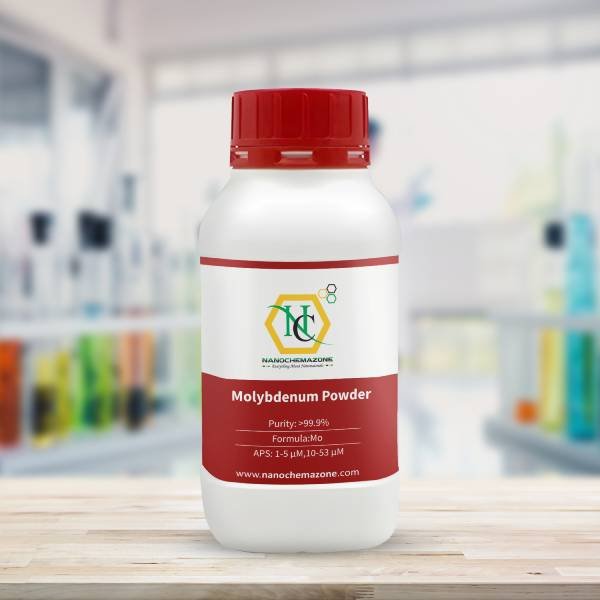
Molybdenum Powder
Molybdenum Powder
| Product | Molybdenum Powder |
| CAS No. | 6885-57-0 |
| Appearance | Dark Gray or Gray Metallic Powder |
| Purity | ≥99%, ≥99.9%, ≥95%(Other purities are also available) |
| APS | 1-5 µM, 10-53 µM (Can be customized), Ask for other available size range. |
| Ingredient | Mo |
| Density | 10.22g/cm3 |
| Molecular Weight | 95.95g/mol |
| Product Codes | NCZ-DCY-244/25 |
Molybdenum Description:
Molybdenum Powder is one of the numerous advanced ceramic materials manufactured by Nanochemazone. Nanochemazone produces too many standard grades when applicable, including Mil Spec (military grade); ACS, Reagent and Technical Grade; Food, Agricultural and Pharmaceutical Grade; Optical Grade, USP and EP/BP (European Pharmacopoeia/British Pharmacopoeia) and follows applicable ASTM testing standards. Typical and custom packaging is available. Additional technical, research and safety (MSDS) information are available. Please request a quote above for more information on lead time and pricingMolybdenum Powder Related Information :
Storage Conditions: Airtight sealed, avoid light and keep dry at room temperature. Please contact us for customization and price inquiry Email: contact@nanochemazone.com Note: We supply different size ranges of Nano and micron as per the client’s requirements and also accept customization in various parameters. Molybdenum Powder Molybdenum powder is a refractory metal powder made from molybdenum metal. It offers high temperature strength, corrosion resistance, thermal conductivity, and lubricity. Overview of Molybdenu Powder Molybdenum is a silvery-white refractory transition metal with very high melting point, excellent corrosion resistance, and good thermal/electrical conductivity. In powder form, it exhibits high strength at elevated temperatures along with stability in harsh environments. Key properties of molybdenum powder include: High temperature strength and creep resistance Excellent corrosion resistance Good thermal and electrical conductivity Low thermal expansion coefficient High hardness and wear resistance Good lubricity in sulfide atmospheres Available in various particle size distributions Molybdenum powder is used where its heat resistance, corrosion resistance, conductivity, and lubricity can be utilized. Major applications include alloying, electronics, coatings, welding, and specialty metals fabrication. Composition of Molybdenum Powder| Element | Purity |
| Molybdenum (Mo) | 99% min |
| Oxygen (O) | 0.01-0.5% |
| Carbon (C) | 0.01-0.1% |
| Iron (Fe) | 0.2-2% |
| Copper (Cu) | 0.1-0.5% |
| Silicon (Si) | 0.05-1% |
| Tungsten (W) | 0.1-1% |
| Sulfur (S) | 0.01-0.1% |
| Property | Value |
| Density | 10.22 g/cm3 |
| Melting Point | 2623°C |
| Thermal Conductivity | 138 W/m∙K |
| Electrical Resistivity | 5.5 μΩ∙cm |
| Young’s Modulus | 324 GPa |
| Poisson’s Ratio | 0.31 |
| Tensile Strength | 350 MPa |
| Yield Strength | 220 MPa |
| Elongation | 20% |
| Vickers Hardness | 200 HV |
| Parameter | Molybdenum | Tungsten |
| Density | 10.22 g/cm3 | 19.3 g/cm3 |
| Melting Point | 2623°C | 3422°C |
| Tensile Strength | 350 MPa | 350 MPa |
| Thermal Conductivity | 138 W/mK | 163 W/mK |
| Electrical Resistivity | 5.5 μΩ.cm | 5.5 μΩ.cm |
| Cost | Lower | Higher |
| Toxicity | Lower | Higher |
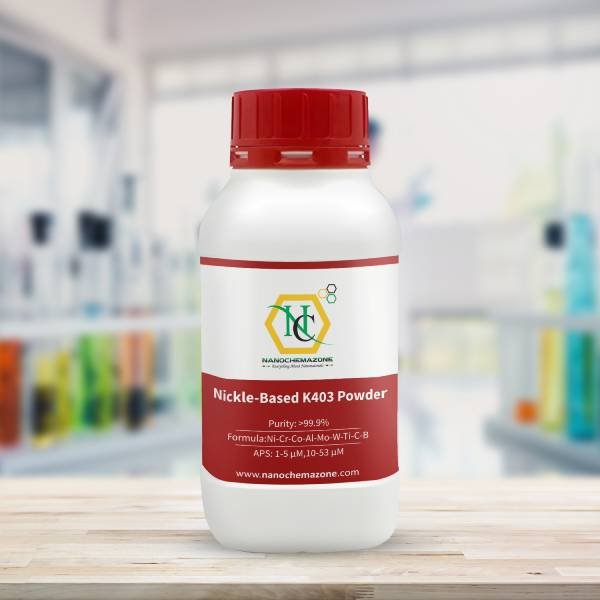
Nickel-Based K403 Powder
Nickel-Based K403 Powder
| Product | Nickel-Based K403 Powder |
| CAS No. | 7440-02-0 |
| Appearance | Silver-White Powder |
| Purity | ≥99%, ≥99.9%, ≥95%(Other purities are also available) |
| APS | 1-5 µM, 10-53 µM (Can be customized), Ask for other available size range. |
| Ingredient | Ni-Cr-Co-Al-Mo-W-Ti-C-B |
| Density | 8.2g/cm3 |
| Molecular Weight | N/A |
| Product Codes | NCZ-DCY-245/25 |
Nickel-Based K403 Description:
Nickel-Based K403 Powder is one of the numerous advanced ceramic materials manufactured by Nanochemazone. Nanochemazone produces too many standard grades when applicable, including Mil Spec (military grade); ACS, Reagent and Technical Grade; Food, Agricultural and Pharmaceutical Grade; Optical Grade, USP and EP/BP (European Pharmacopoeia/British Pharmacopoeia) and follows applicable ASTM testing standards. Typical and custom packaging is available. Additional technical, research and safety (MSDS) information are available. Please request a quote above for more information on lead time and pricingNickel-Based K403 Powder Related Information :
Storage Conditions: Airtight sealed, avoid light and keep dry at room temperature. Please contact us for customization and price inquiry Email: contact@nanochemazone.com Note: We supply different size ranges of Nano and micron as per the client’s requirements and also accept customization in various parameters. Nickel-based K403 Powder K403 powder is a nickel-chromium-iron-molybdenum alloy powder. It offers excellent resistance to oxidation, corrosion and thermal fatigue cracking. K403 has good phase stability at high temperatures. K403 powder is designed for protective coatings, thermal spray, welding, brazing, and other high temperature applications. Overview of Nickel-based K403 Powder K403 powder is a nickel-chromium-iron-molybdenum alloy powder. It offers excellent resistance to oxidation, corrosion and thermal fatigue cracking. K403 has good phase stability at high temperatures. Key features of K403 powder include: Outstanding high temperature strength and creep resistance Resists oxidation and hot corrosion up to 1150°C Retains properties under cyclic heating conditions Compatible coefficient of expansion with common alloys Available in various size ranges and morphologies K403 powder is designed for protective coatings, thermal spray, welding, brazing, and other high temperature applications. This article provides a detailed look at the composition, properties, applications, specifications, pricing, safety, and other essential information about nickel-based K403 powder. Composition of Nickel-based K403 Powder The typical composition of nickel-based K403 powder is:| Element | Composition |
| Nickel (Ni) | Balance |
| Chromium (Cr) | 21-23% |
| Iron (Fe) | 17-20% |
| Molybdenum (Mo) | 8-10% |
| Tungsten (W) | 1-2% |
| Manganese (Mn) | ≤0.5% |
| Silicon (Si) | ≤0.5% |
| Carbon (C) | ≤0.1% |
| Property | Details |
| Density | 8.2 g/cm3 |
| Melting Point | 1350-1400°C |
| Thermal Conductivity | 11 W/m.K |
| Electrical Resistivity | 94 microhm-cm |
| Young’s Modulus | 207 GPa |
| Poisson’s Ratio | 0.29-0.30 |
| Tensile Strength | ≥ 550 MPa up to 1050°C |
| Elongation | 15-25% |
| Hardness | 30-35 HRC |
| Oxidation Resistance | Excellent isothermal up to 1150°C |
| Parameter | K403 Powder | IN738 Powder |
| Composition | Ni-Cr-Fe-Mo | Ni-Cr-Co-Al-Ti |
| Oxidation Resistance | Excellent up to 1150°C | Very Good up to 1100°C |
| Cost | Higher | Lower |
| Phase Stability | Very Good | Poor |
| Mechanical Strength | High up to 1050°C | Good up to 750°C |
| Fabrication | Medium | Easy |
| Applications | Thermal spray, welding | Turbine components, AM parts |
| Availability | Moderate | Readily available |
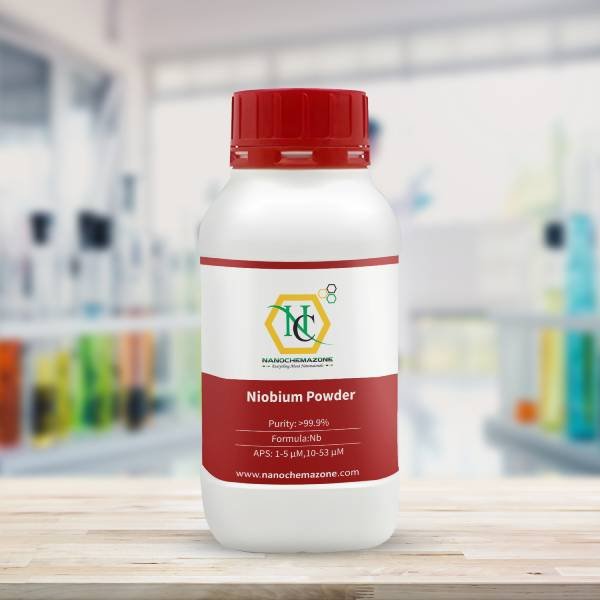
Niobium Powder
Niobium Powder
| Product | Niobium Powder |
| CAS No. | 7440-03-0 |
| Appearance | Silvery- White Powder |
| Purity | ≥99%, ≥99.9%, ≥95%(Other purities are also available) |
| APS | 1-5 µM, 10-53 µM (Can be customized), Ask for other available size range. |
| Ingredient | Nb |
| Density | 8.2g/cm3 |
| Molecular Weight | N/A |
| Product Codes | NCZ-DCY-246/25 |
Niobium Description:
Niobium Powder is one of the numerous advanced ceramic materials manufactured by Nanochemazone. Nanochemazone produces too many standard grades when applicable, including Mil Spec (military grade); ACS, Reagent and Technical Grade; Food, Agricultural and Pharmaceutical Grade; Optical Grade, USP and EP/BP (European Pharmacopoeia/British Pharmacopoeia) and follows applicable ASTM testing standards. Typical and custom packaging is available. Additional technical, research and safety (MSDS) information are available. Please request a quote above for more information on lead time and pricingNiobium Powder Related Information :
Storage Conditions: Airtight sealed, avoid light and keep dry at room temperature. Please contact us for customization and price inquiry Email: contact@nanochemazone.com Note: We supply different size ranges of Nano and micron as per the client’s requirements and also accept customization in various parameters. Niobium Powder Niobium is used in prosthetics and implant devices, such as pacemakers because it is physiologically inert and hypoallergenic. Besides, niobium powders are required as a raw material, in the fabrication of electrolytic capacity Overview of Niobium Powder Niobium is a shiny, white refractory transition metal with outstanding heat resistance and very high melting point. In powder form, it exhibits excellent thermal, electrical, and chemical stability. Key properties of niobium powder include: High heat resistance and refractory nature Excellent corrosion resistance Superconducting below 9.2K (-264°C) Thermal and electrical stability Low neutron absorption High density powder with good chemical purity Available in various particle size ranges Niobium powder is used where its refractory, conductive, and superconductive properties can be utilized. The major applications include electronics, superconductors, alloys, chemical/heat resistant components, optical coatings, and pyrotechnics. Composition of Niobium Powder Niobium powder has the following typical composition:| Element | Purity |
| Niobium (Nb) | 99% min |
| Tantalum (Ta) | 0.5% max |
| Hafnium (Hf) | 0.01% max |
| Nitrogen (N) | 0.03% max |
| Carbon (C) | 0.05% max |
| Oxygen (O) | 0.1-0.2% |
| Hydrogen (H) | 0.0015% max |
| Property | Value |
| Density | 8.57 g/cm3 |
| Melting Point | 2477°C |
| Thermal Conductivity | 53 W/m∙K |
| Electrical Resistivity | 15 μΩ∙cm |
| Young’s Modulus | 105 GPa |
| Poisson’s Ratio | 0.40 |
| Tensile Strength | 550 MPa |
| Compressive Strength | 200 MPa |
| Vickers Hardness | 600 HV |
| Parameter | Niobium Powder | Tantalum Powder |
| Density | 8.57 g/cm3 | 16.6 g/cm3 |
| Melting Point | 2477°C | 2996°C |
| Electrical resistivity | 15 μΩ.cm | 13 μΩ.cm |
| Tensile strength | 550 MPa | 400 MPa |
| Oxidation resistance | Moderate | Better |
| Cost | Lower | Higher |
| Applications | Alloys, capacitors | Medical, electronics |
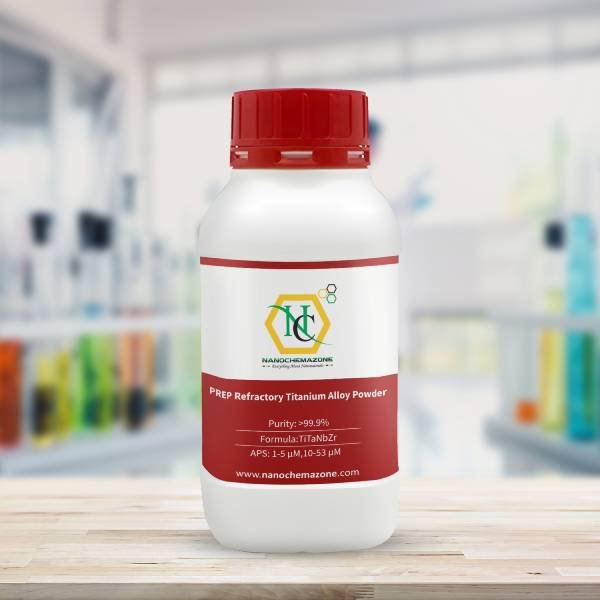
PREP Refractory Titanium Alloy Powder
PREP Refractory Titanium Alloy Powder
| Product | PREP Refractory Titanium Alloy Powder |
| CAS No. | 7440-32-6 |
| Appearance | Gray Powder |
| Purity | ≥99%, ≥99.9%, ≥95%(Other purities are also available) |
| APS | 1-5 µM, 10-53 µM (Can be customized), Ask for other available size range. |
| Ingredient | TiTaNbZr |
| Density | 2.5-4.5g/cm3 |
| Molecular Weight | N/A |
| Product Codes | NCZ-DCY-247/25 |
PREP Refractory Titanium Alloy Description:
PREP Refractory Titanium Alloy Powder is one of the numerous advanced ceramic materials manufactured by Nanochemazone. Nanochemazone produces too many standard grades when applicable, including Mil Spec (military grade); ACS, Reagent and Technical Grade; Food, Agricultural and Pharmaceutical Grade; Optical Grade, USP and EP/BP (European Pharmacopoeia/British Pharmacopoeia) and follows applicable ASTM testing standards. Typical and custom packaging is available. Additional technical, research and safety (MSDS) information are available. Please request a quote above for more information on lead time and pricingNiobium Powder Related Information :
Storage Conditions: Airtight sealed, avoid light and keep dry at room temperature. Please contact us for customization and price inquiry Email: contact@nanochemazone.com Note: We supply different size ranges of Nano and micron as per the client’s requirements and also accept customization in various parameters. PREP Refractory Titanium Alloy Powder TiAl is a new class of aerospace alloys that offers an excellent strength-to-weight ratio as well as high chemical and thermal stability. Gamma titanium aluminide alloy has excellent mechanical properties as well as oxidation and corrosion resistance at elevated temperatures (over 600 degrees Celsius). TiAl is the latest class of materials competing with Nickel superalloys for the fabrication of aircraft engine parts such as low-pressure turbine. Overview of PREP Refractory Titanium Alloy Powder PREP (Plasma Rotating Electrode Process) alloy is a high-performance refractory titanium alloy powder designed for additive manufacturing of components needing excellent mechanical properties at extreme temperatures. This article provides a comprehensive guide to PREP titanium alloy powder covering composition, properties, print parameters, applications, specifications, suppliers, handling, inspection, comparisons, pros and cons, and FAQs. Quantitative information is presented in easy-to-reference tables. Composition of PREP Titanium Alloy Powder PREP alloy has a complex composition containing various solute elements:| Element | Weight % | Purpose |
| Titanium | Balance | Principal matrix element |
| Aluminum | 5 – 7 | Solid solution strengthener |
| Tin | 1 – 3 | Solid solution strengthener |
| Zirconium | 0.5 – 2 | Grain structure control |
| Molybdenum | 1 – 3 | Solid solution strengthener |
| Silicon | 0.5 – 1.5 | Oxidation resistance |
| Niobium | 1 – 3 | Carbide former |
| Tantalum | 1 – 3 | Carbide former |
| Property | Description |
| High strength | Excellent tensile and creep strength up to 700°C |
| Fatigue resistance | High fatigue life at elevated temperatures |
| Fracture toughness | Up to 100 MPa-√m |
| Oxidation resistance | Forms protective oxide scale |
| Thermal stability | Microstructural stability after prolonged exposures |
| Damage tolerance | Resistant to crack growth |
| Biocompatibility | Non-toxic and non-allergenic |
| Parameter | Typical Value | Purpose |
| Layer height | 30-50 μm | Resolution versus build speed |
| Laser power | 150-500 W | Sufficient melting without evaporation |
| Scan speed | 750-1500 mm/s | Density versus production rate |
| Hatch spacing | 80-120 μm | Mechanical properties |
| Hot isostatic pressing | 900°C, 100 MPa, 3 hrs | Eliminate internal voids |
| Industry | Components |
| Aerospace | Turbine blades, compressor parts, mounts |
| Automotive | Connecting rods, valves, turbocharger wheels |
| Medical | Orthopedic implants, surgical tools |
| Chemical | Pumps, valves, reaction vessels |
| Power generation | Hot gas path components |
| Parameter | Specification |
| Particle size range | 15-45 μm typical |
| Particle shape | Spherical morphology |
| Apparent density | >2.5 g/cc |
| Tap density | >4.5 g/cc |
| Hall flow rate | >35 sec for 50 g |
| Purity | >99.95% |
| Oxygen content | <1000 ppm |
| Method | Parameters Tested |
| Sieve analysis | Particle size distribution |
| SEM imaging | Particle morphology |
| EDX | Chemistry/composition |
| XRD | Phases present |
| Pycnometry | Density |
| Hall flow rate | Powder flowability |
| Alloy | Strength | Oxidation Resistance | Cost | Printability |
| PREP | Excellent | Excellent | High | Good |
| Ti64 | Good | Good | Medium | Fair |
| Ti6242 | Excellent | Good | High | Fair |
| CP-Ti | Low | Excellent | Low | Excellent |
| Pros | Cons |
| Outstanding high temperature strength | Expensive compared to Ti64 and CP-Ti |
| Excellent thermomechanical fatigue resistance | Higher density than other titanium alloys |
| Complex geometries feasible | Controlled atmosphere handling mandatory |
| Lower anisotropy than Ti64 and CP-Ti | Processing very technique sensitive |
| Matching properties to PREP wrought forms | Limited suppliers and alloy variants |
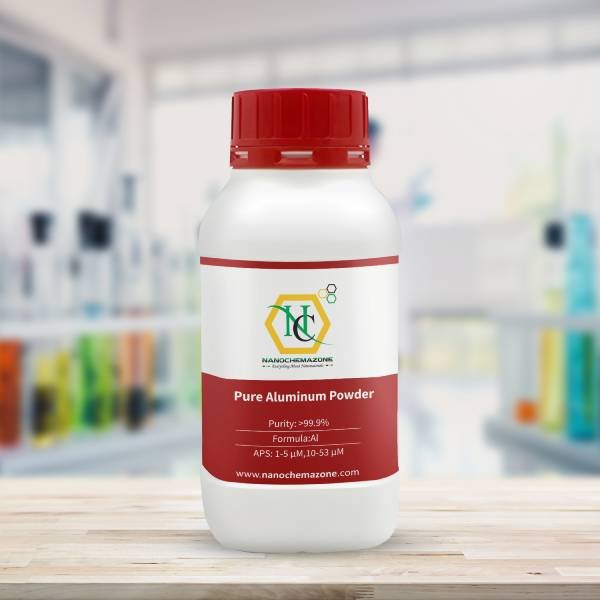
Pure Aluminum Powder
Pure Aluminum Powder
| Product | Pure Aluminum Powder |
| CAS No. | 7429-90-5 |
| Appearance | Slivery Gray Powder |
| Purity | ≥99%, ≥99.9%, ≥95%(Other purities are also available) |
| APS | 1-5 µM, 10-53 µM (Can be customized), Ask for other available size range. |
| Ingredient | Al |
| Density | 2.7g/cm3 |
| Molecular Weight | 26.98g/mol |
| Product Codes | NCZ-DCY-249/25 |
Pure Aluminum Description:
Pure Aluminum Powder is one of the numerous advanced ceramic materials manufactured by Nanochemazone. Nanochemazone produces too many standard grades when applicable, including Mil Spec (military grade); ACS, Reagent and Technical Grade; Food, Agricultural and Pharmaceutical Grade; Optical Grade, USP and EP/BP (European Pharmacopoeia/British Pharmacopoeia) and follows applicable ASTM testing standards. Typical and custom packaging is available. Additional technical, research and safety (MSDS) information are available. Please request a quote above for more information on lead time and pricingPure Aluminum Powder Related Information:
Storage Conditions: Airtight sealed, avoid light and keep dry at room temperature. Please contact us for customization and price inquiry Email: contact@nanochemazone.com Note: We supply different size ranges of Nano and micron as per the client’s requirements and also accept customization in various parameters. Pure aluminum powder Pure aluminum powder contains 99% or higher aluminum content. It provides low density combined with good ductility, conductivity, and corrosion resistance. Overview of Pure Aluminum Powder Pure aluminum powder contains 99% or higher aluminum content. It provides low density combined with good ductility, conductivity, and corrosion resistance. Key properties and advantages of pure aluminum powder include: Pure Aluminum Powder Properties and Characteristics| Properties | Details |
| Composition | 99% or higher Al content |
| Density | 2.7 g/cc |
| Particle shape | Spherical, irregular |
| Size range | 1-150 microns |
| Apparent density | Up to 50% of true density |
| Conductivity | Excellent electrical and thermal conductivity |
| Corrosion resistance | Good due to protective oxide layer |
| Element | Weight % |
| Aluminum (Al) | 99% min |
| Silicon (Si) | 0.5% max |
| Iron (Fe) | 0.5% max |
| Copper (Cu) | 0.05% max |
| Manganese (Mn) | 0.05% max |
| Magnesium (Mg) | 0.05% max |
| Other impurities | 0.05% max |
| Property | Values |
| Density | 2.7 g/cc |
| Melting point | 660°C |
| Thermal conductivity | 237 W/mK |
| Electrical resistivity | 2.65 μΩ-cm |
| CTE | 23.1 x 10^-6 /K |
| Reflectivity | 87% at 400 nm wavelength |
| Property | Values |
| Tensile strength | 90-100 MPa |
| Yield strength | 35-45 MPa |
| Elongation | 35-40% |
| Hardness | 25-35 HB |
| Fatigue strength | 50-90 MPa |
| Shear strength | 60-65 MPa |
| Industry | Uses |
| Thermite welding | Rail welding, metal joining |
| Additive manufacturing | Low strength components |
| Explosives and pyrotechnics | Thermite compositions |
| Powder coatings | Conductive and resistant coatings |
| Diamond tools | Metal matrix with diamond particles |
| Fireworks | Fuel and pyrotechnic compositions |
| Standard | Description |
| ASTM B787 | Standard for pure aluminum powders |
| ASTM B859 | Specs for aluminum and aluminum alloy powders |
| DIN 1718-1 | Designation system for aluminum and aluminum alloys |
| GJB320B | Chinese military standard for aluminum and aluminum alloy powders |
| Size | Characteristics |
| 1-10 microns | Ultrafine grade used in printing pastes |
| 10-45 microns | Fine grade suitable for coatings, pressing |
| 45-150 microns | Coarse grade offers better flowability |
| Apparent Density | Details |
| Up to 50% of true density | For irregular morphology powder |
| 1.3-1.7 g/cc | Higher for spherical powder |
| Method | Details |
| Atomization | Molten aluminum stream broken into fine droplets that solidify into powder |
| Ball milling | Mechanical milling classifies coarse powder into fine powder |
| Annealing | Removes internal stresses and improves powder compressibility |
| Sieving | Classifies powder into different size fractions |
| Recommendation | Reason |
| Use proper ventilation | Avoid concentrated dust environment |
| Employ grounding systems | Prevent static discharge during handling |
| Limit moisture exposure | Prevents oxidation of particles |
| Follow safe protocols | Reduce health and fire hazards |
| Avoid ignition sources | Flammable powder risk |
| Use non-sparking tools | Prevent possibility of ignition |
| Test | Details |
| Chemical analysis | XRF or ICP testing verifies composition |
| Particle size distribution | Laser diffraction analysis |
| Apparent density | Hall flowmeter test per ASTM B212 standard |
| Powder morphology | SEM imaging of particle shape |
| Flow rate analysis | Gravity flow rate through specified funnel |
| Moisture measurement | Loss on drying test |
| Parameter | Pure Al | Al-Mg |
| Density | 2.7 g/cc | 2.7 g/cc |
| Strength | 90-100 MPa | 150-220 MPa |
| Conductivity | Excellent | Good |
| Corrosion resistance | Good | Excellent |
| Cost | Low | High |
| Uses | Thermite welding, pyrotechnics | Structural components |
Pure Aluminum Powder
Pure Aluminum Powder
| Product | Pure Aluminum Powder |
| CAS No. | 7429-90-5 |
| Appearance | Slivery Gray Powder |
| Purity | ≥99%, ≥99.9%, ≥95%(Other purities are also available) |
| APS | 1-5 µM, 10-53 µM (Can be customized), Ask for other available size range. |
| Ingredient | Al |
| Density | 2.7g/cm3 |
| Molecular Weight | 26.98g/mol |
| Product Codes | NCZ-DCY-250/25 |
Pure Aluminum Description:
Pure Aluminum Powder is one of the numerous advanced ceramic materials manufactured by Nanochemazone. Nanochemazone produces too many standard grades when applicable, including Mil Spec (military grade); ACS, Reagent and Technical Grade; Food, Agricultural and Pharmaceutical Grade; Optical Grade, USP and EP/BP (European Pharmacopoeia/British Pharmacopoeia) and follows applicable ASTM testing standards. Typical and custom packaging is available. Additional technical, research and safety (MSDS) information are available. Please request a quote above for more information on lead time and pricingPure Aluminum Powder Related Information:
Storage Conditions: Airtight sealed, avoid light and keep dry at room temperature. Please contact us for customization and price inquiry Email: contact@nanochemazone.com Note: We supply different size ranges of Nano and micron as per the client’s requirements and also accept customization in various parameters. Pure Aluminum Powder Pure aluminum powder refers to aluminum powder produced from just aluminum without the addition of other alloying elements. It exhibits low density, high thermal and electrical conductivity, ductility, excellent corrosion resistance, and reflectivity. Overview of Pure Aluminum Powder Pure aluminum powder refers to aluminum powder produced from just aluminum without the addition of other alloying elements. It exhibits low density, high thermal and electrical conductivity, ductility, excellent corrosion resistance, and reflectivity. Key features of pure aluminum powder include: Unalloyed aluminum with 99%+ purity Highly reactive with high affinity to oxygen Low melting point and excellent thermal conductivity Lightweight with density around 2.7 g/cc Soft and ductile for deformation processing Available in various particle sizes and morphologies Pure aluminum powder is used for protective coatings, pyrotechnic compositions, fuel additives, 3D printing, and other applications requiring pure aluminum properties. This article provides a comprehensive overview of properties, production methods, applications, specifications, and other details of pure aluminum powder. Composition of Pure Aluminum Powder| Element | Weight % |
| Aluminum (Al) | 99%+ |
| Iron (Fe) | 0.35% max |
| Silicon (Si) | 0.10% max |
| Copper (Cu) | 0.05% max |
| Zinc (Zn) | 0.07% max |
| Manganese (Mn) | 0.03% max |
| Magnesium (Mg) | 0.03% max |
| Chromium (Cr) | 0.03% max |
| Others (each) | 0.03% max |
| Others (total) | 0.10% max |
| Property | Value |
| Density | 2.70 g/cm3 |
| Melting Point | 660°C |
| Thermal Conductivity | 237 W/m.K |
| Electrical Resistivity | 2.65 microhm-cm |
| Young’s Modulus | 70 GPa |
| Poisson’s Ratio | 0.33 |
| Tensile Strength | 90-115 MPa |
| Elongation | 8-25% |
| Mohs Hardness | 2.75 |
| Oxidation Resistance | Poor |
| Parameter | Atomized Al Powder | Sintered Al Powder |
| Production Method | Gas or water atomization of molten aluminum | Compacting and sintering of aluminum powder |
| Particle Morphology | Spherical | Irregular, porous |
| Particle Size | 5 to 150 microns | Under 5 microns |
| Flowability | Excellent | Poor |
| Purity | 99 to 99.9% | Lower |
| Cost | Higher | Lower |
| Applications | Thermal spray, AM | Flash powder, explosives |
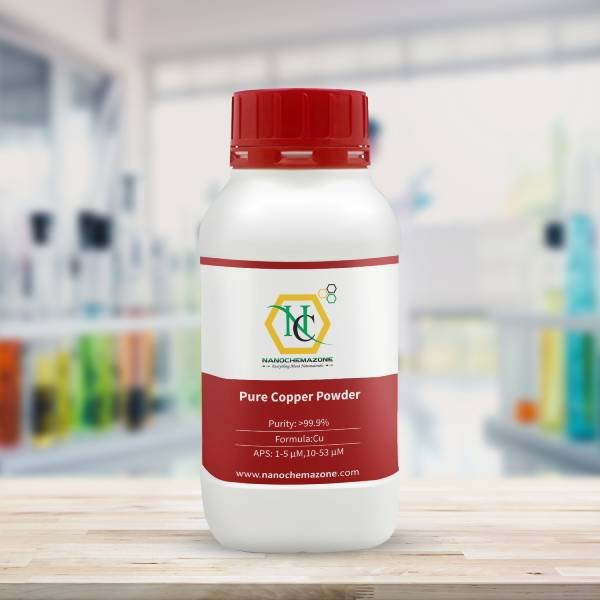
Pure Copper Powder
Pure Copper Powder
| Product | Pure Copper Powder |
| CAS No. | 7429-50-8 |
| Appearance | Red-Brown Powder |
| Purity | ≥99%, ≥99.9%, ≥95%(Other purities are also available) |
| APS | 1-5 µM, 10-53 µM (Can be customized), Ask for other available size range. |
| Ingredient | Cu |
| Density | 63.55g/cm3 |
| Molecular Weight | 8.94g/mol |
| Product Codes | NCZ-DCY-251/25 |
Pure Copper Description:
Pure Copper Powder is one of the numerous advanced ceramic materials manufactured by Nanochemazone. Nanochemazone produces too many standard grades when applicable, including Mil Spec (military grade); ACS, Reagent and Technical Grade; Food, Agricultural and Pharmaceutical Grade; Optical Grade, USP and EP/BP (European Pharmacopoeia/British Pharmacopoeia) and follows applicable ASTM testing standards. Typical and custom packaging is available. Additional technical, research and safety (MSDS) information are available. Please request a quote above for more information on lead time and pricingPure Copper Powder Related Information :
Storage Conditions: Airtight sealed, avoid light and keep dry at room temperature. Please contact us for customization and price inquiry Email: contact@nanochemazone.com Note: We supply different size ranges of Nano and micron as per the client’s requirements and also accept customization in various parameters. Pure Copper Powder Pure copper powder contains 99.5% or higher copper content. It provides excellent thermal and electrical conductivity combined with good corrosion resistance, solderability, and bio-compatibility. Overview of Pure Copper Powder Pure copper powder contains 99.5% or higher copper content. It provides excellent thermal and electrical conductivity combined with good corrosion resistance, solderability, and bio-compatibility. Key properties and advantages of pure copper powder: Pure Copper Powder Properties and Characteristics| Properties | Details |
| Composition | 99.5% or higher copper content |
| Density | 8.94 g/cc |
| Particle shape | Spherical, irregular |
| Size range | 1-150 microns |
| Apparent density | Up to 50% of true density |
| Conductivity | Excellent, second only to silver |
| Solderability | Excellent due to oxidation resistance |
| Bio-compatibility | High, safe for food contact |
| Element | Weight % |
| Copper (Cu) | 99.5% min |
| Oxygen (O) | 0.05% max |
| Lead (Pb) | 0.005% max |
| Other impurities | 0.005% max |
| Property | Values |
| Density | 8.94 g/cc |
| Melting point | 1083°C |
| Thermal conductivity | 400 W/mK |
| Electrical resistivity | 1.72 μΩ-cm |
| Recrystallization temperature | 200-300°C |
| Curie temperature | -269°C |
| Property | Values |
| Tensile strength | 220-340 MPa |
| Yield strength | 69-172 MPa |
| Elongation | 35-60% |
| Hardness | 45-90 HB |
| Modulus of elasticity | 110-130 GPa |
| Compressive strength | 500-700 MPa |
| Industry | Uses |
| Electricals | Contacts, brushes, welding electrodes |
| Electronics | Conductive adhesives, RF shielding |
| Automotive | Brushes, bushings, bearings |
| Industrial | Diamond tools, casting molds |
| Manufacturing | Brazing alloys, powder metallurgy |
| Friction products | Brake pads, clutch discs |
| Standard | Description |
| ASTM B602 | Specification for high purity electrolytic copper powder |
| JIS H2111 | Specs for electrolytic copper and copper alloy powders |
| ISO 3497 | Specification for general purpose copper powders |
| ASTM B243 | Guidance on apparent density and flow rate |
| Size | Characteristics |
| 1-10 microns | Ultrafine grade used in microelectronics |
| 10-30 microns | Fine grade suitable for sintering |
| 30-150 microns | Coarse grade has good flow for pressing |
| Apparent Density | Details |
| Up to 50% of true density | For irregular powder morphology |
| 3.5-5.0 g/cc typical | Improves with greater packing density |
| Method | Details |
| Electrolysis | Copper cathodes dissolved anodically into Cu+ ions and deposited on stainless steel cathodes |
| Ball milling | Coarse powder broken down and classified into specific sizes |
| Annealing | Softens the powder particles and improves compressibility |
| Reducing atmosphere | Prevents oxidation of particles during production |
| Recommendation | Reason |
| Ensure proper ventilation | Prevent exposure to fine particles |
| Use appropriate PPE | Avoid accidental ingestion |
| Follow safe protocols | Reduce health hazards |
| Avoid ignition sources | Flammable dust hazard |
| Ground equipment | Prevent static discharge |
| Use non-sparking tools | Prevent possibility of ignition |
| Test | Details |
| Chemical analysis | ICP or XRF verifies composition |
| Particle size distribution | Laser diffraction analysis |
| Apparent density | Hall flowmeter test per ASTM B212 |
| Powder morphology | SEM imaging of particle shape |
| Tap density test | Density measured after mechanical tapping |
| Flow rate analysis | Gravity flow through a specified funnel |
| Parameter | Pure Copper | Brass/Bronze |
| Density | 8.94 g/cc | 8.7-8.8 g/cc |
| Strength | 220-340 MPa | 350-550 MPa |
| Conductivity | Excellent | Good |
| Corrosion resistance | Excellent | Good |
| Cost | Low | Moderate |
| Uses | Electrical, thermal | Hardware, decorative |
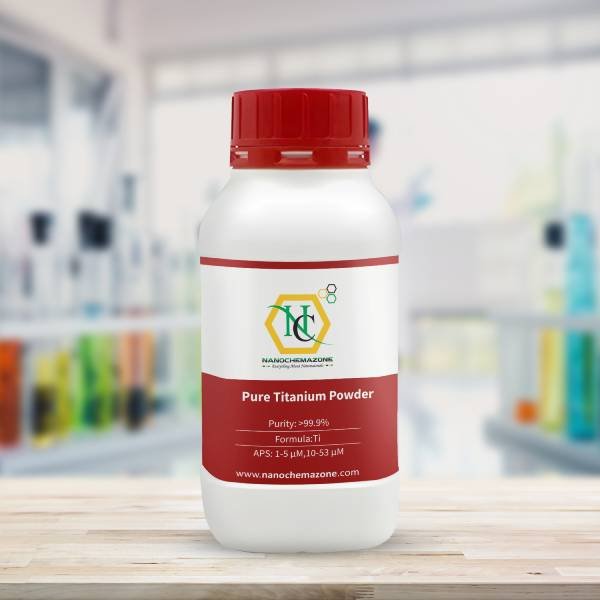
Pure Titanium Powder
Pure Titanium Powder
| Product | Pure Titanium Powder |
| CAS No. | 7429-32-6 |
| Appearance | Silvery-White Powder |
| Purity | ≥99%, ≥99.9%, ≥95%(Other purities are also available) |
| APS | 1-5 µM, 10-53 µM (Can be customized), Ask for other available size range. |
| Ingredient | Ti |
| Density | 4.54g/cm3 |
| Molecular Weight | 47.86g/mol |
| Product Codes | NCZ-DCY-251/25 |
Pure Titanium Description:
Pure Titanium Powder is one of the numerous advanced ceramic materials manufactured by Nanochemazone. Nanochemazone produces too many standard grades when applicable, including Mil Spec (military grade); ACS, Reagent and Technical Grade; Food, Agricultural and Pharmaceutical Grade; Optical Grade, USP and EP/BP (European Pharmacopoeia/British Pharmacopoeia) and follows applicable ASTM testing standards. Typical and custom packaging is available. Additional technical, research and safety (MSDS) information are available. Please request a quote above for more information on lead time and pricingPure Titanium Powder Related Information :
Storage Conditions: Airtight sealed, avoid light and keep dry at room temperature. Please contact us for customization and price inquiry Email: contact@nanochemazone.com Note: We supply different size ranges of Nano and micron as per the client’s requirements and also accept customization in various parameters. Pure Titanium Powder Titanium powder is a metal powder made from titanium metal. It is characterized by its high strength-to-weight ratio, corrosion resistance, and biocompatibility. Titanium powder has diverse applications across industries Overview of Pure Titanium Powder Titanium powder is a metal powder made from titanium metal. It is characterized by its high strength-to-weight ratio, corrosion resistance, and biocompatibility. Titanium powder has diverse applications across industries such as aerospace, medical, automotive, and consumer products. This article provides a comprehensive guide to titanium powder. It covers the composition, properties, applications, specifications, suppliers, handling, inspection, comparisons, pros and cons, and frequently asked questions about titanium powder. Quantitative data is presented in easy-to-read tables for quick reference. Composition of Titanium Powder Titanium powder can be pure titanium or an alloy containing titanium as the main element. The composition determines the properties and applications.| Composition | Details |
| Pure Titanium | Contains >99% titanium. Lowest strength but excellent corrosion resistance. |
| Ti-6Al-4V | 6% aluminum, 4% vanadium. Most common titanium alloy with high strength. |
| Ti-3Al-2.5V | 3% aluminum, 2.5% vanadium. Higher ductility than Ti-6Al-4V. |
| Ti-6Al-7Nb | 6% aluminum, 7% niobium. Higher strength for aerospace applications. |
| Ti-15Mo-3Nb-3Al-0.2Si | 15% molybdenum, 3% niobium, 3% aluminum, 0.2% silicon. Beta titanium alloy. |
| Property | Description |
| High strength | Has excellent strength-to-density ratio, close to high strength steels. |
| Low density | Weighs 60% less than steel or nickel alloys. |
| Corrosion resistance | Forms stable TiO2 oxide film for corrosion protection. |
| Biocompatibility | Non-toxic and compatible with human body tissues. |
| Heat resistance | Maintains mechanical properties up to 600°C. |
| Non-magnetic | Useful for non-magnetic applications. |
| Non-sparking | Safer for flammable environments compared to steel. |
| Industry | Applications |
| Aerospace | Engine components, aircraft structures, space vehicles |
| Medical | Implants, surgical instruments, medical devices |
| Automotive | Connecting rods, valves, springs, fasteners |
| Chemical | Corrosion resistant vessels, heat exchangers, pipes |
| Sporting goods | Golf clubs, tennis rackets, bicycles, helmets |
| Additive manufacturing | Aerospace, automotive, and medical 3D printed parts |
| Parameter | Specifications |
| Particle sizes | 15-45 microns, 45-105 microns, 105-250 microns |
| Particle shape | Spherical, angular, mixed morphology |
| Purity | Grade 1 (99.2% Ti), Grade 2 (99.5% Ti), Grade 4 (99.9% Ti) |
| Alloy grades | Ti-6Al-4V, Ti-6Al-7Nb, Ti-64, Ti-1023 |
| Production method | Gas atomization, plasma atomization, hydride-dehydride |
| Test Method | Parameter Measured |
| Sieve analysis | Particle size distribution |
| Laser diffraction | Particle size distribution, mean size |
| Scanning electron microscopy | Particle morphology, microstructure |
| Energy dispersive X-ray spectroscopy | Chemical composition |
| X-ray diffraction | Phase composition |
| Spectrophotometry | Oxygen, nitrogen, hydrogen content |
| Tap density | Apparent density, flowability |
| Pycnometer | Skeletal density |
| Titanium | Aluminum | Stainless Steel | |
| Density | Low | Lower | Higher |
| Strength | High | Medium | High |
| Corrosion resistance | Excellent | Good | Good |
| Temperature resistance | Good | Medium | Better |
| Cost | High | Low | Medium |
| Magnetic permeability | Low | Low | High |
| Biocompatibility | Excellent | Poor | Good |
| Pros | Cons |
| High strength-to-weight ratio | Expensive compared to steels |
| Corrosion resistant | Reactivity with oxygen at high temperatures |
| Non-toxic and non-allergenic | Low elastic modulus can mean springback in machining |
| Excellent biocompatibility | Low thermal conductivity |
| Retains properties at high temperatures | Requires inert atmosphere processing |
| Wide range of alloying possibilities | Limited high temperature strength |
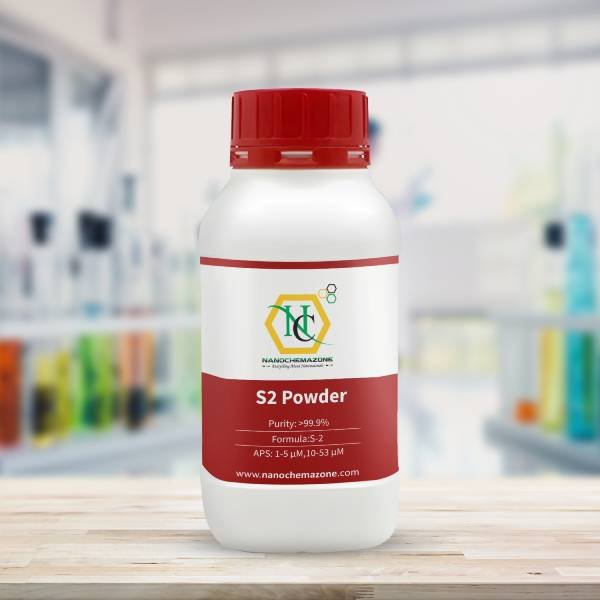
S2 Powder
S2 Powder
| Product | S2 Powder |
| CAS No. | 7704-34-9 |
| Appearance | Off White to White Powder |
| Purity | ≥99%, ≥99.9%, ≥95%(Other purities are also available) |
| APS | 1-5 µM, 10-53 µM (Can be customized), Ask for other available size range. |
| Ingredient | S-2 |
| Density | 2.5-7.8g/cm3 |
| Molecular Weight | 64-12g/mol |
| Product Codes | NCZ-DCY-252/25 |
S2 Description:
S2 Powder is one of the numerous advanced ceramic materials manufactured by Nanochemazone. Nanochemazone produces too many standard grades when applicable, including Mil Spec (military grade); ACS, Reagent and Technical Grade; Food, Agricultural and Pharmaceutical Grade; Optical Grade, USP and EP/BP (European Pharmacopoeia/British Pharmacopoeia) and follows applicable ASTM testing standards. Typical and custom packaging is available. Additional technical, research and safety (MSDS) information are available. Please request a quote above for more information on lead time and pricingS2 Powder Related Information :
Storage Conditions: Airtight sealed, avoid light and keep dry at room temperature. Please contact us for customization and price inquiry Email: contact@nanochemazone.com Note: We supply different size ranges of Nano and micron as per the client’s requirements and also accept customization in various parameters. S2 Powder S2 powder is a high speed tool steel powder ideal for making cutting tools requiring high hardness, strength, and wear resistance at elevated temperatures. It contains tungsten, molybdenum, vanadium, and additional alloys providing excellent hot hardness and thermal fatigue resistance. Overview of S2 Powder S2 powder is a high speed tool steel powder ideal for making cutting tools requiring high hardness, strength, and wear resistance at elevated temperatures. It contains tungsten, molybdenum, vanadium, and additional alloys providing excellent hot hardness and thermal fatigue resistance. Key properties and advantages of S2 powder: S2 Powder Properties and Characteristics| Properties | Details |
| Composition | Fe-1C-5Cr-2.35Mo-6.4W-1.4V-2Si alloy |
| Density | 7.7 g/cc |
| Particle shape | Irregular, angular |
| Size range | 10-150 microns |
| Apparent density | Up to 50% of true density |
| Flowability | Low to moderate |
| Hardness | 62-64 HRC when heat treated |
| Toughness | Very good |
| Element | Weight % |
| Iron (Fe) | Balance |
| Carbon (C) | 0.9-1.2% |
| Chromium (Cr) | 3.8-4.5% |
| Tungsten (W) | 6.4% |
| Molybdenum (Mo) | 1.9-2.2% |
| Vanadium (V) | 1.3-1.6% |
| Manganese (Mn) | 0.2-0.5% |
| Silicon (Si) | 0.9-1.4% |
| Property | Values |
| Density | 7.7 g/cc |
| Melting point | 1320-1350°C |
| Thermal conductivity | 37 W/mK |
| Electrical resistivity | 0.6 μΩ-m |
| Maximum service temperature | 600°C |
| Curie temperature | 770°C |
| Property | Values |
| Hardness | 62-64 HRC |
| Transverse rupture strength | 4500-4800 MPa |
| Compressive strength | 3800-4100 MPa |
| Tensile strength | 2050-2250 MPa |
| Yield strength | 1930-2050 MPa |
| Elongation | 8-10% |
| Impact toughness | 10-14 J/cm2 |
| Industry | Example Uses |
| Automotive | Cutting and milling tools |
| Aerospace | Drills, end mills |
| Manufacturing | Punches, forming dies |
| Oil and gas | Downhole tools, drill bits |
| General machining | Turning, boring, and planing tools |
| Standard | Description |
| ASTM A600 | Specification for tool steels high speed steel |
| JIS G4403 | High speed tool steels |
| DIN 1.2363 | Equivalent to AISI S7 high speed steel |
| UNS T11302 | Designation for AISI S2 grade |
| ISO 4957 | Tool steels specification |
| Particle Size | Characteristics |
| 10-22 microns | Ultrafine grade provides highest density |
| 22-53 microns | Most commonly used size range |
| 53-105 microns | Coarser size provides good flowability |
| Apparent Density | Details |
| Up to 50% of true density | For irregular powder morphology |
| 4.0-5.0 g/cc | Higher for spherical, lower for irregular powder |
| Method | Details |
| Gas atomization | High pressure inert gas breaks up molten alloy stream into fine droplets |
| Vacuum induction melting | High purity input materials melted under vacuum |
| Multiple remelting | Enhances chemical homogeneity |
| Sieving | Classifies powder into different particle size fractions |
| Recommendation | Reason |
| Ensure proper ventilation | Prevent exposure to fine metal particles |
| Use appropriate PPE | Avoid ingestion through nose/mouth |
| Ground equipment | Prevent static sparking |
| Avoid ignition sources | Flammable dust hazard |
| Use non-sparking tools | Prevent possibility of ignition |
| Follow safe protocols | Reduce fire, explosion, health risks |
| Test | Details |
| Chemical analysis | Verifies composition using optical/ICP spectroscopy |
| Particle size analysis | Determines size distribution using laser diffraction or sieving |
| Apparent density | Measured as per ASTM B212 using Hall flowmeter |
| Powder morphology | SEM imaging to determine particle shape |
| Flow rate test | Gravity flow rate through specified funnel |
| Tap density test | Density measured after mechanically tapping powder sample |
| Parameter | S2 | H13 |
| Hardness | 62-64 HRC | 54-57 HRC |
| Hot hardness | Excellent | Good |
| Toughness | Very good | Good |
| Thermal shock resistance | Excellent | Moderate |
| Cold strength | Good | Excellent |
| Cost | High | Low |
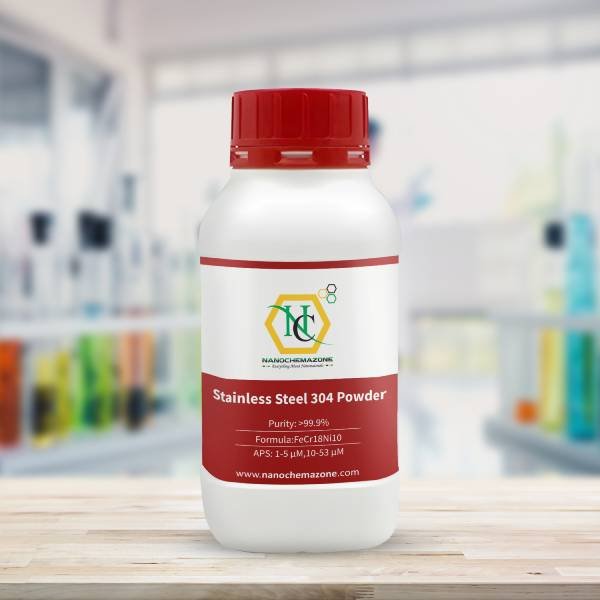
Stainless Steel 304 Powder
Stainless Steel 304 Powder
| Product | Stainless Steel 304 Powder |
| CAS No. | 65997-19-5 |
| Appearance | Silver-Gray Powder |
| Purity | ≥99%, ≥99.9%, ≥95%(Other purities are also available) |
| APS | 1-5 µM, 10-53 µM (Can be customized), Ask for other available size range. |
| Ingredient | FeCr18Ni10 |
| Density | 7.9g/cm3 |
| Molecular Weight | N/A |
| Product Codes | NCZ-DCY-253/25 |
Stainless Steel 304 Description:
Stainless Steel 304 Powder is one of the numerous advanced ceramic materials manufactured by Nanochemazone. Nanochemazone produces too many standard grades when applicable, including Mil Spec (military grade); ACS, Reagent and Technical Grade; Food, Agricultural and Pharmaceutical Grade; Optical Grade, USP and EP/BP (European Pharmacopoeia/British Pharmacopoeia) and follows applicable ASTM testing standards. Typical and custom packaging is available. Additional technical, research and safety (MSDS) information are available. Please request a quote above for more information on lead time and pricingStainless Steel Powder Related Information :
Storage Conditions: Airtight sealed, avoid light and keep dry at room temperature. Please contact us for customization and price inquiry Email: contact@nanochemazone.com Note: We supply different size ranges of Nano and micron as per the client’s requirements and also accept customization in various parameters. stainless steel 304 Powder for 3D Printing 304 powder is a form of stainless steel powder that is widely used in various industries due to its exceptional properties. It is composed of iron, chromium, and nickel, which give it excellent corrosion resistance, high strength, and good formability. The powder form allows for easy processing and customization according to specific requirements. Introduction To 304 Powder 304 powder is a form of stainless steel powder that is widely used in various industries due to its exceptional properties. It is composed of iron, chromium, and nickel, which give it excellent corrosion resistance, high strength, and good formability. The powder form allows for easy processing and customization according to specific requirements. Composition And Properties 304 powder primarily consists of iron, with approximately 18% chromium and 8% nickel. These alloying elements contribute to its corrosion resistance and durability. Additionally, it contains small amounts of carbon, manganese, phosphorus, sulfur, and silicon. The combination of these elements results in a material with remarkable mechanical and chemical properties. Some key properties of 304 powder include: Corrosion resistance: 304 powder exhibits excellent resistance to corrosion from a wide range of substances, including water, acids, and alkalis. Strength and durability: It has high tensile strength, making it suitable for applications that require robust and long-lasting components. Formability: 304 powder can be easily formed into different shapes, allowing for versatility in manufacturing processes. Heat resistance: It maintains its strength and structural integrity even at elevated temperatures. Hygienic properties: Due to its non-porous surface, it is easy to clean and maintain sanitary conditions in applications such as food processing. Industrial Applications 304 powder finds extensive use in various industries. Let’s explore some of its prominent applications: Automotive Industry In the automotive sector, 304 powder is utilized in the manufacturing of exhaust systems, mufflers, and other components exposed to corrosive gases and liquids. Its resistance to oxidation and high-temperature environments makes it an ideal choice for these applications, ensuring longevity and reliability. Food Processing The food processing industry demands materials that meet stringent hygiene and corrosion resistance requirements. 304 powder is widely employed in food processing equipment, such as tanks, pipes, and fittings. Its smooth surface and resistance to food acids and chemicals make it a preferred choice, ensuring the integrity and safety of food products. Chemical Industry 304 powder is extensively used in the chemical industry due to its resistance to various corrosive substances. It is employed in the construction of reactors, storage tanks, and pipelines for handling chemicals and acids. The material’s ability to withstand corrosive environments and retain its structural integrity contributes to safe and efficient chemical processes. Architecture And Construction In architecture and construction, 304 powder finds applications in the fabrication of structural components, handrails, and decorative elements. Its aesthetic appeal, combined with corrosion resistance, makes it an excellent choice for both interior and exterior applications. Moreover, its formability allows for intricate designs and customization according to architectural requirements. Aerospace Sector The aerospace industry requires materials that can withstand extreme conditions, including high temperatures, vibrations, and corrosive environments. 304 powder is utilized in aircraft components, such as exhaust systems, brackets, and fasteners, due to its excellent combination of strength, heat resistance, and corrosion resistance. It plays a vital role in ensuring the safety and reliability of aerospace systems. Advantages Of Using 304 Powder 304 powder offers several advantages over other materials, making it a preferred choice in many industrial applications. Some notable benefits include: Corrosion resistance: The high chromium and nickel content provide exceptional resistance to corrosion, ensuring durability and longevity. Cost-effectiveness: 304 powder offers a cost-effective solution for various applications due to its availability and wide range of uses. Versatility: Its formability allows for customization and adaptability to different manufacturing processes and design requirements. Hygienic properties: The non-porous surface of 304 powder makes it easy to clean and maintain in industries with strict hygiene standards. Recyclability: Stainless steel, including 304 powder, is highly recyclable, contributing to environmental sustainability. Challenges And Limitations While 304 powder boasts numerous advantages, it also has some limitations to consider. These include: Moderate temperature limitations: While it exhibits good heat resistance, prolonged exposure to high temperatures may lead to a reduction in mechanical properties. Sensitivity to certain chemicals: 304 powder may be susceptible to specific corrosive substances, such as chlorides, under certain conditions. Proper material selection is crucial in such cases. Magnetic properties: Unlike some stainless steel alloys, 304 powder is generally magnetic, which may impact its suitability for certain applications. Best Practices For Handling And Storage To maximize the performance and longevity of 304 powder, it is important to follow best practices for its handling and storage. Consider the following guidelines: Store the powder in a clean, dry, and well-ventilated area to prevent moisture and contamination. Handle the powder with clean gloves to avoid transferring oils and other substances that may affect its properties. Keep the powder away from strong acids, alkalis, and chloride-containing substances to minimize the risk of corrosion. Regularly inspect the powder for any signs of damage or contamination before use. Future Trends And Innovations As technology advances and new industrial challenges emerge, the development of stainless steel powders like 304 powder continues. Researchers and manufacturers are exploring ways to further enhance its properties, expand its applications, and optimize its processing techniques. Future trends may include improved heat resistance, increased strength, and the development of eco-friendly manufacturing processes. for your specific needs. Frequently Asked Questions (FAQs) Is 304 powder suitable for outdoor applications? Yes, 304 powder is commonly used in outdoor applications due to its corrosion resistance and durability. However, prolonged exposure to harsh environments may require additional protective measures. Can 304 powder be welded? Yes, 304 powder can be welded using common welding techniques. However, it is important to follow proper welding procedures to ensure optimal results and maintain its corrosion resistance. Can 304 powder be used for medical applications? While 304 powder is not typically used for direct medical implants, it is often employed in medical equipment and devices where corrosion resistance is required, such as surgical instruments and hospital equipment. How does 304 powder compare to other stainless steel alloys? 304 powder is one of the most commonly used stainless steel alloys due to its balanced combination of properties, cost-effectiveness, and availability. However, there are other alloys with specialized properties that may be more suitable for specific applications. Is 304 powder recyclable? Yes, stainless steel, including 304 powder, is highly recyclable. Recycling stainless steel helps conserve resources and reduce environmental impact.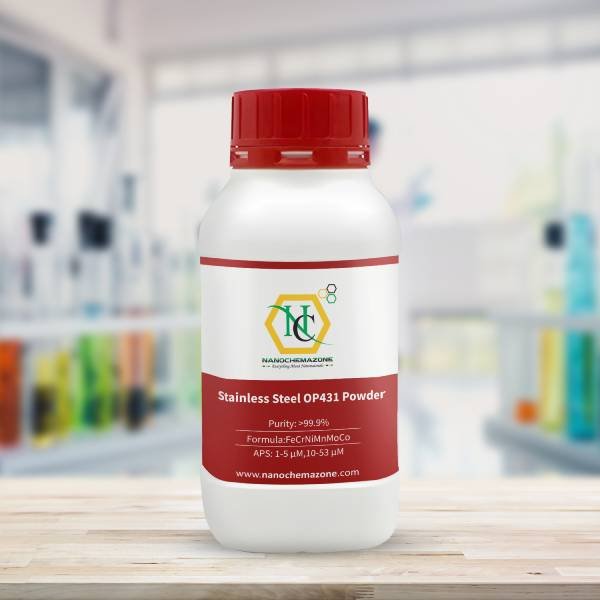
Stainless Steel OP431 Powder
Stainless Steel OP431 Powder
| Product | Stainless Steel OP431 Powder |
| CAS No. | 12597-68-1 |
| Appearance | Metallic Gray Powder |
| Purity | ≥99%, ≥99.9%, ≥95%(Other purities are also available) |
| APS | 1-5 µM, 10-53 µM (Can be customized), Ask for other available size range. |
| Ingredient | FeCrNiMnMoCo |
| Density | N/A |
| Molecular Weight | N/A |
| Product Codes | NCZ-DCY-254/25 |
Stainless Steel OP431 Description:
Stainless Steel 304 Powder is one of the numerous advanced ceramic materials manufactured by Nanochemazone. Nanochemazone produces too many standard grades when applicable, including Mil Spec (military grade); ACS, Reagent and Technical Grade; Food, Agricultural and Pharmaceutical Grade; Optical Grade, USP and EP/BP (European Pharmacopoeia/British Pharmacopoeia) and follows applicable ASTM testing standards. Typical and custom packaging is available. Additional technical, research and safety (MSDS) information are available. Please request a quote above for more information on lead time and pricingStainless Steel OP431 Powder Related Information :
Storage Conditions: Airtight sealed, avoid light and keep dry at room temperature. Please contact us for customization and price inquiry Email: contact@nanochemazone.com Note: We supply different size ranges of Nano and micron as per the client’s requirements and also accept customization in various parameters. Stainless Steel OP431 Powder Stainless steel OP431 powder is a powdered form of stainless steel that consists of iron, chromium, nickel, and other alloying elements. It is manufactured through a specialized process called atomization, where molten stainless steel is rapidly cooled using gas or water, resulting in the formation of fine metal particles. Overview of Stainless Steel OP431 Powder OP431 stainless steel belongs to the ferritic grade steels which contain chromium as the principal alloying element. The addition of aluminum enhances oxidation and corrosion resistance at high temperatures. Key characteristics of OP431 powder include: Excellent oxidation and corrosion resistance up to 1150°C Good creep resistance and thermal fatigue strength Excellent thermo-mechanical stability High thermal conductivity and low thermal expansion Cost-effective compared to austenitic stainless steels Available in various particle size distributions OP431 powder is ideal for applications requiring oxidation resistance, thermal stability and moderate strength at elevated temperatures. Chemical Composition of OP431 Powder OP431 powder has the following nominal composition:| Element | Weight % |
| Iron (Fe) | Balance |
| Chromium (Cr) | 16-18% |
| Aluminum (Al) | 3-5% |
| Yttrium (Y) | 0.2-0.5% |
| Carbon (C) | 0.03% max |
| Silicon (Si) | 1% max |
| Manganese (Mn) | 1% max |
| Property | Value |
| Density | 7.3 g/cm3 |
| Melting Point | 1400-1450°C |
| Thermal Conductivity | 29 W/mK |
| Electrical Resistivity | 0.6 μΩ.cm |
| Young’s Modulus | 200 GPa |
| Poisson’s Ratio | 0.27-0.30 |
| Tensile Strength | 450-650 MPa |
| Yield Strength | 280-480 MPa |
| Elongation | 15-20% |
| Oxidation Resistance | Excellent up to 1150°C |
| Parameter | OP431 | 316L |
| Type | Ferritic | Austenitic |
| Cr content | 16-18% | 16-18% |
| Ni content | – | 10-14% |
| High temperature strength | Higher | Lower |
| Corrosion resistance | Moderate | Excellent |
| Cost | Lower | Higher |
| Applications | Thermal spray, igniters | Automotive, construction |
| Weldability | Poor | Excellent |
T15 Powder
T15 Powder
| Product | T15 Powder |
| CAS No. | 7440-33-7 |
| Appearance | Dark Gray Powder |
| Purity | ≥99%, ≥99.9%, ≥95%(Other purities are also available) |
| APS | 1-5 µM, 10-53 µM (Can be customized), Ask for other available size range. |
| Ingredient | WC-Co |
| Density | 8.19g/cm3 |
| Molecular Weight | N/A |
| Product Codes | NCZ-DCY-256/25 |
T15 Description:
T15 Powder is one of the numerous advanced ceramic materials manufactured by Nanochemazone. Nanochemazone produces too many standard grades when applicable, including Mil Spec (military grade); ACS, Reagent and Technical Grade; Food, Agricultural and Pharmaceutical Grade; Optical Grade, USP and EP/BP (European Pharmacopoeia/British Pharmacopoeia) and follows applicable ASTM testing standards. Typical and custom packaging is available. Additional technical, research and safety (MSDS) information are available. Please request a quote above for more information on lead time and pricingT15 Powder Related Information :
Storage Conditions: Airtight sealed, avoid light and keep dry at room temperature. Please contact us for customization and price inquiry Email: contact@nanochemazone.com Note: We supply different size ranges of Nano and micron as per the client’s requirements and also accept customization in various parameters. T15 Powder T15 powder is a tungsten carbide-cobalt cemented carbide powder that provides an exceptional combination of hardness, strength, and toughness. It contains a high percentage of tungsten carbide along with 15% cobalt as the binder phase. Overview of T15 Powder T15 powder is a tungsten carbide-cobalt cemented carbide powder that provides an exceptional combination of hardness, strength, and toughness. It contains a high percentage of tungsten carbide along with 15% cobalt as the binder phase. T15 Powder Properties and Characteristics| Properties | Details |
| Composition | 85% WC with 15% Co binder |
| Density | 13.0-14.5 g/cc |
| Particle shape | Rounded, multi-faceted |
| Size range | 0.5-15 microns |
| Hardness | 88-93 HRA when sintered |
| Transverse rupture strength | 550-650 MPa |
| Component | Weight % |
| Tungsten carbide (WC) | 84-86% |
| Cobalt (Co) | 14-16% |
| Carbon (C) | 0.8% max |
| Oxygen (O) | 0.5% max |
| Iron (Fe) | 0.3% max |
| Nickel (Ni) | 0.3% max |
| Property | Values |
| Density | 13.0-14.5 g/cc |
| Melting point | 2870°C (WC) and 1495°C (Co) |
| Thermal conductivity | 60-100 W/mK |
| Electrical resistivity | 25-35 μΩ-cm |
| Coefficient of thermal expansion | 4.5-6.0 x 10^-6 /K |
| Maximum service temperature | 500°C in air |
| Property | Values |
| Hardness | 88-93 HRA |
| Transverse rupture strength | 550-650 MPa |
| Compressive strength | 5500-6200 MPa |
| Fracture toughness | 10-12 MPa.m^1/2 |
| Young’s modulus | 550-650 GPa |
| Impact strength | 350-900 kJ/m2 |
| Industry | Example Uses |
| Mining | Rock drill bits, grit blasting nozzles |
| Construction | Demolition tools, rock crushers |
| Manufacturing | Forming dies, metal drawing parts |
| Oil and gas | Stabilizers, downhole motors |
| General | Cutting and machining tools |
| Standard | Description |
| ISO 513 | Classification and application of cemented carbides |
| ASTM B276 | Cobalt-tungsten carbide powders and hard metals |
| JIS G 4053 | Sintered hard metals |
| GB/T 4661-2006 | Chinese standard for cemented carbides |
| Particle Size | Characteristics |
| 0.5-2 microns | Ultrafine grade provides superfinish |
| 0.5-5 microns | Submicron range enhances toughness |
| 3-15 microns | Most commonly used size for optimal properties |
| Method | Details |
| Carburization and reduction-diffusion | Produces fine spherical powders |
| Crushing sintered material | Lower cost, irregular angular particles |
| Milling | Ball milling used for particle size reduction |
| Spray drying | Granulation and spheroidization process |
| Degassing | Removes gaseous impurities |
| Recommendation | Reason |
| Use PPE and ventilation | Prevent exposure to fine particles |
| Avoid ignition sources | Powder can combust if overheated in air |
| Follow safe protocols | Reduce health and fire hazards |
| Use inert atmosphere | Prevent oxidation during powder processing |
| Store sealed containers | Prevent contamination or absorption |
| Test | Details |
| Chemical analysis | Verifies composition using ICP, EDX, or XRF |
| Particle size distribution | Laser diffraction or sedimentation analysis |
| Powder morphology | SEM imaging of particle shape |
| Apparent density | Measured as per ASTM B212 standard |
| Tap density | Density measured after mechanical tapping |
| Hall flow rate | Determines powder flowability |
| Parameter | T15 | WC-TiC-TaC |
| Hardness | 88-93 HRA | 92-96 HRA |
| Fracture toughness | 10-12 MPa.m^1/2 | 8-9 MPa.m^1/2 |
| Strength | Very high | Extremely high |
| Cost | Moderate | Very high |
| Corrosion resistance | Fair | Excellent |
| Applications | General wear parts | Extreme abrasion and corrosion |
TC11 Powder
TC11 Powder
| Product | TC11 Powder |
| CAS No. | 7440-32-6 |
| Appearance | Gray Powder |
| Purity | ≥99%, ≥99.9%, ≥95%(Other purities are also available) |
| APS | 1-5 µM, 10-53 µM (Can be customized), Ask for other available size range. |
| Ingredient | Ti-Al-Mo-Zr-Si |
| Density | 2.1-2.4g/cm3 |
| Molecular Weight | N/A |
| Product Codes | NCZ-DCY-257/25 |
TC11 Description:
TC11 Powder is one of the numerous advanced ceramic materials manufactured by Nanochemazone. Nanochemazone produces too many standard grades when applicable, including Mil Spec (military grade); ACS, Reagent and Technical Grade; Food, Agricultural and Pharmaceutical Grade; Optical Grade, USP and EP/BP (European Pharmacopoeia/British Pharmacopoeia) and follows applicable ASTM testing standards. Typical and custom packaging is available. Additional technical, research and safety (MSDS) information are available. Please request a quote above for more information on lead time and pricingTC11 Powder Related Information :
Storage Conditions: Airtight sealed, avoid light and keep dry at room temperature. Please contact us for customization and price inquiry Email: contact@nanochemazone.com Note: We supply different size ranges of Nano and micron as per the client’s requirements and also accept customization in various parameters. TC11 Powder : A Comprehensive Guide TC11 powder, also known as Titanium Carbide 11, is a cutting-edge material with remarkable properties. It is composed of titanium and carbon atoms, resulting in a high-strength, lightweight powder that exhibits excellent wear resistance and thermal stability. What Is TC11 Powder? TC11 powder, also known as Titanium Carbide 11, is a cutting-edge material with remarkable properties. It is composed of titanium and carbon atoms, resulting in a high-strength, lightweight powder that exhibits excellent wear resistance and thermal stability. Properties Of TC11 Powder TC11 powder possesses several noteworthy properties that make it an ideal choice for various applications. Some key properties of TC11 powder include: High hardness and wear resistance Excellent thermal stability Low density Good electrical conductivity Chemical inertness Advantages And Benefits Of TC11 Powder The utilization of TC11 powder brings forth numerous advantages and benefits. These include: Enhanced mechanical properties Extended lifespan of components Reduced weight and improved fuel efficiency Increased resistance to high temperatures Enhanced electrical conductivity Superior corrosion resistance Applications Of TC11 Powder The versatility of TC11 powder allows for its utilization in a wide range of industries. Some notable applications of TC11 powder are: The Role Of TC11 Powder In Aerospace Industry In the aerospace industry, TC11 powder finds extensive use in manufacturing lightweight components for aircraft and spacecraft. Its high strength, low density, and exceptional thermal stability make it an excellent choice for producing turbine blades, engine components, and structural parts. TC11 Powder In Automotive Manufacturing The automotive industry can benefit greatly from TC11 powder. By incorporating TC11 powder in the manufacturing process, automakers can create lighter and more fuel-efficient vehicles. TC11 powder is used in producing engine parts, exhaust systems, and suspension components. TC11 Powder In Medical Applications TC11 powder has found its way into the medical field due to its biocompatibility and excellent wear resistance. It is used in orthopedic implants, dental prosthetics, and surgical instruments. The use of TC11 powder ensures long-lasting and reliable medical devices. TC11 Powder In Electronics And Gadgets The electrical conductivity and thermal stability of TC11 powder make it highly suitable for electronics and gadget manufacturing. It is used in the production of circuit boards, heat sinks, and various electronic components. TC11 Powder In Sports And Recreation In sports and recreation, TC11 powder plays a significant role. It is used in the manufacturing of sports equipment such as golf clubs, tennis rackets, and bicycle frames. The lightweight and durable nature of TC11 powder make it an excellent choice for performance-driven applications. TC11 Powder In Defense And Military TC11 powder has garnered interest in the defense and military sectors. It is used in the production of armor plates, ballistic vests, and protective gear. TC11 powder provides enhanced protection while ensuring lightweight and agile equipment. Safety Considerations And Handling Of TC11 Powder While TC11 powder offers numerous benefits, proper safety precautions must be followed during handling and processing. It is important to wear appropriate protective gear, ensure adequate ventilation, and follow the recommended guidelines provided by the manufacturer. Future Prospects And Development Of TC11 Powder As technology advances, the development of TC11 powder continues to progress. Researchers are exploring new manufacturing techniques and optimizing its properties for even broader applications. The future of TC11 powder holds immense potential in revolutionizing various industries.
TC18 Powder
TC18 Powder
| Product | TC18 Powder |
| CAS No. | 12070-08-5 |
| Appearance | Dark Gray to Black Fine Powder |
| Purity | ≥99%, ≥99.9%, ≥95%(Other purities are also available) |
| APS | 1-5 µM, 10-53 µM (Can be customized), Ask for other available size range. |
| Ingredient | TiC18 |
| Density | 4.93g/cm3 |
| Molecular Weight | 59.91g/mol |
| Product Codes | NCZ-DCY-258/25 |
TC18 Description:
TC18 Powder is one of the numerous advanced ceramic materials manufactured by Nanochemazone. Nanochemazone produces too many standard grades when applicable, including Mil Spec (military grade); ACS, Reagent and Technical Grade; Food, Agricultural and Pharmaceutical Grade; Optical Grade, USP and EP/BP (European Pharmacopoeia/British Pharmacopoeia) and follows applicable ASTM testing standards. Typical and custom packaging is available. Additional technical, research and safety (MSDS) information are available. Please request a quote above for more information on lead time and pricingTC18 Powder Related Information :
Storage Conditions: Airtight sealed, avoid light and keep dry at room temperature. Please contact us for customization and price inquiry Email: contact@nanochemazone.com Note: We supply different size ranges of Nano and micron as per the client’s requirements and also accept customization in various parameters. TC18 Powder : Unlocking the Power of Titanium Carbide TC18 powder refers to a fine powder composed of titanium carbide (TiC) particles. Titanium carbide, a hard ceramic compound, is renowned for its exceptional hardness, high melting point, and impressive resistance to wear and corrosion. TC18 powder is produced by finely grinding titanium carbide into a powdered form, allowing for its versatile utilization in numerous industries. Properties Of TC18 Powder The properties of TC18 powder make it a highly sought-after material for various applications. Some key properties include: High Hardness: TC18 powder exhibits exceptional hardness, comparable to that of diamonds, making it ideal for wear-resistant applications. Excellent Thermal Stability: With a high melting point of approximately 3140°C (5675°F), TC18 powder can withstand extreme temperatures without significant degradation. Superior Corrosion Resistance: TC18 powder possesses impressive resistance to corrosion, making it suitable for applications in harsh environments. Good Electrical Conductivity: Despite being a ceramic material, TC18 powder exhibits good electrical conductivity, enabling its use in electronic applications. Low Density: TC18 powder has a relatively low density, which contributes to its lightweight nature and potential applications in aerospace and automotive industries. Applications Of TC18 Powder The versatile nature of TC18 powder allows for its application across diverse industries. Some notable applications include: Cutting Tools and Inserts: TC18 powder is widely used in the manufacturing of cutting tools and inserts due to its exceptional hardness and wear resistance. Wear-Resistant Coatings: TC18 powder is employed in the creation of wear-resistant coatings, enhancing the durability and lifespan of various components. Additive Manufacturing: TC18 powder finds use in additive manufacturing processes, such as 3D printing, to create high-strength, complex structures. Electronics: The good electrical conductivity of TC18 powder makes it valuable for electronic applications, including electrical contacts and circuit boards. Aerospace and Automotive Industries: TC18 powder is utilized in the aerospace and automotive sectors for its lightweight nature and ability to withstand high temperatures and corrosive environments. Advantages Of TC18 Powder The utilization of TC18 powder offers several advantages, including: Enhanced Durability: TC18 powder’s high hardness and wear resistance enhance the durability and lifespan of components in various applications. Improved Performance: By utilizing TC18 powder, manufacturers can achieve improved performance in cutting tools, coatings, and electronic components. Lightweight Design: TC18 powder’s low density contributes to lightweight designs in aerospace and automotive industries, enabling fuel efficiency and increased payload capacity. Cost Savings: The enhanced durability and performance of TC18 powder can lead to cost savings by reducing maintenance and replacement costs. Environmental Benefits: TC18 powder’s corrosion resistance and longevity contribute to a reduction in waste and environmental impact. Production And Manufacturing Process Of TC18 Powder The production of TC18 powder involves several stages, including: Raw Material Preparation: Pure titanium and carbon source materials are selected and processed to obtain a suitable mixture for reaction. Reaction Stage: The prepared mixture undergoes a high-temperature reaction, typically through carbothermic reduction, resulting in the formation of titanium carbide. Powderization: The synthesized titanium carbide is then mechanically ground into a fine powder, resulting in TC18 powder. Quality Control and Testing: Rigorous quality control measures are implemented to ensure the desired particle size, purity, and consistency of the TC18 powder. Quality Control Measures To maintain the quality and integrity of TC18 powder, strict quality control measures are employed throughout the production process. These measures include: Particle Size Analysis: Ensuring the powder meets the required size specifications for specific applications. Chemical Composition Testing: Verifying the purity and elemental composition of TC18 powder to meet industry standards. Microstructural Analysis: Examining the microstructure of TC18 powder to assess its homogeneity and ensure consistent quality. Physical Property Evaluation: Conducting tests to evaluate properties such as hardness, thermal stability, and electrical conductivity. Future Prospects Of TC18 Powder With its remarkable properties and versatile applications, TC18 powder holds immense potential for future advancements. Ongoing research and development efforts aim to further optimize its properties, expand its range of applications, and explore new industries that can benefit from this innovative material.
TC4 ELI Powder
TC4 ELI Powder
| Product | TC4 ELI Powder |
| CAS No. | 12070-08-5 |
| Appearance | Silver-Gray Powder |
| Purity | ≥99%, ≥99.9%, ≥95%(Other purities are also available) |
| APS | 1-5 µM, 10-53 µM (Can be customized), Ask for other available size range. |
| Ingredient | Ti-Al-V |
| Density | 4.43g/cm3 |
| Molecular Weight | N/A |
| Product Codes | NCZ-DCY-259/25 |
TC4 ELI Description:
TC4 ELI Powder is one of the numerous advanced ceramic materials manufactured by Nanochemazone. Nanochemazone produces too many standard grades when applicable, including Mil Spec (military grade); ACS, Reagent and Technical Grade; Food, Agricultural and Pharmaceutical Grade; Optical Grade, USP and EP/BP (European Pharmacopoeia/British Pharmacopoeia) and follows applicable ASTM testing standards. Typical and custom packaging is available. Additional technical, research and safety (MSDS) information are available. Please request a quote above for more information on lead time and pricingTC4 ELI Powder Related Information :
Storage Conditions: Airtight sealed, avoid light and keep dry at room temperature. Please contact us for customization and price inquiry Email: contact@nanochemazone.com Note: We supply different size ranges of Nano and micron as per the client’s requirements and also accept customization in various parameters. TC4 ELI Powder TC4 ELI powder is a titanium alloy known for its exceptional mechanical properties and biocompatibility. It is a variant of Ti-6Al-4V alloy, specifically developed for critical applications in industries such as aerospace, medical, automotive, and sports equipment manufacturing. TC4 ELI powder exhibits enhanced purity and reduced interstitial elements, making it highly desirable for various advanced applications. TC4 ELI powder, also known as Titanium 6Aluminum 4Vanadium ELI powder, is an advanced titanium alloy powder used in various high-performance applications. This guide provides a comprehensive overview of TC4 ELI powder, its properties, applications, suppliers, grades, and comparisons to other titanium powders. Overview of TC4 ELI Powder TC4 ELI powder is a high-purity extra low interstitial (ELI) variant of TC4 titanium alloy containing 6% aluminum, 4% vanadium, and low amounts of iron and oxygen. Compared to other titanium alloys, TC4 ELI offers an excellent combination of high strength, low weight, outstanding corrosion resistance, and biocompatibility. The ELI grade ensures maximum ductility and toughness. TC4 ELI is suitable for additive manufacturing, metal injection molding, and other powder metallurgy applications. Its fine powders enable complex geometries and thin walls in 3D printed or sintered parts. TC4 ELI Powder Properties| Property | Description |
| Composition | 6% Al, 4% V, 0.08% max Fe, 0.13% max O |
| Density | 4.43 g/cc |
| Melting Point | 1604°C |
| Strength | 895-930 MPa ultimate tensile strength |
| Ductility | 10-15% elongation |
| Fatigue Strength | 500-550 MPa |
| Young’s Modulus | 110 GPa |
| Thermal Conductivity | 6.7 W/m-K |
| Electrical Resistivity | 178 μΩ-cm |
| Coefficient of Thermal Expansion | 8.9 μm/m-°C |
| Area | Applications |
| Aerospace | Aircraft structures, engine components, space launch systems |
| Implants | Orthopedic implants, dental implants, maxillofacial implants |
| Automotive | Motorsports components, turbocharger wheels |
| Industrial | Marine hardware, offshore drilling parts, valves, pumps |
| Energy | Wellhead components, downhole tools, pipelines |
| Defense | Ballistic armor, weapon components, protective gear |
| Parameter | Details |
| Particle Size Range | 15-45 microns, 45-105 microns, 105-250 microns |
| Particle Shape | Spherical, angular, blended |
| Size Distribution | D10, D50, D90 values |
| Apparent Density | 2.5-3.5 g/cc |
| Tap Density | 3.5-4.5 g/cc |
| Flow Rate | Hall flowmeter measurement |
| Chemical Analysis | Al, V, Fe, O, N, C, H, Ti |
| Lot Number | For traceability |
| Packaging | Vials, jars up to 25 kg |
| Grade | Description |
| As-atomized | No post-processing after gas atomization |
| Annealed | Heat treated to relieve residual stresses |
| Hot isostatic pressed | Consolidated at high temperature and pressure |
| Plasma sintered | Rapidly sintered using plasma discharge |
| ISO-S | Spherical powder made by gas atomization |
| Alloy | Strength | Toughness | Corrosion Resistance | Cost |
| Ti-6Al-4V | Medium | Medium | Medium | Low |
| Ti-6Al-7Nb | Medium | Medium | High | Medium |
| Ti-555 (Ti-5Al-5V-5Mo-3Cr) | Very High | Low | Medium | High |
| TC4 ELI (Ti-6Al-4V-0.08Fe-0.13O) | Very High | High | Very High | High |
TC4 Powder
TC4 Powder
| Product | TC4 Powder |
| CAS No. | 99906-66-8 |
| Appearance | Gray Metallic Powder |
| Purity | ≥99%, ≥99.9%, ≥95%(Other purities are also available) |
| APS | 1-5 µM, 10-53 µM (Can be customized), Ask for other available size range. |
| Ingredient | Ti-6Al-4V |
| Density | 4.41-4.43g/cm3 |
| Molecular Weight | N/A |
| Product Codes | NCZ-DCY-208/25 |
TC4 Description:
TC4 Powder is one of the numerous advanced ceramic materials manufactured by Nanochemazone. Nanochemazone produces too many standard grades when applicable, including Mil Spec (military grade); ACS, Reagent and Technical Grade; Food, Agricultural and Pharmaceutical Grade; Optical Grade, USP and EP/BP (European Pharmacopoeia/British Pharmacopoeia) and follows applicable ASTM testing standards. Typical and custom packaging is available. Additional technical, research and safety (MSDS) information are available. Please request a quote above for more information on lead time and pricingTC4 Powder Related Information :
Storage Conditions: Airtight sealed, avoid light and keep dry at room temperature. Please contact us for customization and price inquiry Email: contact@nanochemazone.com Note: We supply different size ranges of Nano and micron as per the client’s requirements and also accept customization in various parameters. Best Ti-6Al-4V powder (TC4 Powder) for additive manufacturing TC4 powder, also known as Ti-6Al-4V, is a titanium alloy powder composed of 90% titanium (Ti), 6% aluminum (Al), and 4% vanadium (V). It is widely recognized for its exceptional strength, low density, and excellent corrosion resistance. TC4 powder is extensively utilized across industries due to its unique combination of properties, making it a highly sought-after material for various applications. Overview of TC4 Powder TC4 belongs to the two-phase α+β titanium alloy system. The aluminum stabilizes the alpha phase while vanadium is a beta stabilizer. This results in a good balance of strength, ductility and high temperature properties. Key characteristics of TC4 powder include: High strength-to-weight ratio Excellent fatigue strength and fracture toughness Good creep resistance at elevated temperatures Outstanding corrosion resistance Available in range of particle size distributions TC4 powder has emerged as an excellent choice for reducing weight and improving performance in aerospace, automotive, medical and other demanding applications. Composition of TC4 Powder| Element | Weight % |
| Titanium (Ti) | Balance |
| Aluminum (Al) | 5.5-6.75% |
| Vanadium (V) | 3.5-4.5% |
| Iron (Fe) | 0-0.40% |
| Oxygen (O) | 0-0.20% |
| Carbon (C) | 0-0.08% |
| Nitrogen (N) | 0-0.05% |
| Property | Value |
| Density | 4.41-4.43 g/cm3 |
| Melting Point | 1600-1660°C |
| Thermal Conductivity | 6.7 W/mK |
| Electrical Resistivity | 1.7 μΩ.cm |
| Young’s Modulus | 110 GPa |
| Poisson’s Ratio | 0.32-0.34 |
| Tensile Strength | 900-1200 MPa |
| Yield Strength | 860-900 MPa |
| Elongation | 8-15% |
| Fatigue Strength | 400-500 MPa |
| Parameter | TC4 | Ti6Al4V |
| Aluminum content | 5.5-6.75% | 5.5-6.75% |
| Vanadium content | 3.5-4.5% | 3.5-4.5% |
| Density | Higher | Lower |
| Tensile strength | Higher | Lower |
| Ductility | Lower | Higher |
| Oxidation resistance | Similar | Similar |
| Cost | Higher | Lower |
Ti22Al25Nb Powder
Ti22Al25Nb Powder
| Product | Ti22Al25Nb Powder |
| CAS No. | N/A |
| Appearance | Gray to Metallic Silver Powder |
| Purity | ≥99%, ≥99.9%, ≥95%(Other purities are also available) |
| APS | 1-5 µM, 10-53 µM (Can be customized), Ask for other available size range. |
| Ingredient | Ti-Al-Nb |
| Density | 4.65g/cm3 |
| Molecular Weight | N/A |
| Product Codes | NCZ-DCY-262/25 |
Ti22Al25Nb Description:
Ti22Al25Nb Powder is one of the numerous advanced ceramic materials manufactured by Nanochemazone. Nanochemazone produces too many standard grades when applicable, including Mil Spec (military grade); ACS, Reagent and Technical Grade; Food, Agricultural and Pharmaceutical Grade; Optical Grade, USP and EP/BP (European Pharmacopoeia/British Pharmacopoeia) and follows applicable ASTM testing standards. Typical and custom packaging is available. Additional technical, research and safety (MSDS) information are available. Please request a quote above for more information on lead time and pricingTi22Al25Nb Powder Related Information :
Storage Conditions: Airtight sealed, avoid light and keep dry at room temperature. Please contact us for customization and price inquiry Email: contact@nanochemazone.com Note: We supply different size ranges of Nano and micron as per the client’s requirements and also accept customization in various parameters. Ti22Al25Nb Powder Ti22Al25Nb powder is an innovative alloy powder composed of titanium (Ti), aluminum (Al), and niobium (Nb). This unique combination offers exceptional properties that make it highly sought after in various industries. From aerospace to medical and energy sectors, Ti22Al25Nb powder has the potential to redefine material performance and open up new horizons. Overview of Ti22Al25Nb Powder Ti22Al25Nb belongs to the class of titanium aluminide alloys that possess attractive properties like high specific strength, good creep resistance, oxidation resistance, and ability to withstand extreme temperatures. The near-equiatomic ratio of titanium and aluminum provides a balanced combination of light weight, strength and environmental resistance at elevated temperatures. Key characteristics of Ti22Al25Nb powder include: Very high specific strength (strength-to-weight ratio) Excellent high temperature mechanical properties Good creep and fatigue strength Low density compared to nickel and iron-based superalloys Outstanding corrosion resistance Ti22Al25Nb powder has emerged as an excellent choice for reducing weight and improving efficiency in aerospace, automotive, and other high-performance applications at elevated temperatures. Composition of Ti22Al25Nb Powder| Element | Weight % |
| Titanium (Ti) | 22% |
| Aluminum (Al) | 25% |
| Niobium (Nb) | 5-10% |
| Vanadium (V) | 0-5% |
| Chromium (Cr) | 0-2% |
| Carbon (C) | 0-0.2% |
| Oxygen (O) | 0-0.2% |
| Property | Value |
| Density | 3.7-3.9 g/cm3 |
| Melting Point | 1350-1450°C |
| Thermal Conductivity | 16-22 W/mK |
| Electrical Resistivity | 1.7 μΩ.cm |
| Young’s Modulus | 160-180 GPa |
| Poisson’s Ratio | 0.32-0.34 |
| Tensile Strength | 500-900 MPa |
| Yield Strength | 400-600 MPa |
| Elongation | 1-4% |
| Creep Strength | 150-300 MPa |
| Oxidation Resistance | Excellent up to 800°C |
| Parameter | Ti22Al25Nb | Inconel 718 |
| Density | 3.7-3.9 g/cm3 | 8.2 g/cm3 |
| High temperature strength | Comparable | Comparable |
| Oxidation resistance | Better | Good |
| Cost | Higher | Lower |
| Workability | Poor | Excellent |
| Applications | Aerospace components | Aerospace, automotive |
| Availability | Moderate | Readily available |
Ti3Al Powder
Ti3Al Powder
| Product | Ti3Al Powder |
| CAS No. | N/A |
| Appearance | Gray to Metallic Silver Powder |
| Purity | ≥99%, ≥99.9%, ≥95%(Other purities are also available) |
| APS | 1-5 µM, 10-53 µM (Can be customized), Ask for other available size range. |
| Ingredient | Ti3Al |
| Density | 4.4-4.5g/cm3 |
| Molecular Weight | N/A |
| Product Codes | NCZ-DCY-264/25 |
Ti3Al Description:
Ti3Al Powder is one of the numerous advanced ceramic materials manufactured by Nanochemazone. Nanochemazone produces too many standard grades when applicable, including Mil Spec (military grade); ACS, Reagent and Technical Grade; Food, Agricultural and Pharmaceutical Grade; Optical Grade, USP and EP/BP (European Pharmacopoeia/British Pharmacopoeia) and follows applicable ASTM testing standards. Typical and custom packaging is available. Additional technical, research and safety (MSDS) information are available. Please request a quote above for more information on lead time and pricingTi3Al Powder Related Information :
Storage Conditions: Airtight sealed, avoid light and keep dry at room temperature. Please contact us for customization and price inquiry Email: contact@nanochemazone.com Note: We supply different size ranges of Nano and micron as per the client’s requirements and also accept customization in various parameters. Ti3Al Powder Ti3Al powder, also known as titanium aluminide powder, is an intermetallic compound made from titanium and aluminum. It has attracted significant interest in recent years due to its exceptional high temperature properties and light weight compared to other titanium alloys. Ti3Al powder can be produced through various methods including gas atomization, mechanical alloying, and thermal plasma spheroidization. It is available in various particle sizes, morphologies, and purity levels to suit different applications. The main applications of Ti3Al powder are in aerospace, automotive, biomedical, and chemical process industries. Ti3Al Powder: Composition, Properties, Applications, and More Some of the key properties and characteristics of Ti3Al powder include: High strength at elevated temperatures up to 750°C Density about half that of nickel superalloys Outstanding corrosion resistance Low density compared to other titanium alloys Oxidation resistance up to about 700°C Wear resistance Biocompatibility However, Ti3Al also has limitations like poor room temperature ductility, low fracture toughness, and poor weldability. Proper processing and alloying additions are required to optimize the balance of properties for different applications. This article provides a detailed overview of the composition, properties, applications, suppliers, costs, testing methods, and other technical details related to Ti3Al powder. Ti3Al Powder Composition Ti3Al powder has a nominal composition of 75% titanium and 25% aluminum by weight. The titanium aluminide intermetallic compound forms between 50-75% aluminum, with Ti3Al being the most common version. The exact composition can vary depending on the production method. Other elements like Nb, Mo, Si, B, Ta, W, C, and O are often added in small quantities to enhance certain properties. The table below shows the typical composition range:| Element | Weight % |
| Titanium (Ti) | 69 – 76% |
| Aluminum (Al) | 24 – 31% |
| Niobium (Nb) | 0 – 6% |
| Molybdenum (Mo) | 0 – 4% |
| Silicon (Si) | 0 – 2% |
| Boron (B) | 0 – 0.5% |
| Tantalum (Ta) | 0 – 5% |
| Tungsten (W) | 0 – 5% |
| Carbon (C) | 0 – 0.1% |
| Oxygen (O) | 0 – 0.2% |
| Alloy | Room Temp Strength (MPa) | Strength at 500°C (MPa) | Density (g/cm3) |
| Ti3Al | 400 | 260 | 3.9 |
| Ti6Al4V | 900 | 500 | 4.5 |
| Ti64 | 900 | 400 | 4.5 |
| Specification | Details |
| Particle sizes | 15 – 150 microns |
| Morphology | Spherical, angular, mixed |
| Apparent density | 2 – 3.5 g/cm3 |
| Tap density | 3 – 4.5 g/cm3 |
| Purity | ≥99%, ≥99.9% |
| Oxygen content | ≤ 0.2 wt% |
| Nitrogen content | ≤ 0.05 wt% |
| Carbon content | ≤ 0.08 wt% |
| Iron content | ≤ 0.30 wt% |
| Nickel content | ≤ 0.10 wt% |
| Standard packs | 5kg, 10kg, 25kg |
| Alloy | Density | Max Temp | Strength | Ductility | Oxidation Resistance | Cost |
| Ti3Al | Low | Very high | High | Low | Good | High |
| Inconel 718 | High | High | Medium | Medium | Good | Medium |
| Haynes 230 | High | Very high | High | Low | Excellent | Very high |
| Ti6Al4V | Medium | Medium | Medium | Medium | Excellent | Medium |
| Ferritic stainless steels | Medium | Medium | Low | High | Poor | Low |
Ti3Al Powder
Ti3Al Powder
| Product | Ti3Al Powder |
| CAS No. | N/A |
| Appearance | Gray to Metallic Silver Powder |
| Purity | ≥99%, ≥99.9%, ≥95%(Other purities are also available) |
| APS | 1-5 µM, 10-53 µM (Can be customized), Ask for other available size range. |
| Ingredient | Al3Ti |
| Density | 4.4-4.5g/cm3 |
| Molecular Weight | N/A |
| Product Codes | NCZ-DCY-264/25 |
Ti3Al Description:
Ti3Al Powder is one of the numerous advanced ceramic materials manufactured by Nanochemazone. Nanochemazone produces too many standard grades when applicable, including Mil Spec (military grade); ACS, Reagent and Technical Grade; Food, Agricultural and Pharmaceutical Grade; Optical Grade, USP and EP/BP (European Pharmacopoeia/British Pharmacopoeia) and follows applicable ASTM testing standards. Typical and custom packaging is available. Additional technical, research and safety (MSDS) information are available. Please request a quote above for more information on lead time and pricingTi3Al Powder Related Information :
Storage Conditions: Airtight sealed, avoid light and keep dry at room temperature. Please contact us for customization and price inquiry Email: contact@nanochemazone.com Note: We supply different size ranges of Nano and micron as per the client’s requirements and also accept customization in various parameters. Ti3Al Powder Ti3Al powder, also known as titanium aluminide powder, is an intermetallic compound made from titanium and aluminum. It has attracted significant interest in recent years due to its exceptional high temperature properties and light weight compared to other titanium alloys. Ti3Al powder can be produced through various methods including gas atomization, mechanical alloying, and thermal plasma spheroidization. It is available in various particle sizes, morphologies, and purity levels to suit different applications. The main applications of Ti3Al powder are in aerospace, automotive, biomedical, and chemical process industries. Ti3Al Powder: Composition, Properties, Applications, and More Some of the key properties and characteristics of Ti3Al powder include: High strength at elevated temperatures up to 750°C Density about half that of nickel superalloys Outstanding corrosion resistance Low density compared to other titanium alloys Oxidation resistance up to about 700°C Wear resistance Biocompatibility However, Ti3Al also has limitations like poor room temperature ductility, low fracture toughness, and poor weldability. Proper processing and alloying additions are required to optimize the balance of properties for different applications. This article provides a detailed overview of the composition, properties, applications, suppliers, costs, testing methods, and other technical details related to Ti3Al powder. Ti3Al Powder Composition Ti3Al powder has a nominal composition of 75% titanium and 25% aluminum by weight. The titanium aluminide intermetallic compound forms between 50-75% aluminum, with Ti3Al being the most common version. The exact composition can vary depending on the production method. Other elements like Nb, Mo, Si, B, Ta, W, C, and O are often added in small quantities to enhance certain properties. The table below shows the typical composition range:| Element | Weight % |
| Titanium (Ti) | 69 – 76% |
| Aluminum (Al) | 24 – 31% |
| Niobium (Nb) | 0 – 6% |
| Molybdenum (Mo) | 0 – 4% |
| Silicon (Si) | 0 – 2% |
| Boron (B) | 0 – 0.5% |
| Tantalum (Ta) | 0 – 5% |
| Tungsten (W) | 0 – 5% |
| Carbon (C) | 0 – 0.1% |
| Oxygen (O) | 0 – 0.2% |
| Alloy | Room Temp Strength (MPa) | Strength at 500°C (MPa) | Density (g/cm3) |
| Ti3Al | 400 | 260 | 3.9 |
| Ti6Al4V | 900 | 500 | 4.5 |
| Ti64 | 900 | 400 | 4.5 |
| Specification | Details |
| Particle sizes | 15 – 150 microns |
| Morphology | Spherical, angular, mixed |
| Apparent density | 2 – 3.5 g/cm3 |
| Tap density | 3 – 4.5 g/cm3 |
| Purity | ≥99%, ≥99.9% |
| Oxygen content | ≤ 0.2 wt% |
| Nitrogen content | ≤ 0.05 wt% |
| Carbon content | ≤ 0.08 wt% |
| Iron content | ≤ 0.30 wt% |
| Nickel content | ≤ 0.10 wt% |
| Standard packs | 5kg, 10kg, 25kg |
| Alloy | Density | Max Temp | Strength | Ductility | Oxidation Resistance | Cost |
| Ti3Al | Low | Very high | High | Low | Good | High |
| Inconel 718 | High | High | Medium | Medium | Good | Medium |
| Haynes 230 | High | Very high | High | Low | Excellent | Very high |
| Ti6Al4V | Medium | Medium | Medium | Medium | Excellent | Medium |
| Ferritic stainless steels | Medium | Medium | Low | High | Poor | Low |
Ti45Al8Nb Powder
Ti45Al8Nb Powder
| Product | Ti45Al8Nb Powder |
| CAS No. | 196506-01-1 |
| Appearance | Grayish and Metallic Silver Powder |
| Purity | ≥99%, ≥99.9%, ≥95%(Other purities are also available) |
| APS | 1-5 µM, 10-53 µM (Can be customized), Ask for other available size range. |
| Ingredient | Ti-45Al-8Nb |
| Density | 4.1-4.3g/cm3 |
| Molecular Weight | N/A |
| Product Codes | NCZ-DCY-265/25 |
Ti45Al8Nb Description:
Ti45Al8Nb Powder is one of the numerous advanced ceramic materials manufactured by Nanochemazone. Nanochemazone produces too many standard grades when applicable, including Mil Spec (military grade); ACS, Reagent and Technical Grade; Food, Agricultural and Pharmaceutical Grade; Optical Grade, USP and EP/BP (European Pharmacopoeia/British Pharmacopoeia) and follows applicable ASTM testing standards. Typical and custom packaging is available. Additional technical, research and safety (MSDS) information are available. Please request a quote above for more information on lead time and pricingTi45Al8Nb Powder Related Information :
Storage Conditions: Airtight sealed, avoid light and keep dry at room temperature. Please contact us for customization and price inquiry Email: contact@nanochemazone.com Note: We supply different size ranges of Nano and micron as per the client’s requirements and also accept customization in various parameters. Ti45Al8Nb Powder Ti45Al8Nb powder is a revolutionary material that has gained significant attention in various industries due to its exceptional properties. This article explores the composition, manufacturing process, physical and mechanical properties, as well as the applications of Ti45Al8Nb powder. Introduction The aerospace industry is constantly seeking innovative materials that can enhance aircraft performance, durability, and fuel efficiency. One such material that has caught the attention of engineers and researchers is Ti45Al8Nb powder. This unique alloy powder exhibits remarkable properties that make it a promising candidate for aerospace applications. In this article, we will explore the world of Ti45Al8Nb powder and its potential to revolutionize the aerospace industry. Understanding Titanium-Aluminum-Niobium Alloys Titanium-aluminum-niobium alloys, commonly known as Ti-Al-Nb alloys, are a class of lightweight materials that possess excellent strength-to-weight ratios. These alloys combine the desirable properties of titanium, aluminum, and niobium to create a material that is both lightweight and strong. The addition of niobium enhances the high-temperature stability, creep resistance, and mechanical properties of the alloy. The Significance Of Ti45Al8Nb Powder Ti45Al8Nb powder is a specific composition within the Ti-Al-Nb alloy family. It contains 45% titanium, 8% aluminum, and 47% niobium. This particular composition has garnered attention due to its exceptional properties, including high strength, low density, and excellent corrosion resistance. These characteristics make Ti45Al8Nb powder an ideal material for aerospace applications, where weight reduction, durability, and resistance to harsh environments are crucial factors. Properties And Characteristics Of Ti45Al8Nb Powder Ti45Al8Nb powder exhibits several key properties that contribute to its suitability for aerospace applications: High Strength: Ti45Al8Nb powder possesses excellent strength-to-weight ratios, allowing the production of lightweight components without compromising structural integrity. Low Density: With a low density, Ti45Al8Nb powder helps reduce the overall weight of aircraft, leading to improved fuel efficiency and increased payload capacity. Corrosion Resistance: The alloy’s corrosion resistance ensures the longevity of aerospace components, even in aggressive environments encountered during flight. High-Temperature Stability: Ti45Al8Nb powder exhibits exceptional stability at elevated temperatures, making it suitable for applications where exposure to heat is inevitable. Fatigue Resistance: The alloy’s fatigue resistance ensures long-term durability and extends the lifespan of critical components subjected to cyclic loading. Applications In The Aerospace Industry Ti45Al8Nb powder has found various applications in the aerospace industry, including: Engine Components: The powder is utilized in the manufacturing of engine parts such as turbine blades, compressor discs, and combustor liners. Its high-temperature stability and strength make it an ideal choice for these critical components. Structural Components: Ti45Al8Nb powder is used to produce structural components like aircraft frames, wings, and landing gear. Its lightweight nature and excellent strength properties contribute to improved overall aircraft performance. Exhaust Systems: The alloy’s corrosion resistance makes it suitable for exhaust systems, where exposure to high-temperature gases and corrosive byproducts is a concern. Heat Exchangers: Ti45Al8Nb powder can be used in heat exchangers, allowing efficient heat transfer while withstanding the challenging operating conditions encountered in aerospace applications. Advantages Of Ti45Al8Nb Powder In Aerospace Applications The use of Ti45Al8Nb powder in the aerospace industry offers several advantages: Weight Reduction: The lightweight nature of the alloy contributes to fuel efficiency and increased payload capacity, resulting in reduced operating costs. Enhanced Performance: Components made from Ti45Al8Nb powder exhibit improved performance due to the alloy’s high strength, fatigue resistance, and temperature stability. Cost Savings: Although the initial production costs of Ti45Al8Nb powder may be higher than traditional materials, its long-term durability and reduced maintenance requirements lead to cost savings over the lifecycle of aerospace components. Environmental Benefits: Lightweight materials like Ti45Al8Nb powder contribute to reduced fuel consumption and lower emissions, aligning with the industry’s focus on sustainability. Challenges And Future Prospects While Ti45Al8Nb powder shows immense promise for aerospace applications, there are still challenges that need to be addressed. These include: Manufacturing Techniques: Refining the manufacturing techniques to optimize the production of Ti45Al8Nb powder is essential for widespread adoption in the aerospace industry. Cost Considerations: Reducing the production costs of Ti45Al8Nb powder is crucial to make it more economically viable for various aerospace applications. Standardization And Certification: Establishing standardized testing and certification processes will ensure the safety and reliability of components manufactured using Ti45Al8Nb powder. In the future, advancements in manufacturing technologies and research efforts will likely overcome these challenges, unlocking the full potential of Ti45Al8Nb powder in the aerospace industry.
Ti45Nb Powder
Ti45Nb Powder
| Product | Ti45Nb Powder |
| CAS No. | 191152-52-0 |
| Appearance | Metallic Gray or Dark Gray Powder |
| Purity | ≥99%, ≥99.9%, ≥95%(Other purities are also available) |
| APS | 1-5 µM, 10-53 µM (Can be customized), Ask for other available size range. |
| Ingredient | Ti55Nb45 |
| Density | 6.0g/cm3 |
| Molecular Weight | N/A |
| Product Codes | NCZ-DCY-266/25 |
Ti45Nb Description:
Ti45Nb Powder is one of the numerous advanced ceramic materials manufactured by Nanochemazone. Nanochemazone produces too many standard grades when applicable, including Mil Spec (military grade); ACS, Reagent and Technical Grade; Food, Agricultural and Pharmaceutical Grade; Optical Grade, USP and EP/BP (European Pharmacopoeia/British Pharmacopoeia) and follows applicable ASTM testing standards. Typical and custom packaging is available. Additional technical, research and safety (MSDS) information are available. Please request a quote above for more information on lead time and pricingTi45Nb Powder Related Information :
Storage Conditions: Airtight sealed, avoid light and keep dry at room temperature. Please contact us for customization and price inquiry Email: contact@nanochemazone.com Note: We supply different size ranges of Nano and micron as per the client’s requirements and also accept customization in various parameters. Ti45Nb Powder for Additive Manufacturing Ti45Nb powder, a marvel of material science, is making waves in the realm of additive manufacturing. Understanding the Composition and Properties of Ti45Nb Powder At its core, Ti45Nb powder is a metal alloy powder consisting primarily of titanium (Ti) and niobium (Nb). The magic lies in the specific ratio – roughly 55% titanium and 45% niobium by weight. This unique blend imbues the powder with a remarkable set of properties, as summarized in the table below:| Property | Description |
| Composition | 55% Ti, 45% Nb (nominal) |
| Density | ~6.0 g/cm³ |
| Melting Point | ~3000°C |
| Strength | Medium range |
| Elastic Modulus | 40% lower than commercially pure titanium |
| Biocompatibility | Excellent |
| Corrosion Resistance | Outstanding |
| Application | Description |
| Aerospace: Lightweight, high-strength components for aircraft, spacecraft, and satellite structures. | |
| Biomedical: Biocompatible implants for knees, hips, and other joints, as well as dental implants and surgical instruments. | |
| Chemical Processing: Corrosion-resistant components for pumps, valves, and other equipment exposed to aggressive chemicals. | |
| Oil and Gas: High-pressure and high-temperature components for drilling equipment and downhole tools. | |
| Consumer Products: High-performance sporting goods like bicycle frames and golf clubs. |
| Specification | Description |
| Particle Size: Typically ranges from 15 to 45 microns, with customized options available for specific applications. | |
| Grade: Available in various grades depending on the desired level of purity and oxygen content. | |
| Standards: Conforms to industry standards like ASTM F3056 for additive manufacturing powders. |
Ti48Al2Cr2Nb Powder
Ti48Al2Cr2Nb Powder
| Product | Ti48Al2Cr2Nb Powder |
| CAS No. | 191152-52-0 |
| Appearance | Metallic Gray or Dark Gray Powder |
| Purity | ≥99%, ≥99.9%, ≥95%(Other purities are also available) |
| APS | 1-5 µM, 10-53 µM (Can be customized), Ask for other available size range. |
| Ingredient | Ti48Al2Cr2Nb |
| Density | 3.9-4.2g/cm3 |
| Molecular Weight | N/A |
| Product Codes | NCZ-DCY-267/25 |
Ti48Al2Cr2Nb Description:
Ti48Al2Cr2Nb Powder is one of the numerous advanced ceramic materials manufactured by Nanochemazone. Nanochemazone produces too many standard grades when applicable, including Mil Spec (military grade); ACS, Reagent and Technical Grade; Food, Agricultural and Pharmaceutical Grade; Optical Grade, USP and EP/BP (European Pharmacopoeia/British Pharmacopoeia) and follows applicable ASTM testing standards. Typical and custom packaging is available. Additional technical, research and safety (MSDS) information are available. Please request a quote above for more information on lead time and pricingTi48Al2Cr2Nb Powder Related Information :
Storage Conditions: Airtight sealed, avoid light and keep dry at room temperature. Please contact us for customization and price inquiry Email: contact@nanochemazone.com Note: We supply different size ranges of Nano and micron as per the client’s requirements and also accept customization in various parameters. Ti48Al2Cr2Nb powder Ti48Al2Cr2Nb powder is a remarkable alloy that has gained significant attention in recent years due to its exceptional properties and applications in various industries. This article explores the composition, synthesis methods, properties, and diverse applications of Ti48Al2Cr2Nb powder. From aerospace engineering to biomedical advancements, this alloy has the potential to revolutionize several fields. Let’s delve into the fascinating world ofTi48Al2Cr2Nb powder and uncover its wide-ranging possibilities. Introduction Ti48Al2Cr2Nb powder belongs to a class of advanced intermetallic alloys that exhibit outstanding properties such as high strength, excellent oxidation resistance, and superior corrosion resistance. This alloy is primarily composed of titanium (Ti), aluminum (Al), chromium (Cr), and niobium (Nb), which synergistically contribute to its remarkable characteristics. Its unique combination of properties makes it an attractive material for numerous applications. Composition And Structure Of Ti48Al2Cr2Nb Powder Ti48Al2Cr2Nb powder consists of 48% titanium, 2% aluminum, 2% chromium, and 2% niobium. These elements are carefully selected to achieve a balanced composition that imparts desirable mechanical and thermal properties to the alloy. The microstructure of Ti48Al2Cr2Nb powder typically comprises a fine-grained lamellar structure, enhancing its mechanical strength and ductility. Synthesis Methods Several techniques are employed for the synthesis of Ti48Al2Cr2Nb powder, including gas atomization, mechanical alloying, and powder metallurgy processes. Gas atomization involves the rapid solidification of a molten alloy by subjecting it to a high-velocity gas stream, resulting in the formation of spherical powder particles. Mechanical alloying combines elemental powders through high-energy ball milling, promoting alloying and homogenization. Powder metallurgy techniques involve compaction and sintering of elemental powders to form a dense and uniform material. Mechanical Properties Ti48Al2Cr2Nb powder exhibits exceptional mechanical properties, making it suitable for demanding applications. It demonstrates high tensile strength, excellent fatigue resistance, and impressive creep resistance at elevated temperatures. The alloy also possesses good fracture toughness and maintains its mechanical integrity under severe loading conditions. High-Temperature Performance One of the key advantages of Ti48Al2Cr2Nb powder is its exceptional high-temperature performance. The alloy retains its mechanical strength and dimensional stability even at elevated temperatures, making it ideal for applications in gas turbines, jet engines, and other high-temperature environments. Its resistance to oxidation and thermal fatigue ensures prolonged service life under extreme conditions. Aerospace Applications Ti48Al2Cr2Nb powder has garnered considerable interest in the aerospace industry. Its lightweight nature, high specific strength, and excellent heat resistance make it a viable material for aircraft components. From turbine blades to engine casings, this alloy offers enhanced fuel efficiency, increased durability, and improved performance in aerospace applications. Biomedical Applications In recent years, Ti48Al2Cr2Nb powder has found promising applications in the biomedical field. The alloy’s biocompatibility, corrosion resistance, and low elastic modulus make it an attractive choice for orthopedic implants, dental prosthetics, and surgical instruments. Its ability to integrate with human tissues and promote faster healing has propelled its use in advanced medical procedures. Automotive Industry Ti48Al2Cr2Nb powder is also gaining traction in the automotive industry. Its lightweight properties contribute to fuel efficiency, reducing emissions and enhancing overall vehicle performance. The alloy’s strength and corrosion resistance make it suitable for engine components, exhaust systems, and other critical automotive parts. Energy Sector With the growing demand for clean energy, Ti48Al2Cr2Nb powder offers exciting prospects in the energy sector. Its excellent thermal stability, resistance to corrosive environments, and high-temperature capabilities make it an ideal material for gas turbines, power plants, and renewable energy systems. The alloy’s efficiency and reliability contribute to the advancement of sustainable energy technologies. Future Outlook And Research Directions The potential of Ti48Al2Cr2Nb powder continues to expand, with ongoing research focusing on improving its properties and exploring novel applications. Further advancements in alloy design, processing techniques, and surface engineering can unlock new opportunities for this remarkable material. Continued collaboration between researchers, engineers, and industry professionals will drive the innovation and commercialization of Ti48Al2Cr2Nb powder.
TiAl2 Powder
TiAl2 Powder
| Product | TiAl2 Powder |
| CAS No. | 39410-63-4 |
| Appearance | Grey Powder |
| Purity | ≥99%, ≥99.9%, ≥95%(Other purities are also available) |
| APS | 1-5 µM, 10-53 µM (Can be customized), Ask for other available size range. |
| Ingredient | TiAl |
| Density | 4.0g/cm3 |
| Molecular Weight | 63.9g/mol |
| Product Codes | NCZ-DCY-269/25 |
TiAl2 Description:
TiAl2 Powder is one of the numerous advanced ceramic materials manufactured by Nanochemazone. Nanochemazone produces too many standard grades when applicable, including Mil Spec (military grade); ACS, Reagent and Technical Grade; Food, Agricultural and Pharmaceutical Grade; Optical Grade, USP and EP/BP (European Pharmacopoeia/British Pharmacopoeia) and follows applicable ASTM testing standards. Typical and custom packaging is available. Additional technical, research and safety (MSDS) information are available. Please request a quote above for more information on lead time and pricingTiAl2 Powder Related Information :
Storage Conditions: Airtight sealed, avoid light and keep dry at room temperature. Please contact us for customization and price inquiry Email: contact@nanochemazone.com Note: We supply different size ranges of Nano and micron as per the client’s requirements and also accept customization in various parameters. TiAl2 Powder TiAl2 powder is an intermetallic compound consisting of titanium, aluminum and small amounts of other elements like vanadium or chromium. It has a L10 crystal structure and exhibits properties like high strength, low density, good corrosion resistance and excellent oxidation resistance at elevated temperatures. TiAl2 alloys are considered advanced materials suitable for applications in the aerospace, automotive, marine, chemical and power generation industries where operating conditions demand high performance under thermal and mechanical stresses. Some key characteristics of TiAl2 powder include: TiAl2 Powder Composition| Composition | Weight % |
| Titanium (Ti) | 65-67% |
| Aluminum (Al) | 31-32% |
| Vanadium (V) | 1-2% |
| Other elements (Cr, Nb, Mo, Si, Fe, O, N, C) | <1% |
| Property | Details |
| Density | 3.7-4.1 g/cm3 |
| Melting point | 1460°C |
| Thermal conductivity | ~24 W/m.K |
| Electrical resistivity | 134-143 μΩ.cm |
| Young’s modulus | 170-180 GPa |
| Poisson’s ratio | 0.25-0.34 |
| Coefficient of thermal expansion | 11-13 x 10-6 K-1 |
| Characteristic | Description |
| Particle shape | Spherical, granular |
| Particle size | 15-45 μm |
| Purity | ≥99.5% |
| Oxygen content | ≤0.15% |
| Nitrogen content | ≤0.05% |
| Hydrogen content | ≤0.015% |
| Apparent density | ≥90% of theoretical density |
| Flowability | Excellent |
| Industry | Application | Components |
| Aerospace | Jet engines, airframes | Turbine blades, exhaust parts, landing gear |
| Automotive | Turbochargers, valves, springs | Turbine wheels, exhaust valves, valve springs |
| Chemical | Reactors, heat exchangers | Reactor internals, heat transfer tubes |
| Power generation | Gas turbines | Turbine blades, combustion cans |
| Marine | Propellers, shafts | Propeller blades, drive shafts |
| Parameter | Specification |
| Purity | ≥99.5% TiAl2 |
| Oxygen content | ≤0.15% |
| Nitrogen content | ≤0.05% |
| Hydrogen content | ≤0.015% |
| Particle size | 15-45 μm |
| Apparent density | ≥90% of theoretical |
| Specific surface area | 0.1-0.4 m2/g |
| Morphology | Spherical |
| Grade | Alloying Elements | Characteristics |
| TiAl2 | – | Basic unalloyed |
| TiAl2Cr | Chromium | Higher strength |
| TiAl2V | Vanadium | Improved workability |
| TiAl2Nb | Niobium | Enhanced creep resistance |
| Method | Details |
| Gas atomization | Most common, melts titanium and aluminum, breaks up melt stream using nitrogen or argon gas |
| Plasma rotating electrode process (PREP) | Produces spherical powders from ingot, very high purity |
| Mechanical alloying | Ball milling of titanium and aluminum powders to synthesize TiAl2 alloy |
| Test | Method | Details |
| Composition analysis | ICP-OES, GDMS, LECO analysis | Determines Ti, Al, V, Cr, Fe content |
| Particle size distribution | Laser diffraction | Measures size distribution curve |
| Morphology and structure | SEM | Analyzes particle shape, surface structure |
| Apparent/tap density | Hall flowmeter, tap density tester | Measures powder packing density |
| Powder flowability | Hall flowmeter | Evaluates flow characteristics |
| Oxygen/nitrogen analysis | Inert gas fusion | Measures O and N impurity levels |
| Hydrogen analysis | Inert gas fusion, LECO RH404 | Determines hydrogen content |
| Parameter | TiAl2 | TiAl | Ti3Al |
| Density | Lower | Higher | Medium |
| Strength | Medium | Higher | Lower |
| Ductility | Lower | Medium | Higher |
| Oxidation resistance | Excellent | Good | Medium |
| Cost | Medium | High | Low |
| Uses | Turbines, valves | Turbines, airframes | Springs, fasteners |
TiNb Alloy Powder
TiNb Alloy Powder
| Product | TiNb Alloy Powder |
| CAS No. | 7440-03-1 |
| Appearance | Silvery Powder |
| Purity | ≥99%, ≥99.9%, ≥95%(Other purities are also available) |
| APS | 1-5 µM, 10-53 µM (Can be customized), Ask for other available size range. |
| Ingredient | Ti-Nb |
| Density | 140.733g/cm3 |
| Molecular Weight | 128.8g/mol |
| Product Codes | NCZ-DCY-271/25 |
TiNb Alloy Description:
TiNb Alloy Powder is one of the numerous advanced ceramic materials manufactured by Nanochemazone. Nanochemazone produces too many standard grades when applicable, including Mil Spec (military grade); ACS, Reagent and Technical Grade; Food, Agricultural and Pharmaceutical Grade; Optical Grade, USP and EP/BP (European Pharmacopoeia/British Pharmacopoeia) and follows applicable ASTM testing standards. Typical and custom packaging is available. Additional technical, research and safety (MSDS) information are available. Please request a quote above for more information on lead time and pricingTiNb Alloy Powder Related Information :
Storage Conditions: Airtight sealed, avoid light and keep dry at room temperature. Please contact us for customization and price inquiry Email: contact@nanochemazone.com Note: We supply different size ranges of Nano and micron as per the client’s requirements and also accept customization in various parameters. TiNb Alloy Powder Titanium niobium (TiNb) alloy powder is an advanced material with excellent properties for use in biomedical, aerospace, automotive and other demanding applications. This article provides a comprehensive guide to TiNb alloy powder covering composition, properties, processing, applications, specifications, suppliers, costs, handling and more. Introduction to TiNb Alloy Powder TiNb alloy powder is composed of titanium and niobium metals. It offers a unique combination of high strength, low density, biocompatibility, corrosion resistance, fatigue and creep resistance at high temperatures. TiNb alloys are part of a broader class of titanium intermetallic materials that have superior physical, chemical and mechanical properties compared to pure titanium. The addition of niobium as an alloying element enhances certain properties and allows tailoring TiNb alloys for specific applications. Some key advantages of TiNb alloy powder include: High strength-to-weight ratio Ability to withstand extreme temperatures and stresses Resists wear, abrasion and corrosion in harsh environments Biocompatible and non-toxic for medical uses Can be processed into complex shapes using additive manufacturing Provides design flexibility for engineers TiNb alloys compete with nickel and cobalt-based superalloys in the aerospace industry. They also offer an alternative to stainless steels for biomedical implants and devices. TiNb alloys are enabling new applications and designs not possible with other materials. This article provides a technical reference covering the composition, properties, processing, applications, specifications, costs and other practical aspects of TiNb alloy powder. TiNb Alloy Powder Composition TiNb alloys contain primarily titanium and niobium as the key constituent elements. The niobium content typically ranges from 10% to 50% by weight, with the balance being titanium. The ratio of Ti to Nb can be adjusted to create different grades of TiNb alloys optimized for certain properties. Some common TiNb grades include: Ti-10Nb – 10% niobium, 90% titanium Ti-35Nb – 35% niobium, 65% titanium Ti-45Nb – 45% niobium, 55% titanium Ti-50Nb – 50% niobium, 50% titanium Additionally, small amounts of other elements like zirconium, tantalum, molybdenum, chromium may be added to further enhance properties. Oxygen and nitrogen may also be present as impurities. Table 1: Chemical composition of common TiNb alloy grades| Alloy Grade | Niobium Content | Titanium Content |
| Ti-10Nb | 10% | 90% |
| Ti-35Nb | 35% | 65% |
| Ti-45Nb | 45% | 55% |
| Ti-50Nb | 50% | 50% |
| Property | Value |
| Density | 5.2 g/cm3 |
| Melting point | 1600°C |
| Tensile strength | 650 MPa |
| Yield strength | 550 MPa |
| Elongation | 15% |
| Elastic modulus | 60 GPa |
| Hardness | 250 HV |
| Industry | Applications |
| Aerospace | Engine components, airframe parts, hydraulic systems |
| Automotive | Valve springs, engine valves, connecting rods |
| Biomedical | Implants, dental, surgical instruments, devices |
| Chemical | Heat exchangers, reactors, pumps, valves |
| Other | Sporting goods, watches, electrical contacts, furnace parts |
| Method | Description | Particle Size | Morphology |
| Mechanical alloying | Blending and milling Ti and Nb powders | 10 – 50 microns | Irregular, angular |
| Gas atomization | Inert gas atomization of molten alloy | 15 – 150 microns | Spherical |
| Plasma rotating electrode | Centrifugal disintegration of melted electrode | 50 – 150 microns | Spherical |
| HDH process | Hydriding, dehydriding, crushing blended powders | 10 – 63 microns | Irregular, angular |
| Method | Description | Density | Microstructure | Geometry |
| HIP | High pressure, high temperature | Near full density | Fine | Simple shapes |
| Vacuum sintering | Sintering in vacuum furnace | Near full density | Fine | Simple shapes |
| Spark plasma sintering | Pulsed current and pressure | Full density | Ultrafine | Simple shapes |
| Metal injection molding | Powder + binder molding | Near full density | Ultrafine | Complex shapes |
| Additive manufacturing | Powder bed fusion or directed energy deposition | Near full density | Coarse | Complex shapes |
| Parameter | Specification |
| Alloy composition | Ti-35Nb |
| Particle size | 15 to 45 microns |
| Morphology | Spherical |
| Production method | Gas atomization |
| Purity | Ti >99.5%, Nb >99.8% |
| Oxygen content | <1500 ppm |
| Flow rate | >38 sec/50g |
| Apparent density | ≥ 2.7 g/cc |
| Tap density | ≥ 4.2 g/cc |
| Company | Materials | Production Methods |
| AP&C | Ti, Nb, TiNb alloys | Gas atomization |
| Atlantic Equipment Engineers | Ti, Nb, TiNb alloys | Gas atomization, blending |
| TLS Technik | TiNb alloys | Gas atomization |
| Metal Technology | TiNb alloys | Blended elemental, prealloyed |
| Sandvik Osprey | TiNb alloys | Gas atomization |
| Carpenter Additive | Custom TiNb alloys | Gas atomization |
TiNbZrSn Alloy Powder
TiNbZrSn Alloy Powder
| Product | TiNbZrSn Alloy Powder |
| CAS No. | N/A |
| Appearance | Silvery-Gray Powder |
| Purity | ≥99%, ≥99.9%, ≥95%(Other purities are also available) |
| APS | 1-5 µM, 10-53 µM (Can be customized), Ask for other available size range. |
| Ingredient | ZrTi |
| Density | 6.5g/cm3 |
| Molecular Weight | N/a |
| Product Codes | NCZ-DCY-272/25 |
TiNbZrSn Alloy Description:
TiNbZrSn Alloy Powder is one of the numerous advanced ceramic materials manufactured by Nanochemazone. Nanochemazone produces too many standard grades when applicable, including Mil Spec (military grade); ACS, Reagent and Technical Grade; Food, Agricultural and Pharmaceutical Grade; Optical Grade, USP and EP/BP (European Pharmacopoeia/British Pharmacopoeia) and follows applicable ASTM testing standards. Typical and custom packaging is available. Additional technical, research and safety (MSDS) information are available. Please request a quote above for more information on lead time and pricingTiNbZrSn Alloy Powder Related Information :
Storage Conditions: Airtight sealed, avoid light and keep dry at room temperature. Please contact us for customization and price inquiry Email: contact@nanochemazone.com Note: We supply different size ranges of Nano and micron as per the client’s requirements and also accept customization in various parameters. TiNbZrSn Alloy Powder TiNbZrSn alloy powder is an advanced composite material with exceptional properties making it suitable for a wide range of demanding applications. This article provides a comprehensive overview of TiNbZrSn powder including its composition, characteristics, production methods, applications, suppliers, and more. TiNbZrSn Alloy Powder Composition TiNbZrSn alloy powder consists of the following elements:| Element | Weight % |
| Titanium (Ti) | 35-40% |
| Niobium (Nb) | 35-40% |
| Zirconium (Zr) | 5-10% |
| Tin (Sn) | 5-10% |
| Property | Description |
| High strength | Yields strength over 1400 MPa, on par with advanced aerospace alloys |
| Low density | Density around 6.5 g/cm3, much lower than steel |
| Excellent elasticity | Young’s modulus around 100 GPa, enabling flexibility |
| High hardness | Vickers hardness over 450 HV, better abrasion resistance than stainless steel |
| Good corrosion resistance | Resists corrosion in harsh environments |
| Biocompatibility | Non-toxic and suitable for medical implants |
| High melting point | Melting above 2500°C making it viable for high temperature applications |
| Method | Description |
| Gas atomization | Molten alloy sprayed into fine droplets which solidify into powder |
| Plasma rotating electrode process (PREP) | Electrode rotates rapidly in plasma arc to disintegrate into powder |
| Hydride-dehydride (HDH) | Alloy is hydrogenated, mechanically crushed into powder, then de-hydrogenated |
| Industry | Application |
| Aerospace | Aircraft and rocket engine components, space systems |
| Automotive | Valve springs, fasteners, actuators |
| Medical | Implants, prosthetics, devices |
| Defense | Armor, munitions, ballistics |
| Additive manufacturing | 3D printed parts with high strength |
| Chemical processing | Corrosion resistant vessels, piping |
| Attribute | Details |
| Particle sizes | 15-45 microns, 45-106 microns, 106-250 microns |
| Particle shape | Spherical, irregular |
| Purity | Up to 99.9% |
| Oxygen content | Under 2000 ppm |
| Powder grades | Grade 5, 23, 23 ELI |
| Supply form | Loose powder, sintered preforms |
| Parameter | Method | Acceptance Criteria |
| Particle size distribution | Laser diffraction, sieving | Meets specified range |
| Particle shape | SEM imaging | Spherical, smooth surfaces |
| Particle chemistry | EDX/EDS, ICP-OES | Conforms to specified composition |
| Oxygen/nitrogen | Inert gas fusion | Under 2000 ppm oxygen |
| Apparent density | Hall flowmeter | Better flow for higher density |
| Flow rate | Hall flowmeter | Flows freely through aperture |
| Test | Method | Purpose |
| Compressibility | Uniaxial pressing | Assess compaction response |
| Green strength | Transverse rupture strength | Measure strength before sintering |
| Density after sintering | Dimensional measurement | Ensure full consolidation |
| Microstructure | Optical microscopy, SEM | Assess melting, porosity, grains |
| Hardness | Vickers/Rockwell tests | Verify mechanical properties |
| Tensile strength | ASTM E8 | Measure UTS, yield, elongation |
| Advantages | Disadvantages |
| Exceptional strength-to-weight ratio | Expensive compared to common alloys |
| Higher elasticity than other high-strength alloys | Lower ductility than titanium alloys |
| Excellent hardness and wear resistance | Requires careful handling due to reactivity |
| Resists corrosion in harsh environments | Difficult to machine and grind |
| Biocompatible for medical uses | Limited suppliers and availability |
| Withstands extremely high temperatures | Needs hot isostatic pressing for full consolidation |
Titanium Alloy Powder
Titanium Alloy Powder
| Product | Titanium Alloy Powder |
| CAS No. | 12743-70-3 |
| Appearance | Metallic Gray Powder |
| Purity | ≥99%, ≥99.9%, ≥95%(Other purities are also available) |
| APS | 1-5 µM, 10-53 µM (Can be customized), Ask for other available size range. |
| Ingredient | Ti-6Al-4V |
| Density | 4.43g/cm3 |
| Molecular Weight | N/A |
| Product Codes | NCZ-DCY-260/25 |
Titanium Alloy Description:
Titanium Alloy Powder is one of the numerous advanced ceramic materials manufactured by Nanochemazone. Nanochemazone produces too many standard grades when applicable, including Mil Spec (military grade); ACS, Reagent and Technical Grade; Food, Agricultural and Pharmaceutical Grade; Optical Grade, USP and EP/BP (European Pharmacopoeia/British Pharmacopoeia) and follows applicable ASTM testing standards. Typical and custom packaging is available. Additional technical, research and safety (MSDS) information are available. Please request a quote above for more information on lead time and pricingTitanium Alloy Powder Related Information :
Storage Conditions: Airtight sealed, avoid light and keep dry at room temperature. Please contact us for customization and price inquiry Email: contact@nanochemazone.com Note: We supply different size ranges of Nano and micron as per the client’s requirements and also accept customization in various parameters. Titanium Alloy Powder Low oxygen pure titanium powder is the basis of powder metallurgy titanium production, is also one of the company’s leading products. At present, the company through HDH process, and oxygen control technology, the production of high-end ultra-fine low-oxygen pure titanium powder in the international leading position in the indicators, with the characteristics of ultrafine powder size, ultra-low oxygen content, low impurities, to achieve the large-scale production of high-end low-oxygen pure titanium powder. Low oxygen pure titanium powder is the basis of powder metallurgy titanium production, is also one of the company’s leading products. At present, the company through HDH process, and oxygen control technology, the production of high-end ultra-fine low-oxygen pure Titanium Alloy Powder in the international leading position in the indicators, with the characteristics of ultrafine powder size, ultra-low oxygen content, low impurities, to achieve the large-scale production of high-end low-oxygen pure titanium powder. It can produce a variety of titanium powder products, such as 150μm, 75μm, 45μm, 10μm, 3μm and so on, with oxygen content reduced by 50% compared with conventional commercial products. The high-end ultra-fine low-oxygen pure titanium powder produced by the company has been listed as a qualified supplier of titanium powder in China’s first nuclear chemical project. At present, the domestic market share of our high-end low-oxygen pure titanium powder is more than 70%. Product Specification| Pure titanium powder | Mesh | Particle size≤ | PSD | Element(%)< | |||||||||
| D10 | D50 | D90 | Fe | Cl | Mg | Mn | Si | C | N | H | O | ||
| -100mesh | 150μm | 45-50 | 90-95 | 135-140 | 0.03 | 0.02 | 0.01 | 0.01 | 0.01 | 0.03 | 0.03 | 0.03 | 0.13 |
| -200mesh | 75μm | 18-23 | 38-45 | 65-70 | 0.03 | 0.02 | 0.01 | 0.01 | 0.01 | 0.03 | 0.03 | 0.03 | 0.16 |
| -325mesh | 45μm | 10-15 | 26-31 | 46-51 | 0.03 | 0.02 | 0.01 | 0.01 | 0.01 | 0.03 | 0.03 | 0.03 | 0.2 |
Titanium Aluminum TA7 Powder
Titanium Aluminum TA7 Powder
| Product | Titanium Aluminum TA7 Powder |
| CAS No. | N/A |
| Appearance | Metallic Gray to Dark Gray Powder |
| Purity | ≥99%, ≥99.9%, ≥95%(Other purities are also available) |
| APS | 1-5 µM, 10-53 µM (Can be customized), Ask for other available size range. |
| Ingredient | Ti-Al |
| Density | 4.5-2.7g/cm3 |
| Molecular Weight | 46.5g/mol |
| Product Codes | NCZ-DCY-273/25 |
Titanium Aluminum TA7 Description:
Titanium Aluminum TA7 Powder is one of the numerous advanced ceramic materials manufactured by Nanochemazone. Nanochemazone produces too many standard grades when applicable, including Mil Spec (military grade); ACS, Reagent and Technical Grade; Food, Agricultural and Pharmaceutical Grade; Optical Grade, USP and EP/BP (European Pharmacopoeia/British Pharmacopoeia) and follows applicable ASTM testing standards. Typical and custom packaging is available. Additional technical, research and safety (MSDS) information are available. Please request a quote above for more information on lead time and pricingTitanium Aluminum TA7 Powder Related Information :
Storage Conditions: Airtight sealed, avoid light and keep dry at room temperature. Please contact us for customization and price inquiry Email: contact@nanochemazone.com Note: We supply different size ranges of Nano and micron as per the client’s requirements and also accept customization in various parameters. Titanium aluminum TA7 powder TA7 powder belongs to the family of titanium aluminides, which are intermetallic compounds composed of titanium and aluminum. This unique powder exhibits exceptional strength, lightweight characteristics, and high-temperature stability, making it an attractive choice for numerous engineering applications. Overview of Titanium Aluminum TA7 Powder TA7 belongs to the titanium-aluminide intermetallic alloy system combining the lightweight properties of aluminum with the strength and corrosion resistance of titanium. The near-equiatomic ratio of Ti and Al provides an excellent balance of properties for elevated temperature applications. Key characteristics of TA7 powder include: Very high specific strength (strength-to-weight ratio) Excellent high temperature tensile and creep strength Low density compared to nickel or steel alloys Good corrosion resistance in various environments Available in range of particle sizes and morphologies TA7 powder has emerged as an excellent choice for reducing weight and improving efficiency in aerospace engines and airframes operating at high temperatures. Chemical Composition of TA7 Powder TA7 powder has the following nominal composition:| Element | Weight % |
| Titanium (Ti) | Balance |
| Aluminum (Al) | 7% |
| Tin (Sn) | 2-5% |
| Zirconium (Zr) | 1-4% |
| Silicon (Si) | 0.5% max |
| Carbon (C) | 0.1% max |
| Oxygen (O) | 0.13% max |
| Property | Value |
| Density | 3.7-4.0 g/cm3 |
| Melting Point | 1460°C |
| Thermal Conductivity | 6.7 W/mK |
| Electrical Resistivity | 1.78 μΩ.cm |
| Young’s Modulus | 110 GPa |
| Poisson’s Ratio | 0.32 |
| Tensile Strength | 800 MPa |
| Yield Strength | 760 MPa |
| Elongation | 1-2% |
| Creep Resistance | 190 MPa at 700°C |
| Parameter | TA7 | Inconel 718 |
| Density | 3.7-4.0 g/cm3 | 8.2 g/cm3 |
| High temperature strength | Comparable | Comparable |
| Oxidation resistance | Better | Good |
| Cost | Higher | Lower |
| Workability | Poor | Excellent |
| Applications | Aerospace components | Aerospace, automotive |
| Availability | Low | Readily available |
Titanium Based Metal Powder
Titanium Based Metal Powder
| Product | Titanium Based Metal Powder |
| CAS No. | 7440-32-6 |
| Appearance | Light Gray Powder |
| Purity | ≥99%, ≥99.9%, ≥95%(Other purities are also available) |
| APS | 1-5 µM, 10-53 µM (Can be customized), Ask for other available size range. |
| Ingredient | Ti |
| Density | 4.51g/cm3 |
| Molecular Weight | 47.90g/mol |
| Product Codes | NCZ-DCY-268/25 |
Titanium Based Metal Description:
Titanium Based Metal Powder is one of the numerous advanced ceramic materials manufactured by Nanochemazone. Nanochemazone produces too many standard grades when applicable, including Mil Spec (military grade); ACS, Reagent and Technical Grade; Food, Agricultural and Pharmaceutical Grade; Optical Grade, USP and EP/BP (European Pharmacopoeia/British Pharmacopoeia) and follows applicable ASTM testing standards. Typical and custom packaging is available. Additional technical, research and safety (MSDS) information are available. Please request a quote above for more information on lead time and pricingTitanium Based Metal Powder Related Information :
Storage Conditions: Airtight sealed, avoid light and keep dry at room temperature. Please contact us for customization and price inquiry Email: contact@nanochemazone.com Note: We supply different size ranges of Nano and micron as per the client’s requirements and also accept customization in various parameters. Ti6Al4V Powder Titanium Based Metal Powder for Additive Manufacturing Ti6Al4V powder for 3D printing price list :| Metal Powder | Size | Quantity | Price/kg | Size | Quantity | Price/kg |
| TiAl6V4 gr.23 | 20-63μm | 1KG | 138 | 0-45μm | 1KG | 144 |
| 10KG | 109 | 10KG | 124 | |||
| 100KG | 105 | 100KG | 117 |
| Properties | Details |
| Composition | Ti-6Al-4V alloy |
| Density | 4.43 g/cc |
| Particle shape | Predominantly spherical |
| Size range | 15-45 microns |
| Apparent density | Up to 60% of true density |
| Flowability | Good |
| Strength | High for a titanium alloy |
| Corrosion resistance | Excellent |
| Element | Weight % |
| Titanium | Balance |
| Aluminum | 5.5-6.75% |
| Vanadium | 3.5-4.5% |
| Oxygen | <0.2% |
| Carbon | <0.1% |
| Nitrogen | <0.05% |
| Hydrogen | <0.015% |
| Iron | <0.3% |
| Property | Values |
| Density | 4.43 g/cc |
| Melting point | 1604-1660°C |
| Thermal conductivity | 6.7 W/mK |
| Electrical resistivity | 170 μΩ-cm |
| Coefficient of thermal expansion | 8.4 x 10^-6 /K |
| Maximum service temperature | 400°C |
| Property | Values |
| Tensile strength | 950 – 1050 MPa |
| Yield strength | 860 – 950 MPa |
| Elongation | 10 – 18% |
| Hardness | 330 – 380 HB |
| Modulus of elasticity | 110 – 120 GPa |
| Fatigue strength | 400 – 500 MPa |
| Industry | Uses |
| Aerospace | Structural airframe parts, engine components |
| Biomedical | Orthopedic and dental implants |
| Automotive | Connecting rods, valves, springs |
| Chemical | Tanks, vessels, heat exchangers |
| Consumer | Sporting goods, watch cases, cellphone bodies |
| 3D Printing | Aerospace and medical components |
- Selective Laser Melting (SLM): SLM is a powder bed fusion (PBF) technique that employs a high-power laser to selectively melt and fuse fine layers of Ti6Al4V powder. This method produces high-density, high-strength parts with complex geometries.
- Electron Beam Melting (EBM): EBM is another PBF technique that utilizes a focused electron beam to melt Ti6Al4V powder. It is known for its ability to produce parts with excellent surface quality and fine features.
- Directed Energy Deposition (DED): DED is an additive manufacturing process that deposits material through a nozzle while simultaneously melting it with a laser or electron beam. Ti6Al4V powder can be used in DED to create large-scale, near-net-shape components.
- Binder Jetting (BJ): BJ is a PBF technique that uses a liquid binder to selectively adhere Ti6Al4V powder particles together. The unbound powder is then removed, leaving a pre-formed part that is sintered to achieve full density.
| Standard | Description |
| ASTM F2924 | Additive manufacturing Ti6Al4V alloy |
| ASTM F3001 | Specs for gas atomized Ti alloy powder for AM |
| AMS 4954 | Composition limits of Ti-6Al-4V powder for additive manufacturing |
| ASTM B348 | Specs for Ti and Ti alloy powders |
| ASTM F1472 | Wrought Ti6Al4V alloy for surgical implants |
| Particle Size | Characteristics |
| 15-45 microns | General purpose size range |
| 45-100 microns | Optimized for cold spraying |
| 5-25 microns | Finer sizes used in laser AM processes |
| Apparent Density | Details |
| Up to 60% of true density | For spherical powder morphology |
| 2.6 – 3.0 g/cc | Improves with greater packing density |
| Method | Details |
| Gas atomization | High pressure inert gas breaks up molten alloy stream into fine droplets |
| Vacuum arc melting | High purity input materials refined and melted in vacuum |
| Multiple remelts | Improves chemical homogeneity |
| Sieving | Classifies powder into different particle size fractions |
| Recommendation | Reason |
| Avoid inhalation | Due to risk of lung tissue damage from fine particles |
| Use protective mask | Prevent accidental ingestion |
| Handle in ventilated areas | Reduce airborne particle suspension |
| Ensure no ignition sources | Powder can combust in oxygen atmosphere |
| Follow anti-static protocols | Prevent fire from static discharge while handling |
| Store sealed containers in cool, dry area | Prevent moisture pickup and reactivity |
| Test | Details |
| Chemical analysis | ICP spectroscopy used to verify composition |
| Particle size distribution | Laser diffraction used to determine size distribution |
| Apparent density | Measured using Hall flowmeter as per ASTM B212 |
| Powder morphology | SEM imaging to check particle sphericity |
| Flow rate analysis | Using Hall flowmeter funnel |
| Tap density test | Density measured after mechanically tapping powder sample |
| Parameter | Ti6Al4V | Ti64 | Ti Grade 2 |
| Aluminum | 6% | 6% | – |
| Vanadium | 4% | 4% | – |
| Strength | 950-1050 MPa | 950-1050 MPa | 420-550 MPa |
| Ductility | 10-18% | 10-18% | 15-30% |
| Cost | Moderate | Moderate | Low |
| Uses | Aerospace, medical | Aerospace, automotive | Industrial, consumer |

Tungsten Powder
Tungsten Powder
| Product | Tungsten Powder |
| CAS No. | 7440-33-7 |
| Appearance | Matellic Gray to Dark Gray Powder |
| Purity | ≥99%, ≥99.9%, ≥95%(Other purities are also available) |
| APS | 1-5 µM, 10-53 µM (Can be customized), Ask for other available size range. |
| Ingredient | W |
| Density | 19.3g/cm3 |
| Molecular Weight | 183.84g/mol |
| Product Codes | NCZ-DCY-275/25 |
Tungsten Description:
Tungsten Powder is one of the numerous advanced ceramic materials manufactured by Nanochemazone. Nanochemazone produces too many standard grades when applicable, including Mil Spec (military grade); ACS, Reagent and Technical Grade; Food, Agricultural and Pharmaceutical Grade; Optical Grade, USP and EP/BP (European Pharmacopoeia/British Pharmacopoeia) and follows applicable ASTM testing standards. Typical and custom packaging is available. Additional technical, research and safety (MSDS) information are available. Please request a quote above for more information on lead time and pricingTungsten Powder Related Information :
Storage Conditions: Airtight sealed, avoid light and keep dry at room temperature. Please contact us for customization and price inquiry Email: contact@nanochemazone.com Note: We supply different size ranges of Nano and micron as per the client’s requirements and also accept customization in various parameters. Tungsten Powder Tungsten powders are used as consumables in industries such as 3D printing of tungsten and tungsten alloys, porous materials, and highly dense powder coating. With the rapid development of 3D printing technology, porous materials, highly dense powder coating, and injection molding, the demand for high-quality spherical tungsten powders is increasing. Tungsten powders are used as consumables in industries such as 3D printing of tungsten and tungsten alloys, porous materials, and highly dense powder coating. With the rapid development of 3D printing technology, porous materials, highly dense powder coating, and injection molding, the demand for high-quality spherical tungsten powders is increasing. High-quality spherical tungsten powder is not only good flowability, good sphericity, high apparent density and vibrational density, and low oxygen content. Product Properties Appearance: Grey powder Size: 15-40um Note: Other 3D printing powders are available upon any custom requirements| No | Name | Chemical Composition(wt%) |
| 1 | 18Ni300 | Ni17-19, Mo4.5-5.2, Co8.5-9.5, Ti0.6-0.8, Al0.05-0.15,Fe(Bal.) |
| 2 | Hastelloy Alloy | Fe17-20, Cr20.5-23, Mo8-10, W0.2-1, Co0.5-2.5, C0.05-0.15, Ni (Bal.) |
| 3 | AlSi10Mg | Si9-11,Mg0.2-0.45,Al(Bal.) |
| 4 | CoCrW | Cr26.5-29, W7-9, Si1.2-1.9, Co (Bal.) |
| 5 | Co28Cr6Mo | Cr27-29, Mo5-7, Co (Bal.) |
| 6 | Spherical Ti Powder | Ti≥99.9 |
| 7 | TC4 | Al5.5-6.8, V3.5-4.5, Ti (Bal.) |
| 8 | TA15 | Al5.5-7.1, V0.8-2.5, Mo0.8-2,Zr1.5-2.5, Al (Bal.) |
| 9 | 316L | Cr16.00-18.00, Ni10.00-14.00, Mo2.00-3.00, Fe (Bal.) |
| 10 | S136 | Cr12.0-14.0, Si0.8-1.0, V0.15-0.4, C0.2-0.45, Fe (Bal.) |
| 11 | In625 | Cr20-23Mo8-10, Nb 3.15-4.15, Co≤1, Fe≤1, Ni (bal.) |
| 12 | In718 | Cr17-21, Mo2.8-3.3, Nb 4.75-5.5, Co≤1, Ni50-51, Fe (Bal.) |
| 13 | Spherica WC | C3.7-4.2, W (Bal.) |
| 14 | Spherical Cr Powder | Cr≥99.9 |
| 15 | Spherica Mo Powder | Mo≥99.9 |
| 16 | Spherica Ta Powder | Ta≥99.9 |
| 17 | Spherica W Powder | W≥99.9 |